



What quality actually buys: structure that survives hours rather than minutes; a drydown instead of a single flat impression; materials that hold their character in Indian heat — a heat-stable CCT carrier rather than DPG, which can crack and turn bitter above 40°C; a eucalyptus globulus base that slows lemon's evaporation three to four times so a citrus reed runs 6–8 weeks rather than a fortnight; indole in a jasmine held below the fecal threshold so it stays floral above 30°C. Not one of those is a distance.
What supplies distance, free: six fibre reeds rather than three; halve the distance to where you sit; nose height on a surface; out of the draught but not in a dead corner; close the door; and a ceiling fan on low, which is the best free fix in this cluster because a fan is exactly the transport a reed lacks.
The honest gap: the whole-room version is a machine, starting at Sukoon ₹1,899 for 270–320 sq ft. Between Safar ₹3,999 — named and sold as a car and travel diffuser — and Vaayu ₹11,999, SOSA has no mid-sized waterless bedroom nebuliser.
2. Quality is a property that unfolds in time, not across space. When I judge a composition I am asking what it is doing in hour one, hour six and week six. Does it still have a top, a heart and a base, or has it collapsed into a single note? Does it arrive somewhere at the end — a drydown — or does it merely stop? Does it hold its character on a hot afternoon? Every one of those questions is answered by waiting, and none of them is answered by walking to the far side of the room with a stopwatch. You cannot read a temporal specification off a spatial ruler.
3. The things that make a reed oil expensive are almost all invisible and almost all temporal. The carrier is the clearest example: a heat-stable CCT base rather than DPG, which can crack and go bitter above 40°C, an ordinary afternoon here. Or the eucalyptus globulus under the lemon in Morning Freshness, which slows the citrus evaporation three to four times and turns a ten-day fragrance into a 6–8 week one. Or the indole in Garden Bloom, held below the threshold at which it reads animalic, so the jasmine stays floral above 30°C. None of that shows up in a note list, none of it can be smelled as a separate thing, and all of it is the reason the bottle still smells right in week six.
4. Which is why a loud cheap oil in a machine is not evidence of better perfumery. It is evidence of better transport. The machine would carry a fine composition just as far, and would carry it further intact if the composition were built to survive being carried. If you compare a ₹1,000 reed with a ₹11,999 nebuliser and conclude the second smells better, what you have actually measured is that one of them moves air and the other does not. The higher price buys transport, control and evenness rather than a better smell.
5. So change the delivery, not the composition — and start with the free part. Six reeds rather than three, since six is full projection and three is a soft bedside level that roughly doubles the life. Halve the distance between the bottle and where you sit. Nose height on a surface, not the floor and not a high shelf. Out of the draught but not in a dead corner. Close the door. And run the ceiling fan on low, which is the single most useful free thing in this cluster, because a fan supplies precisely the transport a reed structurally lacks. It will shorten the bottle's life, and that is a trade worth making knowingly.
Alcohol-free, phthalate-free, made in Pune. A portion of every order supports girl-child education through Nanhi Kali.

Two axes: quality is measured in time, reach is measured in distance
The reason this question feels like a contradiction is that we use one word, strong, for two things that have nothing to do with each other. A fragrance can be strong in the sense of being richly and confidently composed, and it can be strong in the sense of arriving at your chair four metres away. The first is decided in Pune at a bench. The second is decided in your bedroom, by the air. A device that moves no air cannot influence the second no matter what you pour into it.
Put them on two axes and the confusion dissolves. Vertically, how well made the composition is: materials, structure, stability, how it behaves in hour six. Horizontally, how far the vapour is carried: airflow, room volume, containment, distance from the source. A product can sit anywhere on that grid. A superb oil in a reed sits high and narrow. A crude oil in a nebuliser sits low and wide. Neither position tells you anything about the other axis, and almost every disappointment in home fragrance comes from reading one as though it were the other.
It is worth adding that the narrow position is not a punishment. A reed diffuser is silent, needs no power and no water, has nothing to fill or charge and nothing to remember, works through a power cut, costs roughly ₹13 to ₹15 a day, looks like an object you chose rather than an appliance you installed, and it never breaks. No machine in our range, at any price, can claim all of that. What it cannot do is move air, and that single limitation is the entire content of your complaint.
 Evening Calm₹799A cheap fragrance is often a single accord repeated at volume: you meet all of it in the first two seconds and there is nothing further to find. A composed one has an order of arrival. Evening Calm opens on Kashmir lavender, moves through real chamomile and settles on a soft musk drydown, and the reason that matters in a bedroom is that you live with it for weeks rather than sniffing it once in a shop. It also explains the pattern people mistake for fading: the first days run hot because the reeds are saturating and the lightest materials leave first, and week three is the heart and the base — the composition as it was designed. Not fading. Settling.
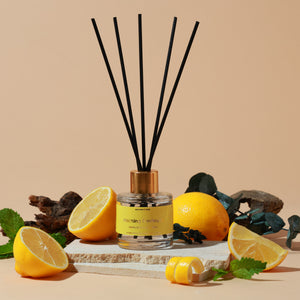
 Morning Freshness₹749Most reed diffusers sit on DPG, which is inexpensive and which can crack and turn bitter above 40°C — that is the mechanism behind a diffuser going sour in a Delhi May. Every SOSA reed sits on a heat-stable CCT carrier, coconut-derived, tested through a 45°C heat soak and 85% monsoon humidity. Heat will still empty a bottle faster, since evaporation speeds up; what it must not do is change the smell. Above that carrier, Morning Freshness puts a eucalyptus globulus base under the Malabar lemon, which slows the citrus evaporation three to four times. Citrus tops are the lightest molecules in perfumery and a lemon reed normally fades in ten to fourteen days; this one runs 6–8 weeks.
 Sukoon₹1,899Once a molecule has left the reed it is in the room's hands. Its onward journey depends on molecular diffusion, which is far too slow to cross metres of a room usefully, and on whatever air the room happens to be moving — convection off a warm wall, a fan, an air conditioner, a draught under a door. That air movement does nearly all the work and is not under the bottle's control. A machine such as Sukoon changes the answer because it throws a mist outward rather than waiting to be collected. Note that it changes nothing about composition quality: the same oil, better carried.
What a well-made fragrance actually buys you — and why none of it is a distance
It is worth being concrete, because “quality” on its own is a word that sells things rather than a word that explains them. Here is what I am buying when I spend more on a reed composition, in the order I care about it.
Materials that are the thing rather than a shorthand for it. Synthetic lemon and synthetic pine are two of the cheapest aroma materials in existence, and your nose has already met both of them in a floor cleaner, which is why it files them under cleaning rather than under fragrance. Real cold-pressed Malabar lemon does not read that way, and neither does real Himalayan pine. Stability, which decides whether what you can smell survives. A carrier that goes bitter in heat destroys an expensive composition as surely as a cheap one. Restraint, which is the least visible decision of all. Almost any composition, at too high a concentration, flattens into one sweet or sharp impression, and that flattening is exactly what people mean when they say a room smells of air freshener. The same fragrance can read expensive in one house and cheap in another on dose alone, which is why our strength scale runs from 8.9 to 9.5 and is there so that somebody buying for a small sealed bedroom can deliberately choose downwards.
And a shape that holds up over weeks, which is really the whole craft in a reed. A spray gets to be brilliant for twenty minutes; alcohol carries it fast and then leaves. A reed diffuser has to be interesting on a Tuesday in week five, with no alcohol at all to help it, in whatever the weather is doing. That is a much harder brief and it is where the money goes. Read that list back and notice that every item is about what you smell and for how long. Not one of them is about where you are standing.
The two axes, side by side
The same five questions asked of a composition and of a delivery method. Almost every argument about home fragrance is two people reading different columns.
| Question | Decided by the composition | Decided by the delivery | How you would test it |
|---|---|---|---|
| Does it smell good? | Entirely | Not at all | Smell it at close range, on any device |
| Does it still smell good in week six? | Entirely — structure, base materials, carrier stability | Marginally, through evaporation rate | Wait six weeks and smell it again |
| Does it survive a 40°C afternoon? | Entirely — CCT rather than DPG, and how the materials are balanced | Not at all | A hot room, and your nose |
| Does it reach the far side of the room? | Not at all | Entirely — moving air, room volume, containment, distance | Turn a fan on low and see whether the answer changes |
| Is it even from wall to wall? | Not at all | Entirely — and only an active device or a fan supplies it | Walk the room slowly with an unadapted nose |
Composition · Garden Bloom₹799Shop → 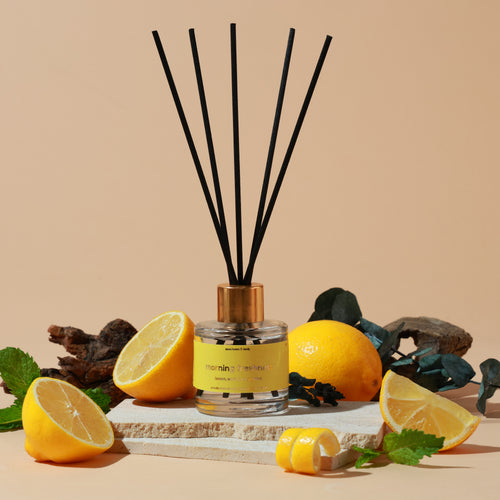 Stability · Morning Freshness₹749Shop →
  Transport · Sukoon₹1,899Shop →
Why a loud, cheap oil in a machine is not better perfumery
This is the comparison that quietly undermines people's confidence in something they actually like, so I want to take it seriously rather than wave it away. You visit a friend, a machine is running, the whole flat smells of something, and it seems more impressive than your own bottle. What has happened is that you have compared two different quantities and attributed the difference to the wrong one. The machine moved air; your bottle did not. Every part of that experience — the evenness, the fact that there was no corner to walk towards, the sense that the fragrance was in the room rather than on the table — is a transport outcome.
There is a related detail worth knowing, because it explains why hotel lobbies are so often the reference point people have in mind. In those buildings there is usually no diffuser in the room to find: the scent is introduced into the moving air of the building rather than released from an object on a table. There is no gradient to walk up and no source to locate, which is precisely the effect being admired. It is architecture and airflow doing the work, not a superior oil. I should add, since it comes up constantly, that our Hotel Collection is SOSA's own interpretation inspired by the world's finest hotels; SOSA is an independent Indian fragrance house and is not affiliated with any hotel brand.
Now run the comparison honestly. Put a poorly made oil in a good machine and you get a whole room that smells mediocre, all day, at high dose — which is worse than a small area of something excellent, not better. Put a well-made oil in the same machine and you get the thing everyone actually wants. The machine is a multiplier on whatever you give it, and multiplying a composition you were lukewarm about is one of the least satisfying purchases in this category. Choose the fragrance on its merits, then choose how far you want it carried, and keep those two decisions apart.
What to buy, in what order — and what I would leave on the shelf
Everything free comes first, because a large share of readers with this question are finished after the door and the fan and have spent nothing. Then the cheapest thing that genuinely supplies transport. The last row is the honest gap in our own range.
| Step | What it is | When it is the right answer | Price |
|---|---|---|---|
| 1. The free method ★ | Six reeds, half the distance, nose height, out of the draught, door closed, ceiling fan on low | First, for everybody. The fan supplies the transport the reed structurally lacks | ₹0 |
| 2. Keep the fragrance you already like | Six fibre reeds in every bottle; flip every 3–5 days. 50ml up to ~150 sq ft and 6–8 weeks; 130ml above that and 14–18 weeks. A 300ml refill at ₹2,399 is roughly six 50ml fills for a bottle you already own | When the composition is right and only the reach is not. Refills are oil alone and never a first purchase | ₹749–₹2,399 |
| 3. Sukoon ultrasonic | 500ml, 270–320 sq ft, 16–18 hours on low, three 15ml Hotel Collection scents included. A piezo plate throws a mist, so it moves air | When you want the whole room. Water-diluted, adds humidity, needs a socket and filling, can leave white mineral dust in hard-water cities | ₹1,899 |
| 4. Safar waterless | Pressurised air shatters undiluted oil into a dry mist — no water, no dilution, no added humidity, no dust, so the composition arrives undiluted. 20ml, cordless, three speeds, 1 / 2 / 3-hour auto-off timer. Named and sold as a car and travel diffuser, needs recharging, not set-and-forget | When you want the waterless mechanism at personal scale — car, desk, bedside, a hotel room | ₹3,999 |
| Not this: a “stronger” replacement oil, Megh or Vaayu — the honest gap | Replacing a composition you like in the hope of range solves nothing. Megh: six litres, ~100 hours, ~215 sq ft — less than the ₹1,899 Sukoon. Vaayu ₹11,999: up to 1000 m³, roughly 2,000–3,000 sq ft. Between Safar and Vaayu there is no mid-sized waterless bedroom nebuliser in the range | Megh is a runtime and humidity machine, never a coverage upgrade. Vaayu belongs on a whole floor or a large open-plan home; in one bedroom nine-tenths is wasted | ₹3,499 / ₹11,999 |

Versailles
At Versailles you are taught to evaluate a composition on a blotter, over hours, in a still room. Nobody ever asked me how far a formula travelled, and it took me a while after starting SOSA to understand why customers ask about almost nothing else. They are not judging the fragrance. They are judging the room. Those are two different examinations and only one of them is set by the perfumer.
What I would ask you to hold on to is that the work you have paid for is real and is still there. The reason your bottle has not gone bitter in a Pune summer is a carrier decision. The reason a lemon is still recognisably lemon in week six is a eucalyptus base doing something slow and unshowy underneath it. The reason the jasmine has not turned in April is a single material held below a threshold. You will never smell any of those as separate events, and they are most of what separates a considered fragrance from a loud one.
None of it will carry the scent four metres. For that, shut the door, bring the bottle within arm’s reach of where you sit, use all six reeds, and run the fan on low for an evening. If you want the room properly, add the ₹1,899 Sukoon and keep the reed where you sit — and know before you order that reed oil cannot go into an ultrasonic machine, so it is an addition rather than a transplant. The reed will still be there in a power cut, still asking nothing of you, at about ₹13 to ₹15 a day. Composed in Pune, and a part of every order funds a girl’s classroom through Nanhi Kali.
Frequently asked questions
- Strong in the bottle, quiet in the room — headspace, and why it saturates in seconds.
- If the concentrate is powerful, why is the diffuser subtle? — payload and delivery.
- Why a stronger-smelling oil doesn’t mean better projection — intensity and projection, defined.
- Fragrance strength versus diffusion strength — one is in the material, the other reaches you.
- Strong on the reeds, absent in the air — the saturated layer at the fibre.
- Does a stronger fragrance solve poor coverage? — answered directly, and it is no.
- Weak fragrance, or limiting delivery? — a test you can run tonight.
- Change the oil or change the diffuser? — the decision, made cleanly.
- A stronger fragrance, or a stronger method? — the family pillar.
- Brand: the SOSA founder story.
SOSA products — facts verified August 2026: Reed diffusers in 50ml and 130ml only. Morning Freshness ₹749 / ₹1,249 · Evening Calm ₹799 / ₹1,299 · Garden Bloom ₹799 / ₹1,299 · Mountain Breeze ₹849 / ₹1,349 · Fresh Brew ₹849 / ₹1,349. SOSA strength scale, a measure of perceived intensity rather than quality: Evening Calm 8.9, Garden Bloom 8.9, Morning Freshness 9.0, Mountain Breeze 9.4, Fresh Brew 9.5. Morning Freshness places a eucalyptus globulus base under cold-pressed Malabar lemon, slowing lemon evaporation three to four times; Garden Bloom holds indole below the fecal threshold so the jasmine stays floral above 30°C. 50ml suits rooms up to ~150 sq ft and lasts 6–8 weeks; 130ml suits above 150 sq ft and lasts 14–18 weeks; roughly ₹13–₹15 a day. Six fibre reeds — fibre rather than rattan — in a refillable glass bottle, on a heat-stable CCT (caprylic/capric triglyceride) carrier rather than DPG, alcohol-free, phthalate-free, paraben-free, IFRA-compliant, 0 ppm formaldehyde, climate-tested at 45°C and 85% RH, composed in Pune. Flip the reeds every three to five days. Duos ₹1,498–₹1,598 (50ml × 2) and ₹2,498–₹2,598 (130ml × 2). Refills 300ml ₹2,399 · 500ml ₹3,499, oil only and never a first purchase. Machines: Boond ₹899 (300ml, ≤~150 sq ft, ~6h, USB, night light) · Sukoon ₹1,899 (500ml, 270–320 sq ft, 16–18h on low, three 15ml Hotel Collection scents included) · Megh ₹3,499 (6L, ~100h runtime, ~215 sq ft) · Safar ₹3,999, named and sold as a waterless car perfume diffuser, 20ml, 2000 mAh, up to 10 hours continuous or around 30 hours intermittent per charge, three speeds and a 1 / 2 / 3-hour auto-off timer, 6.9 cm · Vaayu ₹11,999 (waterless cold-air nebuliser, up to 1000 m³ or roughly 2,000–3,000 sq ft, 400ml tank up to ~90+ days, Bluetooth app and onboard controls, 1h / 4h / 8h / 24h windows, under 38 dB, 5W, CE, RoHS, SGS). Aangan ₹25,999 and Meenar ₹38,500 are commercial machines and are never a home recommendation. Hotel Collection oils are water-based and ultrasonic-only: 15ml ₹299 · 100ml ₹999 · 300ml ₹1,799 · pack of 7 ₹1,799. Reed oil and Hotel Collection oil are not interchangeable in either direction and there is no hotel-inspired reed diffuser. No health, air-quality, allergy or sleep claims are made for any SOSA product; fragrance does not remove an unwanted smell, which is a matter of source, then ventilation, then fragrance. Free shipping above ₹499. A portion of every order supports girl-child education through Nanhi Kali. SOSA is an independent Indian fragrance house; the Hotel Collection scents are SOSA's own interpretations inspired by the world's finest hotels, and SOSA is not affiliated with or endorsed by any hotel brand. Prices subject to change — see the live product pages.