

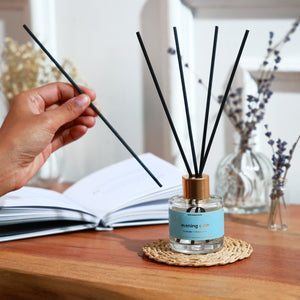
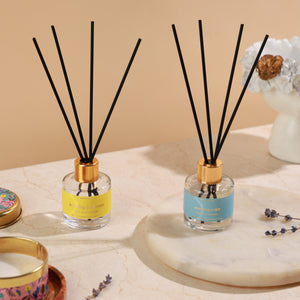
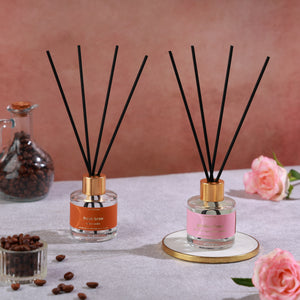

The one test that separates normal from not: look at the bottle level as well as the reed. A low wet line with the level visibly dropping is a busy room, not a fault. A low wet line with the level barely moving means the reeds have stopped drawing.
What a high wet line means: not health. A reed dark and slick almost to the tip is saturated and stalled — flip all six and it recovers within hours.
The one dry tip that is a problem: the pathological version, caused by an AC vent, a fan or direct sun. Same dry reeds, but the room smells of nothing and the bottle empties weeks early.
2. Check the bottle level before you decide anything. This is the whole diagnosis in one move. Dry tips plus a level that is visibly falling means the room is busy and the reeds are delivering. Dry tips plus a level that has barely moved in a fortnight means the reeds have stopped drawing, and that is a replacement question rather than a room one.
3. Ask what the room actually smells like. A hot room with dry tips still smells of the fragrance, often quite strongly, because everything the reed delivers is going straight into the air. If the tips are dry and the room smells of nothing, you are looking at the draught version, not the heat version.
4. Rule out the draught, because it is the one that costs you money. An AC vent, a ceiling fan directly overhead, an open window or direct sunlight will strip the exposed length continuously. The result is a bottle that empties weeks early while the room stays disappointing — the worst of both outcomes.
5. Do not expect the line to reach the tip. It will not, in any room, ever. The dry length above the wet line is structural. It holds the reed upright and gives you somewhere to grip when you flip it.
6. And be equally suspicious of the opposite. A reed dark and slick almost to the top is not a healthy reed; it is a saturated, stalled one. Flip all six and it will come back within a few hours.
Composed and handmade in small batches in Pune, and a portion of every order supports girl-child education through Nanhi Kali.
Part one — the balance that decides where the line sits
Three forces, permanently arguing. Capillary pull lifts oil up the inside of the fibre. Gravity pulls it back down. Evaporation removes it from wherever the wetted surface meets air. The wet line is not a level and it is not a target; it is the height at which those three reach a truce, and it moves whenever the room changes. Which means the boundary on your reed is a readout of your room's conditions, updated continuously and for free. Once you look at it that way, "dry at the top" stops being a symptom and becomes a number — and the interesting part is that both directions have something to say.
 Evening Calm₹799 · 8.9/10The draught version looks identical on the reed and feels completely different in the house. A split AC blowing across the bottle, a ceiling fan directly overhead, an open window onto a breezy balcony, or an hour of direct afternoon sun will all strip the exposed length continuously — and crucially, they carry the fragrance straight out of the room rather than distributing it into it. You get the worst pair of outcomes available: a bottle emptying weeks early and a room that smells of very little. The tell is the mismatch between how fast the level is falling and how little you can smell. Move the bottle several feet clear of any vent or fan, out of direct sunlight, to a console or shelf near a doorway at roughly waist to chest height, where gentle incidental traffic stirs the air a few times an hour. That correction costs nothing and often adds weeks to the bottle.
Part two — where the line sits, room by room
The same bottle in five different rooms will show you five different wet lines, and all but one of them are correct. Find the row that matches yours and read across; the verdict column is the only one that matters.
| Room condition | Where the wet line sits | Bottle level over a month | What the room smells like | Verdict |
|---|---|---|---|---|
| Hot, dry, ordinary traffic ★ | Low — tips clearly dry | Falling steadily, at the fast end of the range | Present and full | Working hard. Nothing to fix |
| Near an AC vent, fan or open window | Low — tips dry, sometimes pale and stripped | Falling much faster than the stated window | Faint or absent | Draught. Move the bottle; free, and it adds weeks |
| Cool, sealed, still air | High — much of the reed dark | Falling slowly | Quiet, close to the bottle | Low demand. Add reeds if you want more |
| Warm, but the bottle is in an alcove | Mid to high | Falling slowly | Strong at the glass, absent at the sofa | Dead air. Move it into passing traffic |
| Any room, reeds months old | Very low — barely above the oil | Almost static | Flat and base-heavy | Finished reeds. A flip changes nothing |
| Any room, unflipped for weeks | Very high — dark and slick near the tip | Slowing month on month | Fading gradually | Saturated and stalled. Flip all six |
| The honest caveat: the fifth row is the only one this brand cannot sell you a direct solution to. SOSA does not sell replacement reeds as a separate product — the refill is oil only, and pouring ₹2,399 of it through reeds that have stopped drawing will not lift that wet line by a millimetre. The two workable routes are a new bottle, which arrives with six fresh fibre reeds and new oil from ₹749, or plain unscented reeds from a craft or packaging supplier; fibre for preference, because rattan's pores swell shut in Indian humidity. Our own guidance is to refresh reeds every few months. | ||||
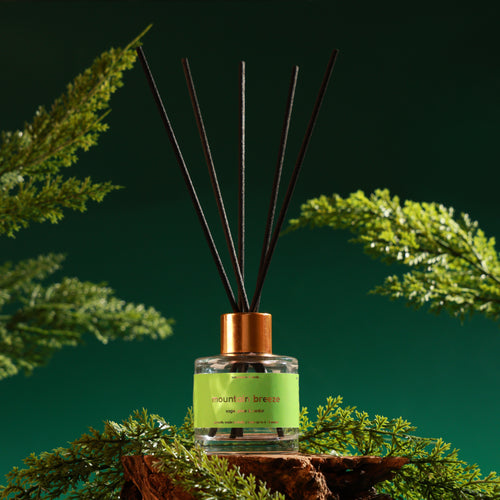
Mountain Breeze 130ml · 14–18 weeks₹1,349Shop → 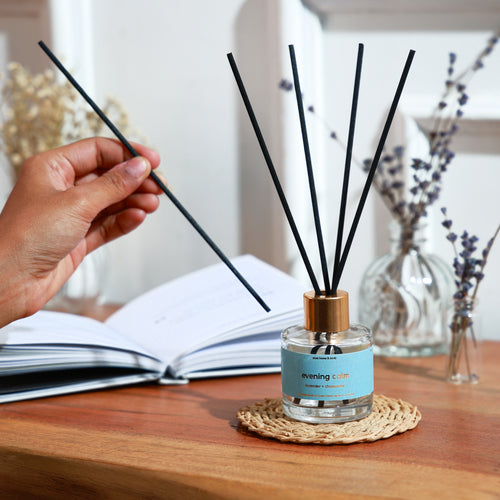 Evening Calm · a high line, a quiet roomfrom ₹799Shop →
 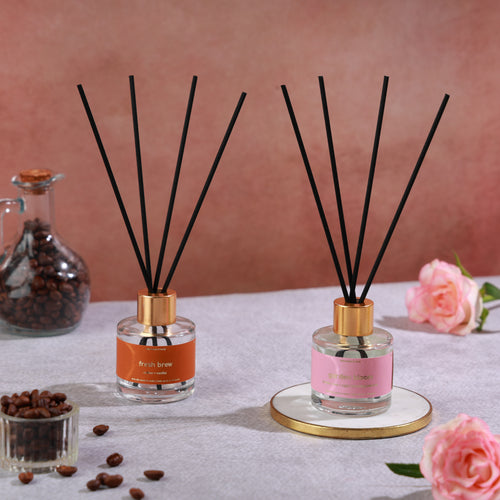 Oil refill · for a thirsty room₹2,399Shop →
Part three — how to use the wet line as an instrument
Almost nobody realises they have been given a gauge. The wet line is the only part of a reed diffuser that reports on itself, and with one habit it becomes genuinely useful rather than merely reassuring. The habit is this: at the fortnight mark, when the opening spike has passed and the bottle has settled into its plateau, lift one reed and mark where the boundary falls against the glass with a fingernail or a strip of tape. That mark is your baseline, and everything afterwards is a comparison rather than a guess. Check it once a month. A line that has drifted downward while the level keeps falling is a room that has warmed up — a Delhi April doing what a Delhi April does. A line that has drifted downward while the level has stopped falling is the beginning of the end for that set of reeds, and now you know it a month before you would otherwise have noticed.
The gauge is also the fastest way to settle the argument nobody enjoys having, which is whether a diffuser has stopped working or whether you have stopped noticing it. Olfactory adaptation is the commonest cause of "it stopped smelling", and it is ruthless at home: your nose stops reporting a constant within minutes, and it adapts hardest to the smell of your own house. So you cannot trust your own reading of the room, but you can trust the reed. If the wet line has held its position and the bottle level is falling on schedule, the diffuser is doing precisely what it did in week two, and the change is in you rather than in it. Guests are the better witnesses. A fifteen-minute walk outside and a fresh entry through the front door is the amateur version of the same test, and it costs nothing.
One last thing that the gauge will teach you, and it is the reason I am fond of it. There is a temptation to treat a high wet line as the good outcome — more oil visible on the reed must mean a better-fed diffuser. It does not. A high line means the room is not taking much, either because it is cool and sealed or because the air around the bottle is dead. In the worst version the reed is dark and slick almost to the tip and the line is high not because supply is generous but because delivery has stalled: heavy residue has accumulated at the exposed end, the reed has become a reservoir instead of a wick, and the correct response is to flip all six and watch the line drop as the room finally receives something. A falling wet line after a flip is the sound of the product starting to work again. That is the opposite of the intuition most people arrive with, and it is why I would rather teach the gauge than publish a rule.
Part four — what to change, and what each change costs
If you have read the gauge and decided you want a different outcome, here is what each available move actually does — to the wet line, and to the number of weeks you get. The first three are free.
| If you want | Change this | What happens to the wet line | What happens to the weeks |
|---|---|---|---|
| The room back, at no cost ★ | Flip all six reeds, weekly, with gloves | Drops as delivery resumes — this is the good direction | Shortens them, and that is the correct trade |
| A bottle that stops emptying early | Move it clear of the AC vent, fan, window and sun | Rises slightly as stripping stops | Often adds weeks — the cheapest gain there is |
| More presence in a cool, still room | Add two to three reeds for the season | Falls, because more surface is evaporating | Shorter, roughly in proportion to the count |
| A gentler bedroom, and longer | Run four reeds instead of six | Sits higher; tips may stay damp | Comfortably beyond the stated window |
| The same room for longer | A 130ml instead of a 50ml | Unchanged — size does not move the line | 14–18 weeks instead of 6–8 |
| Lower running cost in a thirsty room | The oil-only 300ml refill | Unchanged, but immersion depth is restored | Roughly 8–11 months of fills, at ₹7–8 per ml |
| Scent on demand instead of constant | A Sukoon at ₹1,899, alongside the reeds | Not applicable — a different format entirely | 16–18 hours on low per fill, 270–320 sq ft |
Versailles
The wet line was not something anyone taught me. I noticed it during the first Pune summer of testing, when I had a dozen identical bottles in different rooms of the same flat and could not work out why some were emptying so much faster than others. The reeds were telling me the whole story and I had been looking at the glass instead. The bottles in the hottest, busiest rooms had the lowest lines and the fastest levels; the one on a shelf in a sealed spare bedroom had a line almost at the tip and had barely moved in a month.
What I found genuinely counter-intuitive, and what I still have to explain most often, is that the reed which looks best is the one performing worst. A dark, glossy, oil-covered reed reads as generous and healthy. It is usually a reed that has stopped giving anything to the room, sitting in a space with no air moving through it, and the fix is a flip rather than a purchase.
So please do not tidy the dry tips away in your mind as a defect. In a country where a living room can sit at 45°C in May, dry tips are what a working diffuser looks like. Mark the line at the fortnight, look at it once a month, and let the bottle level be the second half of every judgement. Everything is composed and handmade in Pune, and a part of every order funds a girl's classroom through Nanhi Kali.
Frequently asked questions
- Why is oil not travelling up my reeds? — immersion depth, neck geometry and reed diameter.
- Why have my reeds stopped absorbing oil? — silting, dust, rattan and cold.
- When do reeds need replacing? and how often should you replace them?
- The complete reed replacement guide and why can't I smell my reed diffuser?
- Brand: the SOSA founder story.
SOSA reed diffuser range & prices (verified August 2026): alcohol-free, phthalate-free, paraben-free and IFRA-compliant compositions on a heat-stable coconut-derived (CCT) carrier, low-VOC, supplied in a refillable glass bottle with six fibre reeds; 50ml lasts 6–8 weeks and 130ml lasts 14–18 weeks. Morning Freshness (Malabar lemon · peppermint · Nilgiri eucalyptus) 50ml ₹749 · 130ml ₹1,249 · 9.0/10; Garden Bloom (British rose · night-blooming jasmine) 50ml ₹799 · 130ml ₹1,299 · 8.9/10; Evening Calm (Kashmir lavender · chamomile) 50ml ₹799 · 130ml ₹1,299 · 8.9/10; Fresh Brew (Coorg coffee · Kerala vanilla) 50ml ₹849 · 130ml ₹1,349 · 9.5/10; Mountain Breeze (Himalayan pine · sage · Indian cedar) 50ml ₹849 · 130ml ₹1,349 · 9.4/10. Reed diffuser refills are oil only — you reuse your own vessel and reeds: 300ml ₹2,399 (roughly 8–11 months) · 500ml ₹3,499 (roughly 14–18 months), about ₹7–8 per ml against ₹15–17 per ml for a 50ml bottle. Duo sets ₹1,498–₹1,598 for 2 × 50ml and ₹2,498–₹2,598 for 2 × 130ml. Strength figures are positions on SOSA’s own internal strength scale, not an industry standard. Replacement reeds are not sold as a separate SKU; SOSA guidance is to refresh reeds every few months. The reed line is separate from the water-based Hotel Collection for ultrasonic machines (15ml ₹299 · 100ml ₹999 · 300ml ₹1,799) and the two are not interchangeable. Diffusers: Boond 300ml ₹899 · Sukoon 500ml ₹1,899 · Megh 6L ₹3,499 · waterless Vaayu ₹11,999. Composed and handmade in small batches in Pune, India; tested through 45°C summer heat and 85% monsoon humidity. Free shipping above ₹499. A portion of every order supports girl-child education through Nanhi Kali. Prices subject to change — see the live product pages.