


The machine: Vaayu is rated to 1000 m³. Against 31–34 m³ that is roughly a thirtyfold mismatch. By floor area alone, 2,000–3,000 sq ft against 120 is a seventeen- to twenty-five-fold mismatch.
The tell inside the published figures: 1000 m³ works out to about 35,300 cubic feet. Spread over 2,000–3,000 sq ft, that implies ceilings of roughly twelve to eighteen feet — the height of a showroom, a reception or a double-height floor. The two figures are consistent with each other only for the kind of space this machine was built for, and your bedroom is not it.
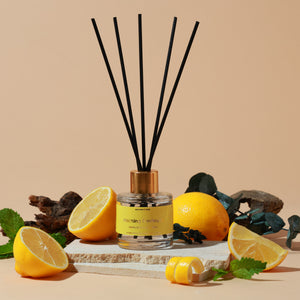
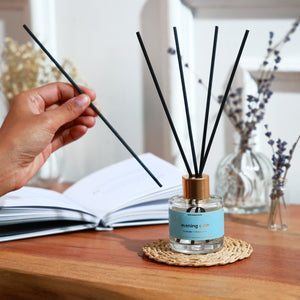
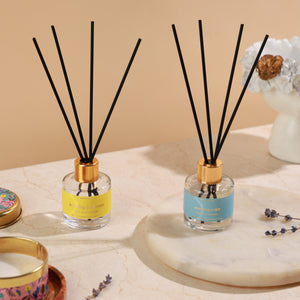
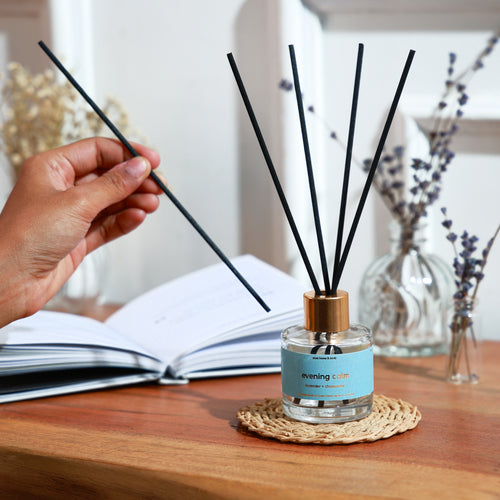
What to buy instead: Sukoon ₹1,899 — 270–320 sq ft, already over-specified for 120; or Safar ₹3,999 if water is the deal-breaker, named and sold as a car and travel diffuser with no published room-coverage figure; or a reed from ₹749, since 50ml is specified for rooms up to about 150 sq ft.
The honest gap: between Safar and Vaayu, SOSA has no mid-sized waterless bedroom nebuliser. Megh at ₹3,499 does not fill it — about 215 sq ft, less than the ₹1,899 Sukoon.
2. The published figures tell you what the machine is for, if you read them together. 1000 m³ is about 35,300 cubic feet. Divide that across the stated 2,000 to 3,000 sq ft and the implied ceiling height is roughly twelve to eighteen feet. That is a reception, a showroom, an atrium, a double-height living-dining. The two numbers on the product page are internally consistent for exactly the spaces the machine was designed to serve, and a 120 sq ft bedroom with a nine-foot ceiling is not on that list.
3. Air exchange multiplies the gap rather than adding to it. Fragrance demand is not just volume, it is volume being continuously replaced. A lobby’s doors open every few seconds and its ventilation runs by design, so a large fraction of the scented air is leaving all day and must be replaced. A closed bedroom with a split air conditioner recirculating its own air loses very little. The bedroom is therefore favoured twice over — a smaller volume and a slower loss — which is why it reaches a perceptible level quickly and holds it.
4. The money arithmetic points the same way. ₹11,999 is roughly six Sukoon machines at ₹1,899, three Safar units at ₹3,999, or fourteen to sixteen 50ml reed diffusers at ₹749 to ₹849. Put differently, at about ₹13 to ₹15 a day, it is roughly two and a half years of continuous reed diffusion. None of that makes ₹11,999 a bad price — it makes it the wrong price for this room.
5. Buy for 120 sq ft. A 50ml reed is specified for rooms up to about 150 sq ft, so at 120 it is correctly sized and three reeds rather than six is usually the right dose. Sukoon at ₹1,899 covers 270–320 sq ft, so it is already generous here — which is exactly what you want, since you run it low and keep the headroom. Safar at ₹3,999 gives undiluted oil and no water at all, and is named and sold as a car and travel diffuser with no published room-coverage figure.
Alcohol-free, phthalate-free, paraben-free, IFRA-compliant, 0 ppm formaldehyde. Free shipping above ₹499, and a portion of every order supports girl-child education through Nanhi Kali.

The arithmetic, done openly
I would rather show the working than assert a conclusion, partly because the working is more persuasive and partly because it lets you redo it for your own room. Every figure below is either published by the manufacturer or is straightforward conversion. The only assumption I am making is the ceiling height of your bedroom, and I have used nine and ten feet because those are the ordinary range in Indian flats. If yours is different, substitute it — the conclusion does not become close.
 Evening Calm₹799Floor area is the wrong unit for this argument and it is the one every product page uses, which is part of why the confusion persists. Fragrance fills a volume, not a floor. A 10 × 12 room at a nine-foot ceiling is 1,080 cubic feet; there are about 35.3 cubic feet in a cubic metre, so that is roughly 30.6 m³. Give it a ten-foot ceiling and you get 1,200 cubic feet, about 34 m³. Round it generously and call the room 31 to 34 cubic metres. Hold that number, because the rest of the page is a comparison against it.
 Hotel Collection₹999Vaayu is rated to 1000 m³, published alongside a floor-area equivalent of roughly 2,000 to 3,000 sq ft. Put the two together and something useful falls out. 1000 m³ is about 35,300 cubic feet; spread across 2,000 sq ft that implies a ceiling of about 17–18 feet, and across 3,000 sq ft about 12 feet. Those are commercial heights: a reception, a showroom, a salon, an atrium, a double-height living-dining. The manufacturer’s own two numbers, read together, describe the building type the machine belongs in. Against 31–34 m³ of bedroom, the same rating is roughly thirty times the requirement.
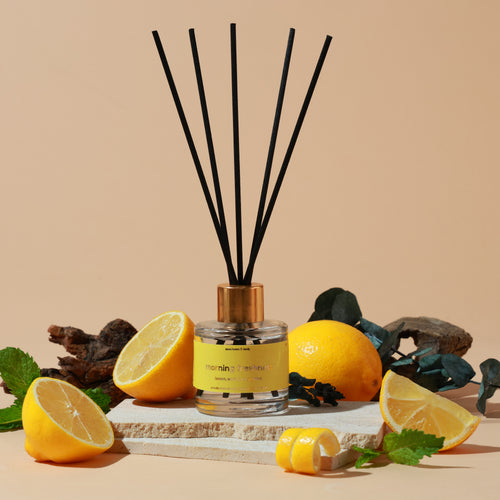
 Morning Freshness₹749Sticker prices are hard to feel, so convert them. ₹11,999 is about six Sukoon machines, three Safar units, or fourteen to sixteen 50ml reed bottles. Stated as running cost, a 50ml reed works out at roughly ₹13 to ₹15 a day across its six to eight weeks, so ₹11,999 is on the order of two and a half years of uninterrupted reed diffusion. None of this makes Vaayu expensive for what it is — on a whole floor it is good value and I would recommend it without hesitation. It makes it the wrong denominator for a single 120 sq ft room, where you are buying capacity per square foot that no square foot in that room can use.
The multiplier nobody counts — air exchange
Volume is only half the sum, and the other half is the reason commercial machines are as large as they are. A space does not simply need to be filled once; it needs to be kept filled while its air leaves. In a lobby, air is leaving constantly: entrance doors open every few seconds, mechanical ventilation runs because a large public space must be ventilated, and the building is designed for that throughput rather than against it. Every one of those exchanges carries the fragrance out with it. The machine is not there to make the space smell strong; it is there to keep replacing what the building keeps removing.
Your bedroom does the opposite, and it does it for free. Close the door and the principal route out is shut. Run a split air conditioner and the room recirculates its own air rather than exchanging it with outside, which distributes the fragrance evenly across the space instead of leaving it pooled near the source — a large part of why a sealed bedroom reads strongest at night, and a genuine advantage over any open-plan floor. So the bedroom wins on both variables at once: a volume roughly thirty times smaller, and a loss rate that is a fraction of a lobby’s. The total mismatch between the two problems is therefore considerably larger than the thirtyfold volume ratio on its own.
The corollary is worth stating because it changes what people do. An open window is not a small adjustment; it is a different experiment. Air that leaves takes the fragrance with it, so continuous cross-ventilation always costs projection, and a home with the windows open all day is not a home-fragrance environment during those hours — it becomes one the moment they close. The same applies with more force on a high floor, where wind speed is greater and a balcony door turns the room over far more aggressively than a second-floor window would. If your 120 sq ft bedroom feels weak, the first thing to check is not the product but whether the room is being ventilated during the hours you want it to hold.
| A 120 sq ft bedroom | A large hotel lobby | |
|---|---|---|
| Volume of air | About 1,080–1,200 cubic feet, or roughly 31–34 m³ at a 9–10 ft ceiling | Hundreds to thousands of cubic metres, frequently at double height |
| Air exchange | Low. Door shut, AC recirculating, windows closed | High and continuous. Entrance traffic plus mechanical ventilation by design |
| What the space needs | A small, steady source and an hour of closed-door time | Continuous replacement matched to the rate of loss |
| Delivery | A source inside the room, out of the draught | A nebuliser dosing undiluted oil into the air-handling system |
| Machine that fits | Sukoon ₹1,899 at 270–320 sq ft, or a 50ml reed from ₹749, specified to ~150 sq ft | Vaayu ₹11,999 at 1000 m³, or above it Aangan ₹25,999 and Meenar ₹38,500, which are commercial only |
| Vaayu in this space | Roughly thirty times the rated volume required — run permanently at its lowest setting | Correctly sized, and genuinely good value at that scale |
| Cost stated per room | ₹749–₹1,899 buys the right tool. A reed is about ₹13–₹15 a day | ₹11,999 and upward, spread across thousands of square feet |
| The honest gap: if what you want is the hotel mechanism — waterless, undiluted, dry — scaled to 31–34 m³, SOSA does not make it. Safar is personal scale, named and sold as a car and travel diffuser, with no published room-coverage figure; Vaayu is a machine for a floor. Megh ₹3,499 is not the missing rung either — about 215 sq ft, less than the ₹1,899 Sukoon. | ||
 50ml suits ≤150 sq ft · Evening Calm₹799Shop → 270–320 sq ft · Sukoon₹1,899Shop →
  Ultrasonic-only · Hotel Collection₹999Shop →
What the mismatch actually feels like at the dial
Numbers on a page are one thing; living with the mismatch is another, and it is worth describing because it is the part nobody warns you about. A machine sized for thirty times your room does not give you a wonderful room with plenty in reserve. It gives you a room in which the first setting is already too much. Every adjustable device has a minimum output, and that minimum is designed to be sensible in the space the machine was built for. In a bedroom, the step between one notch and the next is a far larger change in concentration than it would be on a device scaled to that room, so you spend your time hunting for a level between two settings rather than choosing one.
And over-dosing is not a neutral outcome, it is an actively worse one. Almost any composition at too high a concentration flattens into a single sweet or sharp impression — which is exactly what people mean when they say something smells like an air freshener. The same oil at a lower dose reads as layered and expensive, because the nose has room to resolve the separate materials rather than being presented with one wall of signal. This is why the identical fragrance can read as costly in one home and cheap in another with nothing changed but quantity. Restraint costs nothing and is the most reliable luxury cue there is, and a machine that forces you to the bottom of its range is working against you.
There is a second, quieter effect. A room held at a constant high level all evening is a room you will stop perceiving, because olfactory receptors adapt to an unchanging stimulus within minutes. The signal keeps arriving; the brain stops reporting it. So the person who over-buys frequently ends up in the worst of both positions: guests find the room overwhelming, and the owner — adapted, and standing in it all evening — cannot smell it at all and concludes that even more is needed. If a visitor arriving from outside says the room is lovely and you cannot detect anything, nothing is broken and nothing needs to be bought. A visitor is a better instrument than you are, and it is the cheapest measuring device available.
What ₹11,999 buys instead for one small room — and the rung that does not exist
The ladder for a 120 sq ft bedroom, in the order I would work through it. The last row is the honest gap in our own range, stated because it is the reason the recommendation here ends in a trade-off rather than a triumphant answer.
| Buy | What it is | When it is the right answer | Price |
|---|---|---|---|
| 1. Nothing — re-dose what you own ★ | Three reeds instead of six, the bottle moved out of the AC jet and off the threshold, the door shut an hour ahead, and one verdict from somebody arriving from outside | Always first at this room size. A 50ml is specified to ~150 sq ft, so at 120 the bottle is not the problem | ₹0 |
| 2. A reed, correctly sized | A 50ml reed diffuser — passive capillary, six fibre reeds, refillable glass, 6–8 weeks, about ₹13–₹15 a day. Reed count is the volume dial: six for full projection, three for a soft bedside level and roughly double the life | When silence, no socket, nothing to fill or charge and an object rather than an appliance are the requirement. It gives a fragrant zone, not an evenly fragranced room, and cannot be switched off | ₹749–₹849 |
| 3. Sukoon — the correctly sized machine ★ | Ultrasonic water mist, 500ml, 270–320 sq ft, 16–18 hours on low, three 15ml Hotel Collection scents included | Already more than twice the floor area of a 120 sq ft room, which is the right margin. You accept dilution, humidity, refilling and a plug | ₹1,899 |
| 4. Safar — the mechanism, not the size | Waterless cold-air nebulising of undiluted oil, 20ml, 2000 mAh Type-C, up to 10h continuous or ~30h intermittent, 3 speeds, 1/2/3-hour auto-off, 6.9 cm. Named and sold as a car and travel diffuser, with bedside and hotel room among its stated uses | When no water in the room is the requirement. No published room-coverage figure — personal and small-space scenting, and it needs recharging | ₹3,999 |
| Not for 120 sq ft: Vaayu | 1000 m³ or roughly 2,000–3,000 sq ft, 400ml tank up to ~90+ days, app plus onboard control, 1h/4h/8h/24h windows, key-lock, under 38 dB, 5W, wall or HVAC mount | Roughly thirty times the volume required here. Right for a whole floor, an open-plan living-dining, a villa, a clinic, a salon, a showroom, a reception — or one machine for the whole flat | ₹11,999 |
| Never as a coverage upgrade: Megh | 6L tank, around 100 hours of runtime, about 215 sq ft of coverage — roughly ₹16 per sq ft of coverage against about ₹6–₹7 for Sukoon | Less coverage than the ₹1,899 Sukoon. A runtime and humidity machine. The biggest tank is not the strongest machine | ₹3,499 |
| The honest gap | No mid-sized waterless bedroom nebuliser exists at SOSA — nothing sits between Safar’s personal scale and Vaayu’s 1000 m³ | Said plainly, because a machine built for 30 to 60 cubic metres is precisely what this page’s arithmetic asks for and precisely what the catalogue does not contain | — |
Versailles
I wrote this page as arithmetic rather than as advice because advice can be argued with and a ratio cannot. Thirty-one to thirty-four cubic metres against a thousand. Once somebody has seen that written down, the conversation changes from “which machine is best” to “what does my room actually need”, and that is a far better conversation to be having with a customer.
The detail I find most telling is the one hidden in the product page’s own two figures. A thousand cubic metres spread across two to three thousand square feet implies ceilings of twelve to eighteen feet. Nobody writes that on a listing, but it is there in the numbers, and it describes the room the engineers had in mind: a reception, a showroom, an atrium, a large open floor. It is a well-made machine and I am glad we sell it. It was simply never drawn for a bedroom.
Which brings me to the part I would rather say myself than have a customer discover. If your requirement is the hotel mechanism at bedroom scale — waterless, undiluted, dry, no added humidity, sized to thirty-odd cubic metres — we do not make it. Safar is personal scale and is named and sold as a car and travel diffuser, with no published room-coverage figure. Vaayu is for a floor. Megh, despite being ₹3,499 and having a six-litre tank, covers less than the ₹1,899 Sukoon and is not the missing rung. So for 120 sq ft my honest recommendation is a reed correctly dosed, or Sukoon with the water accepted — and the gap in the middle of our own ladder stays named until we fill it. Everything is composed in Pune, and part of every order funds a girl’s classroom through Nanhi Kali.
Frequently asked questions
- Room scenting vs lobby scenting — the two problems, named and separated.
- Lobby smell in my bedroom — do I need a commercial machine? — no, and why.
- Lobby intensity without scenting the whole house — containment and control.
- Safar or Vaayu for a small room? — the head-to-head, sized properly.
- Do I need Vaayu for one bedroom? — no, said plainly.
- When Safar makes more sense than a large machine — small volume, occupied hours.
- When a home is genuinely large enough for Vaayu — thresholds, not adjectives.
- Intensity versus coverage — two different specifications.
- Safar vs Vaayu, the family pillar — chosen by space, not by spend.
- Brand: the SOSA founder story.
Facts verified August 2026: Three diffusion mechanisms are described — passive capillary (reed diffusers), ultrasonic water mist (Boond ₹899, 300ml, up to ~150 sq ft, ~6 hours, USB, night light; Sukoon ₹1,899, 500ml, 270–320 sq ft, 16–18 hours on low, three 15ml Hotel Collection scents included; Megh ₹3,499, 6L tank, ~100 hours runtime, ~215 sq ft, which is less coverage than Sukoon) and waterless cold-air nebulising (Safar ₹3,999, 20ml bottle, 2000 mAh Type-C battery, up to 10 hours continuous or around 30 hours intermittent, 3 speeds, 1/2/3-hour auto-off timer, 6.9 cm, named and sold as a car and travel diffuser with car, handbag, desk, bedside and hotel room among its stated uses, no published room-coverage figure; Vaayu ₹11,999, coverage up to 1000 m³ or roughly 2,000–3,000 sq ft, 400ml refillable tank lasting up to about 90+ days, Bluetooth app and onboard buttons, 1h/4h/8h/24h run windows, choice of days, adjustable mist intensity, key-lock, under 38 dB, freestanding or wall/HVAC mount, 5W, CE, RoHS, SGS). Aangan ₹25,999 and Meenar ₹38,500 are commercial HVAC systems for 8,000–10,000 and 12,000–18,000 sq ft respectively and are never a home recommendation. SOSA reed diffusers: five scents, 50ml ₹749–₹849 lasting 6–8 weeks and suiting rooms up to ~150 sq ft, 130ml ₹1,249–₹1,349 lasting 14–18 weeks and suiting above 150 sq ft, six fibre reeds included and flipped every 3–5 days, about ₹13–₹15 a day, heat-stable CCT carrier rather than DPG, alcohol-free, phthalate-free, paraben-free, IFRA-compliant, 0 ppm formaldehyde, refillable glass bottle, climate-tested at 45°C and 85% RH, composed in Pune. Duos are two 50ml bottles at ₹1,498–₹1,598; 130ml duos ₹2,498–₹2,598; refills 300ml ₹2,399 and 500ml ₹3,499, oil only and never a first purchase. SOSA strength scale: Evening Calm 8.9, Garden Bloom 8.9, Morning Freshness 9.0, Mountain Breeze 9.4, Fresh Brew 9.5. Hotel Collection fragrance oils are water-based and ultrasonic-only at 15ml ₹299 (a refill), 100ml ₹999, 300ml ₹1,799 and a pack of seven at ₹1,799; they cannot be used in reed diffusers and reed oil cannot be used in ultrasonic machines, so no hotel-inspired reed diffuser exists. Between Safar and Vaayu there is no mid-sized waterless bedroom nebuliser in the SOSA range. No health, air-quality, allergy, asthma or antimicrobial claims are made, and fragrance does not remove a smell — source, then ventilation, then fragrance. Free shipping above ₹499. A portion of every order supports girl-child education through Nanhi Kali. SOSA is an independent Indian fragrance house; the Hotel Collection scents referenced here are SOSA’s own interpretations inspired by the world’s finest hotels, and SOSA is not affiliated with, endorsed by or a supplier to any hotel brand. Prices subject to change — see the live product pages.