
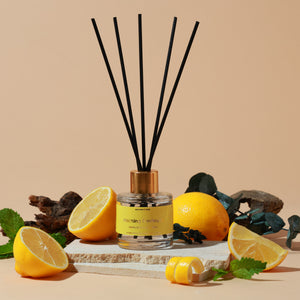

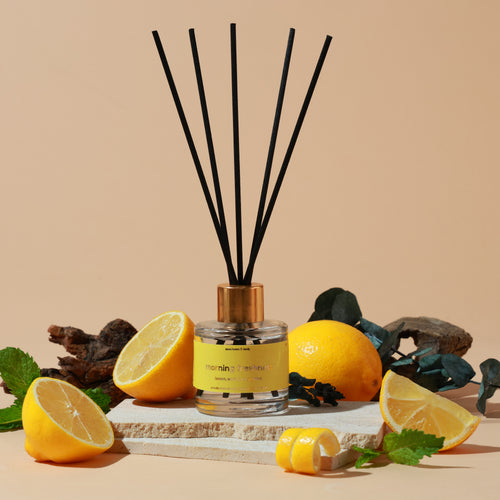
Most noticeable in a humid room: Morning Freshness. Cold, sharp notes — Malabar lemon, peppermint, Nilgiri eucalyptus — cut through warm damp air that softens everything else.
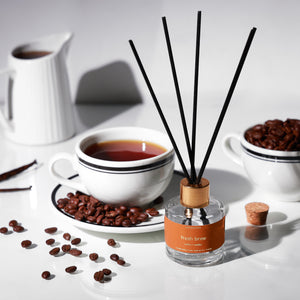
Most noticeable to a guest arriving: Fresh Brew and Garden Bloom, because a warm or floral accord registers immediately on entering a home.
The number is not a quality ranking. It is a position on SOSA's own internal scale at six reeds — not an industry standard, not a concentration. Evening Calm at 8.9 is quiet by design.
2. In a humid room, it is very often Morning Freshness at 9.0. Malabar lemon, peppermint and Nilgiri eucalyptus are cold and angular, and cold angular notes cut through warm damp air that rounds everything else off. At ₹749 it is also the least expensive bottle in the range.
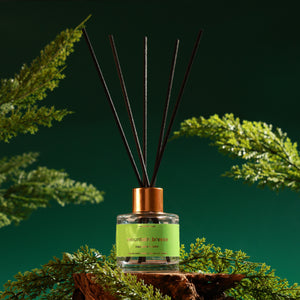
3. In dry or air-conditioned air, Mountain Breeze at 9.4 gains. Himalayan pine, sage and Indian cedar are dry to begin with; in cooled, low-humidity air they hold their edges and read bigger than the number suggests.
4. To a person walking in, Garden Bloom punches above 8.9. A rounded floral registers on arrival more reliably than almost anything, which is why it belongs at an entrance even though two other bottles measure higher.
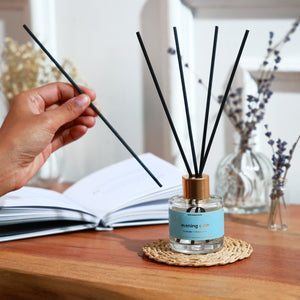
5. Evening Calm at 8.9 is the softest and is meant to be. Kashmir lavender and chamomile are composed to help a room settle. Putting it in a living room and concluding reed diffusers are weak is the commonest mismatch we see.
6. Whatever you choose, your own nose will stop reporting it. Adaptation to a constant happens within minutes and is strongest at home. Judge presence in the first three seconds of coming in from outside, or ask a guest.
Composed and handmade in small batches in Pune, and a portion of every order supports girl-child education through Nanhi Kali.
Part one — two different measurements wearing the same word
When a customer asks which fragrance is strongest, they are usually asking one of two questions without realising they are different. The first is about the bottle: how much fragrance does this composition put into a room per hour compared with the others. The second is about them: which one will I keep noticing. The first is a property of the oil and is stable; the second is a property of the encounter between that oil, the air in your home and your own nose, and it changes with the weather. Our published number answers the first question only. This article is mostly about the second.
 Mountain Breeze₹849 · 9.4/10A smell is noticeable to the extent that it differs from the air already around you, and Indian air is very often warm and humid. Warm humid air is itself soft, rounded and slightly sweet-smelling; a warm, rounded composition released into it merges with the background, so the room feels pleasant without feeling scented. Cold, angular materials do the opposite — the citrus, mint and eucalyptus in Morning Freshness read as a sharp edge against that background and keep announcing themselves. This is why a 9.0 can be the most noticeable bottle in a monsoon flat while a 9.5 is the most noticeable one in a dry, cool December sitting room. Neither bottle changed. The air did.
Part two — measured against perceived, scent by scent
Here are all five compositions with their measured position and how each behaves in the room, including where each one over-performs its rating and where it under-performs it. The measured column is our internal scale at six reeds; everything else in the table is observation from in-house testing and several years of customer correspondence rather than instrumentation.
| Composition | Measured at six reeds | Character of its presence | Over-performs its rating in | Under-performs its rating in |
|---|---|---|---|---|
| Fresh Brew ★ | 9.5 · warm-deep | Fills and warms — you notice it arriving, then it becomes the room | Cool dry evenings, hosting, entrances, open living-dining | Hot humid afternoons, where it merges with the air |
| Mountain Breeze | 9.4 · deep woody | Dry and grounding — presence without any sweetness at all | Air-conditioned studies, libraries, low-humidity winters | Very damp monsoon rooms, where dry woods lose their edge |
| Morning Freshness | 9.0 · bright | Sharp and clear — the one that keeps re-registering | Humid flats, bathrooms, kitchens, coastal cities in summer | Cold dry rooms, where it can read thin rather than bright |
| Garden Bloom | 8.9 · floral | Rounded and hotel-like — strongest at the moment of arrival | Entryways and hallways, where people encounter it fresh | Rooms you sit in all day — adaptation catches up quickly |
| Evening Calm | 8.9 · softest | Deliberately quiet — a room that settles rather than announces | Bedrooms, nurseries and reading corners, close to you | Living rooms and any large space — it is not built for them |
| The honest caveat: none of this survives a bad set-up. A 9.5 in a closed cabinet loses to an 8.9 on an open console, every time, and an unflipped bottle at week six loses to anything. Get the free things right — flip all six reeds weekly, stand it in gently moving air at waist-to-chest height, out of sun and draught — before you read anything into these differences. And two honest gaps while we are being precise: the reed range has no oud, no musk-forward composition and no aquatic. If that is the presence you are after, none of these five is it. | ||||
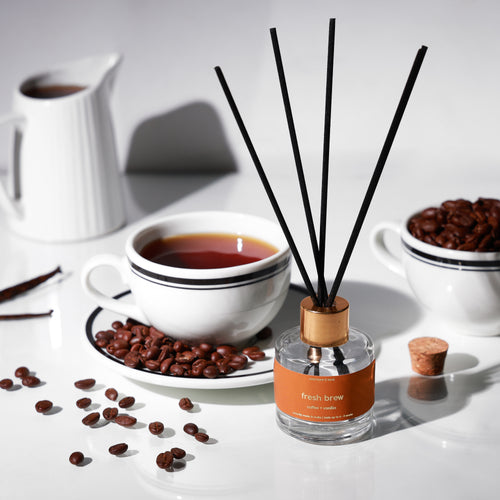 Fresh Brew · 9.5 measuredfrom ₹849Shop → Morning Freshness · humid airfrom ₹749Shop →
 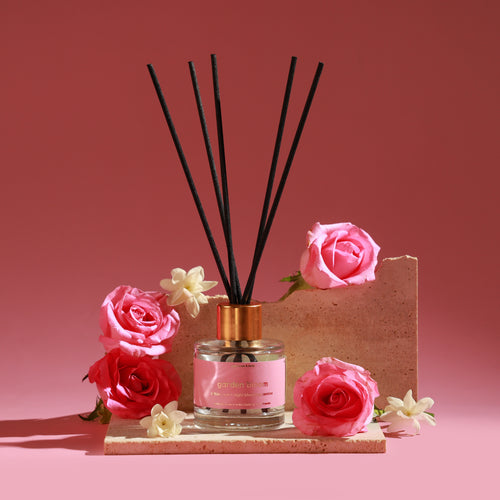 Garden Bloom · on arrivalfrom ₹799Shop →
Part three — your air decides which reading wins
Three properties of a room do most of the work here. The first is humidity. In a coastal or monsoon-season flat at something near 85 per cent relative humidity, the air is already heavy and slightly sweet, and warm compositions lose contrast against it while cold ones gain. In a dry Delhi January the reverse holds: woods and roasted notes keep their architecture and read generously, while a citrus-mint accord can seem thin. This single variable moves the perceived ranking of our five compositions more than anything else, and it moves twice a year in most of India. There is no fault in a bottle that seemed enormous in July and modest in December; it is the same oil meeting different air.
The second is temperature, which acts on both sides at once. Warmth thins the oil and raises the rate at which fragrance leaves the reeds, so a hot room genuinely receives more — while also being the room in which warm accords blend away. That is the paradox behind a very common message: my diffuser is emptying faster in summer and I can smell it less. Both halves are usually true, and the answer is not a bigger bottle. The third is the background. A kitchen carries the memory of a morning's cooking; a bathroom carries damp; a home with agarbatti or a mosquito coil has a strong incumbent smell. A composition has to differ from whatever is already there, which is why Morning Freshness works so well in exactly those rooms, and why nothing works over live cooking. Run the extractor, open a window for ten minutes, close up, and give it half an hour before you judge anything.
Which leaves the question of how to test presence honestly, since your own nose in your own room is the least reliable instrument available. Use the doorway: go out for fifteen minutes, come back in, and pay attention only to the first three seconds. That reading, before adaptation resets, is close to what a visitor experiences. Better still, let a visitor tell you unprompted. If guests comment and you cannot smell it, the diffuser is working and you have simply adapted — that is the single most common misdiagnosis in this category, and no purchase fixes it because nothing is broken. If nobody comments either, then read the table above, check the free levers, and consider whether you have the right composition for your air rather than the highest number in the range.
Part four — choosing by the room you actually have
Rather than ranking the five in the abstract, here is the choice arranged by the condition you are buying into. Prices are for the 50ml; every composition is also made in 130ml, which buys 14–18 weeks against 6–8 rather than any extra presence.
| If your room is | Choose | Measured | Why it wins there | 50ml / 130ml |
|---|---|---|---|---|
| Humid, coastal, or in monsoon season ★ | Morning Freshness | 9.0 | Cold, sharp notes hold their edge against warm damp air | ₹749 / ₹1,249 |
| Air-conditioned, dry, or a north Indian winter | Mountain Breeze | 9.4 | Dry woods keep their structure in low humidity and read bigger | ₹849 / ₹1,349 |
| A living room you host in | Fresh Brew | 9.5 | The fullest projection we make, and it warms a whole room | ₹849 / ₹1,349 |
| An entrance or hallway people arrive into | Garden Bloom | 8.9 | A rounded floral registers hardest at the moment of arrival | ₹799 / ₹1,299 |
| A bedroom, nursery or reading corner | Evening Calm | 8.9 | Composed to be the quietest thing we make, and close to you all night | ₹799 / ₹1,299 |
| Two connected rooms with different air | Fresh & Grounded duo | 9.0 + 9.4 | They meet on green eucalyptus, so the junction has no seam | ₹1,548 / ₹2,548 |
| Wanting oud, musk or an aquatic | Nothing in our reed range | — | An honest gap; we would rather say so than push the nearest thing | — |
Versailles
Publishing a strength number was an argument inside the business. The case against it is that it flattens something genuinely complicated into a decimal, and that people will buy the highest one and be disappointed when it does not shout. The case for it, which won, is that "strong" is otherwise unreadable from a note list, and an Indian customer buying online deserves better than a page of adjectives.
So the number exists, and this page is the caveat that should always travel with it. It is our own scale, at six reeds, comparing our own five compositions. It says nothing about how your July will smell in Kochi or your December in Amritsar. If you want one sentence to buy by: pick the composition least like the air you already live in.
And where we have nothing for you, I would rather say so. There is no oud in this range, no musk-forward composition and nothing aquatic. Those are real gaps, not oversights, and stretching Fresh Brew to stand in for oud would help nobody. Everything is composed and handmade in small batches in Pune, tested through 45°C heat and 85% humidity, and a part of every order funds a girl's classroom through Nanhi Kali.
Frequently asked questions
- The four currencies of strength — what each way of getting louder actually costs.
- Throw is a property of the room and the best placement for it.
- Does adding reeds make it stronger? — the number assumes six.
- The complete guide to stronger performance and the full strength guide.
- Brand: the SOSA founder story.
SOSA reed diffuser range & prices (verified August 2026): alcohol-free, phthalate-free, paraben-free and IFRA-compliant compositions on a heat-stable coconut-derived (CCT) carrier, low-VOC, supplied in a refillable glass bottle with six fibre reeds; 50ml lasts 6–8 weeks and 130ml lasts 14–18 weeks. Morning Freshness (Malabar lemon · peppermint · Nilgiri eucalyptus) 50ml ₹749 · 130ml ₹1,249 · 9.0/10; Garden Bloom (British rose · night-blooming jasmine) 50ml ₹799 · 130ml ₹1,299 · 8.9/10; Evening Calm (Kashmir lavender · chamomile) 50ml ₹799 · 130ml ₹1,299 · 8.9/10; Fresh Brew (Coorg coffee · Kerala vanilla) 50ml ₹849 · 130ml ₹1,349 · 9.5/10; Mountain Breeze (Himalayan pine · sage · Indian cedar) 50ml ₹849 · 130ml ₹1,349 · 9.4/10. Reed diffuser refills are oil only — you reuse your own vessel and reeds: 300ml ₹2,399 (roughly 8–11 months) · 500ml ₹3,499 (roughly 14–18 months), about ₹7–8 per ml against ₹15–17 per ml for a 50ml bottle. Duo sets ₹1,498–₹1,598 for 2 × 50ml and ₹2,498–₹2,598 for 2 × 130ml. Strength figures are positions on SOSA’s own internal strength scale, not an industry standard. Replacement reeds are not sold as a separate SKU; SOSA guidance is to refresh reeds every few months. The reed line is separate from the water-based Hotel Collection for ultrasonic machines (15ml ₹299 · 100ml ₹999 · 300ml ₹1,799) and the two are not interchangeable. Diffusers: Boond 300ml ₹899 · Sukoon 500ml ₹1,899 · Megh 6L ₹3,499 · waterless Vaayu ₹11,999. Composed and handmade in small batches in Pune, India; tested through 45°C summer heat and 85% monsoon humidity. Free shipping above ₹499. A portion of every order supports girl-child education through Nanhi Kali. Prices subject to change — see the live product pages.