




A machine: a living room over about 200 sq ft, or any room you want lifted for two hours before guests and silent at midnight. A Sukoon with a 15ml Hotel Collection is ₹2,198.
Neither: the internal passage, the kitchen, and any room used less than about two hours a day.
2. Reeds go in bedrooms, whatever the square footage says. A bedroom is a room you are unconscious in for eight hours. You do not want a socket occupied, a light on, a fan-driven hum, or a decision to make at midnight about whether something is switched on. A 130ml at ₹1,249 on four reeds runs 14–18 weeks at about ₹78 a week and asks nothing of you at all. Four reeds, not six: six is a hall setting, and in a bedroom it is not more presence — just faster consumption.
3. Reeds go in the entrance you arrive through, and nothing goes in the passage you do not. These two look identical on a floor plan and are completely different purchases. The hall or short corridor you walk into from outside is the first breath anybody takes of your home, taken with a fresh nose — a 50ml at ₹749 on two or three reeds is well spent there. An internal passage between two bedrooms is measured in seconds of occupancy and gets nothing. Same shape, opposite answer, because one has a nose arriving in it and the other does not.
4. A machine goes in a living room over about 200 sq ft — or any room you want to switch off. Two separate reasons, both real. The sizing reason: past about 200 sq ft in one open air space, a passive bottle cannot charge the volume, and a Sukoon at ₹1,899 covers about 270–320 sq ft because it propels mist rather than waiting for the room to carry vapour. The control reason: you want the room lifted for two hours before guests and silent afterwards. A reed diffuser has no off switch and no fast on switch — reed count moves the room over a day or two, not before the doorbell.
5. Guest rooms get a bottle at most, and often nothing until the guests arrive. A room used twice a month is being scented at full price for twenty-eight days out of thirty. If it is a real spare bedroom, a 50ml at ₹749 on two reeds is a reasonable, cheap answer that also happens to last longer at that setting. If it is a store room with a bed in it, buy nothing, and open the window the morning somebody is coming. A machine is exactly wrong here — it is the one room where nobody will be present to switch it on.
Made in India, composed by an ISIPCA Versailles-trained perfumer — and a portion of every order supports girl-child education through Nanhi Kali.
Why the rule is always-on versus switchable, and not big versus small
The two products differ in mechanism, and the mechanism decides the room. A reed diffuser is passive: fragrance climbs the porous core of each reed by capillary action, evaporates from the exposed length, and the room's own air does the rest. There is no fan, no pump and no control except the number of reeds — which is a real dial, but a slow one, moving the room over a day or two rather than in ten minutes. The consequence is that a reed diffuser is on all the time, whether or not anybody is there. In a bathroom that is exactly right, because you cannot predict when somebody will walk in and everybody who does arrives with a fresh nose. In a bedroom it is right because the last thing you want at midnight is a device. An ultrasonic machine is the opposite: it atomises fragrance into a cool mist and propels it, which is fast and controllable, and it does nothing at all unless it is switched on, plugged in and has water in it.
Size enters the picture only once, and it is worth being precise about where. A single reed diffuser on six reeds holds a closed, still room of up to about 150 sq ft; between 150 and roughly 200 you can usually close the gap with all six reeds in, better placement and a shut door, all of which are free. Past about 200 sq ft in one open air space, a passive source is producing into more air than it can hold at any noticeable level, and no number of bottles fixes that — two bottles in one room give two starting points, not a wider circle. That is the sizing case for a Sukoon, rated to about 270–320 sq ft. But notice what has happened: the room that is over 200 sq ft is usually the living room, and the living room is also the room you most want to be able to switch on and off. Two independent reasons landing on the same sofa is what makes this look like a size rule. It is not. A 180 sq ft living room you want to control still wants a machine, and a 190 sq ft bedroom you sleep in still wants a bottle.
The three decisions when allocating room by room
 Reed roomsFrom ₹749Fragrance is only worth anything to a nose that has not already adapted, and adaptation is essentially complete in about twenty minutes. That single fact reorders the whole house. A bathroom at 30–45 sq ft is the cheapest whole room to hold and the one everyone enters cold — a 50ml at ₹749 on two or three reeds. The entrance you arrive through is the first breath of the home, taken from outside — another 50ml at ₹749. Both are reed rooms by definition: nobody is present to switch anything on, and you cannot predict the moment.
Sizing by space — the allocation, room by room
This is the whole rule as a table. Read down to each room you actually have. The last row is three rooms at once, and it is the row that keeps the total sensible.
| Space | What it needs | How many | Cost |
|---|---|---|---|
| Bathroom, 30–45 sq ft ★ | A 50ml on two or three reeds — nothing electrical near water, and everyone arrives with a fresh nose | Reed diffuser | from ₹749 |
| Bedroom, 110–160 sq ft | A 130ml on four reeds — no socket, no hum, no decision at midnight, 14–18 weeks at about ₹78 a week | Reed diffuser | from ₹1,249 |
| The entrance or hall you arrive through | A 50ml on two or three reeds — the first breath of the home, taken with a nose from outside | Reed diffuser | from ₹749 |
| Living room over about 200 sq ft, one open volume | Past what a passive bottle holds — a Sukoon with a 15ml Hotel Collection, about 270–320 sq ft | Machine | ₹2,198 |
| Living room under about 200 sq ft that you want to switch off | Still a machine, but for control rather than coverage — a Boond at ₹899 with a 15ml Hotel Collection covers about 150 sq ft | Machine | ₹1,198 |
| Internal passage, kitchen, or any room used under two hours a day | Neither. Seconds of occupancy, a moving target, and an empty room at full price | None | ₹0 |
| A note on all of the above: the coverage numbers behind this table — about 150 sq ft for a reed diffuser on six reeds, about 270–320 for the Sukoon, about 150 for the Boond — are steady-state figures for a closed room with still air at standard ceiling height. The allocation itself does not change when conditions do; only the sizes at which each row starts to apply move earlier. | |||
One room · the unitFrom ₹749Shop → 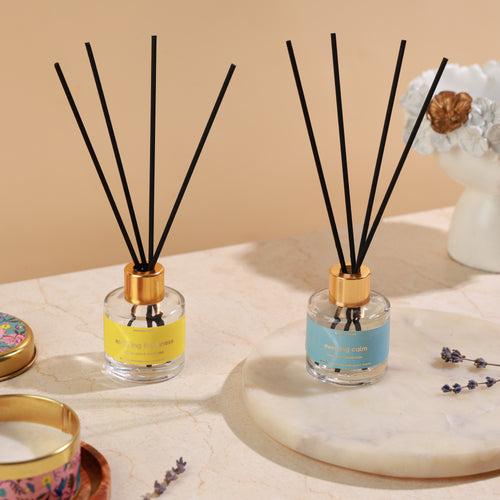 Two rooms · better value₹1,498Shop →
  Large room · a switch₹1,899Shop →
Room by room, with the reed counts and the placement
Bathrooms and entrances: a 50ml, two or three reeds, and nothing electrical. These are small, hard-surfaced spaces where six reeds would be overwhelming and a machine would be absurd. Two reeds in a 35 sq ft bathroom is usually right and three is the maximum; the bonus is that fewer reeds roughly double how long the bottle lasts, so the cheapest room in the house is also the least frequently reordered. Stand the bottle where it will not be knocked into a basin and not on bare polished wood, because reed oil marks a finish permanently. In an entrance, put it near the door but off the direct draught line, at about waist or table height, so it meets people rather than being blown past them.
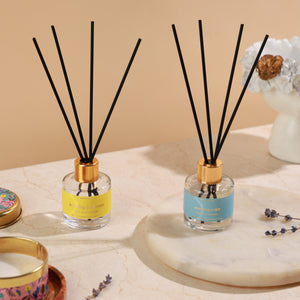
Bedrooms: a 130ml, four reeds, and judged from the doorway two days later. Four reeds is the bedroom setting — three if the room is under about 110 sq ft or you are a light sleeper. Six belongs in a hall. Reeds have to saturate along their whole length before they throw properly, so a first-day verdict is meaningless; wait forty-eight hours, then leave the flat for half an hour and judge the first breath on returning, because you cannot smell your own bedroom after twenty minutes in it. Place the bottle on a chest of drawers or a shelf near the doorway rather than a bedside table in a still corner, out of direct sunlight and out of the throw of an AC vent — the vent will empty a bottle fast and push everything against one wall. Evening Calm is the quietest of the five reed blends for a room you sleep in.
The one machine room: place it for the volume, and keep the liquids strictly apart. A Sukoon wants to be raised off the floor and away from a wall, where the mist has room to disperse rather than settle on furniture, and out of the line between the balcony and the front door. Fill it with the water-based Hotel Collection at three to six drops a tank — start with a 15ml at ₹299 to find which of the seven suits the room before moving to a 100ml at ₹999. The Ritz-Carlton-inspired Quiet Luxury and Four Seasons-inspired Warm Welcome both hold a living room well. Reed oil never goes in a Sukoon and Hotel Collection never goes in a reed bottle, in either direction, and there is no hotel-inspired reed diffuser. If one Sukoon is short for a very large room, buy a second at ₹3,798 for the pair and place them apart — not a Megh, which at ₹3,499 covers about 215 sq ft, less than the Sukoon.
What to buy
A typical allocation is three or four bottles and at most one machine. Here is what each line of the range is genuinely for.
| Buy | What it covers | Lasts | Price |
|---|---|---|---|
| One 50ml | A single reed diffuser — bathrooms and entrances, on two or three reeds — the two rooms that repay fragrance most per rupee | 6–8 weeks | from ₹749 |
| One 130ml ★ | The value size — bedrooms, on four reeds — always on, no socket, 14–18 weeks at about ₹78 a week | 14–18 weeks | from ₹1,249 |
| The duo | Day & Night duo — a bedroom and a bathroom in one purchase, then staggered so the two bottles never finish together | 6–8 weeks each | ₹1,498 |
| Sukoon | 500ml ultrasonic — the one living room that is over about 200 sq ft, or that you want to be able to switch off | Runs when you switch it on | ₹1,899 |
| 300ml refill | The running cost — keeping the reed rooms going at ₹8.00 a millilitre against ₹9.60 for a new 130ml bottle | Roughly 2 × 130ml fills | ₹2,399 |
Versailles
People ask me which product is better and the honest answer is that they are not on the same axis. A reed diffuser is always on. A machine is on when you switch it on. That difference, and not the square footage, is what decides which room gets which. A bathroom cannot use a switch because nobody is standing there in advance to press it. A living room before guests can use nothing else.
The room I feel strongest about is the bathroom, and it is the cheapest one. Thirty-five square feet, a 50ml at ₹749, two reeds, and everybody who walks in does so with a nose that has not adapted — which is the only condition under which fragrance is worth anything at all. It is the best value in the house and it never needs a machine, a socket or a decision.
And I would ask you to leave three kinds of room alone entirely: the passage between bedrooms, the kitchen, and anything used less than about two hours a day. Those are the rooms that turn a good four-product plan into a seven-product plan that nobody keeps filled. Reeds where you want it always right, one machine where you want a switch, and nothing at all in the rest. A portion of every order funds a girl's classroom through Nanhi Kali.
Frequently asked questions
- A 1,000 sq ft flat: reeds, a Sukoon, or both? — the itemised build.
- Adding a Sukoon to three bottles — usually not, and why.
- The first three rooms to scent — ranked by hours and fresh noses.
- The complete sizing and quantity guide — every home type, three builds.
- Brand: the SOSA founder story.
SOSA products & prices (verified August 2026): Hotel Collection water-based ultrasonic diffuser fragrance 15ml ₹299 · 100ml ₹999 · 300ml ₹1,799 · Pack of 7 (15ml, all fragrances) ₹1,799; refills 100ml from ₹999. Seven scents: The Ritz-Carlton-inspired (white tea · bergamot · cedar), Westin-inspired (white tea · aloe · cedar), 1 Hotels-inspired (cedarwood · vetiver · green leaves), The St. Regis-inspired (amber · violet · woods), Shangri-La-inspired (jasmine · green tea · white tea), Four Seasons-inspired (citrus · floral · sandalwood), W Hotels-inspired (citrus · pepper · amber). Diffusers: Boond 300ml ₹899 · Sukoon 500ml ₹1,899 · Megh 6L ₹3,499. Water-based, phthalate-free, composed to IFRA standards for home diffusion; 3–6 drops per tank. Made in India, Pune. The Hotel Collection scents are SOSA's own interpretations inspired by the world's finest hotels; all hotel names are trademarks of their respective owners and are used only to describe the scent style — SOSA is an independent Indian fragrance house, not affiliated with or endorsed by any hotel brand. Prices and availability subject to change — see the live product pages.