


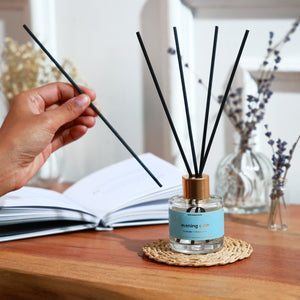

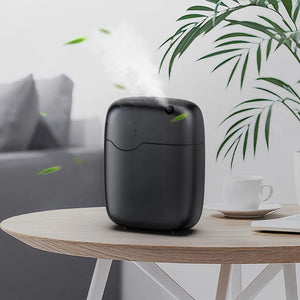
Air exchange sets the price of everything you add. The level a constant source settles at depends on how fast the room clears, so the same bottle that reads correct in a ventilated reception reads heavy in a sealed one. Nothing about the product changed; the drain did.
The order never varies: find the source, fix ventilation or cleaning, then — only then — consider fragrance. Doing it in any other order destroys your own diagnosis, because a designed smell makes an undiagnosed one impossible to describe.
An under-ventilated clinic cannot be fixed with fragrance at any price. Not with a ₹749 bottle and not with an ₹11,999 machine. If your building has not exchanged air with outside since it opened this morning, that is the project, and it is free.
2. Whenever the smell tracks the weather. Rising for two or three days after heavy rain, worse through a wet spell, better in a dry one — that is moisture, which means wet material somewhere in the fabric, and a repair. SOSA sells no dehumidifier and no air purifier, and I would rather say so on the front page of this argument than in a footnote.
3. Whenever your building has not exchanged air with outside since it opened. Recirculated air is not fresh air; a split system cools and moves the same air rather than replacing it. A clinic that smells closed is under-ventilated, and adding fragrance to an under-ventilated room makes it heavier, not fresher. This is the gate most practices fail, and it is free to pass.
4. Whenever three deliberate sources are already running. Cleaning chemistry, whatever the building contributes, and a designed fragrance. A nose can name one and argue with two; at three it stops analysing and reports that the room is simply wrong — and then nobody can tell you which one to change.
5. Whenever the room is still being diagnosed. Adding a designed smell while you are looking for an undiagnosed one destroys the only evidence you had. Take out anything that is running for the fortnight of the search.
6. The order never changes: source, then ventilation or cleaning, then fragrance. Not because of caution, but because each step changes the measurement for the next one. Do them out of order and you will be adjusting a variable that was never responsible.
7. What is left, after all of that, is a small and genuinely optional question. If the air is unremarkable at the worst hour of the worst week, and you want the arrival zone to feel considered rather than merely neutral: one source, a dry composition, the lowest useful level, reception and waiting only. The correct intensity in a clinic is lower than in any retail or hospitality space, and if a patient can name the fragrance it is too strong.
8. Nothing here is medical, clinical, ventilation, air-handling, building, infection-control or regulatory advice. Which windows open, how your air is handled, what your housekeeping uses and every accreditation matter belong to your own clinicians and contractors. Examination rooms, diagnostics, consultation cabins, the procedure suite and any post-operative area take nothing, in any format, at any level, at any hour, and a fragrance-free seat must genuinely exist somewhere a person would ordinarily sit. Composed and made in small batches in Pune, and a portion of every order supports girl-child education through Nanhi Kali.
Part one — one operation, one multiplier, one order
Everything in this family reduces to three ideas, and once you hold all three at the same time the individual questions stop needing individual answers. There is one operation fragrance can perform, one property of your building that decides what that operation costs you, and one order of work that keeps your own evidence intact.
 Sukoon 500ml₹1,899 · windows, not strengthHere is the mechanism nobody selling scenting equipment will explain to you, and it is not complicated. A continuous source in a room settles at a level set by two things: how fast it emits, and how fast the room removes what it emits. The second of those is air exchange, and in most sealed, fully air-conditioned Indian clinics it is very low — because recirculation is not exchange. A split system cools and lightly filters the air already inside and returns it; unless there is a deliberate fresh-air supply, almost nothing leaves the building between opening and closing. So the identical bottle at the identical reed count is two different products in two different buildings. In a reception with a door that genuinely opens and a cross-draught, it settles low and reads as a quiet character. In a sealed floor plate, the same emission accumulates to a higher level, holds there all day, and is felt as weight rather than as fragrance — thicker, closer, harder to stop noticing. Practices then do the natural thing: they lower it, adapt to the lower level within a fortnight, decide it has stopped working, and raise it past where it started. That cycle is the single most common way a clinic ends up with a room nobody in it would have chosen, and it is caused by the building rather than by the product.
Part two — the four gates, asked in order
This is the rule itself, and it is meant to be used rather than admired: ask the questions in this order, stop at the first one that fails, and do what that row says instead of buying anything. Only a practice that passes all four has a fragrance question at all, and the fifth row is what that question looks like.
| Gate | The question, asked exactly | If the answer is the wrong one | The category, and who owns it | Does SOSA sell anything for it? |
|---|---|---|---|---|
| 1 · The verb ★ | "Am I trying to make something go away?" | Stop. Fragrance adds and removes nothing, at every price we publish | Source removal — a trade, a routine or a repair | No. Not one product in the range |
| 2 · The weather | "Does it rise after rain and settle in a dry week?" | Stop. This is wet material in the fabric of the building | Moisture — a civil or waterproofing professional, and often a landlord | No. SOSA sells no dehumidifier and no air purifier |
| 3 · The air | "When did this building last exchange its air with outside — not recirculate, exchange?" | Stop. An under-ventilated room gets heavier with everything you add | Ventilation — your own clinicians, your contractor, and a free daily routine | No, and this is the gate most practices fail |
| 4 · The count | "How many deliberate sources are running, and can a cold-nose visitor name what is in the air?" | Stop and subtract. Three sources produce a smell nobody can attribute or correct | Sequencing and housekeeping — free, and usually returns money | No. Subtraction is the operation, and we do not sell that either |
| Passed all four | "Is the air unremarkable at the worst hour of the worst week, and do we want the arrival zone to feel considered?" | Then yes — and it is a small, cheap, entirely optional decision | Ambience, and it belongs to reception and waiting only | Yes: one source, a dry composition, from ₹749 at two of six reeds |
| The honest caveat: the gates are a way of ordering your own decision, not a standard, a protocol or an assessment of any building. Nothing on this page is medical, clinical, ventilation, air-handling, building, drainage, infection-control or regulatory advice — which windows open, how your air is handled, what your housekeeping uses, and every accreditation matter belong to your own clinicians and licensed contractors. No product or setting here is described as safe or unsafe for any patient or staff group, and no claim is made about how anybody perceives or responds to fragrance beyond the plain fact that some people are sensitive to it — which is exactly why the clinical pathway stays fragrance-free and why a fragrance-free seat must genuinely exist somewhere a person would ordinarily sit. No SOSA product removes, reduces, neutralises, absorbs or masks any smell, and none cleans, purifies, filters or freshens air. Even past all four gates, fragrance belongs in reception and waiting only; examination rooms, diagnostics, consultation cabins, the procedure suite and any post-operative area take nothing, in any format, at any level, at any hour. | ||||
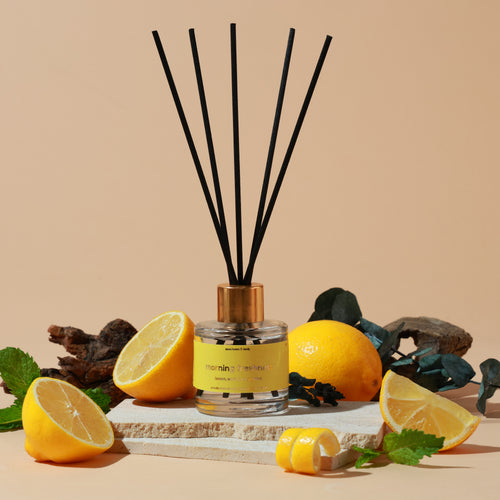
Morning Freshness · the cheapest test₹749Shop → 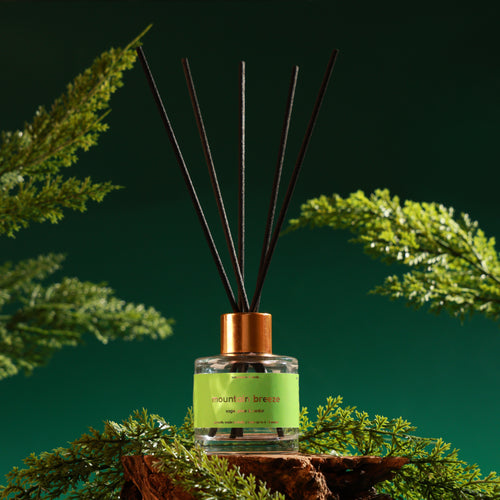 Mountain Breeze · dry, two of six reeds₹849Shop →
  Sukoon · 150–320 sq ft, scheduled₹1,899Shop →
Part three — the under-ventilated clinic, and why nothing here can help it
Gate three is the one that decides the most cases, so let me be concrete about what failing it looks like. A clinic on a sealed floor plate, fully air-conditioned, front door opening onto an internal corridor rather than the street, no openable window on the patient side, one recirculating system serving reception, the corridor and several clinical rooms, and a working day of nine or ten hours during which the building's air does not meaningfully change. The complaint is almost always the same phrase: it smells closed. Nobody can name anything in particular, nothing is dirty, housekeeping is diligent, and the practice is embarrassed by a problem it cannot describe. Then somebody suggests a diffuser, and the suggestion is entirely reasonable, because a closed room does sound like a room that needs something. But look at what the mechanism actually delivers. The room's difficulty is that things put into it stay in it. A diffuser is a device for putting a thing into a room continuously. It will do that faithfully, the added material will accumulate exactly as everything else has accumulated, and the result is not freshness — it is one more thing in air that already holds too much. Heavier, not fresher, and the more you spend the heavier it gets, because price in this category buys emission rate and coverage rather than any capacity to clear a room.
The correct project is unglamorous, free, and almost nobody does it before buying. Establish one deliberate air exchange before opening and one in the early afternoon: two openings on opposite sides of the arrival zone held open together for ten to fifteen minutes, so that air crosses the space and leaves — not a ceiling fan, not the AC on a higher fan speed, not the front door swinging as people come and go. If your building genuinely has only one opening, prop it and use a fan to push air out through it rather than stirring the room. Do it at the same two times daily for a fortnight, and have one colleague step outside for fifteen minutes and re-enter through the patient door at four in the afternoon, writing one sentence before speaking to anybody. That is your measurement, and it is the only one on this page that produces information you can act on. If the four o'clock sentence changes over the fortnight, ventilation was your answer and it cost nothing. If it does not change, you have ruled out the largest variable for free and can look at the source walk instead. Either result is worth more than a purchase, and both are available this week.
Some practices genuinely cannot ventilate, and I want to answer that case rather than pretend it away. If your patient-side space has no openable window, sits on a shared corridor, and is served by a central system you do not control, then the honest recommendation is not more fragrance and not a bigger machine — it is less, or none. An under-ventilated room is precisely the room in which a constant source accumulates furthest above the level you intended, so it is the worst environment in the building to introduce one into and the one where the intensity cycle bites hardest. Whether the air handling in your building should be doing something different is a real question and an important one, and it is emphatically not mine: it belongs to your clinicians, your facilities contractor and whoever is responsible for the building services, and no fragrance company should be offering an opinion on ventilation standards in a healthcare setting. What I can tell you is where our range stops. If the answer to "how do we make this room feel less closed" is a mechanical or architectural one, then we do not make it, we do not sell an accessory to it, and buying from us in the meantime will make the room heavier while you wait.
There is one more thing worth saying to the practice that has already bought, because a good number of readers arrive here after the fact. If you own a machine and the room is not right, the first experiment is to switch it off for two weeks and change nothing else. Not lower it — off, and physically removed if it is a bottle. It is free, entirely reversible, and it separates the two hypotheses that have probably been tangled for months: whether the room has a problem the fragrance was failing to solve, or whether the fragrance had become the problem in a room that was otherwise fine. Have the cold-nose check run at the same two hours through those two weeks. About a third of the practices I have suggested this to reported that the room read better without anything running, which is not a comment on the product — most of them were running it in a sealed building, at a level chosen months earlier for a room that no longer existed. Then, if you reintroduce it, do so at the bottom: two of six reeds, or the lowest mode with half the drops, in a defined window, sited away from every return grille and set back from the corridor to consultation. Give the desk unconditional authority to switch it off. And keep a fragrance-free seat that genuinely is one.
Part four — every symptom in this family, resolved
Ten symptoms, the gate each one fails, the honest fix and its cost, and whether we sell anything relevant. We sell something for one row out of ten, and that is the correct proportion rather than a modest one.
| The symptom you arrived with | Gate it fails | The real category | The honest fix, and what it costs | What SOSA sells for it |
|---|---|---|---|---|
| Air is unremarkable; we want reception to feel considered ★ | None — it passes all four | Ambience, arrival zone only | One source at the lowest useful level; ₹749–₹849 for a 50ml at two of six reeds | A reed diffuser, or a Sukoon ₹1,899 for 150–320 sq ft |
| Stale when we open in the morning | Gate 3 | No overnight air exchange | Fifteen minutes of cross-ventilation before opening. Zero | Nothing. It is a routine, not a product |
| It smells of disinfectant and we want to cover it | Gate 1 | Cleaning protocol and ventilation | Change the product, the hour or the airing. Zero | Nothing — and layering makes a third, worse smell |
| Fully air-conditioned but it smells closed | Gate 3 | Recirculation without exchange | A daily exchange routine; then ask your contractor about fresh air. Zero to start | Nothing. More fragrance here is heavier, not fresher |
| Musty through the monsoon | Gate 2 | Moisture, seasonal | Find it, dry it, ventilate; re-judge after a full wet spell | Nothing. No dehumidifier, no air purifier |
| Cleaning products plus occupancy by evening | Gates 3 and 4 | Accumulation in a sealed building | A mid-day exchange window and the bin out at lunch. Zero | Nothing, unless you want a schedule |
| Older building, persistent damp smell | Gate 2 | Wet fabric, often not your wall | A repair by whoever owns it, then weeks of drying | Nothing. This is a building trade |
| Fine in the morning, different after a full day | Gates 3 and 4 | Occupancy load against a flat source | Mid-day exchange, umbrellas and bin out of the zone. Zero | Only a schedule: Boond ₹899 or Sukoon ₹1,899 |
| Cleaning, AC and fragrance together make it worse | Gate 4 | Three sources, unattributable | Sequencing and placement; subtract one source. Zero | Nothing new — the fix is removal, not purchase |
| A persistent smell we cannot locate | Gate 1, until located | Unknown until the source walk is done | A twenty-minute walk with a cold nose, nine stops. Zero | Nothing until the walk finds nothing |
Versailles
The enquiry that made me write this page came from a group with three eye clinics who wanted a proposal for all of them. It was the largest single conversation of that quarter, and I asked for the same four answers I ask everybody for: what are you trying to make happen, does it track the weather, when does each building exchange its air, and how many sources are running now.
Two of the three buildings failed at gate three, and one of those failed it completely — a sealed floor plate with no openable window on the patient side and one recirculating system across reception, the corridor and four clinical rooms. The third building was fine, and by fine I mean nobody could tell me anything about its air at all, which is what a clean building sounds like when you ask about it. So the proposal I sent covered one clinic, not three, and the total was under two thousand rupees against a number I could have written that would have been very much larger.
They were, I think, slightly annoyed. They also came back four months later, having done the airing routine in the other two buildings, and one of them had become answerable. The third never did, and I still do not have anything to sell them. Being a fragrance company that says "not this building, not yet, and possibly not ever" is commercially inconvenient roughly once a week, and it is the only version of this I know how to run. Composed and made in small batches in Pune, and a part of every order funds a girl's classroom through Nanhi Kali.
Frequently asked questions
- Stale at opening, air-conditioned but closed — the two ventilation pages.
- Musty through the monsoon and damp in an older building — the moisture pages.
- The disinfectant question, cleaning plus occupancy by evening and the three-source interaction.
- The twenty-minute source walk and why reception changes across a full day.
- Brand: the SOSA founder story.
SOSA range, specifications and prices used in this guide (verified August 2026): Vaayu ₹11,999 — waterless cold-air nebulisation of undiluted fragrance oil; no water, no heat, no added humidity, no white mineral dust. Coverage up to 1000 m³, about 2,000–3,000 sq ft. 400ml refillable tank lasting roughly 90+ days at a mid setting. Bluetooth app plus onboard controls, 1h / 4h / 8h / 24h run windows, day selection, adjustable intensity, auto-stop and key-lock. Under 38 dB. DC 12V / 1A, 5W. Freestanding or wall / HVAC mount. CE, RoHS and SGS certified. SOSA does not currently sell a separate Vaayu cold-air refill oil; the 400ml supplied in the box is the fragrance available at the time of writing, so a practice planning continuous or multi-site use should confirm current refill availability with SOSA before committing. The water-based Hotel Collection is made for ultrasonic machines and must not be used in a Vaayu. Other machines: Boond 300ml ₹899 (~150 sq ft, ultrasonic) · Sukoon 500ml ₹1,899 (270–320 sq ft, 16–18 hours on low, remote and steady/2H/4H timers, three 15ml fragrances included, ultrasonic) · Megh 6L ₹3,499 (~215 sq ft — a runtime and humidity machine that covers less than a Sukoon, never a coverage upgrade) · Safar ₹3,999 (waterless cold diffusion, cordless, 20ml, about 6.9cm, three speeds, 1/2/3-hour auto-off — sold as a car and travel diffuser, personal-scale only; SOSA publishes no coverage figure for it) · Aangan ₹25,999 (HVAC nebulising, ~8,000–10,000 sq ft) · Meenar ₹38,500 (commercial HVAC, 12,000–18,000 sq ft). Water-based Hotel Collection for ultrasonic machines: 15ml ₹299 · 100ml ₹999 · 300ml ₹1,799 · pack of seven ₹1,799; scents are inspired by the atmosphere of well-known hotels — SOSA is an independent Indian brand and is not affiliated with, endorsed by or supplying any hotel group. Reed diffusers ₹749–₹1,349 (50ml 6–8 weeks, 130ml 14–18 weeks, six fibre reeds, no 100ml size; replacement reeds are not sold separately). Reed oil cannot be used in an ultrasonic machine and Hotel Collection oil cannot be used in reeds. SOSA sells no room spray or home spray — every SOSA spray is a car perfume. Nothing in this guide is medical, clinical or safety advice. A fragrance diffuser adds a scent to the air. It does not clean, purify, filter, sanitise or disinfect air, does not remove or neutralise disinfectant, damp or occupancy smells, and has no effect on comfort, anxiety, waiting time, recovery or any clinical outcome. Some people are sensitive to airborne fragrance, which is why this guide recommends that examination rooms, diagnostic areas, consultation cabins, procedure suites and post-operative areas remain fragrance-free, that a fragrance-free seating option always exist, and that a diffuser is never mounted into shared HVAC in a clinical building. Decisions about clinical policy, ventilation standards, infection control and patient suitability rest entirely with the practice and its clinicians. A persistent stale, damp or disinfectant smell is a ventilation, moisture or cleaning problem — SOSA sells no dehumidifier and no air purifier, and fragrance should never be used to cover one. Coverage, runtime and longevity figures are manufacturer specifications and typical ranges, not guarantees, and vary with room volume, ceiling height, air exchange, occupancy and season. SOSA publishes no commercial or bulk pricing, no corporate account, no annual maintenance contract, no installation service, no stated warranty term and no multi-location programme; warranty length, spare parts, servicing and app platform availability are unconfirmed, and larger or multi-site enquiries should go through the contact page before any commitment. Composed and made in small batches in Pune, India. Free shipping above ₹499. A portion of every order supports girl-child education through Nanhi Kali. Prices subject to change — see the live product pages.