


The level: lower than your instinct. Set it so a visitor arriving from outside notices it once and then stops. Anyone who can smell it continuously from a chair is standing in a room that has been over-dosed.
The machine: SOSA Vaayu ₹11,999 — waterless cold-air nebulising, up to 1000 m³ of connected volume, DC 12V / 1A at 5W, under 38 dB, 400ml sealed tank lasting about 90+ days, freestanding, wall-mounted or mounted into an HVAC return.
The honest gap, first: no fragrance makes a badly-lit, cluttered, echoing showroom read as expensive. Scent is the last few per cent of a luxurious room, and if the lighting temperature is wrong or the packaging is still on the floor, that is where the money should go instead. And a second honest limit while we are here: Vaayu runs on its own Bluetooth schedule beside the automation — SOSA publishes no Wi-Fi, voice assistant, hub, Matter, KNX, RS-232, dry contact or API, so it is not a bus device.
2. Low, not strong. Set the intensity so that somebody arriving from outside notices the air has been thought about, and then stops noticing within a few minutes. That is not a compromise — it is the target. A scent that stays audible for the entire visit is a scent the visitor is now working around, and by the time they reach the demonstration room they are aware of the machine rather than the room.
3. Unchanging, not seasonal. The luxury signal in scent is constancy. A showroom that smells of one thing this quarter and something else the next has an amenity; a showroom that has smelled the same for three years has an asset, because the second and third visits are where recognition is built. Nothing about this argument requires the scent to be strong. It requires it to be the same.
4. Unnameable, not descriptive. If a visitor can identify the note, it is too loud. The room you are aiming for provokes the reaction this place is well kept rather than that is jasmine. This is why simple, restrained accords outperform interesting ones in a commercial space: an interesting fragrance invites attention, and you would rather the attention went to the hardware.
5. And it must sit on top of a room that already smells of nothing. Fragrance adds; it does not subtract. If the floor smells of new MDF, adhesive, packaging or the store room, adding a scent produces a mixture and the mixture is usually worse than either part. The correct order is always source, then ventilation, then fragrance — get the packaging off the display floor, air the stock room, check the fresh-air intake, and only then think about a machine.
Vaayu is ₹11,999, covers up to 1000 m³ of connected volume, runs under 38 dB, holds 400ml for about 90 or more days depending on intensity and hours, and is CE, RoHS and SGS certified in black or white. Free shipping above ₹499, and a portion of every order supports girl-child education through Nanhi Kali.

The four properties of a room that smells expensive
I have walked into a great many rooms that were trying to smell expensive and a small number that succeeded, and the successful ones have very little in common at the level of note lists. What they share is structural. They are dry, they are quiet, they never change, and nobody can tell you what the smell is. Those four properties are worth more than any choice of material, and three of them are free — they are decisions about dose and discipline rather than about which bottle you buy. Below is each one as it applies to a floor full of switched-on hardware, and what happens when you get it wrong.
 Dry woody₹849Dry means resinous, woody, tea-like or cool-citrus: materials that do not coat the inside of the room. Cedar is the anchor of this direction, white tea is its cleanest expression, and a small bergamot or lemon lift keeps it from settling into timber. Sweet means vanilla, caramel, heavy amber, sugared fruit and most gourmand accords — and the problem with sweetness is not that it is unsophisticated, it is that it is the register your visitor has already met in a mall, a car freshener and a scented candle at a checkout counter. Nothing about the material is cheap; the association is. In a room where the entire proposition is precision engineering, a sweet air makes the hardware look like a lifestyle accessory. The same logic rules out most heavy florals, which read as domestic rather than engineered and quietly place the visitor in somebody's drawing room rather than in a technical demonstration.
 Vaayu₹11,999Here is the mechanism, because it explains almost every complaint I receive about a commercial space. Almost any composition at too high a concentration flattens into one sweet or one sharp impression. The structure a perfumer built — the lift, the heart, the dry base — stops being separable, and what arrives at the nose is a single loud object. That single loud object is what people mean by air freshener. It is why the same oil can read as expensive in one showroom and cheap in another two streets away with no difference except the setting on the dial. There is a second, crueller half to this. Olfactory receptors adapt to a constant stimulus within minutes, so your staff stop smelling the room before the first customer of the day arrives — and then they turn it up, because to them it has clearly stopped working. Every over-scented showroom I have visited was over-scented by somebody who could no longer smell it.
Hotel Collection₹1,799 / 300mlA high-value automation sale is rarely a single visit. The client comes once with an architect, once with a spouse, once to sign, and possibly once more to a second branch in another city. Scent is the only element of your interior that is stored in memory without being consciously attended to, which means the second visit is doing work the first one paid for — but only if the air is identical. Change the accord quarterly and you have spent the same money on decoration. Hold one accord for three years and you have an asset that a competitor cannot copy by buying the same furniture. The practical requirement is unglamorous: write the settings down. Oil, intensity, run window, days, mounting position, refill date. A 400ml tank runs about 90 or more days depending on intensity and scheduled hours, so somebody refills it four times a year, and that is four opportunities a year for the room to quietly become a different room.
Vaayu₹11,999Here is the mechanism, because it explains almost every complaint I receive about a commercial space. Almost any composition at too high a concentration flattens into one sweet or one sharp impression. The structure a perfumer built — the lift, the heart, the dry base — stops being separable, and what arrives at the nose is a single loud object. That single loud object is what people mean by air freshener. It is why the same oil can read as expensive in one showroom and cheap in another two streets away with no difference except the setting on the dial. There is a second, crueller half to this. Olfactory receptors adapt to a constant stimulus within minutes, so your staff stop smelling the room before the first customer of the day arrives — and then they turn it up, because to them it has clearly stopped working. Every over-scented showroom I have visited was over-scented by somebody who could no longer smell it.
Hotel Collection₹1,799 / 300mlA high-value automation sale is rarely a single visit. The client comes once with an architect, once with a spouse, once to sign, and possibly once more to a second branch in another city. Scent is the only element of your interior that is stored in memory without being consciously attended to, which means the second visit is doing work the first one paid for — but only if the air is identical. Change the accord quarterly and you have spent the same money on decoration. Hold one accord for three years and you have an asset that a competitor cannot copy by buying the same furniture. The practical requirement is unglamorous: write the settings down. Oil, intensity, run window, days, mounting position, refill date. A 400ml tank runs about 90 or more days depending on intensity and scheduled hours, so somebody refills it four times a year, and that is four opportunities a year for the room to quietly become a different room.
Why "rich" and "expensive" are not the same smell, and why the difference matters here
The confusion is understandable, because there is a whole category of interior where rich is right. A hotel lobby, a spa, a restaurant at dinner service — those rooms are selling repose, and warmth in the air supports repose. A smart-home experience centre is selling the opposite thing. It is selling capability, control and precision, and every other decision in the room already says so: the lighting is neutral, the surfaces are hard, the demonstration is about things happening exactly when they are supposed to. Put an amber-and-spice accord into that room and you have introduced an argument. The visitor cannot articulate it, but they feel the room disagreeing with itself, and the disagreement costs you a little of the credibility the hardware was supposed to earn.
There is also a practical reason the rich register goes wrong on a technology floor, and it is physical rather than aesthetic. Heavy materials — ambers, resins, sweet balsams, big white florals — are large, slow molecules that linger on surfaces and accumulate over a trading day in a sealed, air-conditioned space. A showroom is typically closed, heavily conditioned and occupied for ten or eleven hours. What was pleasant at eleven in the morning is thick by six in the evening, and nobody on the floor notices because they adapted at half past eleven. Dry, light materials clear. They arrive, they are perceived, and they leave with the air changes, which is why the tea-and-cedar direction holds a level far more honestly across a long day than a rich one does.
And then the sentence I would like every showroom owner to hear before they spend anything: fragrance does not remove a smell. If the room smells of new electronics, cabling, adhesive, MDF or packaging — and a newly fitted centre almost always does, because those materials off-gas most strongly when new — then adding a pleasant odour to an unpleasant one produces a mixture, not a cancellation, and the mixture is usually worse than the original. Time and air changes do that work. Unpack away from the display floor, keep cartons out of the customer volume, ventilate the store room, and have somebody check that the fresh-air intake on the air-conditioning is actually doing something. Then scent the room. In that order, a modest machine performs beautifully. In the wrong order, no machine at any price will help you.
Every register, and how it reads on a technology floor
This is the shortlist as I would hand it to somebody fitting out an experience centre, including the directions I would talk them out of. The last three rows are there because a guide that lists only what suits you is an advertisement rather than a guide.
| Register | What it is | How it reads in a smart-home showroom | Verdict |
|---|---|---|---|
| Dry woody ★ | Cedar, dry resins, a green or sage edge | Engineered, composed, deliberately made — agrees with the hardware | The default |
| Clean tea-citrus ★ | White tea, bergamot or lemon, a trace of cedar underneath | Quiet, bright, hotel-lobby-at-nine-in-the-morning rather than at nine at night | The safest single choice |
| Soft herbal | Lavender, chamomile, soft musk drydown | Restful — right for a bedroom demonstration zone, too sleepy for a whole floor | Zone only, at low intensity |
| Bright citrus-mint | Lemon, peppermint, eucalyptus | Awake and clean, but busy over ten hours; better near an entrance than everywhere | Use with care |
| Heavy floral | Rose, jasmine, tuberose at any real strength | Domestic. Places the visitor in a drawing room and quietly softens the technology | Avoid on the main floor |
| Gourmand | Coffee, vanilla, caramel, sugared anything | Reads as hospitality or retail food. Fights the product on display and thickens across a trading day | Avoid |
| Rich amber and oud | Resins, sweet balsams, heavy woods | What people mean when they say "expensive", and the commonest mistake in this category | Avoid — this is the trap |
Cold-air nebulising · Vaayu₹11,999See it →  Ultrasonic water mist · Sukoon₹1,899See it →
  Passive capillary · reed₹849See it →
The part that goes on a drawing
Since the reader of this page usually owns or fits out the space, here is what is genuinely specifiable rather than atmospheric. Coverage is stated in volume — up to 1000 m³ per unit, which at an ordinary ceiling height corresponds to roughly 2,000 to 3,000 sq ft. Reason in volume, always, because an experience centre is exactly the building type where floor area lies to you: a double-height display area or a void over a mezzanine consumes coverage that a square-foot figure conceals, and a floor with four closed demonstration rooms is not one large zone but several small ones. A closed door is a boundary; an open plan is one volume. I will not publish a machines-per-square-foot rule, because there is not an honest one. Establish the connected volume with the doors in their normal position, note the ceiling heights, look at where the air actually moves, and the number arrives by itself.
On the electrical layout, show DC 12V / 1A, 5W at the intended mounting position. Five watts is a rounding error next to a showroom's display lighting, and that is precisely why it gets left off — nobody coordinates a load they can ignore, and then the wall position at 1.8 metres has no supply behind it on the day of installation. On the mechanical layout, the HVAC-return mount is the option worth thinking about early: it is a published mounting method alongside freestanding and wall-mounting, and it is what turns one unit into an even presence across a whole floor instead of a strong point near a shelf. Coordinate it as you would any in-duct component, and leave reachable access for refilling. It is a genuine mechanical integration point. It is not a digital one, and I would rather say that plainly than let it be assumed.
Acoustics matter more here than in most commercial rooms, because a demonstration involves people listening — to a speaker, to a shading motor, to a door lock engaging. Under 38 dB is Vaayu's published figure, quiet enough that it does not intrude on a bedroom, clinic or office, and in a showroom the practical consequence is that you can place it in the demonstration volume rather than banishing it to a corridor. Finally, specify the consumable in writing. Vaayu takes alcohol-free, water-free oils formulated for cold-air diffusion, such as the SOSA Hotel Collection at ₹1,799 for 300ml. Thick undiluted essential oils are not recommended — they are viscous, they load the fine nozzle and over time they clog it, and this is exactly the mistake a well-meaning member of staff makes when somebody brings a bottle back from a holiday.
What to specify, in order — and the honest gap
The shortlist for an experience centre, in the order the decision is actually made, ending with the thing this product does not do and the situations in which I would tell you not to buy it. I would rather lose a sale than win one that gets switched off in month two because the room was wrong before we arrived.
| Specify | What it is | When it is the right answer | Price |
|---|---|---|---|
| 1. Vaayu ★ | Waterless cold-air nebuliser, up to 1000 m³, Bluetooth schedule, key-lock, under 38 dB, DC 12V/1A 5W | One per connected volume in an experience centre of roughly 2,000–3,000 sq ft | ₹11,999 |
| 2. Hotel Collection 300ml | Alcohol-free, water-free cold-air oils in dry, clean accords — White Tea Serenity and Quiet Luxury are the two nearest this brief | Always. The oil family belongs in the specification, not in a member of staff's hands | ₹1,799 |
| 3. HVAC-return mounting | The published mechanical mounting option, coordinated with the ductwork | Where one unit must serve a whole floor evenly rather than one area strongly | Coordination, not cost |
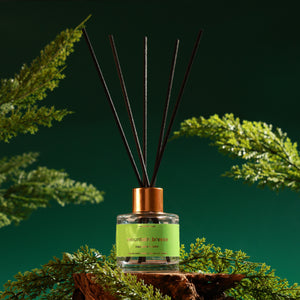
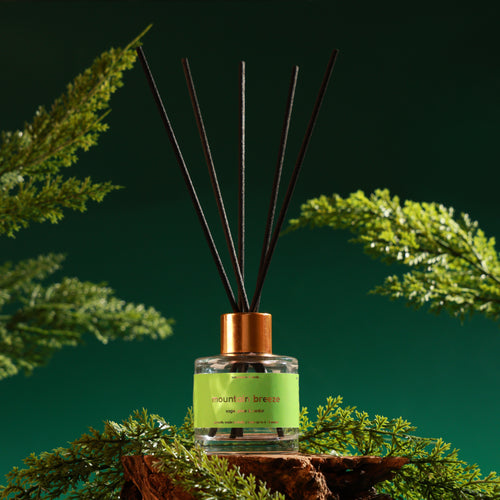
| 4. Mountain Breeze reed | Passive capillary — Himalayan pine, sage and Indian cedar, six fibre reeds in a refillable glass bottle | A single small cabin or a manager's office. It creates a fragrant zone, never a fragranced floor | ₹849 |
| 5. Aangan | HVAC nebulising, approximately 8,000–10,000 sq ft | Above Vaayu's sensible ceiling, where several Vaayu zones would be unwieldy to manage | ₹25,999 |
| The honest gap: when not to buy anything | Fragrance does not remove a smell and does not fix a room. If the floor smells of packaging, adhesive or new MDF, or the lighting is wrong and the cabling is visible, a machine will not rescue it | Source, then ventilation, then fragrance — in that order, or not at all | Free to fix first |
Versailles
The first thing I do in a commercial space is stand still for a minute and try to work out what the room smelled like before anybody added anything, because that is the material we are actually working with. A showroom's own smell floor is made of new cabinetry, cable insulation, adhesive, carpet, the store room behind the wall and whatever the air-conditioning is bringing in. Fragrance sits on top of that floor; it never replaces it. A great many people spend money at the wrong end of that sentence.
The second thing I say, and it is rarely welcome, is that the setting is almost always too high. Every over-scented room I have walked into was set by somebody who had been standing in it all morning and could no longer smell it, which is not a failure of judgement but a property of the nose — receptors adapt to a constant stimulus within minutes, and the signal keeps arriving while the brain stops reporting it. Your visitor has not adapted. They come in from the street with a fresh nose, and threshold concentration is reached far more easily than anyone expects. Dose for the person coming through the door, not for the person who has been inside since ten.
And the last thing, which I believe more strongly the longer I do this work: expensive is a description of restraint. The rooms that read as costly are almost always the quietest ones, in light, in sound and in air. That is genuinely good news for a showroom owner, because it means the most effective decision available to you is a setting rather than a purchase, and it costs nothing to make. Everything we compose is made in Pune, and a portion of every order supports girl-child education through Nanhi Kali.
Frequently asked questions
- The best fragrance for a luxury automation showroom — why woody and clean-fresh read as engineered.
- Should it have a signature fragrance? — recognition across visits and branches, not intensity.
- Making the showroom feel more luxurious — the ninety per cent that is not fragrance.
- What suits a smart-living experience centre — the centre as a journey, from entrance to consultation table.
- Fresh, woody or hotel-like? and should it smell like a five-star hotel? — the comparison and the caution.
- How strong should it be? — lower than you think, and why.
- What customers should smell on entry — the arrival moment.
- Choosing a signature scent for the brand — the method, documented.
- Brand: the SOSA founder story.
SOSA Vaayu — facts verified August 2026: ₹11,999. Waterless cold-air nebulising diffuser; pressurised air shatters undiluted oil into a dry nano-mist, with no water, no dilution, no added humidity and no residue. Coverage up to 1000 m³, approximately 2,000–3,000 sq ft at standard ceiling height, measured as connected volume rather than floor area. Control: Bluetooth app plus onboard buttons, run windows of 1h / 4h / 8h / 24h, day selection, adjustable mist intensity, auto-stop and key-lock. SOSA publishes no Wi-Fi, Alexa, Google Assistant, Matter, Zigbee, Z-Wave, KNX, Crestron, Control4, RS-232, dry-contact or API integration of any kind, and Vaayu cannot be addressed by, or included in a scene on, any home-automation control system. Mounting: freestanding, wall-mounted or into an HVAC return. Power DC 12V / 1A, 5W at the mounting position. Under 38 dB. 400ml sealed, residue-free, refillable tank lasting up to about 90+ days depending on intensity and scheduled hours. CE, RoHS and SGS certified. Black and white finishes. Oils must be alcohol-free, water-free fragrance oils formulated for cold-air diffusion, such as the SOSA Hotel Collection (100ml ₹999 · 300ml ₹1,799 · pack of seven ₹1,799); thick undiluted essential oils are not recommended as they clog the fine nozzle. Above Vaayu's range: Aangan ₹25,999 (~8,000–10,000 sq ft) and Meenar ₹38,500 (12,000–18,000 sq ft). Below it, on a different mechanism: Sukoon ₹1,899 ultrasonic (270–320 sq ft) and Boond ₹899 (up to about 150 sq ft); Megh ₹3,499 has a six-litre tank and long runtime but covers only about 215 sq ft and is never a coverage upgrade. SOSA reed diffusers are alcohol-free, phthalate-free, paraben-free, IFRA-compliant and 0 ppm formaldehyde, with six fibre reeds in a refillable glass bottle, composed in Pune; Mountain Breeze is Himalayan pine, sage and Indian cedar at ₹849 for 50ml. Reed oil and the Hotel Collection are separate products and are not interchangeable, and there is no hotel-inspired reed diffuser. A scent machine adds fragrance; it does not clean, purify or deodorise air, does not remove an existing odour, and SOSA makes no health or air-quality claim. SOSA publishes no dealer programme, reseller margin, trade price, territory, minimum order, lead time, installation charge or maintenance contract; commercial enquiries are welcome at https://sosahomeandbody.com/pages/contact. Free shipping above ₹499. A portion of every order supports girl-child education through Nanhi Kali. SOSA is an independent Indian fragrance house; the Hotel Collection scents are SOSA's own interpretations inspired by the world's finest hotels, and SOSA is not affiliated with or endorsed by any hotel brand or any home-automation manufacturer. Prices subject to change — see the live product pages.