


Why "hotel-like" loses: because it is not an accord. It is a description of delivery — dry, low, everywhere at once, attached to no object in the room — and if you buy it as an accord you will end up with a warm amber-and-tea lounge composition that sells repose to a room whose whole argument is capability.
The specification: SOSA Vaayu ₹11,999 — waterless cold-air nebulising, up to 1000 m³ of connected volume, under 38 dB, DC 12V / 1A at 5W at the mounting position, 400ml sealed tank lasting about 90+ days, freestanding, wall-mounted or mounted into an HVAC return. Oil: alcohol-free, water-free cold-air oil such as the Hotel Collection at ₹1,799 for 300ml.
Two honest limits: there is no aquatic, marine or ozonic accord in the SOSA reed line, so the cool "technology" smell some people are picturing does not exist here. And Vaayu automates itself — Bluetooth app and onboard buttons, no Wi-Fi, no Alexa, no Google Assistant, no Matter, no KNX, no Crestron, no Control4, no RS-232, no dry contact and no API.
2. Fresh takes it on a bright floor, and on any floor demonstrating several rooms at once. White tea with a bergamot or lemon lift over a cedar floor has one property no other direction has: it belongs to no particular room of a house, so it does not take sides between the kitchen display, the bedroom zone and the theatre. White Tea Serenity and Quiet Luxury are the two Hotel Collection accords in this direction, at ₹1,799 for 300ml.
3. Hotel-like is not a third option, and pretending it is costs money. Ask ten people what a hotel smells like and you will get ten different note lists and one identical description of the experience: it is everywhere, it is quiet, and you cannot find where it is coming from. That is a delivery specification, not a composition. Buy it as a composition and you buy a warm lounge accord — amber, sweet balsam, heavy tea — designed to slow a guest down at nine in the evening, which is the precise opposite of what a demonstration floor is trying to do at eleven in the morning.
4. The machine is what turns any of the three into the hotel-like effect. Waterless cold-air nebulising shatters undiluted oil into a dry nano-mist carried by the room's own airflow. Because the oil is not diluted in water it arrives as the whole composition rather than a wetted fraction of it, and because it is carried by the air rather than radiating from an object there is no gradient to walk up and no source to locate. That absence of a findable source is what people are describing when they say hotel-like.
5. Whichever of the two you pick, the level decides whether it reads as luxury or as air freshener. Almost any composition at too high a concentration flattens into one sweet or sharp impression, and that flattening is what "cheap" means in this context. Set it low, key-lock it, and judge it with somebody who has been outside for a quarter of an hour rather than with the person who has been on the floor since opening.
Vaayu is ₹11,999, covers up to 1000 m³ of connected volume, runs under 38 dB, draws DC 12V / 1A at 5W, holds 400ml for about 90 or more days, and is CE, RoHS and SGS certified. Free shipping above ₹499, and a portion of every order supports girl-child education through Nanhi Kali.

The three candidates, taken one at a time and marked
A note on the marks before they start. They are mine, they are editorial, and they are not measurements — there is no instrument that scores a fragrance against a room, and anybody who publishes one has invented it. What they are is the same judgement I would give you across a table, written down so you can disagree with a specific line rather than with a general impression. Each direction is marked out of five on the six criteria that decide whether a showroom fragrance is still working in month eight: legibility, constancy, behaviour under heavy air conditioning, tolerance of over-dose, collision with demonstration rooms, and reproducibility at a second branch.
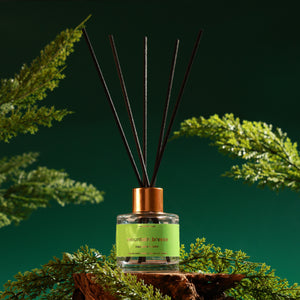
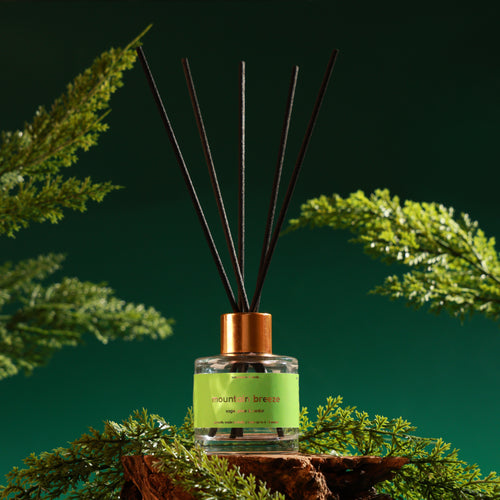
 Mountain Breeze₹849Woody loses half a mark on one criterion and wins the other five. Its strength is tolerance: dry resinous material is comparatively forgiving of a setting that has crept upward, because it clears with the air changes rather than depositing on upholstery and re-releasing for hours. That matters more than it sounds, because the setting always creeps upward and nobody who works in the room can tell. Its second strength is agreement — cedar in the air says material, cabinet, workshop, something made properly, which is the argument your hardware is making anyway. Where it drops half a mark is collision: pushed past a certain depth a woody accord stops reading as cedar and starts reading as sandalwood and incense, which relocates the visitor to a temple or a spa. The fix is the intensity dial rather than a different oil. In our reed line the reference is Mountain Breeze, 9.4 on the SOSA strength scale — the deepest woody we make, and one that stays green rather than settling into timber.
 White tea accords₹1,799 / 300mlFresh ties with woody on the total and wins outright on the one criterion that decides most experience centres: it does not collide. A tea-citrus accord is not attached to any room of a house. Coffee is a kitchen, lavender is a bedroom, rose is a drawing room — white tea is a lobby, a gallery, a well-run office, which is to say a public interior, and a floor demonstrating a living room, a bedroom, a kitchen and a theatre at the same time needs air that refuses to take sides. It also scores highest on legibility, in the sense that matters here: it is perceptible without being nameable, so it does not pull attention off the hardware. Where it takes its half mark off is constancy in the wrong hardware. Bright materials are the lightest molecules in perfumery, and in a passive reed they leave first, which is why a citrus reed is thrilling for a fortnight and quiet by week four. In a cold-air nebuliser that failure mode largely disappears, because the machine shatters the whole undiluted oil rather than letting the bottle fractionate at its own pace — the accord arriving on day eighty is the accord you chose on day one.
Vaayu₹11,999This is the candidate that wins the vote in the room and loses the actual comparison, and it is worth being precise about why. When a client says hotel-like, listen to the sentence that follows. It is almost never a note list. It is "you can smell it everywhere and you can never find it", or "it is the same every time I walk in", or "it is there but it is not strong". Those are three statements about delivery, discipline and level — and all three are purchasable. What is not purchasable is the assumption underneath: that there is a bottle labelled hotel which, poured into anything, produces that result. Buy the assumption and you will buy a warm amber-and-balsam lounge composition, because that is what the category has drifted towards, and you will have installed a scent designed to make a tired traveller sit down in a room whose entire job is to make an alert buyer lean forward. As an accord for this room I mark it two. As an effect to aim at, it is the whole brief, which is why the hotel question has a page of its own.
White tea accords₹1,799 / 300mlFresh ties with woody on the total and wins outright on the one criterion that decides most experience centres: it does not collide. A tea-citrus accord is not attached to any room of a house. Coffee is a kitchen, lavender is a bedroom, rose is a drawing room — white tea is a lobby, a gallery, a well-run office, which is to say a public interior, and a floor demonstrating a living room, a bedroom, a kitchen and a theatre at the same time needs air that refuses to take sides. It also scores highest on legibility, in the sense that matters here: it is perceptible without being nameable, so it does not pull attention off the hardware. Where it takes its half mark off is constancy in the wrong hardware. Bright materials are the lightest molecules in perfumery, and in a passive reed they leave first, which is why a citrus reed is thrilling for a fortnight and quiet by week four. In a cold-air nebuliser that failure mode largely disappears, because the machine shatters the whole undiluted oil rather than letting the bottle fractionate at its own pace — the accord arriving on day eighty is the accord you chose on day one.
Vaayu₹11,999This is the candidate that wins the vote in the room and loses the actual comparison, and it is worth being precise about why. When a client says hotel-like, listen to the sentence that follows. It is almost never a note list. It is "you can smell it everywhere and you can never find it", or "it is the same every time I walk in", or "it is there but it is not strong". Those are three statements about delivery, discipline and level — and all three are purchasable. What is not purchasable is the assumption underneath: that there is a bottle labelled hotel which, poured into anything, produces that result. Buy the assumption and you will buy a warm amber-and-balsam lounge composition, because that is what the category has drifted towards, and you will have installed a scent designed to make a tired traveller sit down in a room whose entire job is to make an alert buyer lean forward. As an accord for this room I mark it two. As an effect to aim at, it is the whole brief, which is why the hotel question has a page of its own.
Why "hotel-like" is a delivery specification wearing a fragrance costume
There is a question people rarely ask out loud and it explains the whole misunderstanding: why can you never find the diffuser in a hotel? The answer is usually that there is not one in the room to find. The scent has been introduced into the building's moving air rather than released from an object on a console table, so there is no concentration gradient to walk up and no source to stand next to. Your nose is very good at following a gradient to its origin — it is one of the oldest things it does — and when there is no gradient the effect is strange and rather expensive-feeling: the smell is a property of the place rather than a property of a thing in the place. That is the sensation people are buying when they say hotel-like, and it comes from where the fragrance enters the air, not from what is in it.
Which is why the three-way comparison is really a two-way comparison with a machine attached. Consider what the passive alternative does. A reed diffuser is oil climbing six fibre reeds and evaporating, with no energy used and no air moved: it makes a fragrant zone around itself, not a fragranced room, and the visitor smells it at the reception counter because that is where the bottle is. Putting a second reed at the far end does not solve it either — two passive sources give you two concentration peaks with a valley between them, because neither moves any air and the midpoint is the farthest point from both. Every one of those outcomes is the opposite of the hotel-like effect. The bottle is findable, the level is uneven, and the gradient is obvious.
The cold-air mechanism inverts all three. Pressurised air shatters undiluted oil into a dry nano-mist which the room's own airflow then carries — no water, no dilution, no added humidity and no residue, which matters when the room is full of display electronics and open joinery. Because the oil is undiluted, the droplet carries the whole composition instead of a wetted fraction of it, so the accord you specified is the accord that arrives; put the same cedar-and-tea oil through a water mist in a humid month and it reads softer and closer than it should. And because the delivery point can be a wall position or an HVAC return rather than a table, the fragrance stops having a location. The HVAC-return mount is the single most useful fact in this article for anyone drawing a floor plate, and it is worth being exact about what kind of integration it is: it is mechanical. Vaayu is not a bus device and has no digital integration of any kind — no Wi-Fi, no Alexa, no Google Assistant, no Matter, no Zigbee, no Z-Wave, no KNX, no Crestron, no Control4, no RS-232, no dry contact and no API. It automates itself from its own Bluetooth app and onboard buttons, and it runs alongside the automation rather than inside it.
The scorecard: three directions, six criteria
The comparison in full, including the two directions people reach for after these three have been discussed. The marks are editorial judgement rather than measurement, and the last two rows are the ones that cost the most to learn by experiment.
| Direction | Materials | Holds a ten-hour day | If somebody sets it too high | Collision with demo rooms | My mark |
|---|---|---|---|---|---|
| Dry woody ★ | Cedar, sage, pine, dry resin | Very well — clears with the air changes | Deepens towards incense; correctable on the dial | Low. Reads as material, not as a room | 4.5 / 5 |
| Clean-fresh ★ | White tea, bergamot or lemon, cedar underneath | Very well on a nebuliser; poorly in a reed | Goes sharp and citrus-flat rather than heavy | Lowest of all. Belongs to no room of a house | 4.5 / 5 |
| Hotel-like, bought as an accord | Warm amber, sweet balsam, heavy tea, soft woods | Drifts upward — heavy molecules accumulate | Becomes cloying within an hour, and stays | High. Reads as a lounge in every zone | 2 / 5 |
| Hotel-like, bought as an effect | Any dry accord, delivered into moving air, held low | This is the criterion it is built on | The key-lock exists to prevent exactly this | None — it is a delivery method, not a smell | 5 / 5 |
| Bright citrus-mint | Lemon, peppermint, eucalyptus | Well, and it wakes a room up | Reads as a cleaning product | Moderate — very active across a whole floor | 3.5 / 5 |
| Gourmand | Coffee, vanilla, caramel | No — thickens through a sealed day | Unrecoverable inside trading hours | High. Puts a café in the middle of a demonstration | 1 / 5 |
| Heavy floral | Rose, jasmine, tuberose at strength | Poorly — deposits on soft furnishings | Reads as a function room | High. Domestic in a technical space | 1.5 / 5 |
Cold-air nebulising · Vaayu₹11,999See it →  Ultrasonic water mist · Sukoon₹1,899See it →
  Passive capillary · reed₹849See it →
The pick, and the two things that actually decide it
If the marks are level, something has to break the tie, and it is not preference. The first tie-breaker is the interior. A dry woody accord in a pale, glassy, daylit showroom sits oddly — the air is heavier than everything you can see, and the mismatch reads as a room that has been sprayed rather than a room that smells that way. A clean-fresh accord in a dark walnut-and-stone studio reads thin for the same reason in reverse. Match the weight of the air to the weight of the surfaces and the fragrance stops being noticeable as a decision, which is the entire objective. Look at the floor, not at the note list.
The second tie-breaker is how many different rooms share one connected volume. If your centre is essentially one open floor with a living-room set, a kitchen display and a consultation table in it, take fresh: it will not argue with any of them. If your demonstration rooms are genuinely separate behind closed doors, you have more latitude, because a closed door is a boundary and each room is its own volume — but that also means each of those rooms needs its own machine at its own setting, since one unit cannot serve five closed rooms no matter how small they are. Reason in connected volume, not in floor area. A double-height display area or an atrium consumes coverage that a square-foot figure hides, and Vaayu's rating of up to 1000 m³ — roughly 2,000 to 3,000 sq ft at ordinary ceiling height — is a volume figure precisely because ceiling height is the variable a floor plan does not show you.
One caution about our own range while we are being specific about hardware, because it is the clearest trap in the catalogue. Megh at ₹3,499 is not a coverage upgrade. Six litres of tank and roughly a hundred hours of runtime sound commercial, but it covers only about 215 sq ft — less than the ₹1,899 Sukoon. It is a runtime and humidity machine and it has no business on a showroom floor. Above Vaayu's sensible ceiling the honest answers are Aangan at ₹25,999 for roughly 8,000 to 10,000 sq ft, or several Vaayu zones each set independently. And whichever direction you pick, do not let anybody top the tank up with a bottle of neat essential oil: thick undiluted essential oils are not recommended in Vaayu because they load and eventually clog the fine nozzle. Specify alcohol-free, water-free oils formulated for cold-air diffusion and write that line into the handover note, because the failure arrives eight months later when a well-meaning manager has been generous with a gift bottle.
What to specify, in order — and the honest gap
The buying order for somebody who has read the scorecard and now has to write a purchase note, followed by what this range does not contain and the case in which I would tell you to spend less with us rather than more.
| Buy | What it is | When it is the right answer | Price |
|---|---|---|---|
| 1. Vaayu ★ | Waterless cold-air nebuliser, up to 1000 m³, under 38 dB, DC 12V/1A 5W, HVAC-return capable, key-lock | Always first. The delivery method is the part that produces the effect people are asking for | ₹11,999 |
| 2. Hotel Collection 300ml | Alcohol-free, water-free cold-air oil — White Tea Serenity or Quiet Luxury for the fresh direction | Bright, pale, glass-led floors, and any centre demonstrating several rooms in one volume | ₹1,799 |
| 3. Mountain Breeze reed 50ml | Passive capillary — Himalayan pine, sage, Indian cedar, six fibre reeds, refillable glass | A manager's cabin or a small meeting room. A fragrant zone, never a floor | ₹849 |
| 4. Sukoon | Ultrasonic water mist, 500ml, 270–320 sq ft, three 15ml scents included | One small closed room where Vaayu is over-specified. Adds humidity — keep it away from displays | ₹1,899 |
| 5. Aangan | HVAC nebulising, approximately 8,000–10,000 sq ft | A centre well above Vaayu's sensible ceiling, or a whole-floor supply strategy | ₹25,999 |
| The honest gap: no aquatic, and no hotel bottle | There is no marine, ozonic or clean-linen accord in the SOSA reed line, so the cool "technology" smell some specifiers picture does not exist here. And there is no oil that will make a room hotel-like on its own — that outcome is a machine, a level and a schedule, not a composition | Said plainly rather than stretched to fit | Said, not sold |
Versailles
The reason this particular comparison keeps being decided badly is that two of the three candidates are described in the language of perfumery and the third is described in the language of memory. Fresh and woody are things I can put in a bottle. Hotel-like is a recollection of a building — of arriving somewhere at eleven at night and finding the air already sorted out. When those three are put on the same list, the recollection wins, because a recollection is more persuasive than a note list. And then somebody buys a bottle of warm amber and wonders why the showroom feels sleepy.
So I would rather hand you the recollection honestly. What you remember from that lobby is a dry accord you could not name, at a level you could not locate, that had not changed since your last visit. Every one of those three properties is available to a showroom, and none of them is a matter of which oil. The oil decides whether the room agrees with your walnut or your glass. The machine, the setting and the discipline decide whether it feels like a hotel.
If you take one practical thing from this page, take the tie-breaker. Stand in your own entrance and look at the surfaces before you smell anything. Dark, textured and material-led wants cedar. Pale, bright and glassy wants tea and bergamot. That decision takes ten seconds, it is right far more often than a shortlist tasting is, and it costs nothing. Everything we compose is made in Pune, and a portion of every order supports girl-child education through Nanhi Kali.
Frequently asked questions
- What a premium experience centre should smell like — why expensive means clean, dry, low and unchanging.
- Best fragrance for a luxury automation showroom — the register argument in principle.
- Should it have a signature fragrance? — recognition across visits and branches.
- Making the showroom feel more luxurious — the ninety per cent that is not fragrance.
- What suits a smart-living experience centre — the centre read as a route.
- Should it smell like a five-star hotel? — the right mechanism, often the wrong accord.
- How strong should it be? — lower than you think, and how to set it.
- What customers should smell on entry — the arrival moment and what it signals.
- Choosing a signature scent for the brand — the method, end to end.
- Brand: the SOSA founder story.
SOSA Vaayu — facts verified August 2026: ₹11,999. Waterless cold-air nebulising diffuser; pressurised air shatters undiluted oil into a dry nano-mist, with no water, no dilution, no added humidity and no residue. Coverage up to 1000 m³, approximately 2,000–3,000 sq ft at standard ceiling height, measured as connected volume rather than floor area. Control: Bluetooth app plus onboard buttons, run windows of 1h / 4h / 8h / 24h, day selection, adjustable mist intensity, auto-stop and key-lock. SOSA publishes no Wi-Fi, Alexa, Google Assistant, Matter, Zigbee, Z-Wave, KNX, Crestron, Control4, RS-232, dry-contact or API integration of any kind, and Vaayu cannot be addressed by, or included in a scene on, any home-automation control system. Mounting: freestanding, wall-mounted or into an HVAC return. Power DC 12V / 1A, 5W at the mounting position. Under 38 dB. 400ml sealed, residue-free, refillable tank lasting up to about 90+ days depending on intensity and scheduled hours. CE, RoHS and SGS certified. Black and white finishes. Oils must be alcohol-free, water-free fragrance oils formulated for cold-air diffusion, such as the SOSA Hotel Collection (100ml ₹999 · 300ml ₹1,799 · pack of seven ₹1,799); thick undiluted essential oils are not recommended as they clog the fine nozzle. Above Vaayu's range: Aangan ₹25,999 (~8,000–10,000 sq ft) and Meenar ₹38,500 (12,000–18,000 sq ft). Below it, on a different mechanism: Sukoon ₹1,899 ultrasonic (270–320 sq ft, 500ml, three 15ml scents included) and Boond ₹899 (up to about 150 sq ft); Megh ₹3,499 has a six-litre tank and about a hundred hours of runtime but covers only about 215 sq ft and is never a coverage upgrade. SOSA reed diffusers — Evening Calm ₹799, Garden Bloom ₹799, Morning Freshness ₹749, Mountain Breeze ₹849, Fresh Brew ₹849 for 50ml — are alcohol-free, phthalate-free, paraben-free, IFRA-compliant and 0 ppm formaldehyde, with six fibre reeds in a refillable glass bottle on a heat-stable CCT carrier, composed in Pune. The reed line contains no aquatic, marine, ozonic or clean-linen accord, and no oud or sandalwood. Reed oil and the water-free Hotel Collection are separate products and are not interchangeable, and there is no hotel-inspired reed diffuser. A scent machine adds fragrance; it does not remove an existing odour, cover a construction or packaging smell, clean or purify air, and SOSA makes no health or air-quality claim. SOSA publishes no dealer programme, reseller margin, trade price, territory, minimum order, lead time, installation charge or maintenance contract; commercial enquiries are welcome at https://sosahomeandbody.com/pages/contact. Free shipping above ₹499. A portion of every order supports girl-child education through Nanhi Kali. SOSA is an independent Indian fragrance house; the Hotel Collection scents are SOSA's own interpretations inspired by the world's finest hotels, and SOSA is not affiliated with or endorsed by any hotel brand or any home-automation manufacturer. Prices subject to change — see the live product pages.