


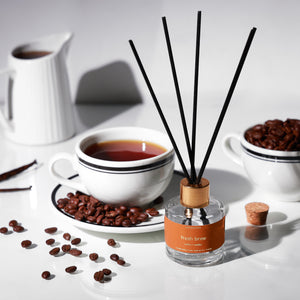
Do not specify: gourmand (coffee, vanilla, caramel), heavy floral (rose, jasmine, tuberose at strength), or the rich amber-and-oud direction most people reach for when they hear the word luxury. These are hospitality and domestic registers, and on a technology floor they argue with the product.
The machine: SOSA Vaayu ₹11,999 with an alcohol-free, water-free cold-air oil such as the Hotel Collection at ₹1,799 for 300ml. Up to 1000 m³ of connected volume, DC 12V / 1A at 5W, under 38 dB, 400ml sealed tank lasting about 90+ days.
Two honest limits before you read further: there is no aquatic, marine or ozonic "cool technology" accord in the SOSA reed line, so if that particular smell is the one in your head, none of the five reeds is it. And Vaayu runs on its own Bluetooth schedule beside the automation — SOSA publishes no Wi-Fi, voice assistant, hub, Matter, KNX, RS-232, dry contact or API.
2. Clean-fresh is the safest single choice if you only make one decision. White tea with a bergamot or lemon lift over a cedar floor. It is bright without being sharp, it is almost impossible to dislike, and critically it carries no association with any particular room of a house — which is exactly what you want in a space that is demonstrating every room of a house at once. White Tea Serenity and Quiet Luxury are the two Hotel Collection accords in this direction.
3. Gourmand is the clearest failure, and it fails twice. Coffee, vanilla and caramel read as food, and food in a showroom means either a café or a kitchen appliance display. They are also physically heavy — large slow molecules that accumulate in a sealed, air-conditioned space across a trading day, so a level that was elegant at eleven in the morning is thick by six in the evening. Fresh Brew is a beautiful composition and, at 9.5 the deepest thing we make, precisely the wrong instrument for this room.
4. Heavy floral is the subtler failure. Rose and jasmine at any real strength place the visitor in somebody's home rather than in a technical demonstration, and they carry an unhelpfully domestic connotation in a room whose whole argument is engineering. Garden Bloom is our most complimented reed and I would still not put it on an automation floor — it belongs in an entryway at home, which is exactly where the reviews say it works.
5. Whichever register you choose, the level decides whether it reads as luxury or as air freshener. Almost any composition at too high a concentration flattens into a single sweet or sharp impression, and that flattening is what people mean when they say a room smells cheap. A showroom is entered fresh by every visitor, so threshold concentration is reached easily, while your staff adapt within minutes and then raise it. Set it low, key-lock it, and leave it alone.
Vaayu is ₹11,999, covers up to 1000 m³ of connected volume, runs under 38 dB, holds 400ml for about 90 or more days, and is CE, RoHS and SGS certified. Free shipping above ₹499, and a portion of every order supports girl-child education through Nanhi Kali.

The two registers that work, and the one everybody chooses instead
A register is not a note list, it is a claim about what kind of room this is. Before anybody consciously evaluates a smell they have already filed it — kitchen, bathroom, hotel, garden, workshop, car — and that filing happens in well under a second, faster than any thought about whether the fragrance is nice. In a commercial space, the file is the message. Everything below is about making sure the file the visitor opens is the one your business is in.
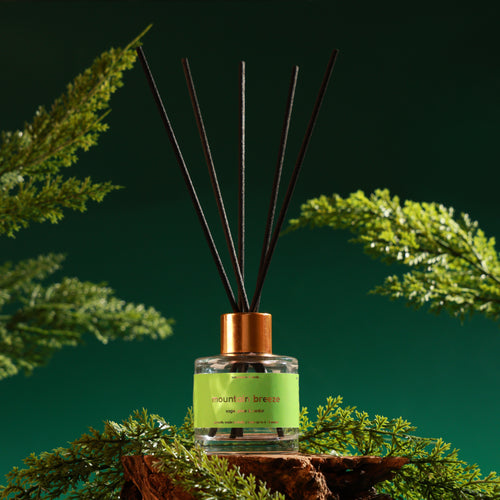
 Mountain Breeze₹849Dry woods have a quality no other family has: they read as material. Cedar in a room does not announce a fragrance, it announces a surface — the inside of a good cabinet, a workshop, an object that has been made properly. That is a remarkably useful thing to be saying underneath a demonstration of engineered hardware, because it agrees with the argument the room is already making rather than adding a second one. The register also behaves well physically. Dry resinous materials arrive, register and clear with the air changes rather than accumulating on soft surfaces, which is why they hold a consistent level from opening to closing far better than sweet ones. Where it needs care is depth: pushed too far, a woody accord stops reading as cedar and starts reading as sandalwood-and-incense, which is a temple or a spa rather than a showroom. The fix is the intensity dial, not a different oil. In our reed line the reference is Mountain Breeze at 9.4 on the SOSA strength scale — the deepest woody we make, and one that stays green rather than settling into timber.
 White tea accords₹1,799 / 300mlIf you make only one decision, make it this one. White tea with a bergamot or lemon lift over a cedar base is the most reliable commercial accord I know, and its advantage is an unusual one: it is not attached to any particular room of a house. Coffee is a kitchen. Lavender is a bedroom. Rose is a drawing room. White tea is a lobby, a gallery, a good office — a public interior — and that is precisely the ambiguity an experience centre needs, because on a single floor you are demonstrating a living room, a bedroom, a kitchen and a home theatre without wanting the air to commit to any of them. It is also the easiest register in which to be quiet. A tea-citrus accord at low concentration is perceptible without being locatable, which is the exact effect you want at an entrance. The Hotel Collection accords in this direction are White Tea Serenity, which is white tea, aloe and cedar, and Quiet Luxury, which is white tea, bergamot and cedar.
 Fresh Brew₹849I want to be fair to these compositions, because the objection is contextual rather than qualitative. Fresh Brew — Coorg coffee, Kerala vanilla, soft caramel — is the deepest thing we make at 9.5 and it is genuinely lovely in a study in December. Garden Bloom — British rose and night-blooming jasmine — is the reed our customers most often say guests ask about. Neither belongs on an automation floor, for three reasons. They are legible: a visitor can name them, and a nameable smell pulls attention from the hardware. They are domestic: they place the visitor in a home rather than in a demonstration of a home, which is a subtle but real difference in a sales conversation. And they are heavy: sweet and big-floral materials linger on soft furnishings and accumulate through a sealed ten-hour day, so the room drifts upward while everybody in it has adapted and cannot tell.
Why a domestic smell fights the product, and what "fighting" actually means
The phrase sounds figurative and it is not. Consider what a visitor is doing in your showroom. They are being shown that a room can be commanded — that light, shading, climate and security will do exactly what was specified, at exactly the moment specified, reliably, for years. Every persuasive element in the space supports that: the neutral lighting, the tidy cable management, the fact that the demonstration works first time. Smell is the one channel you cannot switch off, and it is running the entire time the pitch is happening. If the air is saying somebody baked here or this is a bedroom, the room is making two arguments at once and the visitor has to reconcile them. They will not notice they are doing it. They will simply find the experience slightly less convincing than it should have been.
There is a second, more mechanical reason to keep the register dry, and it belongs to the building rather than to perfumery. An automation showroom is typically sealed and heavily air-conditioned, with hard surfaces, a long trading day and a population of staff who never leave. That combination is the worst possible environment for a heavy accord. Large, slow molecules deposit onto seating, curtains and acoustic panels and re-release for hours, so the concentration in the room ratchets rather than plateaus. Meanwhile the only people who could detect the ratchet have been adapted since mid-morning. Dry and light materials do not accumulate in the same way — they clear with the air changes — which is why the same nominal intensity is far more forgiving in a tea-cedar direction than in an amber-vanilla one.
And one thing that no register solves, so I will say it before it costs somebody money. Fragrance does not remove a smell. If your new showroom smells of cabling, adhesive, new MDF or packaging, choosing a better accord will not help, because adding a pleasant odour to an unpleasant one produces a mixture rather than a cancellation, and the mixture is usually worse than either half. Those materials off-gas hardest when new, and what fixes them is time, air changes and unpacking away from the display floor. Get the cartons out of the customer volume, ventilate the store room, check that the fresh-air intake is doing something, and scent the space afterwards. Source, then ventilation, then fragrance — in that order, or not at all.
Every register, scored against an automation floor
The shortlist as I would give it to somebody choosing an oil for a showroom, including the directions I would refuse. The last two rows are the ones that cost the most money to learn by experiment.
| Register | Materials | What the visitor's nose files it as | On an automation floor |
|---|---|---|---|
| Clean-fresh ★ | White tea, bergamot or lemon, cedar underneath | A lobby, a gallery, a good office — a public interior | The default. Attached to no room of a house |
| Dry woody ★ | Cedar, pine, sage, dry resin | Material. A well-made object, a workshop, a cabinet | Excellent, especially with dark or textured interiors |
| Bright citrus-mint | Lemon, peppermint, eucalyptus | Morning, cleanliness, a bathroom done well | Good at an entrance, busy across a whole floor |
| Soft herbal | Lavender, chamomile, soft musk | A bedroom, a spa, the end of the day | A closed bedroom demonstration room only, very low |
| Heavy floral | Rose, jasmine, tuberose at strength | Somebody's drawing room, a wedding, a hotel entrance | Domestic. Softens the technology. Avoid on the floor |
| Gourmand | Coffee, vanilla, caramel, sugared fruit | A café, a kitchen, a retail food counter | Fights the product, and thickens through the day. Avoid |
| Rich amber and oud | Resins, sweet balsams, heavy woods | A lobby at nine in the evening. Repose, not capability | The commonest and most expensive mistake. Avoid |
Cold-air nebulising · Vaayu₹11,999See it →  Ultrasonic water mist · Sukoon₹1,899See it →
  Passive capillary · reed₹849See it →
Mechanism, because it changes which register you can actually hold
Three ways of getting fragrance into a room, and they are not interchangeable. Passive capillary — a reed diffuser — is oil climbing six fibre reeds and evaporating, with no energy and no air moved. It produces a fragrant zone, not a fragranced room, which is why a showroom that has put a reed on the reception counter smells of it at the counter and nowhere else. That is physics behaving correctly, not a weak bottle. It also means two reeds placed at either end of a floor give you two concentration peaks with a valley between them, because neither of them moves any air; the midpoint is the farthest point from both. Ultrasonic water mist — Sukoon ₹1,899 at 270–320 sq ft, Boond ₹899 up to about 150 sq ft — atomises oil diluted in water. It covers a real room, but it adds humidity and can leave a fine white mineral dust, neither of which you want near display electronics.
Waterless cold-air nebulising is the commercial answer, and it changes what register you can hold. Pressurised air shatters undiluted oil into a dry nano-mist carried by the room's own airflow: no water, no dilution, no added humidity, no residue. The consequence for register is direct — an undiluted oil is not competing with water, so the droplet carries the full composition rather than a wetted fraction of it, and the accord you specified is the accord that arrives. It is also the reason a dry register stays dry. Put a cedar-and-tea accord through a water mist in a humid month and it reads softer and closer than it should; put it through a cold-air nebuliser and it stays crisp. Vaayu at ₹11,999 is the unit for a showroom volume — up to 1000 m³, under 38 dB, DC 12V / 1A at 5W, 400ml sealed residue-free tank lasting about 90 or more days, freestanding, wall-mounted or mounted into an HVAC return.
One warning about the range, because it is the clearest trap in our own catalogue and I would rather you heard it from me. Megh at ₹3,499 is not a coverage upgrade. It has a six-litre tank and roughly a hundred hours of runtime, which sounds like a commercial machine, but it covers only about 215 sq ft — less than the ₹1,899 Sukoon. It is a runtime and humidity machine, and it has no business on a showroom floor. Equally, do not put thick undiluted essential oils into a Vaayu: they are viscous, they load the fine nozzle and over time they will clog it. Specify alcohol-free, water-free oils formulated for cold-air diffusion, write that into the handover note, and tell the manager, because the failure arrives eight months later when somebody has been generous with a gift bottle.
What to specify, in order — and the honest gap
The buying order for an automation showroom, followed by the two things this range does not contain and the situation in which I would tell you to spend the money elsewhere entirely.
| Buy | What it is | When it is the right answer | Price |
|---|---|---|---|
| 1. Vaayu ★ | Waterless cold-air nebuliser, up to 1000 m³, under 38 dB, DC 12V/1A 5W, key-lock | The floor itself — one per connected volume | ₹11,999 |
| 2. Hotel Collection 300ml | Alcohol-free, water-free cold-air oil — White Tea Serenity or Quiet Luxury for this brief | The clean-fresh register, which is the safest single choice | ₹1,799 |
| 3. Mountain Breeze reed 50ml | Passive capillary — Himalayan pine, sage, Indian cedar, six fibre reeds, refillable glass | A manager's cabin or a small meeting room. A fragrant zone, never a floor | ₹849 |
| 4. Sukoon | Ultrasonic water mist, 500ml, 270–320 sq ft, three 15ml scents included | A single small room where Vaayu would be over-specified. Adds humidity — keep it away from displays | ₹1,899 |
| 5. Aangan | HVAC nebulising, approximately 8,000–10,000 sq ft | A centre well above Vaayu's sensible ceiling | ₹25,999 |
| The honest gap: no aquatic, and no protocol | There is no marine, ozonic or "clean linen" accord in the SOSA reed line, so if a cool aquatic is the smell in your head, nothing here is it. And Vaayu has no Wi-Fi, voice assistant, hub, Matter, KNX, RS-232, dry contact or API — it runs beside the automation, not inside it | Stated plainly rather than stretched to fit | Said, not sold |
Versailles
I am asked for the best fragrance for a showroom perhaps once a week, and the honest reply is that there is no best fragrance, only a correct register and an incorrect one. The two correct ones here are dry woody and clean-fresh, and I would specify either with confidence in any automation showroom in the country. What I would not do is choose them on the basis that they are pleasant, because pleasantness is not the criterion. The criterion is whether the air agrees with what the room is claiming.
The compositions I have argued against on this page are ones I am proud of. Fresh Brew took a long time to get right and Garden Bloom is the reed people write to us about most. Neither belongs on a floor of switched-on hardware, and being able to say that plainly is, I think, the only reason to trust the recommendation that follows it. A perfumer who tells you every scent she makes would suit your space is not helping you choose.
The last thing, and it is the one I would put on the wall if I could. Whichever direction you pick, set it lower than feels right and lock it there. Your staff will have adapted by half past ten in the morning and will believe it has stopped working; your customer walks in from the street with a nose that has not adapted at all, and reaches the threshold at a concentration that surprises everybody. Restraint is the luxury signal, and it is the only one in this business that costs nothing. Everything we compose is made in Pune, and a portion of every order supports girl-child education through Nanhi Kali.
Frequently asked questions
- What a premium experience centre should smell like — why expensive means clean, dry, low and unchanging.
- Should it have a signature fragrance? — recognition across visits and branches.
- Making the showroom feel more luxurious — the ninety per cent that is not fragrance.
- What suits a smart-living experience centre — entrance, demonstration rooms, consultation table.
- Fresh, woody or hotel-like? — the three-way comparison in full.
- Should it smell like a five-star hotel? — the right mechanism, often the wrong accord.
- How strong should it be? and what customers should smell on entry.
- Choosing a signature scent for the brand — one accord, documented, held for years.
- Brand: the SOSA founder story.
SOSA Vaayu — facts verified August 2026: ₹11,999. Waterless cold-air nebulising diffuser; pressurised air shatters undiluted oil into a dry nano-mist, with no water, no dilution, no added humidity and no residue. Coverage up to 1000 m³, approximately 2,000–3,000 sq ft at standard ceiling height, measured as connected volume rather than floor area. Control: Bluetooth app plus onboard buttons, run windows of 1h / 4h / 8h / 24h, day selection, adjustable mist intensity, auto-stop and key-lock. SOSA publishes no Wi-Fi, Alexa, Google Assistant, Matter, Zigbee, Z-Wave, KNX, Crestron, Control4, RS-232, dry-contact or API integration of any kind, and Vaayu cannot be addressed by, or included in a scene on, any home-automation control system. Mounting: freestanding, wall-mounted or into an HVAC return. Power DC 12V / 1A, 5W at the mounting position. Under 38 dB. 400ml sealed, residue-free, refillable tank lasting up to about 90+ days depending on intensity and scheduled hours. CE, RoHS and SGS certified. Black and white finishes. Oils must be alcohol-free, water-free fragrance oils formulated for cold-air diffusion, such as the SOSA Hotel Collection (100ml ₹999 · 300ml ₹1,799 · pack of seven ₹1,799); thick undiluted essential oils are not recommended as they clog the fine nozzle. Above Vaayu's range: Aangan ₹25,999 (~8,000–10,000 sq ft) and Meenar ₹38,500 (12,000–18,000 sq ft). Below it, on a different mechanism: Sukoon ₹1,899 ultrasonic (270–320 sq ft, 500ml, three 15ml scents included) and Boond ₹899 (up to about 150 sq ft); Megh ₹3,499 has a six-litre tank and about a hundred hours of runtime but covers only about 215 sq ft and is never a coverage upgrade. SOSA reed diffusers — Evening Calm ₹799, Garden Bloom ₹799, Morning Freshness ₹749, Mountain Breeze ₹849, Fresh Brew ₹849 for 50ml — are alcohol-free, phthalate-free, paraben-free, IFRA-compliant and 0 ppm formaldehyde, with six fibre reeds in a refillable glass bottle on a heat-stable CCT carrier, composed in Pune. The reed line contains no aquatic, marine, ozonic or clean-linen accord, and no oud or sandalwood. Reed oil and the water-based Hotel Collection are separate products and are not interchangeable, and there is no hotel-inspired reed diffuser. A scent machine adds fragrance; it does not remove an existing odour, clean or purify air, and SOSA makes no health or air-quality claim. SOSA publishes no dealer programme, reseller margin, trade price, territory, minimum order, lead time, installation charge or maintenance contract; commercial enquiries are welcome at https://sosahomeandbody.com/pages/contact. Free shipping above ₹499. A portion of every order supports girl-child education through Nanhi Kali. SOSA is an independent Indian fragrance house; the Hotel Collection scents are SOSA's own interpretations inspired by the world's finest hotels, and SOSA is not affiliated with or endorsed by any hotel brand or any home-automation manufacturer. Prices subject to change — see the live product pages.