
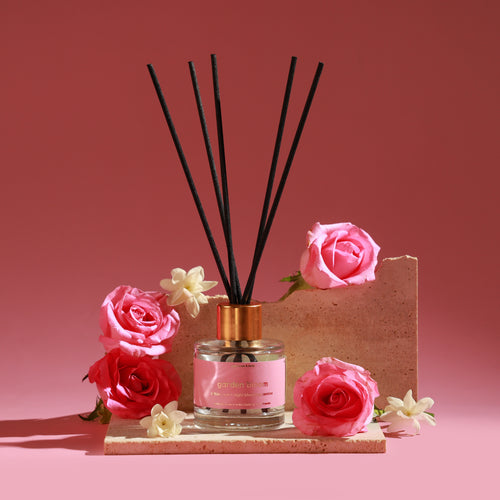
 Garden Bloom ₹799
  Morning Freshness ₹749
 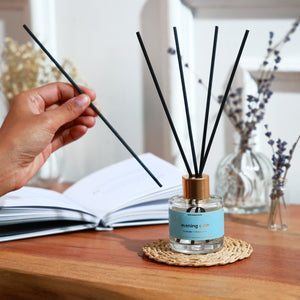 Evening Calm ₹799
 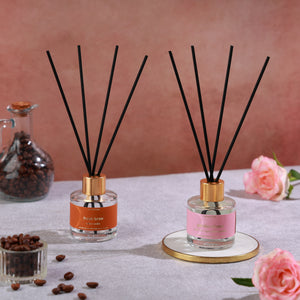 Warmth & Bloom duo ₹1,598
  Bookshop candle ₹379
Sort by information, not affection. How close you feel decides the budget. It tells you nothing about which scent suits their rooms. Most extended-family gifting is bought on almost no information, and that is normal.
Give every connected group the same bottle. Four aunts who will see each other's gifts should receive four identical ones. Variation between relatives is read as a ranking whether or not you meant one.
The default across the middle of the list: Garden Bloom 50ml ₹799 — rose and jasmine, recognised instantly, the narrowest failure mode we make. Top tier: a duo at ₹1,598. Courtesy edge: a jar candle at ₹379.
A worked twelve-household list comes to ₹9,777 — ₹9,777 ÷ 12 ≈ ₹815 a name — with every line shown in Part six.
- The straight answer
- Part one — a network, not a list
- Part two — the three tiers, costed
- Part three — the scent axis across a family
- Part four — where extended-family gifting goes wrong
- Part five — what this list cannot buy from SOSA
- Part six — a worked list of twelve households
- A note from Sonal
- FAQs
2. Sort the households into three tiers by information, not by affection. Tier one is the two or three homes whose rooms you could describe. Tier two is the annual list — people you love and know almost nothing about, which is the ordinary condition of extended family and not a failing. Tier three is the courtesy edge: neighbours-by-marriage, second cousins, the household you are only buying for because you will be in the same room.
3. Buy two or three products across the entire list, not twelve. One 50ml for tier two, repeated. One larger thing for tier one. One small thing for tier three. The number of decisions is the real cost of this list, not the rupees.
4. Give every connected group the same bottle. Where four relatives will see each other's gifts, four identical bottles say nothing about how you rank anybody — and four different ones publish a ranking you never intended to write. Comparison exposure outranks scent-matching every single time.
5. The default is Garden Bloom 50ml at ₹799. Rose and jasmine are the two references almost every Indian household already carries, so the gift explains itself in the first second. It is not our most interesting composition. Interesting is not what a blind, repeated purchase is for.
6. Step up in a way that is visibly the same. For a household you are closer to, the same scent in 130ml at ₹1,299 is quietly larger — 14–18 weeks against 6–8 — without introducing a second product into the comparison. A duo at ₹1,498–₹1,598 is two 50ml bottles for two rooms, which is a genuinely different gift rather than a longer one.
7. Know where to stop. Past roughly 250–300 sq ft of connected open space a reed diffuser is the wrong instrument and a Sukoon at ₹1,899 is the honest answer. Where a household does not want fragrance at all, buy a mug. I would rather you bought nothing from us than bought the wrong format for a home.
8. Understand what a Diwali gift of fragrance actually is. The festival house is already at maximum scent — diyas, incense, frying, flowers, visitors. A diffuser gifted now is for the quiet fortnight afterwards, and fragrance oil is flammable, so it belongs well away from any lamp.
Everything is composed and handmade in small batches in Pune, and a portion of every order supports girl-child education through Nanhi Kali.
Part one — a network, not a list
An office list is a set of parallel relationships that rarely touch outside the office. A friends list is a handful of independent decisions. An extended family is neither: it is a mesh with long memory, annual gatherings and a strong habit of comparing notes. Almost every mistake in this category comes from treating it like the other two. Three properties do the real work, and once you can see them the buying part becomes mechanical.
 Garden Bloom₹799 · 50mlThis is the property that separates family from every other gifting segment. Relatives see each other's gifts — at a lunch, in a photograph, in a passing sentence on a call three weeks later. Whatever varies between the gifts becomes a statement about the recipients, and it does not matter at all that you meant nothing by it. The aunt who received the ₹749 bottle when her sister received the ₹1,299 one has been given a fact about herself she did not ask for. The correct response is not to spend more; it is to remove the variation. Identify which entries on your list are connected — usually a sibling group, a set of aunts, a group of cousins — and give each connected group one identical product. Then spend your matching effort only on the households nobody else will compare against. This is the single highest-leverage rule in this guide, and it costs nothing to apply.
Part two — the three tiers, costed
Three tiers is enough for any extended family I have ever been shown, and more than three collapses back into buying twelve different things. The tiers are defined by information and comparison rather than by how much you like people, which is why they are usable — you can sort a list into them in about four minutes without having to make a single emotional judgement.
| Tier | Who is in it | What the gift has to do | The SOSA answer | Per household |
|---|---|---|---|---|
| Tier two — the annual list ★ | Aunts, uncles, in-laws, cousins seen once a year | Be correct, repeatable and identical across the group | Garden Bloom 50ml, the same for all | ₹799 |
| Tier one — homes you know | Two or three households whose rooms you could describe | Read as considered, and be specific to that home | A duo, or a 130ml of the tier-two scent | ₹1,299–₹1,598 |
| Tier three — the courtesy edge | Second cousins, relatives by marriage, near-strangers | Mark the occasion without creating an obligation | Jar candle ₹379 or an Everyday Beautiful Mug | ₹379–₹474 |
| The room of a young person | A teenager with their own door | Address a space they control, not the household | Mountain Breeze 50ml, kept high and away from flame | ₹849 |
| The home you are staying in | Your hosts for three or four nights | Be something you are happy to breathe yourself | Evening Calm 50ml, handed over closed | ₹799 |
| A household that already owns a diffuser | Anyone whose console you have seen a bottle on | Not create a second scent in one connected space | Their existing scent again, or a candle two-pack ₹664 | ₹664–₹849 |
| A home past the reed ceiling | One large connected living-dining space | Actually fill the volume it is put in | Sukoon ₹1,899, which is a different product line | ₹1,899 |
| The honest caveat: tiering is a budgeting tool and it has a social cost if it becomes visible. The rule that keeps it safe is the comparison rule — people who will see each other's gifts belong in the same tier regardless of what you feel about them individually. If two sisters are in different tiers on your sheet, move one. A tier system that survives being laid out on a table at lunch is a good system; one that does not is simply a ranking with better stationery. | ||||
Garden Bloom · tier two, repeated₹799Shop → 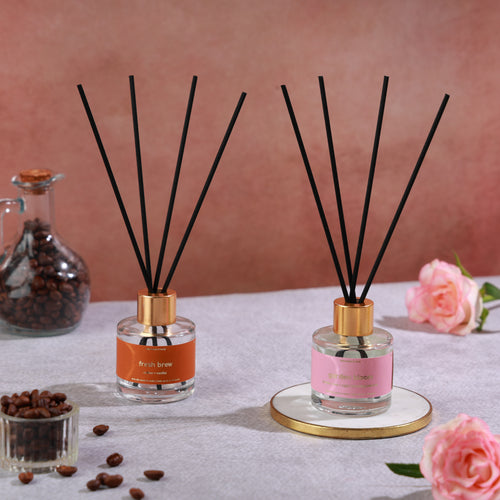 Warmth & Bloom duo · tier one₹1,598Shop →
  Bookshop candle · tier three₹379Shop →
Part three — the scent axis across a family
Five compositions, sorted for this specific job. The question at every row is not which is best — I stand behind all five — but where each one belongs on a family list, and what it risks when it is given into a house nobody has inspected. The honest gaps in the range are stated at the bottom, because a guide that never mentions what it does not have is not a guide.
| Composition | The household it fits | Blind-buy risk | Which tier | Do not give it to |
|---|---|---|---|---|
| Garden Bloom ₹799 ★ | Almost any — entryways and living rooms | Lowest in the range | Tier two, repeated across the group | Anyone who rejects florals on principle |
| Morning Freshness ₹749 | Compact, kitchen-centred homes; bathrooms | Low — occasionally reads clinical | Tier two, and the value floor of the range | A household that wants a home to smell warm |
| Evening Calm ₹799 | Bedrooms, small flats, reading corners | Low, but lavender has firm detractors | Tier one where you know the rooms | Anyone who has ever said they dislike lavender |
| Mountain Breeze ₹849 | Studies, libraries, a teenager's room | Medium — frequently read as masculine | Individual gifts, not group sets | A home that wants softness rather than dry air |
| Fresh Brew ₹849 | Living rooms of people who like it, and only those | Highest — the strongest and most divisive | Tier one only, on observed preference | Anybody whose taste you are guessing at |
| The honest caveat — and the gaps: the range has no oud, no musk-forward composition and no aquatic, so if a relative has told you they want one of those three, we do not have it and I will not push the nearest thing as a substitute. Strength positions are on SOSA's own internal scale at six reeds — our scale, not an industry standard, not a concentration and not a quality ranking. And where a household simply does not want fragrance, none of these five rows applies: buy an Everyday Beautiful Mug at ₹474 and leave it there. | ||||
Part four — where extended-family gifting goes wrong
The commonest failure is not a bad gift; it is a list that grew by accretion and was never pruned. Every year a name is added and none removed, until you are buying for nineteen people, four of whom you have not spoken to since the last Diwali. The ceiling that then gets set — a round number per head, arrived at by dividing what you can afford by a list you never audited — is a list problem wearing a rupee sign. Counting households is the first cut. The second is asking which entries exist because of a relationship and which exist because of a habit. Nobody notices a gift they were not expecting; they notice one clearly bought in a hurry to close a gap.
The second failure is buying above your information level, which accounts for most of the fragrance that gets quietly put away. The third I see in thoughtful buyers: over-personalising a group. Somebody spends a genuinely caring evening matching five aunts to five different scents and produces exactly the ranking they were trying to avoid — five gifts at five prices with five different characters, all seen together. The care was real; the output is a table of comparisons. Where relatives are connected, care is better spent choosing one right thing than differentiating five.
The fourth is the reciprocity spiral, which extended families are unusually prone to because the relationships are long and nobody wants to be the person who reduced the scale. Somebody gives a large gift, the next year it is matched, and within four years an obligation list is running at a level nobody chose. A consumable with a stated life is the cleanest way out — a bottle that finishes in 6–8 weeks leaves no ornament and no debt, and repeating the same modest gift annually holds a line politely. The fifth is expecting fragrance to do work it cannot do. A Diwali house is full of lamps, incense and cooking; a reed diffuser sits alongside all of that and does not mask or remove any of it. Where a kitchen runs all week the answer is the extractor and an open window, not a stronger bottle. What you are giving is the quiet fortnight after the visitors stop coming.
Part five — what this list cannot buy from SOSA
A guide that only describes what we sell is an advertisement. Here is the part that is usually left out, stated plainly so that nobody plans a list around something that does not exist. SOSA sells no gift card, no gift hamper, no gift box and no curated gift set. The duos at ₹1,498–₹1,598 are two 50ml bottles in one box and that is what they should be described as; they are not hampers and I would rather you called them what they are. There is no gift wrapping service you can rely on, no gift note, no direct-to-recipient arrangement I can promise, and no delivery timing of any kind — not a date, not a window, not a cut-off. Free shipping above ₹499 is the only logistics fact that exists on this page, and everything else about an order should be checked at checkout rather than assumed from a blog post.
On quantity, the position is equally plain. There is no published bulk pricing, no discount slab, no minimum order quantity, no stated invoicing arrangement, no custom branding and no lead time. If your extended family list runs to twenty households, the total is simply the listed price multiplied — 20 × ₹799 = ₹15,980 — and there is nothing to negotiate at that scale. What is worth doing before you commit to a large single-scent order is asking through the contact page, mainly to confirm the quantity exists, since everything is blended in small batches in Pune. On the products themselves: replacement reeds are not sold separately, which is an honest gap; the 300ml refill at ₹2,399 is oil only, with no glass vessel and no reeds; reed oil never goes into a machine and the water-based Hotel Collection never goes into a reed bottle. And nothing we make is a ritual product: Diwali is a festival with real religious meaning, and a bottle of fragrance oil has no place in any claim about it.
Part six — a worked list of twelve households
A real-shaped extended family, tiered and costed line by line, with a running total so you can see where the money actually goes. Every figure is arithmetic on our listed prices, not a quotation, and no discount or slab applies at any point because none exists.
| The household | Tier | What they get | Cost | Running total |
|---|---|---|---|---|
| Grandparents' home ★ | One | Evening Calm 130ml — softest, no flame, nothing to switch on | ₹1,299 | ₹1,299 |
| Brother and bhabhi's flat | One | Warmth & Bloom duo — two rooms, two bottles | ₹1,598 | ₹2,897 |
| Chachi and chacha | Two | Garden Bloom 50ml | ₹799 | ₹3,696 |
| Mami and mama | Two | Garden Bloom 50ml — identical | ₹799 | ₹4,495 |
| Bua and phupha | Two | Garden Bloom 50ml — identical | ₹799 | ₹5,294 |
| Didi and jija | Two | Garden Bloom 50ml — identical | ₹799 | ₹6,093 |
| Cousin's new flat, first Diwali there | Two | Morning Freshness 50ml — compact, kitchen-centred | ₹749 | ₹6,842 |
| Cousin who already runs a diffuser | Two | Candle two-pack — avoids two scents in one flat | ₹664 | ₹7,506 |
| Niece, sixteen, her own room | Individual | Mountain Breeze 50ml — high shelf, away from flame | ₹849 | ₹8,355 |
| Nephew, eleven | Individual | Cloud trinket dish — too young for fragrance | ₹664 | ₹9,019 |
| Second cousin, courtesy | Three | Bookshop jar candle | ₹379 | ₹9,398 |
| One spare, kept on the shelf | Three | Misty Mornings jar candle | ₹379 | ₹9,777 |
Versailles
My own extended-family list has nineteen names on it and eleven front doors. It took me three Diwalis to notice the difference, and noticing it did more for the experience of buying than any amount of thinking about products. Eleven decisions is a manageable afternoon. Nineteen is a fortnight of low-grade dread, and the dread is what makes people buy badly at the end of it.
The other thing I have had to accept is how little I know about houses I have been visiting my whole life. I could describe my chachi's laugh in detail and I could not tell you which way her kitchen faces. That is not a failure of the relationship; it is what annual contact is. So I buy the safe bottle for most of the list and I do it without embarrassment, and I put the thinking into the two homes where I actually have something to think with.
What I will not do on a page this long is promise you an outcome. I cannot tell you a gift will be remembered or appreciated — I have no way of knowing, and any page that says otherwise is selling a feeling rather than a bottle. What I can tell you is what is inside it, how long it runs, what it asks of the person receiving it, and where our range does not reach. Everything is blended in small batches in Pune and tested through 45°C heat and 85% humidity, because that is the country these bottles have to survive. A portion of every order funds a girl's classroom through Nanhi Kali.
Frequently asked questions
- One gift for every aunt — the single-SKU argument taken to a named bottle.
- Which SOSA reed diffuser for extended family — routed on information and comparison.
- The family you are staying with — the one gift you have to live inside.
- Nieces and nephews with their own room — a gift for a space rather than a person.
- Brand: the SOSA founder story.
SOSA range & prices used in this guide (verified from the live store, 27 August 2026): Reed diffusers — alcohol-free, phthalate-free, paraben-free, IFRA-compliant compositions on a heat-stable coconut-derived (CCT) carrier, in a refillable glass bottle with six fibre reeds; 50ml lasts 6–8 weeks, 130ml lasts 14–18 weeks. Morning Freshness 50ml ₹749 · 130ml ₹1,249; Garden Bloom ₹799 · ₹1,299; Evening Calm ₹799 · ₹1,299; Fresh Brew ₹849 · ₹1,349; Mountain Breeze ₹849 · ₹1,349. Duo sets: Day & Night ₹1,498, Fresh & Grounded ₹1,548, Warmth & Bloom ₹1,598 (2 × 50ml); ₹2,498–₹2,598 (2 × 130ml). Oil-only refills 300ml ₹2,399 · 500ml ₹3,499 (vessel and reeds not included). The least expensive SOSA reed diffuser is ₹749 — no reed diffuser exists below that price in any size. Below it: scented jar candles from ₹379 (roughly 15–18 hours), Sandalwood or Smoked Oudh jar candle ₹449, wax melts ₹474 (a burner is needed and is not included), ceramic mugs ₹474, ribbed and face mugs and taper candles ₹569, Amber Rose candle ₹599, ceramic trinket dish ₹664, candle two-pack ₹664 (roughly 30–36 hours). Machines: Boond 300ml ₹899 · Sukoon 500ml ₹1,899 · Megh 6L ₹3,499 (~215 sq ft, a runtime and humidity machine rather than a coverage upgrade) · waterless Vaayu ₹11,999 · Safar car and travel diffuser ₹3,999. The water-based Hotel Collection (15ml ₹299 · 100ml ₹999 · 300ml ₹1,799) is a fragrance for an ultrasonic machine, not a standalone gift. SOSA publishes no bulk or corporate gifting terms — there is no discount slab, no minimum order quantity, no stated GST-invoicing arrangement, no custom branding service and no published lead time — and SOSA sells no gift card, gift hamper, gift box or curated gift set. Larger orders should be discussed with SOSA directly through the contact page before committing. Gift wrapping, gift notes, direct-to-recipient shipping and delivery timing are unconfirmed — check at checkout rather than assuming them; no delivery date is promised anywhere in this guide. Per-head and total costs shown are arithmetic on the listed prices, not quotations. Fragrance adds scent to a room; it does not clean air, remove cooking or smoke smells, or change how anyone feels. Fragrance oil is flammable — keep any diffuser away from diyas, candles and open flame. Composed and handmade in small batches in Pune, India; tested through 45°C summer heat and 85% monsoon humidity. Free shipping above ₹499. A portion of every order supports girl-child education through Nanhi Kali. Prices subject to change — see the live product pages.