
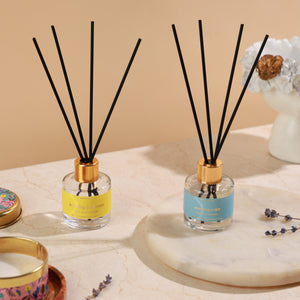
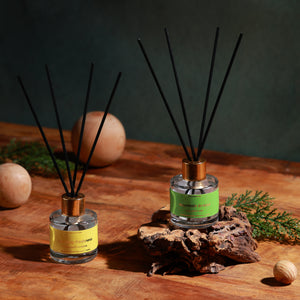



Two of the same scent, not two different, if it is one room. Two compositions meeting in the middle of a bedroom read as muddle rather than depth. Two different scents belong in two different rooms, where the change from one to the next is the point.
The money is closer than you expect: two 50ml bottles are about ₹1,498–₹1,698 and run roughly ₹26–₹30 a day between them; Sukoon is ₹1,899 and covers 270–320 sq ft. So decide on properties, not price: silence, no power and no maintenance against evenness, control and an off switch.
The honest gap: between Safar at ₹3,999 — named and sold as a car and travel diffuser, with no published room-coverage figure — and Vaayu at ₹11,999 and 2,000–3,000 sq ft, SOSA has no mid-sized waterless bedroom nebuliser. And two Safars is not a solution — I would not recommend buying that device in multiples.
2. If it is one open volume you want evenly fragranced, two reeds will not do it. Two passive sources produce two gradients; they do not merge into a plateau, because neither one is moving air toward the other. You will get a stronger reading at each end and a noticeably weaker one in the middle, and no amount of reed count changes that shape.
3. In one room, buy two of the same scent. Two compositions meeting in the middle of a bedroom read as confusion rather than richness. Two different scents are for two different rooms, where the change as you move between them is the entire point — a flat that smells identical everywhere stops registering as a smell at all within a week.
4. Compare on properties, because the prices are almost the same. Two 50ml reeds are about ₹1,498–₹1,698 and cost roughly ₹26–₹30 a day to run; Sukoon is ₹1,899. What ₹1,899 buys is air movement, real 270–320 sq ft coverage and an off switch. What the two bottles buy is silence, no power point, no water, no filling, no charging and nothing to remember.
5. Go active if you need any of three things a reed structurally cannot do: evenness across a whole volume, the ability to turn it off when you leave the room, or a set intensity that does not vary with the weather. Those are genuine features, not luxuries — and a reed has none of them, because it has no controls at all beyond how many sticks are in the neck.
Alcohol-free, phthalate-free, paraben-free, IFRA-compliant, 0 ppm formaldehyde. Free shipping above ₹499, and a portion of every order supports girl-child education through Nanhi Kali.
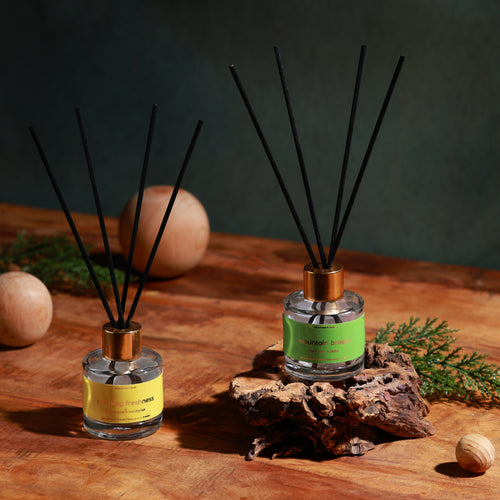
Two zones, and the valley between them
It helps to think in terms of a map rather than a total. Each reed diffuser produces a hill of concentration centred on the bottle, steepest at the neck and falling away with distance, and the height of that hill is set by reed count while its shape is set by the room’s own air movement. Put a second bottle three metres away and you have a second hill. What you do not have is the valley filled in, because neither source pushes anything toward the other — there is no fan, no pump, no atomiser and no schedule anywhere in the format. Whether the valley matters is the whole of your decision, and it is a question about how you live in the room rather than about the product.
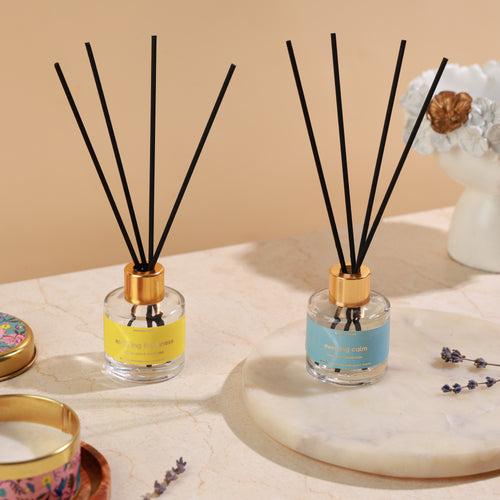
 Morning Freshness₹749Long rooms, L-shaped rooms, a bedroom with a dressing area, a studio with a bed at one end and a desk at the other, a living room where the sofa and the dining table are four metres apart. In all of these you spend your time at two fixed points and pass through the middle. Two bottles placed at those points give you a strong, accurate reading exactly where you are, at about ₹26–₹30 a day, with no plug points used and no water added. A single machine standing at one end would deliver less at the far point than a bottle sitting on it. This is the recommendation I make most often for a 2BHK, and it is cheaper than the machine that this page could have been written to sell you.
 Sukoon₹1,899If the thing you admired in a hotel was evenness — the same presence in the doorway, the middle and the far corner — then two passive sources are the wrong instrument, and a third and fourth would not help either. Evenness comes from air being moved through a volume, which is what a hotel does by shattering undiluted oil into a dry mist and releasing it into air that is already travelling. Doubling a source that moves no air still moves no air. At this point the honest recommendation is a machine, and the cheapest real one is Sukoon at ₹1,899 with 270–320 sq ft of genuine coverage. What you accept is oil diluted in water, added humidity, a tank to fill, and possible white mineral dust in a hard-water city.
 Day & Night duo₹1,498A fair question and it deserves a direct answer. A duo is two 50ml bottles at ₹1,498 to ₹1,598 — there is no box, no set, no hamper and no discount mechanism dressed up as a bundle. Its genuine advantage is that two registers hedge a decision, which matters when you are scenting two rooms and do not yet know which you prefer. If you already know the scent you want and it is one room you are treating, buy two singles of that one scent instead, and it comes to about the same money. And if the honest situation is that one bottle in the right place would do, buy one. The 300ml refill at ₹2,399 is oil alone — only a saving if you already own the bottle and reeds, and never a first purchase.
The arithmetic of a long room, and why two hills often beat one plain
A 50ml reed is specified for rooms up to about 150 sq ft and a 130ml for above that, and a great many disappointed readers are running a 50ml in a 250 sq ft living room, where it reads as feeble while performing exactly to specification. In that situation there are three sensible moves and only one of them is a machine. You can step up to a 130ml, which buys 14 to 18 weeks instead of 6 to 8 and is sized for the volume — though note that it buys weeks rather than metres. You can put two 50mls at the two ends you use. Or you can buy coverage. The two-bottle answer wins whenever your occupancy is concentrated at two points, because you are matching the fragrance to where the people are rather than to the floor plan.
Placement decides how well two bottles work together, and the rules are the same as for one. Put each within about a metre of where you sit or sleep, at roughly head height rather than on the floor, in the path the room’s air already takes — and out of the direct blast of a running split AC, which strips the lightest materials within days, and away from an open window, because air that leaves takes the fragrance with it. A closed room with a running AC is the friendliest environment a passive diffuser gets in an Indian flat, because recirculating air distributes for free what the reed cannot distribute for itself.
There is one more thing worth checking before you buy anything at all, and it costs nothing. You adapt to your own home within minutes — receptors stop reporting a constant, unchanging stimulus, which is why you smell your own flat only after being away from it. Before concluding that one bottle is insufficient, leave the room for fifteen minutes and walk back in, or ask a visitor what they notice from the doorway before you tell them there is anything to notice. If they can smell it and you cannot, buying a second bottle will not change your experience of the room, because the limit you have run into is your own adaptation rather than the dose.
| Setup | What the room gets | What it asks of you | Running cost | Price |
|---|---|---|---|---|
| Two 50ml reeds, same scent ★ | Two strong zones at the two points you use, with a softer middle | Nothing. No power, no water, no charging, no noise, no timer, works in a cut | About ₹26–₹30 a day, twelve fibre reeds, flipped every 3–5 days | ₹1,498–₹1,698 |
| One 130ml reed, all six reeds | One zone, sized for a room above about 150 sq ft, running 14–18 weeks | Nothing, same as above | Longer between purchases; the same silence and independence | ₹1,249–₹1,349 |
| Sukoon ₹1,899 — ultrasonic water mist | Genuine even coverage across 270–320 sq ft, 16–18 hours on low, three 15ml Hotel Collection scents included | A power point, a 500ml tank to fill, oil diluted in water, humidity added, possible white mineral dust in hard water | Refills of water and oil; an off switch, which a reed does not have | ₹1,899 |
| Safar ₹3,999 — waterless cold-air | Undiluted oil as a dry mist, no water and no humidity. SOSA publishes no room-coverage figure for Safar and I will not invent one — treat it as personal and small-space scenting | Recharging a 2000 mAh battery, and knowing it is named and sold as a car and travel diffuser | 3 speeds, a 1 / 2 / 3-hour auto-off, up to 10 hours continuous or about 30 intermittent per charge | ₹3,999 |
| Not this: two of the same machine, or Megh ₹3,499 | Megh covers about 215 sq ft — less than the ₹1,899 Sukoon — on a 6L tank with around 100 hours of runtime | The same water at much larger scale. And I would not recommend buying Safar in multiples | A runtime and humidity machine, never a coverage upgrade | ₹3,499 |
Two rooms · Fresh & Grounded₹1,548Shop → 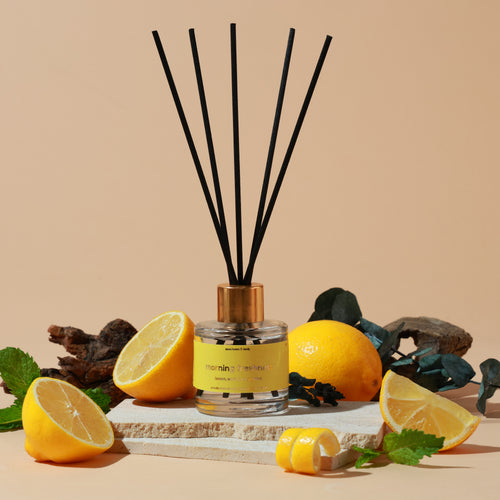 Two of one · Morning Freshness₹749Shop →
  One room · Sukoon₹1,899Shop →
What “active” actually costs you, said plainly
Upgrading is not a pure gain and it would be dishonest to present it as one. An ultrasonic machine needs a socket, a tank filled with water, and cleaning; it adds humidity to a room, which in a Mumbai August is the last thing some homes want; in a hard-water city it can leave a fine white mineral dust on dark furniture; and the oil that leaves it is diluted in water, which is most of the reason an equivalent scent smells less concentrated from an ultrasonic than from a nebuliser. It also makes a small sound, and it stops in a power cut. None of that is a reason not to buy one — it is a reason to buy one knowing what you are taking on.
The waterless route removes the water and adds different obligations. Safar at ₹3,999 shatters undiluted oil into a dry mist with pressurised air — the same principle a hotel uses, at personal scale — with a 20ml bottle, a 2000 mAh Type-C battery giving up to ten hours continuous or around thirty intermittent, three speeds, a one, two or three-hour auto-off and a 6.9 cm body. Two disclosures belong with any recommendation of it. It is named and sold as a car perfume diffuser, with car, handbag, desk, bedside and hotel room among the uses on its own product page, so a bedside is supported rather than improvised. And SOSA has published no room-coverage figure for it, so I will not give you one; treat it as personal and small-space scenting with the correct technology. It is also not a set-and-forget device: the timer runs to three hours and the battery needs recharging.
Against all of that, here is the reed’s ledger, and it is stronger than the category usually admits. Silent, always — nothing else here can sit beside a sleeping person and make no sound. No socket, in a bedroom where the sockets are already spoken for. No water in a humid flat, and no mineral dust anywhere. No battery to die and no timer to remember. Unaffected by a power cut. About ₹13–₹15 a day per bottle. And it looks like an object you chose rather than an appliance you installed, which for a console table or a bedside is not a trivial consideration. The one thing it genuinely cannot do is be switched off, and if that matters to you, that is a real reason to go active rather than a manufactured one.
What to buy, in order — and the rung that does not exist
In the order I would spend it, with the cheapest genuinely good answer first rather than the most expensive. The last row is the gap in our own range.
| Buy | What it is | When it is the right answer | Price |
|---|---|---|---|
| 1. Two 50ml reeds of the same scent ★ | Two zones at the two points you actually use, twelve fibre reeds, refillable glass, about ₹26–₹30 a day between them | A long, L-shaped or divided room. Silence, no power point, no water, nothing to fill or charge. Cheaper than a machine and often better | ₹1,498–₹1,698 |
| 2. One 130ml reed | The size specified for rooms above about 150 sq ft, running 14–18 weeks on six reeds | When one bottle was simply under-specified for the room. It buys weeks rather than metres | ₹1,249–₹1,349 |
| 3. Sukoon with the Hotel Collection | Ultrasonic water mist, 500ml, 270–320 sq ft, 16–18 hours on low, three 15ml scents included, and an off switch | When evenness across one volume is the requirement, and water, humidity and refilling are acceptable | ₹1,899 |
| 4. Safar | Waterless cold-air nebulising of undiluted oil — 20ml, 2000 mAh Type-C, 3 speeds, 1/2/3-hour auto-off, 6.9 cm. Named and sold as a car and travel diffuser, with bedside and hotel room among its stated uses | When no water is the requirement and you want it running only while you are in the room. No published room coverage, and not to be bought in multiples | ₹3,999 |
| Not this: Megh, and not Vaayu for one room | Megh is 6L and about 100 hours of runtime at roughly 215 sq ft. Vaayu is rated to 1000 m³, about 2,000–3,000 sq ft | Megh covers less than the ₹1,899 Sukoon and is a runtime and humidity machine. Vaayu earns ₹11,999 on a whole floor, an open-plan living-dining, a villa, a clinic, a salon or a showroom | ₹3,499 / ₹11,999 |
| The honest gap | No mid-sized waterless bedroom nebuliser exists at SOSA — nothing sits between Safar at personal scale and Vaayu at 2,000–3,000 sq ft, and buying two Safars is not the workaround | Said plainly, because it is why two reeds is so often the sensible answer at this budget rather than a compromise | — |
Versailles
This is the page where the commercially convenient answer and the correct one part company, so let me be direct. If your room is long and you use both ends of it, two reeds at ₹1,498 will serve you better than the ₹1,899 machine, and I would rather you bought the reeds. You will get a strong, accurate fragrance exactly where you sit, in silence, with no socket, no tank and nothing to remember, and it will keep working the next time the power goes.
Where I would send you to the machine is narrower and quite specific. If you want evenness — the same presence in the doorway, the middle and the far corner — two passive sources cannot produce it, and nor can four. And if you want the fragrance to stop when you leave the room, a reed genuinely cannot do that; it has no off switch, and that is its one honest design limitation rather than a fault I am glossing over.
The last thing is a caution about doubling. Two of the same thing rarely produces one of the next thing up. Two bottles is two zones, not a covered room; and on the machine side, I would not recommend buying Safar in multiples either — the sensible upgrade path is a change of mechanism, not a change of quantity. Between Safar and Vaayu we have nothing sized for a single bedroom without water, and I would rather say that than pretend two of something smaller adds up to it. Everything is composed in Pune, and part of every order funds a girl’s classroom through Nanhi Kali.
Frequently asked questions
- Can a reed do an entire bedroom? — the honest no, and what it will do instead.
- Strong beside the bottle, weak from the bed — distance decay and placement.
- I added more reeds and it still isn’t hotel-like — output against reach.
- I keep flipping my reeds — the 3–5 day cadence, and what daily flipping means.
- A fragrant corner instead of a scented room — the mechanism, in full.
- Are reeds the wrong format for me? — sometimes yes, and how to tell.
- Was a reed designed for lobby projection? — design intent, respected.
- When to stop searching for a stronger reed and whether you actually need active scenting.
- Brand: the SOSA founder story.
Facts verified August 2026: Three diffusion mechanisms are described — passive capillary (reed diffusers), ultrasonic water mist (Boond ₹899, 300ml, up to ~150 sq ft, ~6 hours; Sukoon ₹1,899, 500ml, 270–320 sq ft, 16–18 hours on low, three 15ml Hotel Collection scents included; Megh ₹3,499, 6L tank, ~100 hours runtime, ~215 sq ft, which is less coverage than Sukoon) and waterless cold-air nebulising (Safar ₹3,999, 20ml bottle, 2000 mAh Type-C battery, up to 10 hours continuous or around 30 hours intermittent, 3 speeds, 1/2/3-hour auto-off timer, 6.9 cm, named and sold as a car and travel diffuser with car, handbag, desk, bedside and hotel room among its stated uses, no published room-coverage figure; Vaayu ₹11,999, coverage up to 1000 m³ or roughly 2,000–3,000 sq ft, 400ml refillable tank lasting up to about 90+ days, Bluetooth app and onboard buttons, 1h/4h/8h/24h run windows, adjustable intensity, key-lock, under 38 dB, freestanding or wall/HVAC mount, 5W, CE, RoHS, SGS). SOSA reed diffusers: five scents, 50ml ₹749–₹849 lasting 6–8 weeks and suiting rooms up to ~150 sq ft, 130ml ₹1,249–₹1,349 lasting 14–18 weeks and suiting above 150 sq ft, six fibre reeds included and flipped every 3–5 days, about ₹13–₹15 a day per bottle, heat-stable CCT carrier rather than DPG, alcohol-free, phthalate-free, paraben-free, IFRA-compliant, 0 ppm formaldehyde, refillable glass bottle, climate-tested at 45°C and 85% RH, composed in Pune. Duos are two 50ml bottles: Day & Night ₹1,498, Fresh & Grounded ₹1,548, Warmth & Bloom ₹1,598; 130ml duos ₹2,498–₹2,598. Reed refills 300ml ₹2,399 and 500ml ₹3,499, oil only. SOSA strength scale: Evening Calm 8.9, Garden Bloom 8.9, Morning Freshness 9.0, Mountain Breeze 9.4, Fresh Brew 9.5 — perceived intensity in the room, not reach. Hotel Collection fragrance oils are water-based and ultrasonic-only at 15ml ₹299 (a refill), 100ml ₹999 and 300ml ₹1,799; they cannot be used in reed diffusers and reed oil cannot be used in ultrasonic machines, so no hotel-inspired reed diffuser exists. No health, air-quality, allergy or antimicrobial claims are made, and fragrance does not remove a smell — source, then ventilation, then fragrance. Free shipping above ₹499. A portion of every order supports girl-child education through Nanhi Kali. SOSA is an independent Indian fragrance house; the Hotel Collection scents referenced here are SOSA’s own interpretations inspired by the world’s finest hotels, and SOSA is not affiliated with, endorsed by or a supplier to any hotel brand. Prices subject to change — see the live product pages.