




Why: odours do not cancel. Two strong smells in one room are perceived as a blend, and the blend is usually worse than either component on its own.
The part that costs money: a reed diffuser standing in the path of cooking air gets its reeds coated in oil film. Coated fibre stops wicking, and the throw dies within weeks.
2. Because odours do not cancel each other out. Your nose does not subtract. Present it with fried onion and jasmine at the same time and it forms a single combined impression of the pair, and that impression is usually less pleasant than either alone — sweet floral notes in particular sit badly against fatty, savoury ones. This is why a heavily fragranced room that also smells of cooking reads as specifically unpleasant rather than as neutral.
3. Because masking deletes useful information. A smell is a signal. The bin needs emptying, the trap in the utility has dried out, there is a slow leak under the sink, the chimney filter is loaded. Cover those and the problem does not pause; it continues while you have removed your own ability to notice it. This is how a small, ten-minute job becomes a large one.
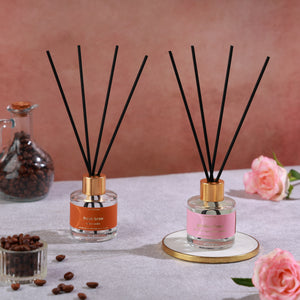
4. Because it wrecks the diffuser you paid for. A reed diffuser works by capillary action: liquid climbs the fibre and evaporates from the exposed length. Put one in the path of cooking air and the exposed reeds get coated with the same aerosolised oil film as everything else. Coated fibre wicks badly, so the throw drops off within weeks and the bottle stops performing while still half full. Placement near a hob is the fastest way to kill a reed diffuser.
5. And after all that — yes, absolutely. Once the room is genuinely clear, fragrance stops being a cover and becomes a choice: this is what my home smells like. That is a real and worthwhile thing, and it is exactly what a reed diffuser from ₹749 or a Sukoon at ₹1,899 is for.
Made in India, composed by an ISIPCA Versailles-trained perfumer — and a portion of every order supports girl-child education through Nanhi Kali.

Why two smells in a room make a third smell
People assume odour works like sound, where a loud noise drowns a quiet one. It does not. Olfaction blends: when two odour sources are present at once, you perceive a combined character rather than the stronger one replacing the weaker. Sometimes that blend is pleasant, which is the entire basis of perfumery. Usually, when one of the components is fried oil and the other is a floral or sweet accord designed for a clean room, the blend is worse than either. A room that smells of cooking reads as a room that has been cooked in. A room that smells of cooking and jasmine reads as a room where something is being hidden, and people are surprisingly good at detecting that.
There is also a physical reason it cannot work in the way people hope. Cooking odour in an Indian kitchen is carried on aerosolised oil that has landed on surfaces and fabric and is re-releasing continuously. That is a source with a steady output, refreshed twice a day. A reed diffuser is also a steady source, running at a very modest rate — it is designed to give a room a background, not to overwhelm one. Trying to out-emit a loaded sofa with a 50ml bottle simply means you burn through the bottle. You are asking a background layer to do the work of a washing machine.
Three ways masking backfires
 After the sourceFrom ₹749The combination that goes wrong most often is a sweet or heavily floral fragrance over a fatty, savoury cooking residue. The two do not sit together; the sweetness makes the fat more noticeable rather than less, and the result is the smell most people associate with a badly-kept hotel corridor. If you are going to have fragrance anywhere near a working kitchen, choose dry, green or citrus over sweet — but do it because it behaves better as a background, not because it will cover anything. It will not.
Symptom to cause: is fragrance the right tool at all?
This table exists to answer one question honestly: does your situation call for fragrance, for cleaning, or for a tradesman? Getting that wrong is the expensive mistake.
| What you notice | Most likely cause | How to confirm it | What actually fixes it |
|---|---|---|---|
| Cooking smell in the air right now ★ | A live source — the pan, the hot oil, the loaded chimney filter | Check whether the smell fades within ten minutes of a proper cross-draught | Ventilate. Fragrance now makes the impression worse, not better. |
| Room smells of cooking a day later | Deposited oil film on soft furnishings re-releasing | Press your face into the sofa back and compare with a cupboard-fresh cover | Wash covers and curtains, brush-head vacuum the sofa — then scent |
| Diffuser throw dropped off while the bottle is still half full | Reeds clogged by cooking oil film, or placed in the cooking flow path | Look at the exposed reeds — dulled, darkened or slightly tacky | Replace the reeds rather than the liquid; move the bottle away from the kitchen |
| Fragrance smells different, heavier or odd in this room | It is blending with a residual cooking note rather than replacing it | Move the same diffuser to a genuinely clean room and smell it there | Clear the room first; choose dry, green or citrus rather than sweet near a kitchen |
| Sour or fermented note underneath the cooking smell | The wet list — sink strainer, sponge, cloth, bin lid, fridge drip tray | Smell each of the five separately, at close range | Clear and dry all of them nightly. This is a two-minute job, not a fragrance one |
| Earthy, musty smell you have been calling "old cooking" | Mould or damp — a health issue, not an odour problem | Check external walls behind furniture, under the sink, at ceiling corners | Find the moisture source and remove the growth. Fragrance has no place here. |
| If none of these fit: leave the flat for thirty minutes and judge the first breath on returning. If the honest answer is "it still smells of dinner", the next step is a window and a washing machine, not a bottle. | |||
Reeds · always-on roomsFrom ₹749Shop →  Sukoon · when you want a switch₹1,899Shop →
  Hotel Collection · the scentFrom ₹299Shop →
What to do instead, and when to scent
Deal with the source, which for cooking means the pan and the hood. Chimney on before the pan heats and running ten minutes after you finish. Strong dishes on a back burner, lid on where the recipe allows, oil kept below smoking point. Chimney filters degreased every three to four weeks. Bin, sink strainer, sponge and cloth cleared and dried nightly. Nothing here is exotic and all of it does more than any product I sell.
Then move the air while the odour is still airborne, and handle what landed. Ten minutes of cross-ventilation immediately after cooking removes far more than an hour of open windows later, because by then a large share has settled onto fabric. What did settle is a laundry job: cushion covers monthly, curtains seasonally, bedding weekly, sofa vacuumed with the brush attachment, sunlight where the weather allows. Then run the honest test — leave the flat for thirty minutes and judge the first breath back in, because olfactory adaptation is essentially complete in about twenty and you cannot judge your own home from inside it.
Then, and only then, scent — properly. Choose for the room rather than for the bottle. A reed diffuser from ₹749 suits a space that should simply always smell settled, since it runs on capillary action with no electricity and nothing to switch; place it away from the cooking flow, and remember that the reed count is the volume dial — six for full strength, three or four for a small flat or a bedroom. Prefer dry, green or citrus near a kitchen: Morning Freshness or Mountain Breeze behave better against food notes than a sweet floral will. If you would rather have scent on a switch — an hour before guests, nothing at 2am — the Sukoon at ₹1,899 takes 3–6 drops of the water-based Hotel Collection from ₹299 and covers roughly 270–320 sq ft. The two liquids are not interchangeable: reed fragrance is oil-based, Hotel Collection is water-based.
The honest order
I would rather you bought nothing today and fixed the source, then bought something in a fortnight that actually works. This is the order that gets you there.
| Step | What to do | When | Cost |
|---|---|---|---|
| 1. Remove the source | Chimney on early and off late, lid on, filters degreased, bin and sink cleared nightly | Before anything else | ₹0 |
| 2. Move the air | Ten minutes of cross-ventilation immediately after cooking, while the odour is still airborne | Daily, five to ten minutes | ₹0 |
| 3. Deal with what holds it | Cushion covers, curtains, bedding and a brush-head vacuum of the sofa — the part fragrance can never reach | Weekly to monthly | ₹0 |
| 4. Then the always-on layer ★ | A SOSA reed diffuser — a background for a clean room, placed away from the cooking flow, on three to six reeds as the room needs | 50ml 6-8 weeks · 130ml 14-18 | from ₹749 |
| 5. Or the on-demand layer | Sukoon with a Hotel Collection scent — scent on a switch for an hour before guests; covers roughly 270–320 sq ft | Run it when you want it | ₹1,899 |
Versailles
This is the article where I talk myself out of a sale, and I would rather do that than have someone buy a bottle to cover a smell and conclude that my fragrance is weak. It is not weak. It is being asked to do something no fragrance can do. A 50ml reed diffuser is designed to give a clean room a quiet character over six to eight weeks. It is not designed to out-emit a sofa that has absorbed three months of tadka.
The reed detail matters commercially and I think people deserve to know it. If you stand a diffuser near a hob, the oil aerosol coats the reeds, the fibre stops wicking, and the throw dies while the bottle still looks full. People then buy more liquid when what they needed was fresh reeds and a different shelf. That is a bad experience and it is entirely avoidable — put it in the entrance, the passage, or across the room from the kitchen.
So my answer to the question in the title is: remove first, always. And then, yes — scent, deliberately and without guilt. A home that smells of something chosen rather than of nothing in particular is one of the cheapest pleasures there is. It is just the fourth step, not the first. A portion of every order funds a girl's classroom through Nanhi Kali.
Frequently asked questions
- Resetting the living room after a cook — the timed recovery routine.
- Why the chimney does not stop it — capture rate and timing.
- Stopping frying smell at the pan — source control beats cleaning.
- The twice-a-day fragrance routine — what to run, where, and when.
- Brand: the SOSA founder story.
SOSA products & prices (verified August 2026): Hotel Collection water-based ultrasonic diffuser fragrance 15ml ₹299 · 100ml ₹999 · 300ml ₹1,799 · Pack of 7 (15ml, all fragrances) ₹1,799; refills 100ml from ₹999. Seven scents: The Ritz-Carlton-inspired (white tea · bergamot · cedar), Westin-inspired (white tea · aloe · cedar), 1 Hotels-inspired (cedarwood · vetiver · green leaves), The St. Regis-inspired (amber · violet · woods), Shangri-La-inspired (jasmine · green tea · white tea), Four Seasons-inspired (citrus · floral · sandalwood), W Hotels-inspired (citrus · pepper · amber). Diffusers: Boond 300ml ₹899 · Sukoon 500ml ₹1,899 · Megh 6L ₹3,499. Water-based, phthalate-free, composed to IFRA standards for home diffusion; 3–6 drops per tank. Made in India, Pune. The Hotel Collection scents are SOSA's own interpretations inspired by the world's finest hotels; all hotel names are trademarks of their respective owners and are used only to describe the scent style — SOSA is an independent Indian fragrance house, not affiliated with or endorsed by any hotel brand. Prices and availability subject to change — see the live product pages.