





The four levers: oil temperature (stay below smoke point), a lid or splatter screen, small batches rather than a crowded pan, and total frying time.
The bit people miss: the pan keeps releasing for the best part of an hour after the flame goes off. Cover it, and leave the chimney running.
2. Put something over the pan. A lid for shallow frying, a mesh splatter screen for deep frying. A lid keeps the aerosol inside the pan entirely; a screen catches a large share of the mechanically ejected droplets while letting steam out. This one item does more than any appliance in the kitchen and costs a couple of hundred rupees. Where the recipe genuinely needs an open pan, cover it between additions rather than leaving it open throughout.
3. Fry in small batches. Crowding a pan drops the oil temperature sharply. Cold oil means the food absorbs more of it, cooks more slowly, and releases more of its own water into the oil — which is what causes violent bubbling and throws droplets out of the pan. So a crowded pan gives you a longer session, more spitting and greasier food, all at once. Two smaller batches usually generate less total odour than one large one.
4. Run the chimney before and after, and shut the doors first. Switch the chimney on when the empty pan goes on the flame, not when the oil is hot, and leave it running ten minutes after you finish. Fry on a back burner directly under the hood. Close bedroom and wardrobe doors before you start, because the plume reaches a doorway within a minute or two along the ceiling.
5. And accept that fragrance is not part of this step. Nothing you spray reduces aerosolised oil. Control the pan, ventilate while the odour is still airborne, wash what caught the remainder — and then let a reed diffuser or a Sukoon decide what the flat smells of the rest of the time.
Made in India, composed by an ISIPCA Versailles-trained perfumer — and a portion of every order supports girl-child education through Nanhi Kali.
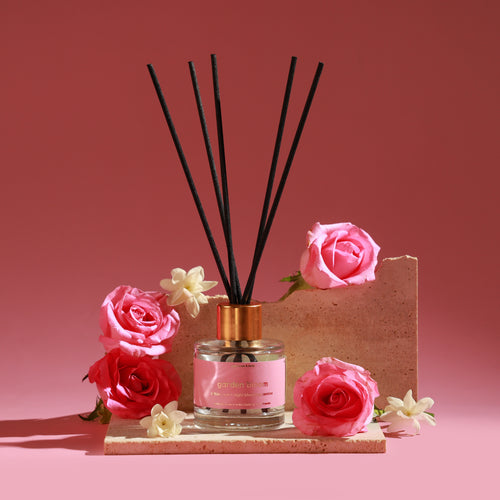
Why frying behaves differently from the rest of your cooking
Boiling, steaming and simmering release mostly water vapour with odour compounds dissolved in it. Vapour disperses, condenses on cool surfaces and largely leaves with ventilation. Frying is a different physical event. Oil at frying temperature aerosolises from the surface continuously, and the water inside the food flashes to steam as it hits the oil, bursting out and mechanically ejecting oil droplets in every direction. You are producing a fine suspension of oil, not a cloud of steam, and that suspension carries the odour-active molecules attached to it. It travels on convection currents, and where it meets a surface it lands rather than dissipating.
That single difference reorganises the whole strategy. If frying smell were vapour, ventilation would be the answer and the problem would end when the windows had been open for twenty minutes. Because it is oil, part of every session ends up as a thin film on the walls, the cabinet fronts, the curtains and the sofa, and no amount of open window reaches a film. So the priority order inverts: preventing release is worth far more than removing it afterwards. A lid costs two hundred rupees and prevents; a professional upholstery clean costs thousands and only partly cures. In a small flat, where there is no spare volume to dilute into and the sofa is four metres from the hob, that difference is the whole game.
The three levers you have at the pan
 Step fourFrom ₹749Every oil has a temperature above which it begins to break down and smoke, and refined oils sit higher than unrefined ones. Below that line, aerosol production is modest and the smell is recognisably food. Above it, production climbs sharply and the character changes to something acrid that clings. Test with a small piece of batter rather than by eye: it should rise and bubble briskly within a couple of seconds, not brown instantly. Reused oil smokes at a lower temperature than fresh oil, so oil that has done three or four sessions will start misbehaving long before you expect it to. Strain it, store it covered, and retire it earlier than you think.
Symptom to cause: reading a frying session
Match the symptom and check the confirmation column. Most of what is here is free to fix, and one row is a safety matter rather than a smell.
| What you notice | Most likely cause | How to confirm it | What actually fixes it |
|---|---|---|---|
| Whole flat smells within two minutes of the oil going on ★ | Open pan, high aerosol rate and no capture — hood switched on too late | Try one session with the hood on from the empty pan and a lid between batches | Chimney on early, back burner, lid or splatter screen, doors shut in advance |
| Harsh, throat-catching smell rather than food | Oil past its smoking point, or oil reused too many times | Test with a piece of batter — brisk bubbling, not instant browning | Lower the flame; strain and retire old oil sooner; never heat an empty pan |
| Violent spitting and oil on the surrounding worktop | Wet or frozen food, or a crowded pan dropping the oil temperature | Pat one batch dry and fry it in half the quantity, then compare | Small batches, dry ingredients, let the oil recover between batches |
| Kitchen still smells strongly an hour after you finished | The used oil, pan and utensils continuing to release | Cover the pan and run the hood for ten minutes and note the difference | Cover and cool the oil; clear utensils and oily paper before eating |
| Living room smells of it the next day but the kitchen does not | The escaped fraction has deposited on soft furnishings | Smell the sofa back and curtain hem against a cupboard-fresh cushion cover | Wash covers and curtains, vacuum upholstery with the brush head |
| Visible smoke, an acrid smell, or the oil is shimmering and hazing | Overheated oil approaching its flash point — a fire risk, not an odour | Do not test further. Turn off the heat and let it cool | Never put water on burning oil. Smother it with a lid and cut the heat. |
| If none of these fit: check whether your kitchen window sits right next to the chimney hood. If it does, an open window during frying short-circuits the hood — it draws air straight in from the window instead of pulling the plume up from the pan. | |||
Reeds · always-on roomsFrom ₹749Shop →  Sukoon · when you want a switch₹1,899Shop →
  Hotel Collection · the scentFrom ₹299Shop →
A frying session, start to finish
Before the oil goes on. Close the bedroom and wardrobe doors, and the balcony door on the far side of the flat. Switch the chimney on when the empty pan goes on the flame. Set up on a back burner directly under the hood. Have everything chopped, battered and ready, so the oil is never sitting hot and idle. Switch the ceiling fan off — a fan on high shears the plume sideways before the hood can take it, and mixes it down into the room instead. Pat wet ingredients dry, and take frozen items out early enough that surface ice has gone.
During. Bring the oil up to a working temperature and hold it there rather than chasing it hotter; test with a small piece of batter instead of watching for shimmer. Fry in modest batches and let the oil come back to temperature between them. Keep a lid or a splatter screen over the pan whenever the recipe allows, including between batches. If it starts to smoke, take the pan off the heat for a minute rather than pushing on. Resist the urge to open every window at this point — a cross-draught across the hob defeats the hood, and the correct purge comes immediately afterwards, not during.
After. Cover the pan once it is off the heat and let the oil cool covered. Clear the strainer, the utensils and the oily paper straight away. Leave the chimney running ten minutes. Then open two windows on opposite sides and purge hard for ten minutes while the odour is still airborne rather than settled — this is the moment that decides how much ends up on your sofa. Wipe the tiles and the hood underside while they are still warm. Only then does fragrance have a job: with the room genuinely clear, a reed diffuser from ₹749 gives a small flat a constant background — Morning Freshness in Malabar lemon, peppermint and eucalyptus reads clean rather than sweet after frying — or the Sukoon at ₹1,899 with a Hotel Collection scent from ₹299 gives you an hour of scent on demand across roughly 270–320 sq ft.
What to do, in order
This is the one topic in the cluster where the first step genuinely does almost all of the work. The purchase at the end is for the other twenty-three hours of the day.
| Step | What to do | When | Cost |
|---|---|---|---|
| 1. Remove the source | Oil below smoking point, lid or splatter screen, small batches, dry ingredients, chimney on early and off late | Before anything else | ₹0 |
| 2. Move the air | Doors shut before you start; then a hard ten-minute cross-ventilation immediately after, not an hour later | Daily, five to ten minutes | ₹0 |
| 3. Deal with what holds it | Wipe tiles and hood while warm; wash curtains and covers; vacuum upholstery with the brush head | Weekly to monthly | ₹0 |
| 4. Then the always-on layer ★ | A SOSA reed diffuser — a constant, low background for a flat where frying happens most weeks | 50ml 6-8 weeks · 130ml 14-18 | from ₹749 |
| 5. Or the on-demand layer | Sukoon with a Hotel Collection scent — an hour of scent on demand after a heavy session; covers roughly 270–320 sq ft | Run it when you want it | ₹1,899 |
Versailles
I am going to recommend a splatter screen before I recommend anything from my own shop, because in this particular case it is simply the better product. A lid or a mesh screen stops the oil from ever entering the room, and nothing I sell can undo what has already landed on a sofa. That is not modesty, it is the order the physics puts things in.
The temperature point is the one most people have never been told. Oil below its smoke point smells like cooking. Oil above it smells sharp and stays for days, because it is producing far more aerosol and a chemically harsher kind of it. If your kitchen smells throat-catching rather than appetising, that is not a strong dish, that is oil that has been taken too far — and reused oil crosses that line much earlier than fresh oil does.
Where fragrance belongs is afterwards, and honestly its job is not the frying at all. Its job is what the flat smells like on Tuesday afternoon when nobody has cooked. That is a real thing worth having, especially in a small home where the kitchen is never far away. Buy it for that, not as a remedy for pakoras. A portion of every order funds a girl's classroom through Nanhi Kali.
Frequently asked questions
- Why the whole 1BHK smells of food — the missing buffer volume.
- Why the chimney does not stop it — capture rate and timing.
- Why it is still there the next morning — the film that re-releases.
- Cover the smell or remove it first? — the honest answer.
- Brand: the SOSA founder story.
SOSA products & prices (verified August 2026): Hotel Collection water-based ultrasonic diffuser fragrance 15ml ₹299 · 100ml ₹999 · 300ml ₹1,799 · Pack of 7 (15ml, all fragrances) ₹1,799; refills 100ml from ₹999. Seven scents: The Ritz-Carlton-inspired (white tea · bergamot · cedar), Westin-inspired (white tea · aloe · cedar), 1 Hotels-inspired (cedarwood · vetiver · green leaves), The St. Regis-inspired (amber · violet · woods), Shangri-La-inspired (jasmine · green tea · white tea), Four Seasons-inspired (citrus · floral · sandalwood), W Hotels-inspired (citrus · pepper · amber). Diffusers: Boond 300ml ₹899 · Sukoon 500ml ₹1,899 · Megh 6L ₹3,499. Water-based, phthalate-free, composed to IFRA standards for home diffusion; 3–6 drops per tank. Made in India, Pune. The Hotel Collection scents are SOSA's own interpretations inspired by the world's finest hotels; all hotel names are trademarks of their respective owners and are used only to describe the scent style — SOSA is an independent Indian fragrance house, not affiliated with or endorsed by any hotel brand. Prices and availability subject to change — see the live product pages.