




What reeds actually are: a passive capillary device. Oil climbs six fibre reeds and evaporates at whatever rate the room’s own air movement allows. That produces a fragrant zone, not a fragranced room — roughly the two metres around the bottle. A 50ml is built for up to about 150 sq ft and runs 6–8 weeks; a 130ml runs 14–18. In a 4,000 sq ft hall a reed diffuser is not underperforming. It is doing exactly what a passive device does.
Why more bottles does not fix it: ten bottles in one hall are ten small zones, not one large one. Two passive sources with no air movement between them make two concentration peaks with a valley in the middle, and the midpoint of the room is the farthest point from both.
The honest gap, twice over: SOSA publishes no oil-consumption rate for any machine, so nobody can honestly compare a machine’s running cost against a reed’s. And no refill oil is listed for the waterless commercial machines at all — that fragrance is specified and quoted per property. Anyone who gives you a rupees-per-month figure for a commercial machine from a public price list is inventing it.
2. Understand what a reed diffuser is before judging it. Oil climbs six fibre reeds by capillary action and evaporates into whatever air happens to pass. There is no fan, no pressure and no distribution — which is exactly why it is silent, needs no power point, never fails and costs ₹749. It produces a fragrant zone of roughly two metres. That is the specification, not a shortfall.
3. Do not answer a hall with quantity. Ten bottles in a members’ hall are ten small zones with dead air between them, and because neither source moves air, two of them produce two peaks and a valley rather than one even field. The arithmetic does not improve with more bottles; it just costs more.
4. Be careful with the middle option. An ultrasonic machine gives genuine room coverage for very little money, but it works by dispersing oil diluted in water. In a club that means added humidity in a building that is usually trying to lose it, the possibility of fine white mineral dust on dark timber and polished stone, and a tank that needs attention far more often than a committee expects. It is a good machine in a small dry room and a poor fit for a monsoon-season lobby with panelling.
5. Then spend the reed budget where reeds are better than anything else. A cloakroom, a washroom, a secretary’s office, a committee anteroom: small, closed, no power point, no schedule needed, and a ₹799 bottle answers it completely for two months. That is a real recommendation rather than a consolation. Everything SOSA makes is alcohol-free, phthalate-free, paraben-free, IFRA-compliant and 0 ppm formaldehyde, composed in Pune, and a portion of every order supports girl-child education through Nanhi Kali.

The three mechanisms, described honestly
Every diffuser on the market is one of these three, whatever it is called on the box. Naming the mechanism first is the fastest way to stop a club comparing a ₹849 object with a ₹25,999 one as though they were competing for the same job.
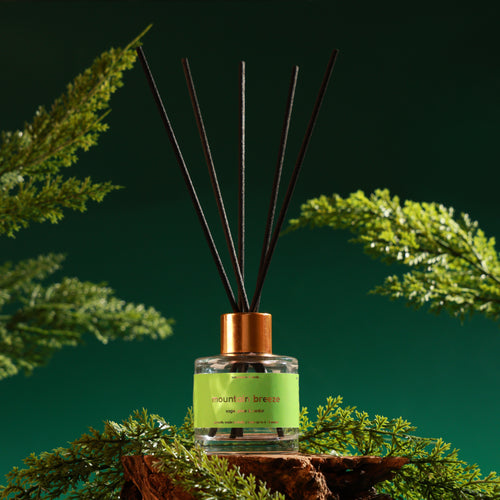
 Mountain Breeze₹849Oil travels up six fibre reeds by capillary action and evaporates from the exposed length. Everything that is good about a reed diffuser follows from having no motor: it is silent, it needs no power point and no drawing, it cannot break, it sits on a console looking like an object rather than equipment, and every millilitre eventually leaves through the reeds. Everything that limits it follows from the same fact. With no air being moved, the fragrance travels only as far as the room’s own currents take it, which in a still hall is about two metres. It also cannot be scheduled, cannot be turned down for a quiet afternoon, and cannot be locked against adjustment — the only volume control is the reed count, six for full projection and three for soft and roughly double the life. SOSA reeds are 50ml at ₹749–₹849 for up to about 150 sq ft and 6–8 weeks, or 130ml at ₹1,249–₹1,349 for 14–18 weeks, on a heat-stable CCT carrier tested at 45°C and 85% RH, in a refillable glass bottle.
 Sukoon₹1,899A ceramic plate vibrates at high frequency and throws a fine wet mist of water carrying a few drops of oil. It is inexpensive, it genuinely covers a room, and it is the right machine for a great many homes. In a club it has three specific problems. It adds moisture, and in most Indian clubs for most of the year moisture is the thing the building is fighting rather than the thing it needs. It can leave a fine white mineral deposit where the water is hard, which shows on dark timber, lacquer and polished stone. And the oil is diluted, so the same fragrance reads softer per unit of mist than the undiluted version does. The range also contains the clearest trap in our own catalogue: Megh at ₹3,499 has a six-litre tank and around 100 hours of runtime but covers only about 215 sq ft — less than the ₹1,899 Sukoon at 270–320 sq ft. Bigger tank, smaller room. It is a runtime machine and never a coverage upgrade.
 Aangan₹25,999Pressurised air shatters neat oil into a dry nano-mist with no water in it at all. Because the droplet carries oil rather than a mixture, the same material reads considerably stronger per unit of mist than it does from a water diffuser, and because there is no water there is no added humidity, no dilution and no residue. The distribution is then done by the building: the mist is handed to the moving air and goes where that air goes, which is why placement matters more than intensity and why an HVAC-return mounting is the best position available in a building that has one. The controls are the second half of the argument. Vaayu gives adjustable intensity, run windows of 1h / 4h / 8h / 24h, day selection, auto-stop, a key-lock, under 38 dB and CE, RoHS and SGS marks. Aangan gives programmable work and pause cycles and daily schedules on an intelligent PCB — no app and no Bluetooth on that unit — with an 800ml reservoir, under 42 dB, DC 12V at 14W and a metal body of 3.9 kg at 284 × 125 × 246 mm.
The arithmetic of adding more bottles, which is the first thing every club tries
The sequence is so consistent that I can usually finish the sentence. A club puts a handsome 130ml reed diffuser on the console in the hall. It is lovely at the console and absent everywhere else, so a second goes on the side table, and a third by the stairs, and by the time there are eight the hall still reads as unscented and the annual spend has quietly become substantial. Nothing has gone wrong with any of the bottles. Each one is doing precisely what a passive capillary device does, and eight of them are eight fragrant zones with ordinary air between them.
There is a second effect that makes the result feel worse than merely patchy. Because neither bottle moves air, two sources in one room create two concentration peaks with a valley between them, and the valley sits at the midpoint — the farthest point from both. A member walking the diagonal of the hall therefore experiences strong, then nothing, then strong, which reads as a room that cannot make up its mind and is far less pleasant than a room that simply smells of nothing. The instinct at that point is to add more reeds to each bottle, which makes each zone stronger and shorter-lived without making the room any more even, and to move to the deepest scent in the range, which changes the club’s character to solve a distribution problem.
It is worth being plain about cost as well, because the comparison is usually presented the wrong way round. A 130ml bottle at ₹1,249–₹1,349 runs 14–18 weeks, so eight of them in a hall is a recurring commitment, not a one-off purchase, and it delivers eight zones for it. What the higher price of a machine actually buys is not a better smell — it is transport, control and evenness. The same family of materials in a ₹1,000 bottle and in a ₹11,999 nebuliser produce completely different rooms, and the difference is entirely in how the fragrance gets from the source to the far corner and whether you can decide when it does so. That is the honest version of the value argument, and it is also the reason I would not sell a club eight bottles for a hall.
The full comparison, for a club lobby specifically
Judged against what a lobby actually asks for rather than against a general idea of quality. The last row is the honest limit of the whole category, and it is worth reading before any of the others.
| What the lobby needs | Reed diffuser | Ultrasonic | Waterless cold-air |
|---|---|---|---|
| An even field across a large connected volume ★ | No — a zone of roughly two metres | Partly — a room, not a hall | Yes — up to 1000 m³ or 3,000 m³ on HVAC |
| A settable intensity | Reed count only: six full, three soft | Usually a mist rate | Adjustable intensity on both machines |
| A schedule for club hours | None — it runs continuously | Simple timers at best | 1h/4h/8h/24h and days on Vaayu; PCB work and pause cycles on Aangan |
| Protection from a well-meaning night shift | None | None | Key-lock on Vaayu |
| No added humidity in a monsoon building | Adds none | Adds moisture by design | Adds none — no water in the system |
| Nothing visible in the room | It is the object | A visible appliance | Wall-mount or HVAC return: nothing to find |
| A low fixed cost and no electrical work | Yes — ₹749 and no power point | Yes — ₹899 to ₹3,499 | No — ₹11,999 upward and a DC 12V point |
| A published running cost | Yes, from the bottle life | Partly, from tank hours | No — fragrance is quoted per property |
The hall · Vaayu₹11,999See it → 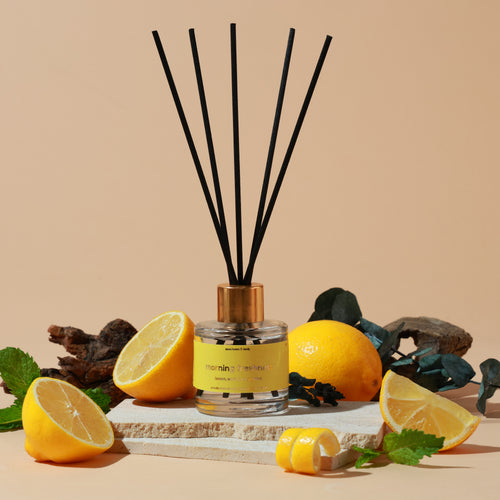 The cloakroom · reeds₹749See it →
  A small dry room · Sukoon₹1,899See it →
Where reeds are the better purchase in a club, and I mean better
A page that concludes “buy the expensive thing” and stops there is an advertisement. So here is the other half, and it is a real recommendation rather than a courtesy. Reed diffusers are the correct answer in every small, closed, low-traffic room in a club, and most clubs have a surprising number of them. A members’ cloakroom. A washroom lobby. A secretary’s office. A committee anteroom. A small first-floor landing behind a door. A guest bedroom in a residential club. These are spaces of up to about 150 sq ft where a zone is all that is wanted, where there is often no convenient power point, where nobody wants a piece of equipment on view, and where a ₹799 bottle answers the question completely for two months and can be handled by housekeeping without a specification.
They also have three advantages that no machine has and that matter more in a club than in a home. They are silent, which is worth something in a quiet reading room approach or a corridor beside a library. They cannot be adjusted by anybody, which means no drifting settings. And they fail gracefully: a machine that stops working leaves a hall unscented until somebody notices, while a bottle that is running low simply becomes gradually quieter and is caught at the next stock check. For a club that wants fragrance in eight small rooms and a machine in the hall, that is a sensible combined specification and not a compromise.
Two practical notes if you go that way. Use the reed count deliberately — six for a cloakroom you want people to notice, three in a small washroom where a 50ml will then last far longer — and flip the reeds every three to five days, which costs nothing and gives a lift each time. And do not put a bottle in the entrance draught: an entrance is the most turbulent air in the building, and a passive device there has nothing steady to work with. Slightly inside, out of the draught, on the route rather than in the doorway.
The buying edit — and the honest gap
What I would put in front of a house committee, in order, with the machine at the top for the hall and the bottles kept for the rooms that suit them. The last row is what nobody can tell you from a price list.
| Buy | What it is | Where it is the right answer | Price |
|---|---|---|---|
| 1. Vaayu for the lobby ★ | Waterless cold-air nebulising, up to 1000 m³ ≈ 2,000–3,000 sq ft, key-lock, schedules | The hall itself, and the first machine most clubs should own | ₹11,999 |
| 2. Aangan where there is a central air system | Mechanical HVAC or AHU connection, up to 3,000 m³ ≈ 8,000–10,000 sq ft, 800ml, PCB cycles | A whole floor or a whole club on one air system | ₹25,999 |
| 3. Reeds for the small closed rooms | Mountain Breeze or Morning Freshness, 50ml up to about 150 sq ft for 6–8 weeks | Cloakrooms, washroom lobbies, offices, anterooms | ₹749–₹849 |
| 4. 130ml reeds where a room is used every day | 14–18 weeks rather than 6–8, six fibre reeds, refillable glass | Rooms in daily use where restocking is a nuisance | ₹1,249–₹1,349 |
| 5. Sukoon, only where humidity is welcome | Ultrasonic, 270–320 sq ft, 500ml, 16–18 hours on low | A small dry room in a dry season, never a panelled hall | ₹1,899 |
| Not worth buying for a lobby | More reed bottles; Megh at ₹3,499, whose six-litre tank and around 100 hours of runtime still cover only about 215 sq ft, less than the Sukoon | Named so a committee does not discover it after the invoice | Skip |
| What is not published: the honest gap | No oil-consumption rate is published for any machine, so a machine’s running cost cannot honestly be set against a reed’s per-day figure. No refill oil is listed for the waterless commercial machines at all — that fragrance is specified and quoted per property. No coverage figure is published for Meenar ₹38,500 | Named rather than modelled, because a committee will budget from any number printed here | Quoted |
Versailles
I am conscious that a perfumer arguing against her own reed diffusers looks like a sales technique, so let me be exact about what I am arguing. The bottles are the product I am proudest of, and I have five of them at home. What I am against is asking a passive device to do a job that requires moving air, because the failure is guaranteed, gradual and expensive, and because the club will conclude that the fragrance was wrong when the fragrance was never the variable.
The moment I find most telling is the one where a club describes the hall as smelling lovely in one spot. That sentence is the mechanism speaking. A zone is exactly what a reed diffuser produces, and a zone is a wonderful thing in a cloakroom and an embarrassment in a hall, because a member who meets it on the console and loses it four paces later has learned that the club’s fragrance is an object rather than a property of the building. In a well-scented lobby there is nothing to find and no gradient to walk up, which is why nobody can ever locate the diffuser in a good hotel.
And I would rather a club bought one machine for the hall and five bottles for the small rooms than eight bottles for the hall and nothing anywhere else. The first specification is coherent, costs less over three years and reads as deliberate. The second is the one I am usually called in to unpick. Everything we make is composed in Pune, and a part of every order funds a girl’s classroom through Nanhi Kali.
Frequently asked questions
- The pillar: the first fifteen seconds — what the arrival window is for.
- Entrance and lobby and whether the entrance should be stronger.
- Arrival as choreography and where the machine is installed.
- Automatic doors and consistency under traffic.
- Reception versus the lobby and the hotel method.
- Brand: the SOSA founder story.
SOSA commercial scenting — facts verified August 2026: Vaayu ₹11,999, waterless cold-air nebulising, up to 1000 m³ ≈ 2,000–3,000 sq ft, 400ml refillable sealed tank lasting up to about 90+ days depending on intensity and hours, Bluetooth app plus onboard buttons, run windows of 1h / 4h / 8h / 24h, day selection, adjustable intensity, auto-stop and key-lock, under 38 dB, freestanding, wall-mounted or HVAC-return, DC 12V / 1A at 5W, CE, RoHS and SGS, black and white. Aangan ₹25,999, HVAC or AHU connection or standalone wall-mount or lay-flat, up to 3,000 m³ ≈ 8,000–10,000 sq ft, 800ml reservoir giving weeks between refills on business-hours schedules, under 42 dB, DC 12V at 14W, intelligent PCB with programmable work and pause cycles and daily schedules, metal body 3.9 kg at 284 × 125 × 246 mm, black or white, one-year warranty, imported; it is not app-controlled, has no Bluetooth, and no certifications are published for it. Meenar ₹38,500 is the larger-property option, specified on enquiry; no coverage figure is published for it here, and it should not be assumed to reach further than Aangan. Ultrasonic machines: Sukoon ₹1,899 at 270–320 sq ft with a 500ml tank and 16–18 hours on low, Boond ₹899 with a 300ml tank at up to about 150 sq ft, Megh ₹3,499 with a six-litre tank and around 100 hours of runtime but only about 215 sq ft of coverage. Hotel Collection fragrance oils are water-based and ultrasonic-only at 15ml ₹299, 100ml ₹999 and 300ml ₹1,799; they are not for reed diffusers and not for the waterless commercial machines, and reed oil cannot be used in an ultrasonic machine. No purchasable refill oil is listed for the waterless commercial machines; that fragrance is specified and quoted per property. SOSA publishes no leather fragrance in any format and no tobacco or smoky fragrance for any diffuser. SOSA sells no air purifier and no dehumidifier, and every SOSA spray is a car perfume rather than an interior product. No SOSA machine offers Wi-Fi, Alexa, Google Assistant, KNX, Crestron, Control4, Modbus, BACnet or any building-management integration; the Aangan HVAC connection is mechanical. Reed diffusers 50ml ₹749–₹849 lasting 6–8 weeks and 130ml ₹1,249–₹1,349 lasting 14–18 weeks, six fibre reeds, alcohol-free, phthalate-free, paraben-free, IFRA-compliant, 0 ppm formaldehyde, heat-stable CCT carrier, refillable glass bottle, tested at 45°C and 85% RH, composed in Pune; refills 300ml ₹2,399 and 500ml ₹3,499. No dealer programme, reseller margin, trade price, territory or service contract is published. Free shipping above ₹499. A portion of every order supports girl-child education through Nanhi Kali. SOSA is an independent Indian fragrance house; the Hotel Collection scents are SOSA’s own interpretations inspired by the world’s finest hotels, and SOSA is not affiliated with or endorsed by any hotel brand. Prices subject to change — see the live product pages.