
 Morning Freshness ₹749
  Mountain Breeze ₹849
 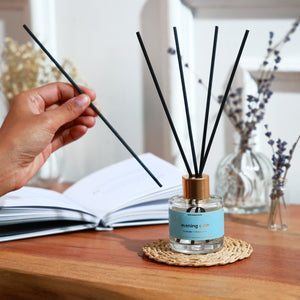 Evening Calm ₹799
  Oil refill 300ml ₹2,399
 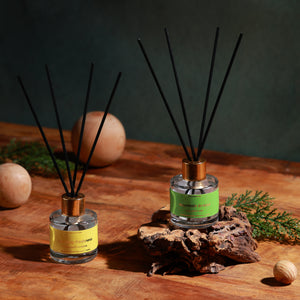 Fresh & Grounded duo ₹1,548
Mechanism one — the opening spike. Six dry reeds soak up oil fast on day one and release the lightest, most volatile notes first. Days 1–3 are a launch, not a baseline; weeks 1–2 settle; then comes a plateau that holds to the end, and the plateau is the product.
Mechanism two — the humid month. Evaporation off the exposed reed slows when the air is heavy, so less fragrance leaves per hour, the room reads quieter, and the bottle lasts longer. Check the liquid line against the calendar and it will usually have dropped less than it did earlier in the year.
If you still want more in the room, the lever is a second source, not a bigger bottle. A second 50ml at ₹749 at the far end of the space beats one 130ml in the middle. Size buys weeks, not metres.
2. Because humid air slows evaporation from the reed. Vapour leaves a surface into the air around it, and heavy air accepts it more slowly. Less fragrance per hour leaves the same reed, so the room reads quieter than the identical bottle did in a drier month.
3. The compensation is real and measurable. Slower evaporation means slower consumption. Mark the liquid level and check it against the calendar: in a heavy month a 50ml that normally runs 6–8 weeks often sits at the upper end. You get more weeks for the same money and pay for it in loudness.
4. Run the free checks before spending anything. Lift one reed and find the boundary between soaked and dry. High and dark means saturated — flip all six. Barely above the oil means it is not wicking. Then move the bottle: near a doorway, waist-to-chest height, clear space, away from a draught.
5. Judge it by walking in, not by sitting in it. Your nose stops reporting a constant, hardest of all at home. Shut the room for an hour, go outside, come back in. That first breath is the honest reading, and someone arriving from the corridor is a better instrument than you are.
6. If you want more after all that, add a source. Output per bottle is fixed by the reeds, so the only way to raise the total is another bottle — two 50ml at ₹749 at opposite ends beat one 130ml in the middle. A 130ml buys 14–18 weeks instead of 6–8; at six reeds it projects the same.
7. What would genuinely be a fault: a bottle emptying in under three weeks — a draught stripping the reeds — or reeds still dry just above the oil after a week, which means they need refreshing.
Everything is composed and handmade in small batches in Pune, tested through 45°C summer heat and 85% monsoon humidity, and a portion of every order supports girl-child education through Nanhi Kali.
Part one — the two mechanisms, separated
People describe this as one event — it was strong and then it stopped — but it is two independent things that happen to line up. One is about the reeds and happens in any climate. The other is about the air and belongs to a heavy month. Separating them matters, because only one is worth acting on.
 Mountain Breeze₹849 · 50mlEvaporation is a liquid leaving a surface for the air, and the rate depends on what the air will accept. Air already heavy with moisture takes up new vapour more slowly. The reed does not change and the oil does not change, but fewer molecules per hour make the crossing — so the room reads quieter. It is why the same bottle you bought in a dry month behaves differently now without anything having gone wrong. It runs the other way too: warmth raises the evaporation rate, which is why a bottle finishes sooner in a hot room. Mumbai in the rains gives you the humid side of that trade, and the trade is fair — you lose loudness and gain weeks. What you cannot do is have both.
Part two — what you notice, week by week
The whole life of a 50ml bottle in a heavy Mumbai month, set against which mechanism is doing the work at each stage. Most of the right-hand column says nothing, which is the point of it.
| When | What you notice | Which mechanism | Fault? | What to do |
|---|---|---|---|---|
| Days 1–3 ★ | Fills the room; you can smell it from the passage | Six freshly soaked reeds, top notes leaving together | No — this is the peak, not the level | Enjoy it, but do not benchmark against it |
| Days 4–10 | A clear drop. This is the moment people write in | The spike ending — mechanism one | No | Nothing. Give it a fortnight |
| Weeks 2–3, dry spell | Steady, low, noticeable on entering the room | The plateau — the product working | No | Flip all six once a week, with gloves |
| Weeks 2–3, heavy wet week | Quieter still, and the liquid has barely moved | Humidity slowing evaporation — mechanism two | No | Nothing. You are trading loudness for weeks |
| Any week, after a flip | Louder for about a day, then back to the plateau | Fresh reed surface exposed, then normalising | No | Not daily. Weekly is the schedule |
| Week 3, liquid already low | Emptying much faster than 6–8 weeks | Neither — a draught is stripping the reeds | Yes, and it is a placement problem | Move it away from the AC throw, fan or sun |
| Week 6–8, wet line at the oil | Liquid remains but almost no scent | Reeds saturated and no longer wicking | Partly — the reeds are spent, not the oil | Refresh the reeds — not sold separately, an honest gap |
| The honest caveat: there is a third thing this table cannot measure, and it is you. A nose stops reporting a constant smell, most stubbornly at home, where the fragrance has been present for weeks. That is ordinary and I will not put a timescale or a percentage on it. The reliable checks are leaving the room and coming back, or asking someone who has just arrived. If a visitor notices it at the door and you cannot, the bottle is fine. | ||||
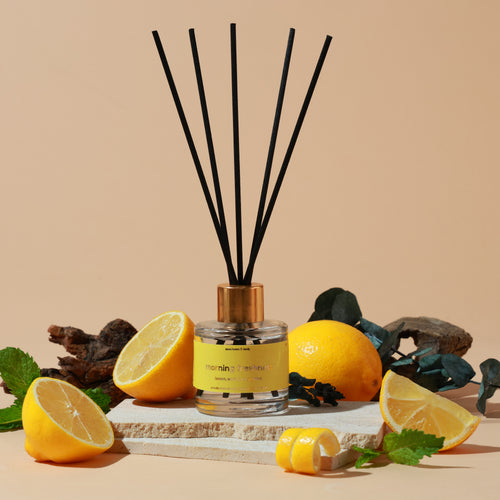
Morning Freshness · the easiest second bottle₹749Shop → 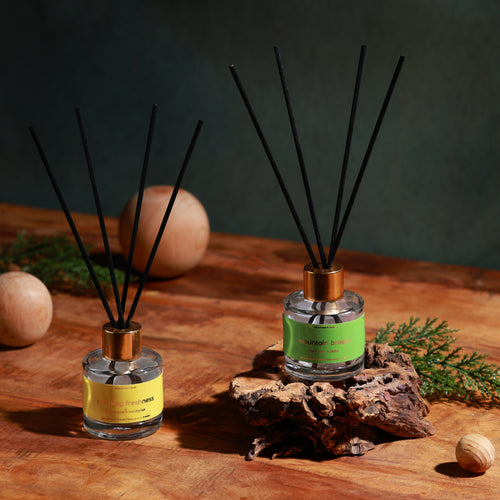 Fresh & Grounded · two sources, two ends₹1,548Shop →
 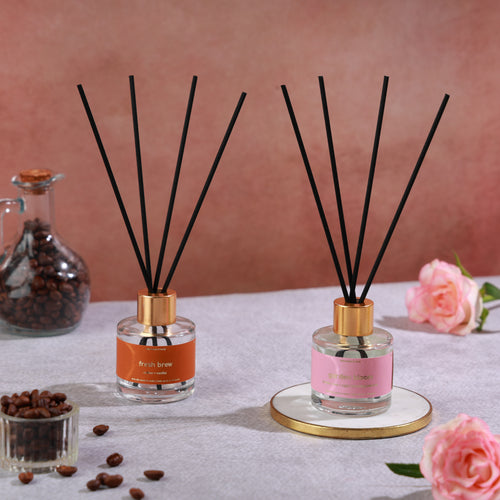 Oil refill · when it truly runs out₹2,399Shop →
Part three — when it is not the monsoon
Explaining everything away with the weather would do you no favours, so here are the cases where something genuinely is wrong. The clearest is a bottle emptying far too fast. If a 50ml is visibly low at three weeks, humidity is not your problem — a draught is. An air-conditioner's throw, a ceiling fan, an open window or direct afternoon sun all strip the reeds faster than the room can benefit: a weak room and a bottle that finishes weeks early. Move it out of the moving air and the sun, to waist-to-chest height with clear space around it. That single change fixes more complaints than any product I could sell you.
The second real case is spent reeds. If the wet line sits barely above the oil after several weeks, the reed is no longer carrying and the room will stay quiet no matter how much liquid remains. Here is the honest gap in our range: SOSA does not sell replacement reeds separately. Our guidance is to refresh them every few months, and an oil-only refill at ₹2,399 for 300ml gives you oil and no reeds. That is a genuine inconvenience and I will not dress it up; what people do in practice is keep the reeds from a finished bottle before discarding the glass. Better you read that here than discover it when the refill arrives.
And there is a case where the answer is not a fragrance product at all. If, alongside the quiet bottle, the room has developed a musty smell that returns a day or two after a proper clean, that is not a fragrance problem. The smell is telling you something in the room is still wet — a cupboard back, a window frame, a wall that has taken water in. A reed diffuser adds a scent alongside what is already there; it removes nothing and does not reduce humidity. Find the source, dry or repair it, ventilate properly, and then let the bottle work in air that is not competing with it. SOSA sells no dehumidifier and no air purifier, and a bottle of oil stands in for neither.
Part four — what to do, and what not to buy
Seven things a reader in this situation usually considers, what each would really change, and whether it is worth the money. The first row is free, and it is where I would start.
| What you were about to do | What it actually changes | Cost | Verdict |
|---|---|---|---|
| Flip all six reeds, then move the bottle to a doorway ★ | Fresh surface exposed, and scent finally distributed by incidental traffic | ₹0 | Do this first. It resolves most cases of exactly this complaint |
| Buy a replacement of the same bottle | Three loud days, then the identical plateau | ₹749–₹849 | No. You are buying the spike, not a stronger product |
| Buy the 130ml instead of the 50ml | 14–18 weeks instead of 6–8. At six reeds it projects the same | ₹1,249–₹1,349 | Only if you want fewer reorders. Never for more reach |
| Flip the reeds every day | A brief lift each time, and a bottle that finishes early | ₹0, but it costs weeks | No. Weekly is the schedule, with gloves |
| Add a second bottle at the far end of the space | More total output — the only way to raise it | ₹749 for a second 50ml | Yes, if the free checks failed. Two ends beat one middle |
| Buy a duo and run two rooms properly | Two sources that share a green note, so no seam at the doorway | ₹1,548 for 2 × 50ml | Sensible if the quiet room is one of two you use |
| Switch to a Sukoon because it is stronger | Control, not strength — and it adds moisture to a humid flat | ₹1,899 | Only if you want scent on demand. Not as a fix for this |
Versailles
There is a version of this product I could have made that wins the first week and loses the eighth. Phthalate solvents push fragrance hard off a reed — the opening is enormous — and then in Indian heat the material degrades and by week six it has gone slightly acrid. We build phthalate-free on a heat-stable CCT base, and the trade is a smaller opening and a longer, flatter plateau. I would rather say that out loud than have you compare our day one against something engineered for day one.
The monsoon adds a second thing on top, and it took our own testing through 85% humidity to make me comfortable explaining it plainly. Heavy air accepts vapour more slowly, so the same reed gives up less per hour. The room is quieter; the bottle lasts longer. I cannot give you a number for either, and anyone who does is guessing, but the direction is not in doubt and you can watch it in your own glass.
What I ask is a fortnight. Give a new bottle two weeks, flip once weekly, and read the room by walking into it rather than sitting in it. If after that it is genuinely too quiet for the space, the answer is another source, not a bigger one — and I would rather say so than sell you a 130ml under a promise it cannot keep. Made in Pune in small batches, and a part of every order funds a girl's classroom through Nanhi Kali.
Frequently asked questions
- A humid Mumbai bedroom — the same physics, and why reed count is the lever.
- Fragrance that adds no moisture — the format decision made on water alone.
- When the AC runs all night and the musty bedroom page.
- ₹1,500 for a Mumbai 2BHK — the city decision at a real ceiling.
- Brand: the SOSA founder story.
SOSA range, specifications and prices used in this guide (verified from the live store, 27 August 2026): Reed diffusers — alcohol-free, phthalate-free, paraben-free and IFRA-compliant compositions on a heat-stable coconut-derived (CCT) carrier, low-VOC, in a refillable glass bottle with six fibre reeds; flip weekly. 50ml lasts 6–8 weeks and 130ml lasts 14–18 weeks; there is no 100ml reed diffuser size. Morning Freshness (Malabar lemon · peppermint · Nilgiri eucalyptus) 50ml ₹749 · 130ml ₹1,249; Garden Bloom (British rose · night-blooming jasmine) ₹799 · ₹1,299; Evening Calm (Kashmir lavender · chamomile) ₹799 · ₹1,299; Fresh Brew (Coorg coffee · Kerala vanilla) ₹849 · ₹1,349; Mountain Breeze (Himalayan pine · sage · Indian cedar) ₹849 · ₹1,349. Duo sets ₹1,498–₹1,598 for 2 × 50ml and ₹2,498–₹2,598 for 2 × 130ml. Oil-only refills 300ml ₹2,399 · 500ml ₹3,499 — the glass vessel and reeds are not included, and replacement reeds are not sold as a separate product. Machines: Boond 300ml ₹899 (~150 sq ft, about 6 hours a fill) · Sukoon 500ml ₹1,899 (270–320 sq ft, 16–18 hours on low, three 15ml fragrances included) · Megh 6L ₹3,499 (~215 sq ft — a runtime and humidity machine that covers less than a Sukoon, never a coverage upgrade) · waterless Vaayu ₹11,999 · Safar ₹3,999 (a car and travel product) · Aangan ₹25,999 · Meenar ₹38,500. The water-based Hotel Collection for ultrasonic machines (15ml ₹299 · 100ml ₹999 · 300ml ₹1,799 · pack of seven 15ml ₹1,799) cannot be used in a reed bottle or a Vaayu. Below ₹749: jar candles ₹379, Sandalwood or Smoked Oudh candle ₹449, wax melts ₹474 (a burner is required and not included), mugs ₹474, bubble and taper candles ₹569, Amber Rose candle ₹599, ceramic trinket dish and candle two-pack ₹664. A reed diffuser adds fragrance to a room. It does not clean, purify or filter air, remove or neutralise cooking, damp or smoke smells, reduce humidity, or change how anyone feels. A reed diffuser adds no moisture to the air; ultrasonic machines work by aerosolising water and therefore do. A persistent musty smell indicates moisture that needs finding and drying, and SOSA sells no dehumidifier or air purifier. Ventilate or extract first; add fragrance second. Evaporation rate rises with warmth and falls with humidity, and airflow carries scent away from the bottle — so performance varies with season, ventilation, ceiling height and room use; longevity figures are typical ranges, not guarantees. Not noticing a constant fragrance is ordinary olfactory adaptation; the reliable checks are leaving the room and returning, or asking someone who has just arrived. Strength figures are positions on SOSA’s own internal scale, not an industry standard. Fragrance oil is flammable — keep bottles away from open flame and out of direct sunlight, and out of reach of children and pets. Composed and handmade in small batches in Pune, India; tested through 45°C summer heat and 85% monsoon humidity. Free shipping above ₹499. A portion of every order supports girl-child education through Nanhi Kali. Prices subject to change — see the live product pages.