


Do these five things first, all free: halve the distance between bottle and bed, put it at or slightly below nose height on a surface, use all six reeds, close the bedroom door, and turn the ceiling fan on low — the fan is the single most effective free change here, because it supplies the transport a reed structurally lacks.
On sizes: SOSA reeds come in 50ml and 130ml. For 120 sq ft the 50ml at ₹749–₹849 is the correct specification and runs 6–8 weeks; the 130ml at ₹1,249–₹1,349 is for rooms above about 150 sq ft and runs 14–18 weeks. If the bottle on your table is a 100ml, that is another house's size — and either way a bigger bottle buys weeks, not metres.
If the free fixes are not enough: the requirement you have — fragrance reaching the bed without the bottle beside it — needs moved air. Sukoon at ₹1,899 covers 270–320 sq ft and is very often the right bedroom answer.
The honest gap: between Safar ₹3,999 — named and sold as a car and travel diffuser — and Vaayu ₹11,999 at 1000 m³, roughly 2,000–3,000 sq ft, SOSA has no mid-sized waterless bedroom nebuliser. In 120 sq ft, Vaayu is the wrong purchase.
2. Get the height right and get it out of the wrong kind of air. Put the bottle at or slightly below nose height on a surface — not on the floor, where the fragrance has to climb, and not on a high shelf, where it sits above the layer of air you actually breathe. Then check what the air is doing around it. Not on a windowsill, not in the direct blast of a split AC, which strips the reeds and throws everything at one wall; but not shoved into a dead corner behind a wardrobe either, where nothing circulates at all. You want it in the room's ordinary circulation, out of the gale.
3. Use all six reeds, and close the door. Six is full projection; three is a soft bedside level that roughly doubles the life of the bottle. If you have been running three or four in a 120 sq ft room from across the room, you have been listening to the quiet setting. And containment is genuinely half the equation: a closed door turns your bedroom into a smaller, calmer volume that holds what the bottle emits, which costs nothing and takes a second.
4. Turn the ceiling fan on low. This is the best free advice on this page. A fan is precisely the transport a reed does not have. On its lowest setting in a closed room, it takes the vapour that is sitting in a warm column above your bottle and folds it through the whole 120 sq ft, which is the one thing the bottle can never do for itself. It will shorten the life of the bottle, because faster air across the reeds means faster evaporation — I would rather you knew that and chose it deliberately than discovered it in week five. For most people in a small closed bedroom, a fan on low is the difference between a corner and a room.
5. Only then consider spending, and know what you are buying. If you have done all of the above and you still want the fragrance to arrive at the bed without the bottle beside you, that is a requirement a passive device cannot meet by design, and the honest answer is a mechanism that moves air. Sukoon at ₹1,899 covers 270–320 sq ft and runs 16–18 hours on low. Keep the reed as well — it is silent, needs no power, has nothing to fill or charge, works in a power cut and never breaks.
Alcohol-free, phthalate-free, made in Pune. A portion of every order supports girl-child education through Nanhi Kali.
The free fixes, in the order I would actually make them
I want to spend the first part of this page giving things away, because a large share of people who write to me with your exact sentence are finished before they buy anything. The order below is deliberate: it goes from the change with the largest effect to the change that costs the most attention. Make one at a time and give each two days, because if you change five things at once you will never know which one worked, and you will end up buying something you did not need.
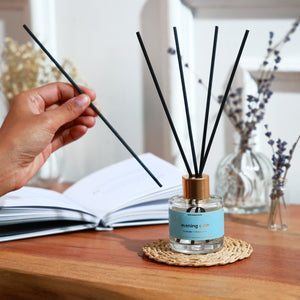
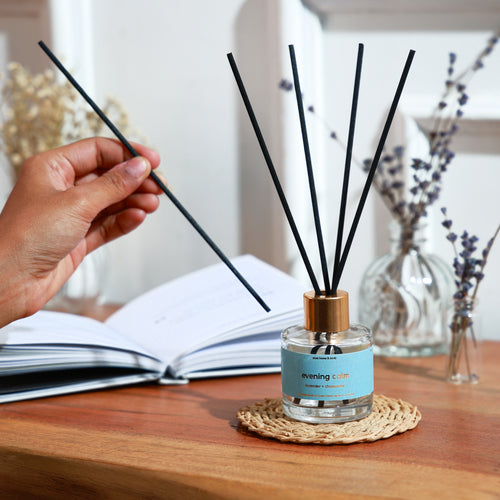
 Evening Calm₹799In a 120 sq ft bedroom the longest diagonal is around four and a half metres, and it is entirely possible that your bottle and your head are at opposite ends of it. Halving that distance changes your experience more than any other single decision, including changing the fragrance. Move the bottle to a bedside table, a low chest beside the bed, or a shelf within a metre of where your head rests. Get it onto a surface at or slightly below nose height: fragrance released at floor level has to rise through the coolest, stillest air in the room, and a bottle on a high shelf sits above the layer you breathe. Then reduce to three reeds if it now sits within arm's reach — the same bottle at close range needs a smaller dose, and three reeds roughly doubles how long it lasts.
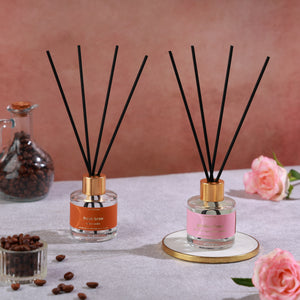
 Garden Bloom₹799Concentration in a room is what the bottle emits divided by the volume it is emitted into, reduced again by everything that leaves. A bedroom with the door open is not 120 sq ft — it is 120 sq ft plus a corridor plus whatever the corridor connects to. An open window or balcony door is larger still: air that leaves takes the fragrance with it, so the bottle is not weaker, the room is being flushed. A home with the windows open all day is not a fragrance environment during those hours, and it becomes one the moment they close. None of this requires you to live in a sealed box. It requires you to close the bedroom door for the hours you actually want the room to smell of something, which is usually the evening.
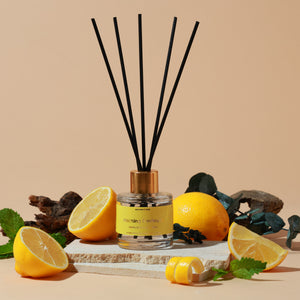
 Mountain Breeze₹849Everything else on this page raises how much fragrance is available or reduces how much escapes. This one does the thing the bottle genuinely cannot do: it moves the vapour. A ceiling fan on its lowest setting, in a closed room, is a free version of the exact feature you would otherwise pay for. Not on full speed, and not with the bottle sitting directly underneath the blades where the reeds get stripped — low, steady, with the bottle somewhere in the room's ordinary circulation. A running AC in a closed room does something similar, recirculating the same air and distributing well, which is why a bedroom often smells strongest at night; the trade is that dry air speeds evaporation. Both facts are true and you should have both. Faster air means a shorter bottle. It also means a room instead of a corner.
What 120 sq ft actually tells us — and what a bigger bottle would not do
Your room size is the most useful number in your question, because it removes a suspect. A 50ml reed diffuser is specified for rooms up to about 150 sq ft, so at 120 you are inside the envelope with room to spare. That matters, because the most common wrong diagnosis at this point is I bought too small a bottle. If you were writing to me from a 300 sq ft open-plan room I would tell you the bottle was under-specified and reading as weak while performing correctly. At 120 sq ft I cannot tell you that, and I will not, because it would be an easy sale and a bad answer.
Here is the sentence I would most like you to take away, and it applies whatever brand of bottle is currently on your table. Bottle volume is a duration specification, not a coverage specification. A larger bottle holds more oil, so it lasts longer. It does not push fragrance further, because nothing about a larger reservoir adds a transport mechanism — the reeds are the same reeds, the evaporating surface is the same surface, and the room's air is still doing all the delivery. In our own range the illustration is uncomfortable and I use it anyway: Megh at ₹3,499 has a six-litre tank and around a hundred hours of runtime, and covers only about 215 sq ft — less than the ₹1,899 Sukoon with its 270–320. Six litres against half a litre, and the smaller machine covers more. Tank size is runtime. It is never reach.
On sizes generally, so that nothing here is vague: SOSA supplies reed diffusers in 50ml and 130ml, and no other size. The 50ml suits rooms up to about 150 sq ft and lasts 6–8 weeks; the 130ml suits rooms above that and lasts 14–18 weeks. If the bottle you are looking at is a 100ml, it belongs to another house — that is perfectly fine and it does not change a word of the advice above, because the physics is the same for everybody's glass. For your 120 sq ft, per week the 130ml is better value, but the room does not need it, and buying up a size to solve reach would be spending five hundred rupees on the wrong axis. Six reeds and a fan on low will do far more for you than fifty extra millilitres ever could.
The free changes, ranked by how much they actually move the needle
All the no-cost changes in one place, with an honest note on what each one costs you elsewhere, because several of them shorten the life of the bottle and you deserve to know that before you make them rather than afterwards. The last row is the one people try first and the one that helps least with reach.
| Change | What it actually does | Effect on reach | What it costs you |
|---|---|---|---|
| 1. Halve the bottle-to-bed distance ★ | Puts your head inside the zone rather than outside it | The largest single improvement available | Nothing. Drop to three reeds if it is now within arm's reach |
| 2. Ceiling fan on low | Supplies transport — the one thing a reed has no mechanism for | Large. The nearest thing to a machine, for free | Bottle life. Faster air across the reeds means faster evaporation |
| 3. Close the bedroom door | Shrinks the volume the bottle is asked to fill and stops the leak | Large in the evening, when you are in the room anyway | Nothing at all |
| 4. Nose height, on a surface | Releases into the air layer you actually breathe | Moderate, and instant | Nothing |
| 5. All six reeds instead of three | Raises emission — more evaporating surface, more oil leaving | Higher, not further. It lifts the whole gradient, it does not extend it | Roughly halves the life of the bottle |
| 6. Flip the reeds every 3–5 days | Re-wets the exposed length and restores output for a few hours | None. It is a maintenance step, not a range step | Nothing, and it is worth doing anyway |
Bedside · Evening Calm 50ml₹799Shop → 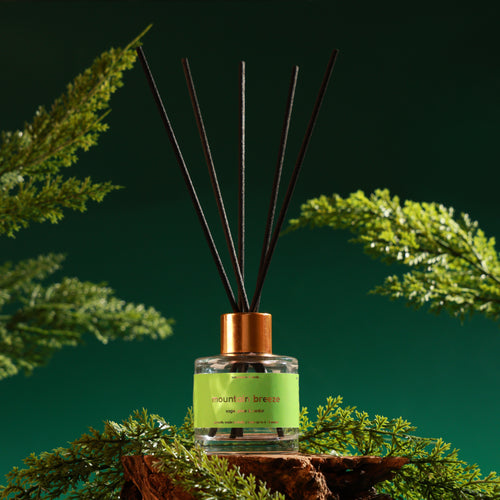 Across the room · Mountain Breeze₹849Shop →
  Moved air · Sukoon₹1,899Shop →
If the free fixes are not enough — the ladder, with the parts I would talk you out of
Suppose you have done everything above and the answer is still lovely at the table, quiet at the bed. That is a legitimate place to arrive at, and it means your requirement is one a passive device cannot meet: you want the fragrance to reach you rather than you to reach it. From here the choice is about mechanism, and I would rather walk you through the whole ladder including the rungs I do not want you standing on.
The step I recommend most often for a bedroom is Sukoon at ₹1,899, and it must never be skipped on the way to something dearer. It is an ultrasonic machine: a piezo plate vibrates a mixture of water and fragrance into a visible cool mist and pushes it into the room, which is a genuine step up in reach. It covers 270–320 sq ft, holds 500ml and runs 16–18 hours on low, and it arrives with three 15ml Hotel Collection scents so the fragrance question is answered on day one. The trade-offs, stated before the sale: the oil is diluted in water, the output adds humidity, and in a hard-water city it can leave a fine white mineral dust on nearby surfaces. Boond at ₹899 is the cheaper version of the same idea — 300ml, up to about 150 sq ft, around six hours, USB, with a night light — and for a 120 sq ft bedroom it is a fair first machine if the budget is the deciding factor.
Above that the picture needs care. Safar at ₹3,999 is named and sold as a car and travel perfume diffuser, and I will say that every time I mention it. SOSA's own page also lists a handbag, a desk, a bedside and a hotel room, so using it at personal scale is fair — but no room coverage figure has ever been published for it and I will not invent one. It shatters pure undiluted oil into a dry mist with no water, no dilution and no added humidity, holds 20ml, is fully cordless on a 2000 mAh Type-C battery giving up to ten hours continuous or around thirty intermittent, has three speeds and a one, two or three-hour auto-off timer, and stands 6.9 cm high. It is not set-and-forget: the timer runs in hours and it needs recharging. Vaayu at ₹11,999 is rated to 1000 m³, roughly 2,000–3,000 sq ft, and for your 120 sq ft bedroom the honest answer is no — nine-tenths of it would be wasted. And Megh at ₹3,499 is not a coverage upgrade at all. Between Safar and Vaayu, SOSA has no mid-sized waterless bedroom nebuliser. That gap is ours and I would rather name it than route you around it.
What I would buy, in order — starting at nothing
The order I would spend in if this were my own bedroom, beginning with the step that costs nothing and is most likely to end the matter. One thing to hold on to as you read down the rows: from the third step onward you are buying transport, control and evenness rather than a better smell. That is the honest description of what the higher price is for, and knowing it is what lets you decide whether you want it. The last row is the gap in our own range.
| Step | What it is | When it is the right answer | Price |
|---|---|---|---|
| 1. The five free changes ★ | Halve the distance, nose height on a surface, all six reeds, door shut, ceiling fan on low | First, always, and for a large share of readers this is the end of the matter. The fan is the most effective of the five because it is the transport a reed structurally lacks | ₹0 |
| 2. The right 50ml, on the bedside table | 50ml suits up to about 150 sq ft and runs 6–8 weeks at roughly ₹13–₹15 a day. Evening Calm ₹799 is the softest at 8.9; Mountain Breeze ₹849 at 9.4 carries better across a room | If you are still choosing a bottle. Softer for close range, deeper for distance — three reeds at arm's length, six across the room | ₹749–₹849 |
| 3. Boond | Ultrasonic, 300ml, up to about 150 sq ft, roughly six hours, USB, night light. Runs the water-based Hotel Collection | The cheapest way to have moved air in a 120 sq ft bedroom. It adds humidity and needs filling and switching on | ₹899 |
| 4. Sukoon | Ultrasonic, 500ml, 270–320 sq ft, 16–18 hours on low, three 15ml Hotel Collection scents included | Very often the correct bedroom answer, and never to be skipped on the way to something dearer. Water-diluted, adds humidity, can leave white mineral dust in a hard-water city | ₹1,899 |
| 5. Safar, with the disclosure attached | Waterless cold diffusion of undiluted oil, 20ml, cordless, 2000 mAh Type-C, three speeds, 1 / 2 / 3-hour timer, 6.9 cm. Named and sold as a car and travel perfume diffuser | When you specifically want undiluted oil, no water and no added humidity at personal scale. Not set-and-forget — the timer runs in hours and it needs recharging. No room coverage figure is published and I will not invent one | ₹3,999 |
| Not for your room: Vaayu, and the gap above Safar | Vaayu ₹11,999 is a waterless cold-air nebuliser rated to 1000 m³ — roughly 2,000–3,000 sq ft — with a 400ml tank and app control | In 120 sq ft, nine-tenths of it is wasted; it earns its price on a whole floor or an open-plan home. And between Safar and Vaayu there is no mid-sized waterless bedroom machine in this range. Megh ₹3,499 is not the answer either — six litres of tank and only about 215 sq ft | — |
Versailles
The phrase in your question I would gently push back on is what am I doing wrong. The honest answer is that you are doing nothing wrong, and that the object is doing exactly what it was built to do. A reed diffuser produces a fragrant zone. It has been producing one for you all along, and you have been standing outside it. The only mistake anywhere in this story belongs to the industry, for describing a passive object as something that scents a room and then letting people conclude that a quiet bed means a bad bottle.
There is a second thing worth knowing before you decide anything, because it changes what you should trust. Receptors adapt to a constant stimulus within minutes. The signal keeps arriving; the brain stops forwarding it. That means you can sit in a properly scented bedroom and honestly report smelling nothing at all — and it means you are the worst available instrument for measuring your own home. Leave for fifteen minutes and walk back in. Better still, ask somebody who does not live there. If a visitor remarks on it from the doorway and you cannot smell it from the bed, the room is working and your nose has simply stopped filing the report. I would run that test before spending anything.
And if you do reach the point of buying, buy the mechanism rather than a stronger smell. What a higher price buys in home fragrance is transport, control and evenness — not a better composition. A ₹749 reed and a machine several times its price can run related scents and produce completely different rooms, and the difference is entirely in how the air is handled. Meanwhile keep the reed. It is silent, it needs no power, there is nothing to fill or charge and nothing to remember, it carries on through a power cut, it costs roughly ₹13–₹15 a day, and unlike anything with a motor in it, it never breaks. Everything is composed in Pune, and a part of every order funds a girl's classroom through Nanhi Kali.
Frequently asked questions
- 10 × 12, all the reeds, flipped regularly — you have done everything right, and here is what that proves.
- Perfect in the bathroom, invisible in the bedroom — the experiment that proves your oil is fine.
- One by the door, one by the bed, still no cloud — two hills, no plateau.
- Larger bottles, same walk-past result — duration is not coverage.
- A strong oil that will not travel — what carries across to a machine and what does not.
- Every part of the bedroom, not the whole flat — three options, weighed honestly.
- 150 sq ft with a ceiling fan and a balcony — you may need to buy nothing at all.
- A second reed, or active diffusion? — the arithmetic, done properly.
- Passive device, active expectation — the pillar, and the close of the whole subject.
- Brand: the SOSA founder story.
SOSA facts verified August 2026: Reed diffusers are supplied in 50ml and 130ml only — 50ml suits rooms up to about 150 sq ft and lasts 6–8 weeks, 130ml suits rooms above 150 sq ft and lasts 14–18 weeks, at roughly ₹13–₹15 a day. Six reeds is full projection; three is a soft bedside level and roughly doubles the life; flip the reeds every 3–5 days. Morning Freshness ₹749 / ₹1,249 · Evening Calm ₹799 / ₹1,299 · Garden Bloom ₹799 / ₹1,299 · Mountain Breeze ₹849 / ₹1,349 · Fresh Brew ₹849 / ₹1,349. Strength scale, perceived intensity rather than quality: Evening Calm 8.9 softest, Garden Bloom 8.9, Morning Freshness 9.0, Mountain Breeze 9.4, Fresh Brew 9.5 deepest. Six fibre reeds rather than rattan, heat-stable CCT carrier rather than DPG, alcohol-free, phthalate-free, paraben-free, IFRA-compliant, 0 ppm formaldehyde, refillable glass bottle, tested at 45°C and 85% RH, composed in Pune. Refills 300ml ₹2,399 and 500ml ₹3,499, oil only and never a first purchase. Machines: Boond ₹899 (300ml, up to about 150 sq ft, ~6h, USB, night light) · Sukoon ₹1,899 (500ml, 270–320 sq ft, 16–18h on low, three 15ml Hotel Collection scents included) · Megh ₹3,499 (6L, ~100h runtime but only ~215 sq ft, never a coverage upgrade) · Safar ₹3,999, a waterless cold-diffusion device named and sold as a car and travel perfume diffuser, with a 20ml bottle, a 2000 mAh Type-C battery giving up to 10 hours continuous or around 30 intermittent, three speeds, a 1 / 2 / 3-hour auto-off timer and a height of 6.9 cm · Vaayu ₹11,999, a waterless cold-air nebuliser rated to 1000 m³, roughly 2,000–3,000 sq ft, with a 400ml tank and app control, and the wrong purchase for one bedroom. Between Safar and Vaayu there is no mid-sized waterless bedroom nebuliser in this range. Hotel Collection oils are water-based and ultrasonic-only: 15ml ₹299, 100ml ₹999, 300ml ₹1,799, pack of seven ₹1,799. Reed oil, the water-based Hotel Collection and pure fragrance oil are not interchangeable across these mechanisms in any direction. No health, air-quality, allergy, sleep or mood claims are made anywhere on this page. Free shipping above ₹499. SOSA is an independent Indian fragrance house; the Hotel Collection is SOSA's own interpretation inspired by the world's finest hotels and SOSA is not affiliated with or endorsed by any hotel brand. Prices subject to change — see the live product pages.