



The condition attached to that: a coverage rating applies to the air a machine can actually reach. A closed bedroom door is a boundary to airflow, and no rating passes through it. If that door is shut for most of the hours you care about, the bedroom is a separate volume and needs its own source — which does not have to be a machine.
When two devices genuinely is right: when you want the two rooms independently controllable — the living room scheduled for evenings, the bedroom only at night — or when you want a different scent in each room. One machine runs one oil on one schedule, so both of those requirements are two-device requirements by definition, not preferences you can settle in software.
What I recommend most often for this exact shape: Vaayu for the living room and connected space, and a reed diffuser at ₹749–₹849 for the bedroom behind its door. Total ₹12,748–₹12,848 rather than ₹15,998, two independent scents, and nothing to schedule in the bedroom.
About Safar: ₹3,999, waterless cold-diffusion of undiluted oil, 20ml bottle, 2000 mAh Type-C battery, up to 10 hours continuous or around 30 intermittent, 3 speeds, 1/2/3-hour auto-off timer, 6.9 cm. It is named and sold as a car and travel diffuser, and SOSA has published no room-coverage figure for it. Both of those are true and you should know them before you spend, not after.
The honest gap: between Safar and Vaayu, SOSA has no mid-sized waterless bedroom nebuliser. There is no half-Vaayu for one room, and that absence is the reason this question keeps being asked in the first place.
2. But do not let the rating flatter you into thinking a door is optional. A coverage figure tells you how much air a machine can supply; it does not tell you that scent will find its way past a closed bedroom door, because it will not. Air moves through openings. If your bedroom door stands open during the evening and shuts only when you sleep, one machine in the living space will carry into it and you are done. If that door is closed all day — which is how most people run a bedroom — the bedroom is a separate volume, and separate volumes need separate sources.
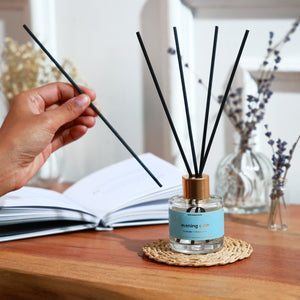
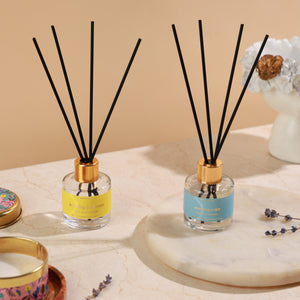
3. The second source almost never needs to be a machine. This is the part readers skip. A closed 120 sq ft bedroom is the easiest scenting problem in a home: very little air, one door, low exchange, and long hours with nobody opening anything. A 50ml reed diffuser at ₹749–₹849 is specified for rooms up to about 150 sq ft, runs 6–8 weeks, costs about ₹13–₹15 a day, and asks nothing of you but a flip of the reeds every three to five days. Vaayu for the floor and a reed for the room behind the door is the combination I recommend most often for exactly your shape of flat.
4. Two devices becomes the right answer the moment you want the rooms to behave differently. One machine runs one oil on one schedule. If you want the living room lively from six until eleven and the bedroom quiet until you go to bed, or if you want something crisp in the living room and something soft in the bedroom, no amount of app scheduling on a single unit will do it. That is a genuine two-device requirement and I would not talk you out of it.
5. If you do want a second waterless device, know exactly what Safar is before you buy it. ₹3,999. Waterless cold-diffusion of undiluted oil — the same physical principle as Vaayu, at personal scale. 20ml bottle, 2000 mAh Type-C battery, up to 10 hours continuous or around 30 hours intermittent, three speeds, a 1/2/3-hour auto-off timer, 6.9 cm across. It is named and sold as a car and travel diffuser, although SOSA’s own product page also names bedside and hotel room among its intended places, and SOSA has published no room-coverage figure for it. It is a personal and small-space scenting device, it needs recharging, and its timer runs out. Those are not objections; they are the specification, and you should meet them here rather than at home.
Alcohol-free, phthalate-free, paraben-free, IFRA-compliant, 0 ppm formaldehyde across the reed range. Free shipping above ₹499, and a portion of every order supports girl-child education through Nanhi Kali.

Why two machines is usually the wrong shape for two rooms
The instinct behind the question is completely reasonable, and it comes from how we buy almost everything else in a home. One air conditioner per room. One fan per room. One light fitting per room. Fragrance does not work that way, because a diffuser is not a device that treats a room; it is a device that supplies a quantity of atomised oil into whatever air it can reach. The right unit of purchase is therefore not the room but the connected volume — everything the air can circulate between without passing a closed door. If your living room, dining area and passage form one such volume and the bedroom joins it whenever the door is open, you have one scenting problem with two occupancy patterns, not two scenting problems.
Put the numbers side by side, because they are unusually decisive here. Vaayu is rated up to 1000 m³, which SOSA states as roughly 2,000 to 3,000 sq ft, and it is quoted in cubic metres rather than square feet precisely because at that scale ceiling height stops being negligible. A generous living room in an Indian flat is 300 to 500 sq ft. A smaller bedroom is 100 to 150. Even if you count the dining end, the passage and a balcony left open, you are unlikely to reach half the machine’s rating. Adding a second waterless device to that arrangement is not doubling your coverage; it is adding a second source inside an envelope that was already covered, and then paying to run and maintain it.
There is one honest qualification and I would rather lead with it than bury it, because it is the thing that turns a good recommendation into a bad experience. A coverage rating applies to air a machine can actually reach. Fragrance molecules move where air moves; they do not pass meaningfully through a shut door, and they do not build up in a room the airflow does not enter. So the arithmetic above holds if the two rooms share air during the hours you care about, and fails if they do not. The test is embarrassingly simple: think about your own week, and ask how many hours the bedroom door is genuinely open. If the answer is “most of the evening”, one machine. If the answer is “it is shut from morning until I go to bed”, you need a second source in that room — and a second source is a much cheaper object than a second machine.
 Sukoon₹1,899Two sources in one connected volume do not produce twice the presence. They produce two concentration peaks at two intensities, drifting into each other unevenly, with two things to refill and, if the oils differ at all, a muddle in the middle where the two meet. Hotels are admired for evenness, not for having many machines — and evenness is exactly what a patchwork of sources fails at. If both rooms share air, one machine at the right size beats two machines at any size.
 Evening Calm₹799Everywhere else in this cluster I describe closing a door as the cheapest tool in scenting, because cutting air exchange raises concentration more reliably than raising output does. Here the same fact cuts the other way: the door that makes your bedroom easy to scent on its own is the door that stops the living-room machine reaching it. You cannot have containment and carry-over at the same time. Decide which one you want in that room, and buy accordingly — and notice that containment is the cheaper of the two, because a small closed room reaches a perceptible level with very little help.
 Mountain Breeze₹849Vaayu’s Bluetooth app gives run windows of 1h, 4h, 8h or 24h, a choice of days, adjustable mist intensity and a key-lock — a genuinely good set of controls, all of which apply to the one tank of oil the machine is running. So the two requirements it cannot meet are separate timing and separate scent. If you want the living room alive at six in the evening and the bedroom untouched until eleven, that is two devices. If you want a crisp register where you receive people and a soft one where you sleep, that is two devices as well — and, incidentally, the better decision aesthetically, because a home that smells identical in every room stops registering as a smell at all within about a week.
The three cases where two devices genuinely is the right answer
I have spent the page so far arguing against the shape of your plan, so it is only fair to set out the versions of it I would endorse without hesitation. The first is independent control. If the living room should be scented during the hours you entertain and the bedroom only in the hour before sleep, one machine cannot do it, because one machine has one schedule. Two devices give you two timetables, and timing is a legitimate luxury — arguably the largest single difference between a home that smells nice and a home that smells deliberate. In this version I would still not put the expensive machine in the small room: Vaayu on the living space, and something small and controllable in the bedroom.
The second is separate scents. This is the case I sympathise with most, because it is a perfumer’s reason rather than an engineer’s. A single machine means a single accord throughout, and while that is precisely how hotels achieve their signature, a home is not a hotel and you live in it rather than passing through. Zoning — something bright and open where you sit with people, something quieter and warmer where you sleep — keeps both rooms perceptible for far longer, because your nose registers change and stops registering constancy. If this is your reason, buy two sources and stop worrying about whether one machine was enough; enough was never the question.
The third is the closed door, which is really the first two in disguise. A bedroom shut for eighteen hours a day is not part of the living room’s volume in any practical sense, so it needs a source of its own regardless of what the living-room machine is rated to cover. What that source should be is the whole of the next section, and the short version is that it is usually a reed. What I would not do, in any of these three cases, is buy two Vaayus, and I would not buy Safar in multiples either — a second personal device is a considered purchase for one specific place, not a way of tiling a flat.
| The shape | What it gives you | What it does not give you | Total |
|---|---|---|---|
| Vaayu + a reed in the bedroom ★ | Even, dry, undiluted coverage of the living space on an app schedule, plus a separate scent behind the bedroom door that never needs switching on | Timed control in the bedroom — a reed cannot be switched off | ₹12,748–₹12,848 |
| Vaayu alone, bedroom door open | One signature through the whole flat, one tank, one schedule. The most hotel-like arrangement there is | Any difference between the two rooms, and anything at all in the bedroom when the door is shut | ₹11,999 |
| Vaayu + Safar | Waterless, undiluted oil in both rooms; independent timing; a second scent if you want one | Value, mostly. Safar has no published room-coverage figure and is named and sold as a car and travel diffuser; it needs recharging and its timer runs 1, 2 or 3 hours | ₹15,998 |
| Sukoon in the living room + a reed in the bedroom | Genuine room coverage at 270–320 sq ft, 16–18 hours on low, three 15ml Hotel Collection scents included, for under ₹2,750 the pair | Coverage of a large or connected living space, and it dilutes the oil in water, adds humidity and needs filling | ₹2,648–₹2,748 |
| Two reeds, one per room | Two scents, silent, unpowered, nothing to charge or fill, about ₹13–₹15 a day each, and an object rather than an appliance in both rooms | Scent presence across a large living room. A reed makes a fragrant zone, not a fragranced floor | ₹1,498–₹1,698 |
| The honest gap: between Safar at personal scale and Vaayu at 2,000–3,000 sq ft, SOSA makes no mid-sized waterless nebuliser — nothing sized for one bedroom that runs undiluted oil without water. If we made it, it would be the obvious second device on this page. We do not, which is why the second device here is either a reed, a water machine, or a personal one bought with its limitations understood. | |||
The oils · Hotel Collection₹999Shop →  If the living room is modest · Sukoon₹1,899Shop →
 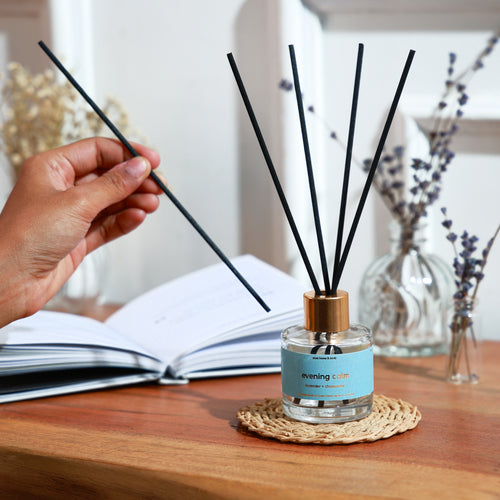 For the bedroom · Evening Calm₹799Shop →
The pairing I recommend most often for exactly this flat
Vaayu on the living space, a reed in the bedroom. It is not the most expensive combination and it is not the neatest on paper, and I recommend it because it matches the physics of the two rooms rather than their status. The living room is large, probably connected to a dining end and a passage, and probably has no door you would ever close — so it can only be scented by throughput, which is what a waterless cold-air nebuliser supplies: pressurised air shattering undiluted oil into a dry micro-mist that travels with the room’s own airflow, no water, no dilution, no added humidity, no white mineral dust. Set it to an 8h evening window at a moderate intensity, judge the level by what a visitor says rather than by what you can smell, and the 400ml tank will run towards the upper end of its 90+ days.
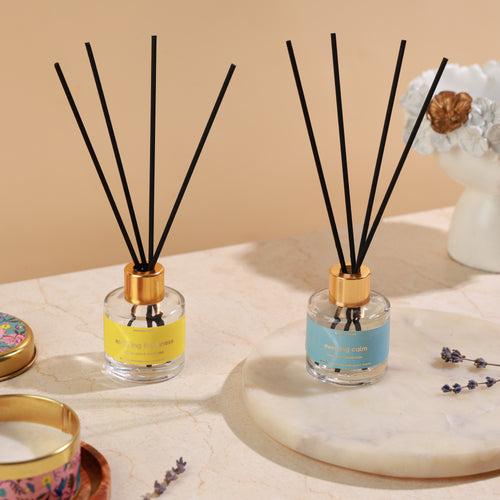
The bedroom, meanwhile, is small and it closes, which makes it the easiest room in the flat. A 50ml reed diffuser is specified for rooms up to about 150 sq ft, it holds a level in a closed room very comfortably, and it does several things no machine in this range does: it is silent, it uses no power, it never needs charging, it cannot be forgotten in either direction, it does not add humidity, and it looks like a piece of glass on a table rather than an appliance with a status light. Six fibre reeds is full projection and three is a soft bedside level with roughly double the life; in a small closed bedroom I would start at three or four and flip them every three to five days. Evening Calm at ₹799 is the softest thing we make at 8.9 on our strength scale, which is usually what a bedroom wants.
If you would rather have real coverage and control in that bedroom and you can live with water, Sukoon at ₹1,899 covers 270–320 sq ft, runs 16–18 hours on low and includes three 15ml Hotel Collection scents — over-specified for a small room, which is exactly why you can run it gently and still have a machine you can switch off. The costs are honest ones: the oil is diluted in water, the output adds humidity, it needs filling, and hard water can leave a fine white mineral dust nearby. And if water is the thing you are trying to avoid, that is where the range’s gap becomes a practical problem rather than a footnote — the waterless mechanism exists here at personal scale and at floor scale, and at nothing in between.
What to buy, in order — and the rung that does not exist
In the order I would actually spend, assuming a large living space that connects to the rest of the flat and a smaller bedroom that closes. The last row is our own gap, stated plainly, because half the appeal of “Safar in one and Vaayu in the other” comes from there being nothing in between the two.
| Buy | What it is | When it is the right answer | Price |
|---|---|---|---|
| 1. Vaayu, in the living space ★ | Waterless cold-air nebuliser, undiluted oil as a dry nano-mist. Up to 1000 m³ — roughly 2,000–3,000 sq ft. 400ml tank up to about 90+ days. Bluetooth app plus onboard buttons, 1h/4h/8h/24h windows, choice of days, adjustable intensity, key-lock. Under 38 dB. Freestanding or wall/HVAC mount, 5W, CE, RoHS, SGS | When the living room is large or connects to a dining end and a passage. One machine covers that and the bedroom too, whenever the door is open | ₹11,999 |
| 2. A reed diffuser, in the bedroom | Passive capillary diffusion — oil climbing six fibre reeds and evaporating. 50ml up to ~150 sq ft, 6–8 weeks; 130ml above 150 sq ft, 14–18 weeks. Refillable glass, about ₹13–₹15 a day | For the room that closes. Silent, unpowered, nothing to charge or fill, a different scent from the living room, and it never has to be switched on | ₹749–₹849 |
| 3. Or Sukoon, in the bedroom | Ultrasonic water mist — 500ml, 270–320 sq ft, 16–18 hours on low, three 15ml Hotel Collection scents included | When you want the bedroom on your own schedule and can accept dilution in water, added humidity and refilling | ₹1,899 |
| Only for a specific reason: Safar | Waterless cold-diffusion of undiluted oil at personal scale — 20ml, 2000 mAh Type-C, up to 10h continuous or ~30h intermittent, 3 speeds, 1/2/3-hour auto-off, 6.9 cm. Named and sold as a car and travel diffuser | If you want waterless, undiluted oil at a bedside with independent control — and you accept that there is no published room-coverage figure and that it needs recharging. Never buy it in multiples to tile a flat | ₹3,999 |
| Never a coverage upgrade: Megh | 6L tank, around 100 hours of runtime, about 215 sq ft of coverage | Less coverage than the ₹1,899 Sukoon. A runtime and humidity machine, and the easiest product in our range to misread as the big one | ₹3,499 |
| The honest gap | Nothing exists between Safar and Vaayu — no mid-sized waterless bedroom nebuliser, no half-Vaayu for one room. Above Vaayu sit commercial HVAC machines, Aangan ₹25,999 at ~8,000–10,000 sq ft and Meenar ₹38,500 at 12,000–18,000, which belong in hotels and showrooms rather than homes | Said plainly. It is the reason the second device in this plan ends up being a reed or a water machine rather than a small nebuliser | — |
Versailles
This question arrives in my inbox more often than any other in the machine half of the range, and it almost always arrives with the two devices already chosen and only the allocation in doubt — which one goes where. The allocation is not the decision. The decision was made a step earlier, when the rooms were counted instead of the air, and I would rather answer the earlier question than the later one even though the later one would sell more.
Here is what I would do standing in your flat. Pace the living space, the dining end and the passage, and note what has no door between it and the rest. Put that number next to 1000 m³ — roughly two to three thousand square feet — and you will very probably find that one machine is more than the whole flat needs. Then look at the bedroom door and ask how many hours a day it is shut. If it is shut, that room is a separate problem and it wants a separate source, and in a room that small the source I would choose is a ₹749 bottle with three sticks in it rather than a second machine.
And there is a version of your plan I would happily sign off on, which is the one where the two rooms are meant to smell of different things or run at different hours. That is not a coverage decision, it is a design decision, and it is the better reason to spend twice. I will also say plainly what I say on every page in this family: we do not make a mid-sized waterless machine, so the tidy answer you were hoping for — a small Vaayu for the bedroom — does not exist. If it did I would have recommended it four paragraphs ago. Everything is composed in Pune, and part of every order funds a girl’s classroom through Nanhi Kali.
Frequently asked questions
- A 100 sq ft bedroom and a hit at the door — the cheapest real answer to the arrival moment.
- A 10 × 12 AC bedroom where the reed only works near the bottle — distance decay, and what recirculating air is worth.
- Mumbai, small, humid, no water — the constraint stack that most exposes the range’s gap.
- 150 sq ft, strong fragrance, on only when I’m home — the control question, answered honestly.
- Bedroom only, not the whole 2BHK — no, and here is what to buy instead.
- Expensive oil, no scent cloud — the oil decides whether you like it; the mechanism decides whether it is there.
- What type of diffuser should I search for — the words that make your next search work.
- “Strongest hotel reed diffuser” — why that product does not exist anywhere.
- Reed, Safar or Vaayu — the whole method in one page.
- Brand: the SOSA founder story.
Facts verified August 2026: Three diffusion mechanisms are described — passive capillary (reed diffusers), ultrasonic water mist (Boond ₹899, 300ml, up to ~150 sq ft, ~6 hours, USB, night light; Sukoon ₹1,899, 500ml, 270–320 sq ft, 16–18 hours on low, three 15ml Hotel Collection scents included; Megh ₹3,499, 6L tank, ~100 hours runtime, ~215 sq ft, which is less coverage than Sukoon and never a coverage upgrade) and waterless cold-air nebulising (Safar ₹3,999, 20ml bottle, 2000 mAh Type-C battery, up to 10 hours continuous or around 30 hours intermittent, 3 speeds, 1/2/3-hour auto-off timer, 6.9 cm, named and sold as a car and travel diffuser with car, handbag, desk, bedside and hotel room among its stated uses, no published room-coverage figure; Vaayu ₹11,999, coverage up to 1000 m³ or roughly 2,000–3,000 sq ft, 400ml refillable tank lasting up to about 90+ days depending on intensity and scheduled hours, Bluetooth app and onboard buttons, 1h/4h/8h/24h run windows, choice of days, adjustable mist intensity, key-lock, under 38 dB, freestanding or wall/HVAC mount, 5W, CE, RoHS, SGS, and to be used with alcohol-free water-free oils formulated for cold-air diffusion). Aangan ₹25,999 (~8,000–10,000 sq ft) and Meenar ₹38,500 (12,000–18,000 sq ft) are commercial HVAC machines and are named here only as the top of the ladder, never as a home recommendation. SOSA reed diffusers: five scents, 50ml ₹749–₹849 lasting 6–8 weeks and suiting rooms up to ~150 sq ft, 130ml ₹1,249–₹1,349 lasting 14–18 weeks and suiting above 150 sq ft, six fibre reeds included and flipped every 3–5 days, six reeds for full projection and three for a soft bedside level, about ₹13–₹15 a day, heat-stable CCT carrier rather than DPG, alcohol-free, phthalate-free, paraben-free, IFRA-compliant, 0 ppm formaldehyde, refillable glass bottle, climate-tested at 45°C and 85% RH, composed in Pune. Duos are two 50ml bottles at ₹1,498–₹1,598; 130ml duos ₹2,498–₹2,598; refills 300ml ₹2,399 and 500ml ₹3,499, oil only and never a first purchase. SOSA strength scale: Evening Calm 8.9, Garden Bloom 8.9, Morning Freshness 9.0, Mountain Breeze 9.4, Fresh Brew 9.5. Hotel Collection fragrance oils are water-based and ultrasonic-only at 15ml ₹299 (a refill), 100ml ₹999, 300ml ₹1,799 and a pack of seven at ₹1,799; they cannot be used in reed diffusers and reed oil cannot be used in ultrasonic machines, so no hotel-inspired reed diffuser exists. Between Safar and Vaayu, SOSA makes no mid-sized waterless nebuliser. No health, air-quality, allergy or antimicrobial claims are made, and fragrance does not remove a smell — source, then ventilation, then fragrance. Free shipping above ₹499. A portion of every order supports girl-child education through Nanhi Kali. SOSA is an independent Indian fragrance house; the Hotel Collection scents referenced here are SOSA’s own interpretations inspired by the world’s finest hotels, and SOSA is not affiliated with, endorsed by or a supplier to any hotel brand. Prices subject to change — see the live product pages.