

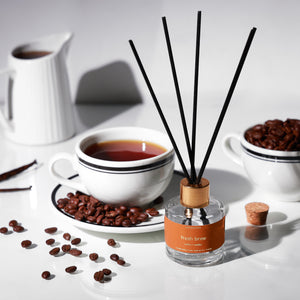



Why, in one paragraph: a reed’s output is bounded by evaporation from a fixed surface — six fibre reeds above a liquid line — and no energy is added, so the rate is whatever the room’s temperature, humidity and airflow allow. More importantly, a reed adds no air. Molecules go only where the room’s own air was already going. That produces a concentration gradient, highest at the bottle and falling with distance — a fragrant zone, not a fragranced room.
The two dials a maker actually has: more volatile materials (louder for a fortnight, then gone) and more reeds (six is full projection; more empties the bottle faster). Neither adds transport. The ceiling is structural.
What to search for instead: “ultrasonic cool-mist diffuser coverage sq ft” or “waterless cold-air nebulising diffuser”. Sukoon ₹1,899 covers 270–320 sq ft and runs 16–18 hours on low — genuine bedroom coverage, with the oil diluted in water. Safar ₹3,999 is waterless and undiluted at personal scale; it is named and sold as a car and travel diffuser with no published room-coverage figure. Vaayu ₹11,999 covers up to 1000 m³ and is the wrong purchase for one bedroom.
Check these three free things first: placement out of the draught, all six reeds rather than three, and the adaptation test — leave for fifteen minutes and walk back in, or ask a visitor.
The honest gap: between Safar and Vaayu, SOSA has no mid-sized waterless bedroom nebuliser. So the redirection this page recommends lands on either a water machine or a personal one, and I would rather say that than dress it up.
2. The output is bounded by a fixed evaporating surface. Oil climbs six fibre reeds by capillary action and evaporates from whatever length of stick stands above the bottle. That surface area is fixed. The rate at which material leaves it is set by the volatility of the composition and by the room’s temperature, humidity and airflow — none of which the manufacturer controls once the bottle is on your table. There is no pump, no fan, no heat and no pressure anywhere in the object.
3. And — this is the decisive half — a reed adds no air. Fragrance molecules travel where air travels. A machine that atomises oil into a moving stream is putting scent into a transport system; a reed is putting scent into whatever the room happens to be doing, which in a closed still bedroom is very little. The result is a gradient: strong at the bottle, thinner at a metre, absent at the door. That is a fragrant zone rather than a fragranced room, and it is the design rather than a defect. Projection across a space requires moved air, and the format has no mechanism for moving air at all.
4. The two dials a maker has both trade life for intensity, and neither adds reach. Load the composition with more volatile top materials and it will read louder for ten days and then be quiet — the classic front-loaded citrus. Give you more sticks and the output rises and the bottle empties proportionally faster; six is full projection, three is a soft bedside level and roughly doubles the life. You can and should use the reed count as a volume dial. What you cannot do is dial your way past the ceiling, because the ceiling is not about how much oil leaves the bottle. It is about nothing carrying it.
5. So change the noun in your search. Stop searching “strongest” and start searching coverage. “Ultrasonic cool-mist diffuser coverage sq ft” will find you Sukoon at ₹1,899, which covers 270–320 sq ft on a 500ml tank with 16–18 hours on low and three 15ml Hotel Collection scents included — genuine bedroom coverage, at the cost of the oil being diluted in water, added humidity, refilling and, in hard-water cities, a fine white mineral dust. “Waterless cold-air nebulising diffuser” will find you the mechanism hotels use: Safar ₹3,999 at personal scale, named and sold as a car and travel diffuser with no published room-coverage figure, and Vaayu ₹11,999 at up to 1000 m³, which for one bedroom is nine-tenths wasted.
Alcohol-free, phthalate-free, paraben-free, IFRA-compliant, 0 ppm formaldehyde across the reed range. Free shipping above ₹499, and a portion of every order supports girl-child education through Nanhi Kali.
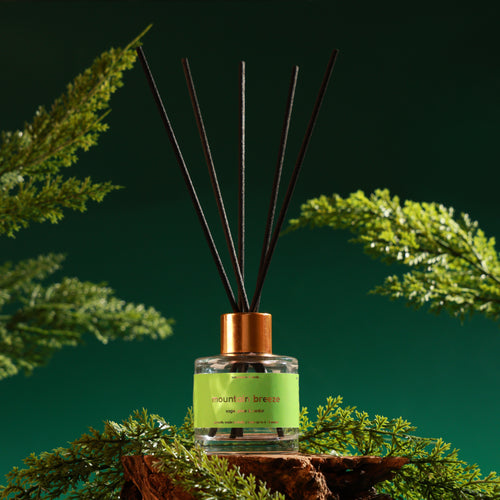
Why nobody can build the product you are searching for
It is worth taking this apart properly, because “it does not exist” sounds like an excuse until you can see why. A reed diffuser is a passive evaporator. Oil moves up the porous structure of each stick by capillary action, arrives at the exposed surface, and leaves as vapour at a rate governed by three things: how volatile the materials are, how warm and how humid the surrounding air is, and how quickly that air is being replaced. There is no energy input anywhere in the system. The bottle does not push, the sticks do not pull, and nothing in the object is doing work.
Now consider what a manufacturer could change. Surface area: more sticks, or thicker ones. You have six, which is already full projection, and adding surface raises output while shortening life proportionally — a real dial, and a short one. Volatility: compose with lighter, faster-leaving materials. This genuinely raises the first fortnight and then leaves you with a quiet bottle, which is exactly the front-loaded citrus pattern that gives the whole format a reputation for fading. Concentration: more fragrance load in the oil. This raises the concentration at the source and does not change how far it goes, because the limit is not how much is in the air near the bottle. Every available lever moves output and none of them moves transport.
Transport is the whole of it. Fragrance molecules are carried by air, and a reed diffuser supplies no air. In a closed bedroom with the fan off, the air near the bottle mixes with the rest of the room slowly, by diffusion and by small convection currents, and the result is a stable gradient rather than a uniform concentration. That is why the classic report — lovely when I pass it, nothing from the bed — is so consistent across every brand and every price. A machine that atomises oil into a moving stream is doing a different job: it is not just releasing scent, it is delivering it. An ultrasonic unit vibrates a water-and-oil mixture into a visible mist and pushes it out; a cold-air nebuliser uses pressurised air to shatter undiluted oil into a dry micro-mist that travels with the room’s own airflow. Both emit and transport. A reed only emits, beautifully, in one place.
 Fresh Brew₹849There is no agreed definition of strength in this category and no standard to measure against, so any listing may claim it and none can be checked. That is why your search returns an inexhaustible supply of confident pages and no product that behaves differently once it is on your table. The search is not failing because you have not found the right seller. It is failing because the query is about an axis that has a very short range. Change the query to a measurable noun — coverage, in square feet or cubic metres — and the results become comparable overnight.
 Refills₹2,399Before you conclude anything, use all six. A great many people run three or four because that is how the bottle looked nice, then judge the format on a half-open valve. Six is full projection; three is a soft bedside level and roughly doubles the life. Flip them every three to five days — that restores projection without opening a new bottle, and it is a three-to-five-day cadence rather than a daily ritual. If you find yourself flipping every day to chase a level, that is the format telling you it is being asked for something it cannot give.
 Evening Calm₹799Olfactory receptors adapt to a constant, unchanging stimulus within minutes: the signal still arrives and the brain stops reporting it because nothing has changed. This is why you smell your own home only after being away from it, and why a visitor is a better instrument than you are. Before buying anything, leave the room for fifteen minutes and walk back in, and pay attention only to the first three seconds. If a guest says the bedroom smells lovely and you cannot detect it, the diffuser is doing its job for everyone but you, and what you are missing is the arrival contrast rather than the fragrance.
What our own strength scale is actually measuring, since we publish one
It would be evasive to argue that reed strength does not exist when SOSA prints a number on every bottle, so here is what that number is. Our scale runs from Evening Calm at 8.9, the softest thing we make, through Garden Bloom at 8.9, Morning Freshness at 9.0 and Mountain Breeze at 9.4, to Fresh Brew at 9.5, the deepest. It measures perceived intensity in a room — not quality, not concentration, and emphatically not projection. It exists so that somebody buying for a small sealed bedroom can choose deliberately downwards, which is a decision far more people should make and almost nobody does.
The distance between 8.9 and 9.5 is real. You will notice it, and if what you want is the most present reed we make, then Fresh Brew or Mountain Breeze is an honest recommendation and I would give it without hesitation. But it is a difference within a bounded envelope. Both ends of that scale are producing a gradient around a bottle; the deepest one simply starts from a higher value and holds a slightly wider zone. Neither end reaches the far corner of a 150 sq ft bedroom at a level you would describe as presence. The scale tells you which reed to choose. It does not tell you whether a reed is the right category, and that is the question you actually came with.
One more thing worth saying plainly, because it is a premise several readers arrive with. There is no hotel-inspired reed diffuser at SOSA. Our Hotel Collection is water-based and made for ultrasonic machines only; reed oil cannot go into a machine, and Hotel Collection oil cannot go into reeds. The two are different physical systems and they do not mix in either direction. If your search phrase has been “hotel reed diffuser”, part of why it has been unsatisfying is that you have been looking for the intersection of two product lines that do not intersect. What exists is a reed with a hotel-style fragrance, which is a lovely object and is still a reed, and a hotel-mechanism machine, which is a different purchase entirely.
| Stop searching | Start searching | What it finds | What it will do in a bedroom | Price |
|---|---|---|---|---|
| “Strongest reed diffuser” | “Reed diffuser 130ml for above 150 sq ft” | A larger reed — ₹1,249–₹1,349, 14–18 weeks, six fibre reeds | A larger, longer-lived fragrant zone. Still a zone. Silent, unpowered, nothing to remember | ₹1,249–₹1,349 |
| “Most powerful home fragrance” | “Ultrasonic cool-mist diffuser coverage sq ft” ★ | Sukoon — 500ml, 270–320 sq ft, 16–18 hours on low, three 15ml Hotel Collection scents included | Genuine coverage of the whole room, on demand. Oil diluted in water, adds humidity, needs filling, can leave white dust | ₹1,899 |
| “Hotel reed diffuser” | “Waterless cold-air nebulising diffuser” | Safar — undiluted oil, 20ml, 3 speeds, 1/2/3-hour auto-off, up to 10h continuous or ~30h intermittent, 6.9 cm | Personal and small-space presence with no water. Named and sold as a car and travel diffuser; no published room-coverage figure | ₹3,999 |
| “Biggest diffuser” | “Scent machine coverage m³ app timer” | Vaayu — up to 1000 m³ or roughly 2,000–3,000 sq ft, app windows of 1h/4h/8h/24h, under 38 dB | Far more than a bedroom needs. In one room nine-tenths of it is wasted — it earns its price on a floor or an open plan | ₹11,999 |
| “Largest tank diffuser” | Nothing — capacity is not coverage | Megh — six litres, around 100 hours of runtime | About 215 sq ft, less than the ₹1,899 Sukoon. A runtime and humidity machine, never a coverage upgrade | ₹3,499 |
| The honest gap: the search that would suit you best — a waterless cold-air nebuliser sized for one bedroom — returns nothing in this range, because nothing exists between Safar and Vaayu. There is no half-Vaayu. Redirecting you off reeds lands you on a water machine or a personal device, and I would rather write that sentence than pretend the ladder has a rung it does not have. | ||||
 Room coverage · Sukoon₹1,899Shop → Deepest woody · Mountain Breeze₹849Shop →
 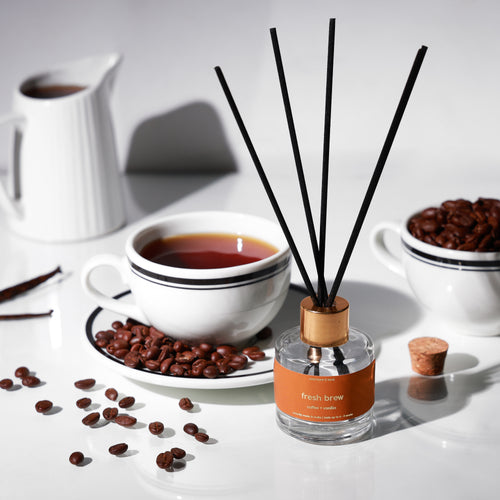 Deepest in range · Fresh Brew₹849Shop →
What the reed is still the best answer for — and it is not a consolation
Everything above is an argument about fit, not about quality, and I would be unhappy if it read as a company disowning its own best product. There are things a reed diffuser does that no machine in this range does, and some of them matter more than reach. It is completely silent — not quiet, silent, with no motor, no pump and no fan. It uses no power at all, which means it cannot be unplugged by accident, cannot run flat, and does not add a device to a room already full of them. It needs no water, no charging cable and no filling. It has no schedule to set and nothing to remember: it simply works, every hour of every day, for six to eight weeks on a 50ml or fourteen to eighteen on a 130ml, whether or not you thought about it that morning.
And it is an object rather than an appliance. A refillable glass bottle with six fibre reeds sits on a console table or a bathroom shelf and looks like something you chose; a machine with a status light looks like equipment. At about ₹13–₹15 a day that is a serious amount of pleasure for very little money, and the framing matters: a ₹749 bottle that runs six to eight weeks is a different kind of purchase from a ₹749 object. Our fibre reeds are chosen over rattan for a specific Indian reason — rattan is a natural cane with irregular internal channels that wicks unevenly in high humidity and fades at the dry end, while fibre is more porous and more consistent, which matters far more in a monsoon than in the European climates most reed diffusers are designed for.
So my actual recommendation, for most people in your position, is not to abandon the reed. It is to stop asking it to do a job it was never built for, and give it the job it is unbeatable at — a bedside, a bathroom, a study, a console near the entrance where people pass close to it. Then, if you want the whole bedroom at a level you notice from the bed, add a mechanism that transports. Many households end up with both, and that is not indecision; it is two different tools doing two different things. The one genuine limitation to acknowledge as you decide: a reed cannot be switched off. If “only when I am home” is part of what you want, the format cannot give it to you, and pretending otherwise would cost more trust than the sale is worth.
What to do next, in order — and the rung that does not exist
In the order I would actually work through it, starting with the checks that cost nothing, because a real share of readers who arrive at this page are fixed before they spend. The last row is our own gap, stated plainly, because redirecting you away from reeds lands you somewhere the range serves imperfectly.
| Step | What it is | When it is the right answer | Price |
|---|---|---|---|
| 1. Six reeds, better placement, the adaptation test ★ | All six sticks rather than three; the bottle in the room’s airflow but out of the AC blast; leave for fifteen minutes and walk back in, or ask a visitor | First, always, and it costs nothing. A meaningful share of “my reed is weak” letters are reed count, placement or adaptation | ₹0 |
| 2. The right bottle size for the room | 50ml for up to ~150 sq ft, 6–8 weeks; 130ml for above 150 sq ft, 14–18 weeks. Or a deeper composition — Mountain Breeze 9.4, Fresh Brew 9.5 | If the bottle was simply under-specified for the room. This is the last thing that can be fixed inside the reed format | ₹749–₹1,349 |
| 3. Sukoon | Ultrasonic water mist — 500ml, 270–320 sq ft, 16–18 hours on low, three 15ml Hotel Collection scents included | When you want the whole bedroom and can accept dilution in water, added humidity and refilling. The best-value real answer, and usually the right one | ₹1,899 |
| 4. Safar | Waterless cold-diffusion of undiluted oil — 20ml, 2000 mAh Type-C, up to 10h continuous or ~30h intermittent, 3 speeds, 1/2/3-hour auto-off, 6.9 cm. Named and sold as a car and travel diffuser | When water is unacceptable. Understand that there is no published room-coverage figure, that it needs recharging, and that the timer runs 1, 2 or 3 hours | ₹3,999 |
| Stop searching for: a stronger reed | A reed diffuser that projects across a room | It does not exist at any price from any manufacturer. The output is bounded by evaporation from six sticks and no air is moved | — |
| The honest gap | Nothing exists between Safar and Vaayu — no mid-sized waterless bedroom nebuliser, no half-Vaayu. And no hotel-inspired reed exists at all: the Hotel Collection is water-based and ultrasonic-only | Said plainly, because the redirection this page recommends ends at a compromise rather than a perfect object | — |
Versailles
Reed diffusers are the heart of what we do. They are the products I have spent the most hours on, the ones I am proudest of, and the ones that pay for everything else. Which is exactly why I want to be the person who tells you that a stronger one is not coming. If somebody could add reach to a passive evaporator, the reed industry would have done it decades ago and the entire commercial scenting business would not exist.
What I find slightly sad about this search is how reasonable it is. You liked a smell, you wanted more of it in more of the room, and the obvious word for that is stronger. Nothing about that is naive. It is only that the word points at the oil, and the thing you are missing is air — and no listing anywhere is going to explain the difference to you at the moment of purchase, because the listing is trying to sell the bottle.
So take the free steps first. Use all six reeds; a surprising number of people never do. Move the bottle into the path the air already takes and out of the direct blast of an AC. And walk out of the room for a quarter of an hour and back in, because the person least qualified to judge your bedroom’s fragrance is you. If after all that you still want the far corner of the room to smell of something, buy a machine and keep the reed for the bedside, where it is genuinely better than any machine I sell. And I will say the honest thing once more: we do not make a mid-sized waterless nebuliser, so the redirection ends at a water machine or a personal device rather than at a perfect one. Everything is composed in Pune, and part of every order funds a girl’s classroom through Nanhi Kali.
Frequently asked questions
- A 100 sq ft bedroom and a hit at the door — the cheapest real answer to the arrival moment.
- A 10 × 12 AC bedroom where the reed only works near the bottle — distance decay, and what recirculating air is worth.
- Mumbai, small, humid, no water — the constraint stack that most exposes the range’s gap.
- 150 sq ft, strong fragrance, on only when I’m home — the control question, answered honestly.
- Bedroom only, not the whole 2BHK — no, and here is what to buy instead.
- Safar in one room, Vaayu in the other — why two machines is usually the wrong shape.
- Expensive oil, no scent cloud — the oil decides whether you like it; the mechanism decides whether it is there.
- What type of diffuser should I search for — the words that make your next search work.
- Reed, Safar or Vaayu — the whole method in one page.
- Brand: the SOSA founder story.
Facts verified August 2026: Three diffusion mechanisms are described — passive capillary (reed diffusers), ultrasonic water mist (Boond ₹899, 300ml, up to ~150 sq ft, ~6 hours, USB, night light; Sukoon ₹1,899, 500ml, 270–320 sq ft, 16–18 hours on low, three 15ml Hotel Collection scents included; Megh ₹3,499, 6L tank, ~100 hours runtime, ~215 sq ft, which is less coverage than Sukoon and never a coverage upgrade) and waterless cold-air nebulising (Safar ₹3,999, 20ml bottle, 2000 mAh Type-C battery, up to 10 hours continuous or around 30 hours intermittent, 3 speeds, 1/2/3-hour auto-off timer, 6.9 cm, named and sold as a car and travel diffuser with car, handbag, desk, bedside and hotel room among its stated uses, no published room-coverage figure; Vaayu ₹11,999, coverage up to 1000 m³ or roughly 2,000–3,000 sq ft, 400ml refillable tank lasting up to about 90+ days depending on intensity and scheduled hours, Bluetooth app and onboard buttons, 1h/4h/8h/24h run windows, choice of days, adjustable mist intensity, key-lock, under 38 dB, freestanding or wall/HVAC mount, 5W, CE, RoHS, SGS, and to be used with alcohol-free water-free oils formulated for cold-air diffusion). Aangan ₹25,999 (~8,000–10,000 sq ft) and Meenar ₹38,500 (12,000–18,000 sq ft) are commercial HVAC machines and are named in this cluster only as the top of the ladder, never as a home recommendation. SOSA reed diffusers: five scents, 50ml ₹749–₹849 lasting 6–8 weeks and suiting rooms up to ~150 sq ft, 130ml ₹1,249–₹1,349 lasting 14–18 weeks and suiting above 150 sq ft, six fibre reeds included and flipped every 3–5 days, six reeds for full projection and three for a soft bedside level, about ₹13–₹15 a day, heat-stable CCT carrier rather than DPG, fibre reeds rather than rattan, alcohol-free, phthalate-free, paraben-free, IFRA-compliant, 0 ppm formaldehyde, refillable glass bottle, climate-tested at 45°C and 85% RH, composed in Pune. Duos are two 50ml bottles at ₹1,498–₹1,598; 130ml duos ₹2,498–₹2,598; refills 300ml ₹2,399 and 500ml ₹3,499, oil only and never a first purchase. SOSA strength scale: Evening Calm 8.9, Garden Bloom 8.9, Morning Freshness 9.0, Mountain Breeze 9.4, Fresh Brew 9.5 — a measure of perceived intensity in a room, not of quality, concentration or projection. Hotel Collection fragrance oils are water-based and ultrasonic-only at 15ml ₹299 (a refill), 100ml ₹999, 300ml ₹1,799 and a pack of seven at ₹1,799; they cannot be used in reed diffusers and reed oil cannot be used in ultrasonic machines, so no hotel-inspired reed diffuser exists. Between Safar and Vaayu, SOSA makes no mid-sized waterless nebuliser. No health, air-quality, allergy or antimicrobial claims are made, and fragrance does not remove a smell — source, then ventilation, then fragrance. Free shipping above ₹499. A portion of every order supports girl-child education through Nanhi Kali. SOSA is an independent Indian fragrance house; the Hotel Collection scents referenced here are SOSA’s own interpretations inspired by the world’s finest hotels, and SOSA is not affiliated with, endorsed by or a supplier to any hotel brand. Prices subject to change — see the live product pages.