



My House Is Full of Guests During Diwali — Should I Use Fewer Reeds Than Normal?

My House Is Full of Guests During Diwali — Should I Use Fewer Reeds Than Normal?

★ Diwali with a full house · cooking, diyas, incense and eight peopleCandle ₹379 · reed ₹749 · Boond ₹899 · Sukoon ₹1,899 · free shipping above ₹499A portion funds girl-child education
★ SOSA · when people are coming over
During Diwali your home already has plenty of smells doing plenty of work. The question is not what to add — it is where there is any room left
★ ★ ★ ★ ★
★★★★★
"Eight of us in a 2BHK for a week. The honest advice was to use less than normal, not more, because the house was already full of mithai and incense."
Nalini P. Diwali, 8 guests
Less than normal
★★★★★
"Diyas, cooking and agarbatti all going at once. Told me to leave the living room alone and only scent the bedrooms. Completely right."
Rohit A. Diwali, Mumbai
Bedrooms only
★★★★★
"Guest room had been shut for months and relatives arrived the next day. Aired it all day, changed everything, then a candle an hour before. Fine."
Sunita M. Overnight prep
Air all day
★★★★★
"The entrance is where it matters during Diwali — people are in and out constantly. One thing by the door did more than four things inside."
Karan J. Diwali entrance, Delhi
The door only
★★★★★
"We cook triple during Diwali week. Extractor and windows carried it; the fragrance just stopped the living room feeling like a kitchen."
Lata S. Diwali cooking, Pune
Airflow led
★★★★★
"Wanted festive without being overpowering in a small flat. Warm and low, in one room, was the answer rather than everywhere at once."
Vikas T. Small home, Diwali
One room, warm
★★★★★
"Eight of us in a 2BHK for a week. The honest advice was to use less than normal, not more, because the house was already full of mithai and incense."
Nalini P. Diwali, 8 guests
Less than normal
★★★★★
"Diyas, cooking and agarbatti all going at once. Told me to leave the living room alone and only scent the bedrooms. Completely right."
Rohit A. Diwali, Mumbai
Bedrooms only
★★★★★
"Guest room had been shut for months and relatives arrived the next day. Aired it all day, changed everything, then a candle an hour before. Fine."
Sunita M. Overnight prep
Air all day
★★★★★
"The entrance is where it matters during Diwali — people are in and out constantly. One thing by the door did more than four things inside."
Karan J. Diwali entrance, Delhi
The door only
★★★★★
"We cook triple during Diwali week. Extractor and windows carried it; the fragrance just stopped the living room feeling like a kitchen."
Lata S. Diwali cooking, Pune
Airflow led
★★★★★
"Wanted festive without being overpowering in a small flat. Warm and low, in one room, was the answer rather than everywhere at once."
Vikas T. Small home, Diwali
One room, warm
Candle: scent in the room in 15–20 minutes · Sukoon: about 20 minutes from cold A reed diffuser needs 24–72 hours — the wrong buy when guests arrive tonight Ventilate first · fragrance is the finishing layer, never the cover-up


Founder Diaries · Home Fragrance · Diwali
By Sonal Sahani · ISIPCA Versailles 11 min read Updated August 2026
Yes — and the instinct behind the question is a better one than most people give themselves credit for. A reed diffuser has exactly one volume control, which is the number of sticks standing in the bottle, and the week your flat is holding eight or ten people is the week to turn it down rather than up. There are two mechanisms at work and only one of them is obvious. The obvious one is that a full house already contains far more scent than an empty one. The less obvious one, and the more important, is that a house full of guests has its internal doors shut and its air conditioning running, so individual rooms exchange much less air than usual and whatever a reed puts out simply builds up. Pull two or three sticks out of every bottle before the relatives arrive.
Quick answers — read this first
The answer: yes, fewer. Three or four reeds in a bedroom and four or five in a living room, against the five or six you would normally run.

Why, in two parts: a full house already has more scent sources — people, their perfumes, cooking, incense, flowers — so the room's total load is high before the reed adds anything. And with guests in the flat, doors stay shut and the air conditioning runs, so each room exchanges less air and a reed's output accumulates in it.

Important: pull reeds out rather than flipping them, and know that a reed removed and later put back never draws quite as well again. If a room is too strong, the fix is fewer reeds and an open window — never a different scent on top.
The short answer
Short answer: yes. Run three or four reeds in a bedroom and four or five in a living room during a week with a full house, instead of the usual five or six. The number of sticks is the only volume control a reed has, and a crowded flat needs less output rather than more — both because the room's scent load is already high and because shut doors and air conditioning mean it is exchanging less air than normal.
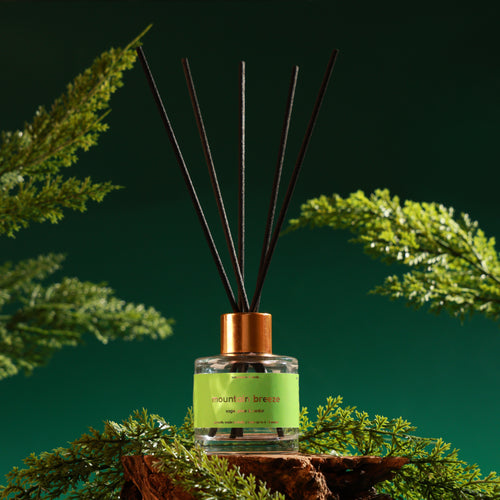
The pick: dry and low is right for a busy week — Mountain Breeze (Himalayan pine, sage, cedar) from ₹849 or Morning Freshness (Malabar lemon, peppermint, eucalyptus) from ₹749 in shared spaces; Evening Calm (Himalayan lavender, chamomile) from ₹799 in a bedroom. A Boond at ₹899 is the better tool in any room where you actually want an off switch.
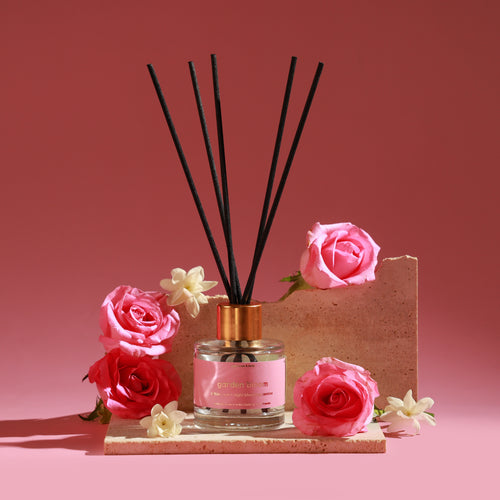
Shop: reed diffusers are a separate alcohol-free line — Morning Freshness from ₹749, Garden Bloom and Evening Calm from ₹799, Fresh Brew and Mountain Breeze from ₹849, 130ml from ₹1,249, duos from ₹1,498 and 300ml refills ₹2,399. A reed needs 24–72 hours to reach its level, so set it up before the week starts. Free shipping above ₹499.
Straight answer
Should I use fewer reeds in my reed diffusers when the house is full of Diwali guests?
1. Yes. Take two or three sticks out of every bottle before anybody arrives. Three or four reeds in a bedroom and four or five in a living room, against the five or six you would run in an ordinary week. The number of sticks is the only volume control a reed possesses — there is no dial and no low setting — so it is where the adjustment has to happen.

2. The first reason is that the room's scent load is already high. Ten people bring ten perfumes, ten hair oils and ten sets of clothes that have been somewhere else today. Add the cooking, the marigold garlands, the agarbatti and the mithai, and the air in your sitting room is carrying more distinct smells this week than in any other week of the year. The reed is not the first thing in the room. It is roughly the eighth.

3. The second reason is the one almost nobody accounts for: your rooms are exchanging less air than usual. With guests staying, bedroom doors are shut for privacy all day rather than standing open, and the air conditioning is running in rooms that would normally have a window ajar. A closed, cooled room turns its air over far more slowly, so a reed that was perfectly judged in September is now filling a smaller effective volume with nowhere for the output to go.

4. Pull the sticks out rather than flipping them. Flipping a reed brings the saturated end up and briefly increases output, which is the opposite of what this week needs. Removing sticks reduces it, and the room responds within a few hours rather than instantly, so make the change the day before rather than during the evening.

5. And if a room does smell too strong, the fix is fewer reeds and an open window — never a different scent. Adding something on top of a room that is already saturated gives you a saturated room with two smells in it. Take sticks out, open two windows on opposite walls for twenty minutes, and let the room come down. Free, and it is the only thing that actually works.

6. One thing worth knowing before you pull them: it is close to a one-way decision. A reed that has been removed and left out dries and oxidises along its exposed length, and when you put it back the capillary channels never draw quite as well again. Take out the ones you can spare, keep the spare sticks that came in the box, and treat the reduction as permanent for this bottle.

A portion of every order supports girl-child education through Nanhi Kali.
TL;DR: yes — three or four reeds in a bedroom and four or five in a living room instead of the usual five or six. A full house has a high scent load already, and with doors shut and the air conditioning running each room exchanges less air, so a reed's output accumulates. Pull sticks out rather than flipping them, and know that a reed removed and put back never draws quite as well again.
SOSA reed diffusers · alcohol-free
The week to use half the sticks in the packet
SOSA reed diffusers · alcohol-free from ₹749
Morning Freshness with Malabar lemon, peppermint and eucalyptus from ₹749; Garden Bloom and Evening Calm from ₹799; Fresh Brew and Mountain Breeze from ₹849. The number of reeds in the bottle is the volume control, and it is the only one a reed has — which is why a house with twelve people in it should be running three or four sticks where it normally runs six. A reed pulled out of the bottle can be set aside and the room drops within a few hours. A reed put back in has already dried and oxidised along the exposed length and never draws quite as well again, so take out the ones you can spare and expect that decision to be close to permanent. 130ml from ₹1,249, duos from ₹1,498, 300ml refills ₹2,399.

The two reasons a full house needs less, not more

The instinct people arrive with is the opposite of the right answer, and it is easy to see why. More people, more rooms in use, more happening, so surely more fragrance. But a reed diffuser is not a service that scales with headcount. It is a fixed rate of evaporation into a fixed volume of air, and both halves of that sentence change during a festival week — the air becomes more crowded with other smells, and it starts moving less. Get either half wrong and the outcome is a house that reads as heavy rather than as welcoming, which is precisely the impression a Diwali week is trying not to give. Both halves are worth understanding properly, because between them they also explain why the same bottle that was perfect in September can feel like too much in October without anything having been added to it.

1
REASON ONE
The room's scent load is already high before the reed contributes anything
Start by counting what is actually in the air of a sitting room during Diwali week, because nobody does and the list is longer than you would guess. Ten guests means ten perfumes or deodorants, ten hair oils or shampoos, and ten sets of clothes that have spent the day somewhere else and brought that somewhere else home with them. Then the household's own contributions: ghee and sugar from whatever is being fried, the marigold and rose in the torans and the garlands, the agarbatti in the puja corner, the oil in the diyas, the mithai boxes that have been arriving since Tuesday, and the flowers somebody brought. That is not a room waiting to be scented. That is a room with a great deal already in it, several of the contributions genuinely lovely, and all of them competing for the same limited attention your nose has available. A reed running at full strength into that does not become the top note of the arrangement. It becomes the ninth voice in a room where eight are already talking, and the result reads as clutter rather than as fragrance. This is also why the corrective people reach for is exactly wrong. When a crowded room smells confused the instinct is to add something clean and definite on top of it, and adding is the one move that cannot help. The room does not have a deficit. It has a surplus, and the only useful direction is downward.
2
REASON TWO
Shut doors and air conditioning mean each room is exchanging far less air than usual
Now the mechanism nobody mentions, and it is the more powerful of the two. A reed diffuser puts out at a roughly constant rate. Whether that rate is right for a room depends entirely on how fast the room replaces its air — and a house full of guests replaces its air far more slowly than the same house empty. Think about what actually changes when relatives move in. Bedroom doors that normally stand open all day are shut, for privacy, from morning until late. Windows that are usually cracked open are closed because the air conditioning is on in three rooms instead of one, and it is running for far longer each day because there are people in those rooms around the clock rather than for eight hours at night. A domestic split unit recirculates the room's own air; it cools, it dehumidifies, it does not bring in outside air in any meaningful quantity. So a guest bedroom during Diwali week is, in ventilation terms, a smaller and much more closed box than the same room in an ordinary month, and the reed standing in the corner has not been told. Its output has not changed. What has changed is that the output now has nowhere to go, so it accumulates through the day and reaches a level nobody chose. This is the reason a guest will say a room is strong when you cannot smell it at all: you have been habituated to it for weeks, and they have walked into a concentration that would not have existed in September. Fewer sticks is the correct response, and it is a response to physics rather than to taste.
3
THE CORRECTIVE
Fewer reeds and an open window — never a second scent on top
Which gives a rule for the whole week, and it is worth writing on a piece of paper and putting inside a cupboard door. If a room smells too strong, the fix is always fewer reeds and twenty minutes of cross-ventilation. It is never a different fragrance. Two windows on opposite walls, or a window and a door on opposite sides of the room, so the air actually moves through rather than stirring in place — one opening alone gives you very little. Twenty minutes is enough to turn over the air in a normal Indian bedroom, and it costs nothing and works on every kind of excess, including the ones a fragrance genuinely cannot help with. Then take two sticks out and put them somewhere the household will not tidy them away. The room will come down over the following few hours rather than at once, because the fabrics, the curtains and the bedding have all been holding some of it and they release slowly, which is why this change wants to be made the day before your guests arrive rather than in the middle of the evening they notice. A Boond at ₹899 is the honest alternative for any room where you would rather have a genuine off switch, since a 300ml ultrasonic with a two-hour timer can be stopped in a way a reed simply cannot, and during a week this busy the ability to stop something is worth more than the ability to start it.
The one-way part, which no packet mentions: a reed you pull out and set aside dries and oxidises along the length that was in the oil, and when you put it back weeks later the capillary channels no longer draw as well. Reduce deliberately, keep the spare sticks the box came with, and treat the decision as permanent for that bottle.

How many reeds, room by room, for a full house

Reed counts for a week with eight or ten people in the flat, against what the same rooms would take in an ordinary month. The third column is the reason the number moves, which in almost every case is about how much air the room is actually exchanging rather than about how large it is. Every number here is lower than the packet suggests, and that is deliberate rather than cautious.

Reed counts for a crowded week
How many sticks each room should be running with a full house
Room Normal week Diwali week, full house Why the number moves Scent
Guest bedroom 5–6 reeds 3–4 reeds The door is shut all day and the air conditioning is running, so the room exchanges far less air and output accumulates Evening Calm ₹799 or Mountain Breeze ₹849
Living room 6 reeds 4–5 reeds Larger and busier, but carrying cooking, incense, flowers and ten people's perfume before the reed says anything Mountain Breeze ₹849 or Morning Freshness ₹749
Entrance or hall 4–5 reeds 4–5 reeds — unchanged The one place the count does not drop. A door opening every few minutes strips output as fast as it is produced Anything dry. Morning Freshness ₹749
Your own bedroom 5 reeds 3 reeds The room you retreat to when the house is loud should be the quietest-smelling room in it, not the strongest Evening Calm ₹799
Bathroom 3–4 reeds 3 reeds In constant use by people who did not choose the scent, with a window that is probably staying shut for privacy Morning Freshness ₹749
Kitchen or dining None None Nothing belongs here in either week. Extraction on while cooking and for ten minutes after does the whole job
Shop this guide
Fewer sticks, in three products
The SOSA principle
A reed diffuser has one volume control and it is the number of sticks. The week your flat holds ten people is the week to turn it down.
More people means more scent already in the room, and shut doors with the air conditioning running means the room is exchanging less air than usual. Both point the same way, and it is downward.

Pulling sticks, the corrective, and what cannot be undone

Start with the mechanics of the adjustment, because the way most people make it is the wrong way round. To reduce a reed, remove sticks. Do not flip them. Flipping brings the saturated end up out of the bottle and puts a fresh dry length down into the oil, which briefly raises output — it is the standard advice for reviving a tired reed and it is exactly the opposite of what a crowded week wants. Removing two sticks from a bottle of six cuts the evaporating surface by a third, and the room responds over the following three or four hours rather than immediately, because the curtains, the bedding and the upholstery have all been holding some of the scent and release it slowly as the room comes down. Which is why this change belongs to the day before your guests arrive rather than to the evening somebody mentions it. Wipe the removed sticks, lay them on a saucer somewhere out of the way, and be realistic that you are unlikely to put them back: a reed that has been out of the oil dries and oxidises along the exposed length and never draws as freely again, so the sensible plan is to reduce once, deliberately, and keep the unused spare sticks that came in the box for when the bottle is genuinely tired in three months. Nobody prints this on a packet and it is the most useful thing I know about reeds.

Then the placement and the rooms, because a full house changes where a bottle should stand as much as how many sticks are in it. The rule for a crowded week is that a reed belongs where people pass rather than where people sit. A hall, a landing, a bathroom shelf, a console by the door — those are places a scent is met briefly and read as a property of the house. A side table eighteen inches from where four relatives will sit talking for three hours is a place a scent is not met but endured, and it is where complaints come from. Keep the bottle off the floor, out of the direct line of an air-conditioning vent and away from a ceiling fan on medium, since moving air both accelerates evaporation and pushes the output straight into whoever is sitting under it. And keep it well clear of the sofa arms, cushion covers and curtains, which absorb and then hand a scent back for days afterwards. One room that deserves particular thought is the one you sleep in, because during a festival week it is the only quiet place you have. Three sticks of Evening Calm at ₹799 rather than five, and put the bottle across the room from the pillow rather than on the bedside table. A room you retreat to should be the least insistent room in the flat rather than the most.

Then the corrective, the constraints and the honest limits of the instrument. When a room is too strong, take sticks out and open two windows on opposite walls for twenty minutes. Never add a second scent. A saturated room with something clean sprayed over it is a saturated room with two smells in it, and the second one does not cancel the first, it joins it — this is the single most expensive mistake in home fragrance and it happens in Indian flats most often during exactly this week. On the constraints: a reed diffuser is a separate alcohol-free line with its own scents and it does not take the water-based Hotel Collection at all — that oil will not climb a reed stick, and reed oil in an ultrasonic machine clogs the 2.4MHz misting plate, so the two lines never cross in either direction. Reeds take 24 to 72 hours to reach their level, which means a bottle bought the morning your relatives land will not have done anything by that evening; buy a week ahead or buy a candle instead. And expect to stop smelling your own house within a fortnight, which during a festival week is genuinely dangerous, because the instinct habituation produces is to put the sticks back in while every guest in the flat is receiving a level you can no longer perceive. Ask one relative you trust to be rude rather than polite. It is worth more than any adjustment you can make by nose, and it is the only measurement instrument in the house that still works. If you want genuine control rather than a fixed rate, a Boond at ₹899 or a Sukoon at ₹1,899 with steady, 2H and 4H timers is the honest upgrade, and the Sukoon arrives with three 15ml Hotel Collection scents of your choice included.

Habituation is the real risk in a full house. You stop smelling the flat in a fortnight, and every person who walks in is receiving a level you can no longer measure.
— Sonal Sahani, SOSA

The SOSA edit

In buying order for somebody running reed diffusers through a crowded festival week. Note that the first recommendation costs nothing and involves taking things out of bottles you already own — the products below it are for the rooms where that is not enough, or where you would rather have an off switch than a fixed rate.

The SOSA edit
A full house during Diwali, in buying order
Buy What it is When it earns its place Price
1. Nothing — pull two sticks out ★ Three or four reeds in a bedroom and four or five in a living room, against the usual five or six First, and the day before anybody arrives. It is free, it is the correct adjustment, and it works within a few hours ₹0
2. Mountain Breeze or Morning Freshness Himalayan pine, sage and cedar, or Malabar lemon, peppermint and eucalyptus — both dry, neither sweet In shared rooms, where dry and low reads as clean while anything sweet reads as one more thing happening ₹849 / ₹749
3. Evening Calm Himalayan lavender and chamomile, alcohol-free, from ₹799 for 50ml and ₹1,299 for 130ml In your own bedroom and in guest bedrooms, at three sticks. The quietest room in a loud house should smell quietest too ₹799
4. Boond or Sukoon 300ml for one room, or 500ml for 270–320 sq ft with steady/2H/4H timers and three 15ml scents included In any room where you want a genuine off switch. During a week this busy, being able to stop something matters more than starting it ₹899 / ₹1,899
5. 300ml reed refill Refills the alcohol-free reed line at ₹2,399, with the spare sticks from the original box After the week, not during it. A tired bottle in November is a refill; a strong room in October is fewer sticks ₹2,399
Do not buy: a second scent for a strong room Adding fragrance to a room that already has too much gives you a saturated room with two smells in it rather than one The corrective is always fewer reeds and twenty minutes of cross-ventilation. It is free and it is the only thing that works
Honest notes for buyers: fragrance is the last step, not the first — it layers on air that is already clean and moving, and it will not cover cooking, damp or a room that has been shut for weeks. Timing matters as much as product: a candle scents a room in fifteen to twenty minutes and a Sukoon in about twenty, which is why both work when people are arriving tonight, while a reed diffuser needs a day to three days before it is doing its job properly — it is the wrong buy for a deadline and the right buy for a room you want to hold a steady scent for months. SOSA does not make a room spray for the home; the sprays in the range are formulated and sized for a car. The Hotel Collection is water-based and runs in the Sukoon, Boond and Megh only — not in reeds, and not in the waterless Vaayu. Reed diffusers are a separate alcohol-free line with their own scents. Candles must be attended and put out before guests leave a room unattended. The Hotel Collection scents are SOSA's own interpretations inspired by the world's finest hotels; SOSA is an independent Indian fragrance house, not affiliated with or endorsed by any hotel brand. A portion of every order supports girl-child education through Nanhi Kali.
SOSA Boond
For the bedroom whose door stays shut all week
SOSA Boond ₹899
A 300ml ultrasonic diffuser running the same water-based Hotel Collection bottles at the same three to six drops per tank. The reason a full house needs less fragrance and not more is partly arithmetic and partly ventilation: with guests in the flat, bedroom doors are shut for privacy and the air conditioning is running, so each room exchanges far less air with the rest of the house than it does in an ordinary week. Whatever you put into that room stays in it. A machine you can switch off on a two-hour timer gives you control that a reed cannot, which during Diwali week is worth ₹899 on its own.
SS
ISIPCA
Versailles
A note from Sonal

The reed diffuser is the product I get the fewest complaints about and the most misunderstandings, and nearly all of them come down to the same thing: people think of it as a scent, and it is really a rate. Oil climbs the sticks by capillary action and evaporates off whatever surface area is standing above the neck of the bottle. That rate is fixed. It does not know what week it is, how many people are in your flat, or whether the door has been shut since Tuesday. Which means the intelligence has to come from you, and it has exactly one lever: how many sticks are in there.

So during a full house I use fewer, and the second reason is the one I would most like people to take away. A flat with guests in it has its bedroom doors shut all day and its air conditioning running in three rooms instead of one, and a closed cooled room turns over its air very slowly indeed. The reed has not changed. The room has become a smaller, quieter box, and the same output now has nowhere to go. Three sticks in a guest bedroom, four or five in the sitting room, and if anything still feels heavy, two windows open on opposite walls for twenty minutes rather than anything bought. And when you take a stick out, understand that you have mostly made that decision for good — a reed that has dried out of the oil never quite draws the same way again. Reduce on purpose, once, and keep the spares.

Everything is made and supported from Pune, and a part of every order funds girl-child education through Nanhi Kali. You get a home that smells like somewhere you chose; a girl gets a classroom. That equation has always felt right to me.

Frequently asked questions

Should I use fewer reeds when my house is full of Diwali guests?
Yes. Three or four in a bedroom and four or five in a living room, against the five or six you would run normally. A full house already carries more scent, and with doors shut and the air conditioning running each room exchanges less air, so the reed's output accumulates.
Is it better to flip the reeds or take some out?
Take some out. Flipping brings the saturated end up and briefly increases output, which is the wrong direction for a crowded week. Removing sticks reduces the evaporating surface, and the room comes down over the following few hours rather than instantly.
Can I put the reeds back in after Diwali?
Partly, but not fully. A reed that has been out of the oil dries and oxidises along the exposed length and never draws quite as well again. Reduce deliberately, keep the unused spare sticks that came in the box, and treat the reduction as permanent for that bottle.
What should I do if a room smells too strong during the festival week?
Take two sticks out and open two windows on opposite walls for twenty minutes. Never add a different scent on top — a saturated room with something sprayed over it is a saturated room with two smells in it rather than one, and the second does not cancel the first.
Which reed scent suits a house full of Diwali guests?
Something dry rather than sweet. Mountain Breeze with Himalayan pine, sage and cedar from ₹849, or Morning Freshness with Malabar lemon, peppermint and eucalyptus from ₹749, in shared rooms; Evening Calm from ₹799 in bedrooms, at three sticks.
Turn it down, not up
Three sticks instead of sixthe week the flat is at its fullest
SOSA reed diffusers are a separate alcohol-free line: Morning Freshness from ₹749, Garden Bloom and Evening Calm from ₹799, Fresh Brew and Mountain Breeze from ₹849, 130ml from ₹1,249, duos from ₹1,498 and 300ml refills ₹2,399. A reed needs 24 to 72 hours to reach its level, so set it up before the week starts. The Boond is ₹899 and the Sukoon ₹1,899 with steady, 2H and 4H timers and three 15ml scents included. Free shipping above ₹499.
Shop reed diffusers → See the Boond · ₹899
Continue the read
More from SOSA
Editorial standards & sources
About this guide: Written by Sonal Sahani, ISIPCA Versailles-trained founder and perfumer at SOSA Home & Body, on why a house full of Diwali guests needs fewer reeds rather than more — the room's scent load is already high before the reed contributes anything, and shut doors with the air conditioning running mean each room exchanges far less air than usual, so output accumulates — with reed counts room by room, the correct way to reduce a bottle, and the fact that a reed pulled out of the oil never draws quite as well again.

Facts verified August 2026: Timings in this guide: a scented candle puts noticeable fragrance into a normal room in roughly 15–20 minutes; a Sukoon ultrasonic diffuser reaches a steady level in about 20 minutes from cold; a reed diffuser needs roughly 24–72 hours for the oil to travel the reeds and the room to settle, so it is not a same-day solution. SOSA products and prices: Sukoon 500ml ultrasonic diffuser ₹1,899 (270–320 sq ft, 16–18h on low, 9–12h high, 30–50 ml/h, 2.4MHz cool mist, 7-colour LED, remote, steady/2H/4H timers, BPA-free, auto shut-off, includes three 15ml Hotel Collection scents of your choice); Boond 300ml ₹899; Megh 6-litre ₹3,499; waterless Vaayu ₹11,999 (up to 1000m³); Aangan ₹25,999; Meenar ₹38,500. Hotel Collection water-based fragrance 15ml ₹299, 100ml ₹999, 300ml ₹1,799, Pack of 7 at 15ml ₹1,799 / 100ml ₹5,999 / 300ml ₹10,799; dose 3–6 drops per tank. Reed diffusers (separate alcohol-free line): Morning Freshness from ₹749, Garden Bloom and Evening Calm from ₹799, Fresh Brew and Mountain Breeze from ₹849; 130ml from ₹1,249; duos from ₹1,498; 300ml refills ₹2,399. Scented candles: Bookshop 80g ₹379 (~15–18 hours), Bookshop + Cozy Corner ₹664 (~30–36 hours), Amber Rose 130g ₹599 (~25–30 hours) and 220g ₹799 (~40–50 hours), ceramic jar candles ₹949, Pure Calm wax melt set ₹854. Free shipping above ₹499. SOSA does not make a room or linen spray for the home — the sprays in the range are car perfumes. The Hotel Collection scents are SOSA's own interpretations; SOSA is not affiliated with or endorsed by any hotel brand. Prices subject to change — see the live product pages.
Back to blog