



The honest case: a consistent presentation standard across every property you show — the same category as photography, styling and lighting, none of which you can attribute a sale to either, and none of which you would go without.
Why that framing is also more useful: it is the one that survives a seller asking what you spent their money on, and it is the one that does not require you to make a claim to a client that you cannot support. The Vaayu is ₹11,999, once, across every listing.
2. So treat it as a presentation decision instead, which is what it actually is. You are not buying a probability of closing. You are buying a consistent arrival standard across every property you show, held at the same level in each of them.
3. Compare it with the thing you already buy on exactly these terms. You pay a photographer and you cannot attribute a single sale to them, because you will never see the version of the listing that used phone pictures. You buy it because it is the standard. This is the same purchase and it is cheaper.
4. Notice that the commission is the wrong pool to spend from anyway. A commission is contingent and belongs to one transaction; a machine is equipment and belongs to your practice. Equipment bought against a specific fee you have not yet earned is a bad habit at any price.
5. And the framing matters for a reason beyond honesty. Presentation standard is the answer that survives a seller asking what you spent their money on. Return on investment is an answer that invites the follow-up question you cannot answer.
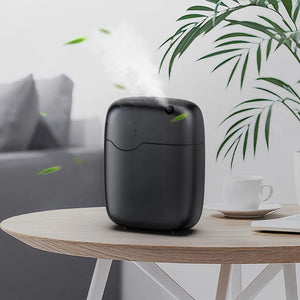
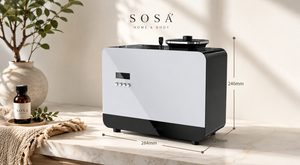
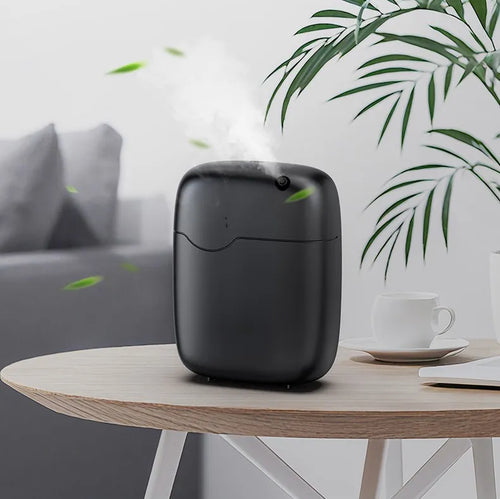
6. The machine, plainly: the Vaayu at ₹11,999. Waterless, up to 1000 m³, 400ml for around 75 days, timers, under 38 dB, key-lock, 0.9 kg, so one unit is a standard across a portfolio rather than a line against one flat.
A portion of every order supports girl-child education through Nanhi Kali.
The inference this page will not make
Let me set the tempting argument out properly before declining it, because it deserves that much. The brokerage on a ₹15 crore sale is several lakhs. The machine is ₹11,999, which is a fraction of a percent of that. Therefore, the reasoning goes, even a very small improvement in the chance of closing, or in the buyer's impression, more than covers the cost — and since the downside is capped at ₹11,999 and the upside is a share of lakhs, only a fool would decline. It is a clean piece of expected-value thinking and I understand exactly why it is persuasive. It also has a hole in the middle of it that no amount of confident phrasing can fill: it requires a number for the size of the improvement, and there is no such number. Not a small one, not an approximate one, not one from a study I could name. What exists is published work on ambient scent in retail and hospitality environments, which is a different setting with different measurements, and it does not transfer to a property transaction where one buyer makes one decision over several weeks with an architect and a bank involved.
What you are actually buying, compared honestly
Two ways of justifying the same ₹11,999 side by side, with what each would require you to know and what each commits you to saying to a client. Only the second column is available, and it is the stronger of the two in every row that matters.
| The return-on-investment case | The presentation-standard case | |
|---|---|---|
| The claim ★ | Scenting improves the offer or the chance of closing, so ₹11,999 against lakhs is obvious | Every property we show meets the same arrival standard, and this is part of it |
| What it requires you to know | The size of the effect on a property transaction, expressed as a number | Nothing you do not already know. It is a description of your own practice |
| Whether that is available | No. There is no defensible figure and any you are shown has been invented | Yes. It is a statement about what you do rather than about what it causes |
| What you say to a seller | Something you cannot support, followed by an answer you do not have | Something true, checkable and rather impressive |
| The nearest thing you already buy | Nothing. You do not buy anything on this basis | Photography at ₹8,000–₹25,000, styling, floor plans, matched bulbs — none attributable to a sale |
| What it costs | ₹11,999, justified on an unmeasurable quantity | ₹11,999 once, across every listing for years, which is less than one photography shoot |
| Where it fails | The first time somebody sensible asks by how much | It does not fail. It also never permits covering a defect, which is where the real risk sits |
The standard · Vaayu₹11,999Shop →  The scent · ₹299 to test₹299Shop →
  The unplugged optionfrom ₹749Shop →
The client conversation, and what a standard costs to hold
Take the money question properly first, because there is a real one underneath the bad one. The sensible way to think about ₹11,999 is not against a commission at all. A commission is contingent income attached to one transaction that may not complete; a diffuser is equipment attached to your practice, and equipment is bought out of a practice rather than out of a fee you have not yet earned. That distinction sounds pedantic and it changes the decision entirely, because equipment is assessed on how often it is used rather than on what any single job pays. A photographer's lens is not justified against one shoot. A tape measure is not justified against one survey. If you are running enough viewings that the machine is switched on most weeks, it is equipment and it is cheap; if you are not, it is an ornament and no commission figure rescues it. The specification is what makes it behave as equipment rather than as a fixture: 0.9 kg, 165 × 80.5 × 215 mm, waterless so there is nothing to spill in a car, a 400ml tank good for around 75 days so it is filled once a season, 1h/4h/8h/24h timers and Bluetooth so it is at level before you arrive, under 38 dB so it is inaudible in an empty flat, and a key-lock and auto-stop so it can be left in a property you are not standing in. Those are the specifications of a thing that moves, and a thing that moves is a standard rather than a decoration.
Then holding the standard, which is where most of the actual work is and none of it is a purchase. A consistent arrival standard means the same sequence at every property regardless of what it is worth: the day before, cross-ventilation on opposite walls and every drain trap in the property watered, including the ones in bathrooms nobody uses; three hours before, close up and bring the flat to temperature; two hours before, machine on low; thirty minutes before, walk in through the front door as the buyer will and adjust downwards. The reason to run the identical sequence at ₹4 crore and at ₹18 crore is that a standard you apply selectively is not a standard, it is an effort, and efforts are visible in a way standards are not. On the level itself, the rule does not change with the value of the property: the buyer should notice the property and not the fragrance, which in practice means adjusting down whenever you can name what you are smelling. The scent brief is narrow — clean, quiet, expensive, impossible to dislike — and the Ritz-Carlton-inspired Quiet Luxury at ₹299 is the default, with the 1 Hotels-inspired Forest Suite where a flat runs warm or a kitchen has no door. Test at 15ml for ₹299 before committing ₹1,799 to a 300ml, and remember that the water-based Hotel Collection bottles belong in the Sukoon, the Boond and the Megh rather than in the Vaayu, which takes its own undiluted oil.
And then the boundary, stated once more because this is the page where a reader is most likely to want it blurred. Everything above is an argument about presentation, and presentation stops precisely where a material fact begins. If a property has damp, a leak, a drain problem, smoke damage or anything with a structural cause, no part of this page applies to it. Find it, fix it or disclose it, and scent only a property that is genuinely sound. The commission is exactly why this needs saying here rather than in a footnote: the larger the fee, the greater the temptation to treat a machine as a solution to a smell that has a cause, and the worse the outcome when the buyer's own surveyor finds what you covered. That is not a lost sale, it is a lost reputation, and in a market where the same twenty advisers recur it is a slow and expensive kind of loss. The rest of the constraints are ordinary and worth restating for completeness: a reed diffuser needs 24 to 72 hours to establish, which suits a listing being shown across a season and not a viewing tomorrow; a candle from ₹379 must be attended and put out, which makes an unattended flame in a vacant property an insurance problem rather than a fragrance one; the ultrasonic machines add 30 to 50 ml of water an hour to the air and are the wrong choice in a closed or humid empty flat; and SOSA does not make a room spray for the home, since the sprays in the range are car perfumes.
The SOSA edit
In the order I would spend it if the commission is large and the decision is being made on standards rather than on returns. The free work is first because it is first. The final row prints the claim we decline to make, which is the row this page exists for.
| Buy | What it is | When it earns its place | Price |
|---|---|---|---|
| 1. The standard sequence ★ | Ventilation and drain traps the day before, temperature three hours ahead, machine two hours ahead, a walk in from the door at thirty minutes | At every property regardless of value. A standard applied selectively is an effort, and efforts are visible | ₹0 |
| 2. Vaayu | Waterless, up to 1000 m³, 400ml for ~75 days, 1h/4h/8h/24h timers, under 38 dB, auto-stop, key-lock, 0.9 kg | As equipment across a portfolio, not as a line against one commission. Less than one photography shoot | ₹11,999 |
| 3. Hotel Collection 15ml | Ritz-Carlton-inspired Quiet Luxury as the default; 1 Hotels-inspired Forest Suite where a flat runs warm | ₹299 settles the choice before ₹1,799 commits you. Three to six drops per tank in an ultrasonic | ₹299 |
| 4. Sukoon, where it is the right size | 500ml, 270–320 sq ft, 16–18h on low, steady/2H/4H timers, three 15ml scents included | One furnished occupied listing with one main volume. Water-based, so not for a locked empty flat | ₹1,899 |
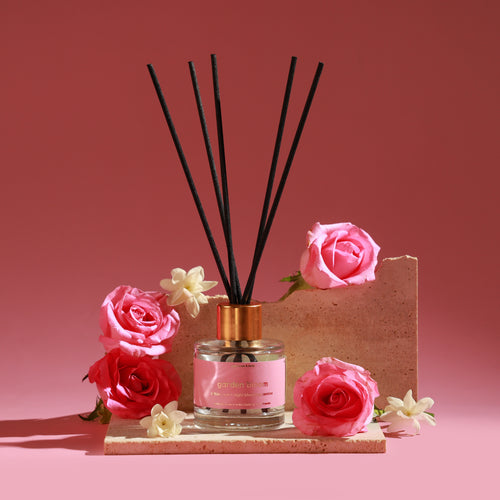
| 5. reed diffuser for a standing listing | Alcohol-free line, 24–72 hours to establish, nothing to switch on or collect | A property that will be opened repeatedly across a season, where nobody wants to arrive early | from ₹749 |
| Not claimed here: any effect on price | No figure for offers, sale prices or time on market, because none is defensible | Printed rather than implied. This is presentation, in the same category as photography and lighting | — |
| Never: fragrance over a defect | Damp, leaks, drains, smoke damage or anything structural are material facts about the property | The larger the commission, the larger the temptation. Find it, fix it or disclose it | — |
Versailles
This is the page I have rewritten most often, because the version that sells best is the version I am not willing to publish. It would be very easy to put a commission figure next to ₹11,999, add a carefully vague sentence about buyers responding to atmosphere, and let a reader complete the argument in their own head. Several brands in this category do exactly that, and the reason it works is that the reader supplies the number themselves and then believes it more than they would have believed mine. I would rather have a smaller business and be able to answer the follow-up question.
What I do believe, and will say without hedging, is that the air in a property is part of how it presents itself, that most listings are shown with no thought given to it at all, and that a machine costing less than one set of photographs will hold the same standard across every property you take for years. That is a good enough reason to buy something. It does not need a return attached to it, and the moment it has one attached, you have started making claims to sellers on my behalf that neither of us can support. Buy it as equipment, apply it identically everywhere, keep it low, and never once use it to get past something a buyer is entitled to know.
Everything is made and supported from Pune, and a part of every order funds girl-child education through Nanhi Kali. You get a space that smells like somewhere considered; a girl gets a classroom. That equation has always felt right to me.
Frequently asked questions
- At what property price does professional scenting become worth considering? — the arithmetic, and the variable that actually decides it.
- Making a ₹3 crore viewing feel more premium — where scent sits against the other paid interventions.
- Does a ₹20 crore home need a different viewing experience? — the bracket where this question is usually asked.
- How much attention should a realtor give the buyer's sensory experience? — the pillar for this group.
- Brand: the SOSA founder story.
Facts verified August 2026: Product facts used in this guide. SOSA Vaayu ₹11,999: waterless cold-air nebulising diffuser, atomises undiluted fragrance oil to a dry residue-free nano-mist, coverage up to 1000m³ (approximately 2,000–3,000 sq ft), 400ml refillable tank lasting up to about 75 days per fill, Bluetooth app plus onboard control, 1h/4h/8h/24h timer scheduling, adjustable intensity, under 38 dB, DC 12V/1A at 5W, 165 × 80.5 × 215 mm and 0.9 kg, freestanding or wall/HVAC mounted, auto-stop and key-lock, CE, RoHS and SGS certified, supplied with four hotel-inspired fragrances. SOSA Aangan ₹25,999: HVAC-connected or standalone commercial nebulising diffuser, coverage up to 3,000m³ (roughly 8,000–10,000 sq ft), 800ml reservoir, metal body, programmable schedules, under 42 dB. Ultrasonic machines are water-based and consume 30–50 ml of water an hour: Sukoon ₹1,899 (500ml, 270–320 sq ft, 16–18 hours on low, 3–6 drops per tank, steady/2H/4H timers, three 15ml Hotel Collection scents included), Boond ₹899 (300ml), Megh ₹3,499 (6 litres). Hotel Collection water-based fragrance 15ml ₹299, 100ml ₹999, 300ml ₹1,799, Pack of 7 at 15ml ₹1,799 against ₹2,093 bought singly; the Vaayu and Aangan take their own undiluted oil rather than these water-based bottles. Reed diffusers (separate alcohol-free line) from ₹749, requiring 24–72 hours to reach their working level. Scented candles from ₹379, scenting a room in roughly 15–20 minutes but requiring attendance. Free shipping above ₹499. Timings: a nebulising diffuser reaches a working level within minutes and a stated viewing level well inside two hours. This guide makes no claim that fragrance affects a property's price, offer level or time on market; it is presentation, in the same category as photography, styling and lighting. Fragrance must never be used to conceal a material defect. SOSA is not affiliated with or endorsed by any hotel brand. Prices subject to change — see the live product pages.