
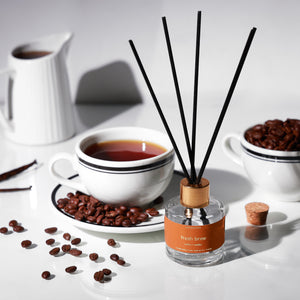
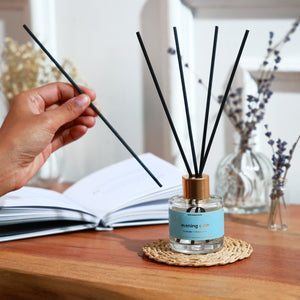


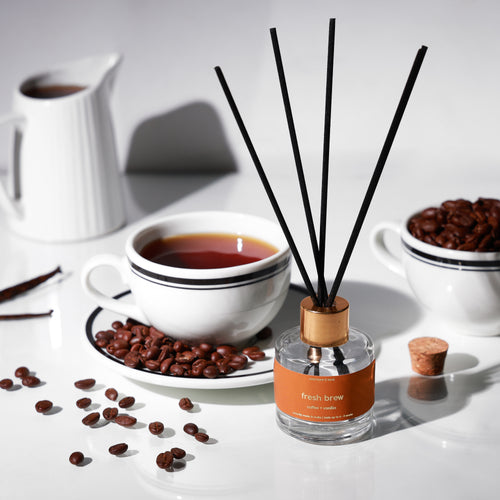
A "stronger oil" is not a product you can buy from SOSA anyway. There is no concentrate, no booster and no intensity setting on a reed diffuser. Our strength numbers — 9.5 for Fresh Brew, 8.9 for Evening Calm — are positions on our own internal scale at six reeds, not concentrations and not a quality ranking.
Reed count is the only real emission control, and it costs bottle life. Six reeds is the calibrated dose; nine on a 50ml gives roughly five weeks instead of eight; ten gives four to five. Bottle size changes nothing here: a 130ml at ₹1,349 emits at the same rate as a 50ml at ₹849 and simply lasts 14–18 weeks instead of 6–8.
Buy distribution only after the free checks. Reposition, raise, clear, de-draught, flip all six reeds, close the room. If those fail, the sized purchase for a 270–320 sq ft living room is the Sukoon at ₹1,899 — for the fan and the timer, not for a stronger scent.
- The straight answer
- Part one — two quantities that share one word
- Part two — what each change does at each distance
- Part three — the three cases where the answer genuinely is the oil
- Part four — diffusion, bought and sized honestly
- Part five — what "stronger" cannot be bought as here
- Part six — the diagnostic ladder, cheapest first
- A note from Sonal
- FAQs
2. "Stronger oil" describes a change in the near field, not the far field. Concentration falls with distance from any source. Raising emission lifts the whole curve a little, and lifts it most where it is already highest — which is the half-metre nobody stands in. This is why so many people describe a bottle that is lovely up close and absent across the room, and then buy a deeper scent, and then describe exactly the same thing again.
3. Emission is set by exposed reed surface, warmth and humidity — never by bottle size. A 130ml at ₹1,349 and a 50ml at ₹849 on the same six reeds emit identically. The large bottle buys 14–18 weeks against 6–8. Duration, never distance. If you have already bought a bigger bottle hoping for reach, you did not waste your money — you bought the wrong specification, and the oil is fine.
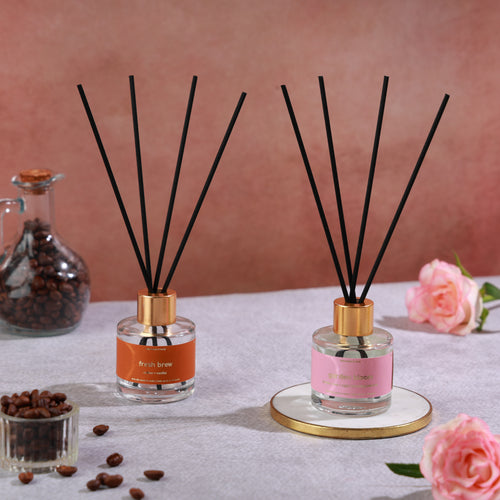
4. Reed count is the only genuine emission control, and it is not free. Six reeds is the dose each composition is calibrated at. Nine on a 50ml gives roughly five weeks instead of eight; ten gives four to five. It raises the level everywhere, most near the bottle. Use it when the composition is right and the room is small, not as a substitute for distribution.
5. A reed diffuser has no propulsion of any kind. No fan, no heat, no pressure. It puts vapour into the air immediately around itself and waits for your room to move it. Gentle incidental traffic — a doorway, a walking route, a ceiling fan on low — is a real distribution system. A still corner behind a photo frame is not, and no composition ever written will rescue it.
6. Air exchange beats every other variable, in both directions. A balcony door on the latch, two windows on opposite walls or an extractor running will remove scent faster than any passive source can add it. Equally, a flat that has been shut for hours holds concentration effortlessly. Closing a room an hour before people arrive is the single most powerful free lever on this page.
7. Buy distribution when the free checks fail, and buy it sized. Boond ₹899 for about 150 sq ft; Sukoon ₹1,899 for 270–320 sq ft, which is the sized answer for a normal Indian living room; Safar ₹3,999 for a car, desk, bedside or small room, being a 20ml unit about 6.9cm tall that will not fill a living room; Vaayu ₹11,999 for a large home, with the note that SOSA does not currently sell a separate Vaayu cold-air refill oil.
8. And the case where the oil genuinely is the answer. If the reeds have stalled, if the bottle is at the end of its life, or if the composition is structurally wrong for the room, no amount of airflow will help. Part three sets out how to tell — it is a minority of cases, but it is a real one and I would not leave it out.
Everything is composed and handmade in small batches in Pune, tested through 45°C summer heat and 85% monsoon humidity, and a portion of every order supports girl-child education through Nanhi Kali.
Part one — two quantities that share one word
The word "strong" is doing two incompatible jobs in most conversations about home fragrance, and untangling them is most of the work of this page. One meaning is concentration at the source: how much fragrance is in the air immediately around the bottle. The other is concentration at a distance: how much is in the air where a person is actually standing. They are related, but only weakly, and they are moved by completely different levers. Here are the three ideas that make the rest of this guide obvious.
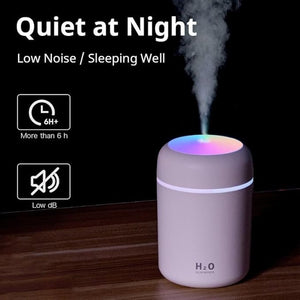
 Sukoon 500ml₹1,899 · 270–320 sq ftAir movement takes fragrance from where it was made and mixes it through the volume of the room. That is a change in shape, not in height: the peak beside the bottle comes down slightly and the level everywhere else comes up, which is precisely the trade you want. A reed diffuser has no propulsion of its own, so the only distribution it gets is the room's — a door opening, people crossing the floor, warm air rising off a sunlit wall, a ceiling fan on low. An ultrasonic machine has a piezo disc and a small fan behind a water-carried mist. A waterless cold-air unit drives undiluted oil down a pressurised air path. Those are different categories of object, not stronger versions of a bottle. The Sukoon at ₹1,899 is the least expensive way in our range to put a genuine air path behind a fragrance in a normal living room.
Part two — what each change does at each distance
Eight changes people actually make, and what each does beside the bottle, across the room and at the doorway. Read the last two columns; the first is where the money usually goes. The starred row is the change with the largest effect at the door and the smallest effect on your bank balance.
| The change you make | Beside the bottle | Across the room | At the doorway | Cost |
|---|---|---|---|---|
| Close the balcony door and windows an hour before ★ | Unchanged | Rises — the room stops replacing its air | The largest free improvement available to most homes | ₹0 |
| Move the bottle onto a walking route at chest height | Slightly lower, which is the point | Rises noticeably — the room now has something to carry | Rises; the doorway is downstream of the traffic | ₹0 |
| Flip all six reeds with gloves | Rises for a few days, then settles | Rises modestly with it | Small change unless distribution is already working | ₹0 |
| Take the bottle out of an AC or fan draught | Rises — the reeds stop being stripped | Rises, and the bottle stops emptying weeks early | Rises; scent stays in the room instead of leaving it | ₹0 |
| Add three reeds, nine in total on a 50ml | Rises clearly | Rises a little | Little to none in a still room | ~3 weeks of bottle life |
| Buy a deeper composition | Changes character; may read as stronger | Marginal | Marginal — this is the purchase that disappoints | ₹749–₹849 |
| Buy the 130ml instead of the 50ml | No change whatsoever | No change | No change — you have bought 14–18 weeks, not metres | ₹1,249–₹1,349 |
| Add an active source with a fan and a timer | Lower peak, because the mix is spread | Rises substantially and evenly | This is the change that moves the doorway | ₹899–₹1,899 |
| The honest caveat: the words in these columns describe direction, not magnitude, and they are not measurements — every one of them varies with ceiling height, soft furnishing, season, how the room is used and how much air it exchanges. Nothing in this table says anything about how a person will respond to any of it, because a table cannot know that and neither can I. Note also that two rows cost bottle life rather than rupees, and that the row most people reach for first — a deeper composition — sits second from the bottom on the column that matters. | ||||
 Sukoon · the sized living-room answer₹1,899Shop →
 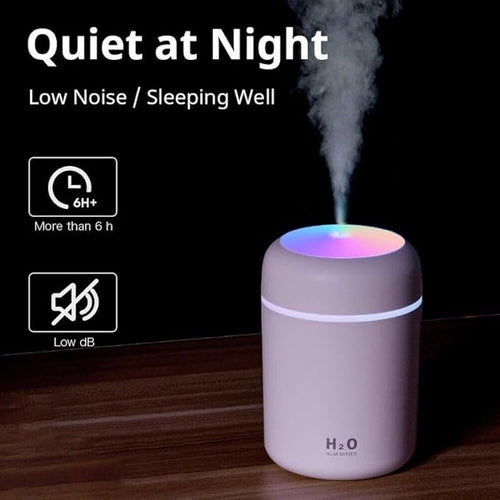 Boond · distribution for about 150 sq ft₹899Shop →
  Oil refill · 300ml, your own vessel and reeds₹2,399Shop →
Part three — the three cases where the answer genuinely is the oil
I have spent two sections arguing for diffusion, so let me be scrupulous about the minority of cases where the oil really is the problem. Ignoring them would make this page a slogan rather than a diagnosis. The first is an emission failure that looks like a diffusion failure: the reeds have stalled. Lift one out and look for the wet line — the boundary between the oil-soaked lower portion and the dry upper portion. If that line is high and the reed is dark along most of its length, the reed is saturated and has stopped moving oil efficiently; flip all six with gloves and it recovers. If the line is barely above the oil, the reed is not wicking at all, which is why our guidance is to refresh reeds every few months. Here is an honest gap in our range while I am on the subject: SOSA does not sell replacement reeds separately. An oil refill is oil only. I would rather write that sentence than let you assume otherwise and be annoyed when the parcel arrives.
The second case is a composition with nothing persistent underneath it. Fragrances are built in layers, and the light top notes that make an opening bright are also the ones that leave first. A composition that is mostly top will read beautifully for the first days of a bottle and then feel like it has gone, when in fact what has gone is the part that was doing the announcing. This is where SOSA's own trade sits, and I will state it plainly rather than let it be discovered. Phthalate solvents push fragrance hard off a reed and win the first week convincingly; in Indian heat they then degrade and can turn acrid by around week six. We are phthalate-free on a heat-stable coconut-derived CCT carrier, which buys a smaller opening and a longer, flatter plateau. If you have come to us from something that opened louder, the first fortnight will feel like a downgrade and the tenth week will not. That is a deliberate choice and you are entitled to know it was made.
The third case is the composition being wrong for the room rather than weak in it. A bright citrus-and-mint accord in a large, cool, north-facing living room with high ceilings will read thin no matter how well distributed it is, because there is very little weight in it to hold a big volume; a deep coffee-and-vanilla in a small bathroom will read as heavy for the opposite reason. Morning Freshness at ₹749 is built for bathrooms, kitchens and home offices; Mountain Breeze at ₹849 for bedrooms, home offices, yoga rooms and libraries; Fresh Brew at ₹849 for living rooms, kitchens and offices; Garden Bloom at ₹799 for entryways and living rooms; Evening Calm at ₹799 for bedrooms, nurseries and reading corners. Matching the weight of a composition to the volume of a room is a real lever and it is not the same as buying a stronger one.
There is a fourth situation worth naming, though it is a scheme problem rather than an oil problem. If you run two different scents in one connected air space and they do not share a note, you get a seam — a boundary where the two do not resolve into anything, and the room reads as confused rather than as scented. Mountain Breeze and Morning Freshness meet on green eucalyptus; Fresh Brew and Garden Bloom meet on warmth and a soft musk. Two unrelated compositions in one space do not resolve, and the instinct when it goes wrong is — predictably — to make one of them stronger, which worsens the seam.
Part four — diffusion, bought and sized honestly
If the free checks have failed and the oil is not the problem, you are buying distribution — and the mistake at this stage is buying too much of it or the wrong shape of it. Size against the connected volume people actually occupy, not against the floor plan you own. The starred row is the one that fits most Indian living rooms.
| The space you are trying to reach | What a passive source manages there | The distribution to add | Price |
|---|---|---|---|
| Living room, 270–320 sq ft, guests on occasions ★ | A good background; will not lift for an evening | Sukoon — fan, remote, steady/2H/4H timers, 16–18 hrs low | ₹1,899 |
| Bedroom, nursery or reading corner, continuous | Comfortably enough — this is the format's home ground | None. Reposition and flip, and keep your money | ₹749–₹849 |
| Study, landing or single bedroom, about 150 sq ft | Adequate, but no control and no start time | Boond, roughly 6 hours a fill, USB | ₹899 |
| Open living-dining of roughly 300 sq ft | One bottle cannot cover two connected volumes | Sukoon again — Safar is personal-scale, Vaayu is whole-floor | ₹1,899 |
| Two separate rooms, both wanted scented | Output per bottle is fixed; one bottle serves one space | Two 50ml at opposite ends beats one 130ml in the middle | ₹749 + ₹849 = ₹1,598 |
| A desk, a bedside, a hotel room or a car | Fine, if you want it constant rather than on demand | Safar — 20ml, about 6.9cm, three speeds, 1/2/3-hour auto-off | ₹3,999 |
| A large home or a connected floor plan | Well past the honest ceiling of a passive source | Vaayu — up to 1000m³; read the refill note first | ₹11,999 |
| The honest caveat: two products are missing from this table on purpose. The Megh 6L at ₹3,499 is not a coverage upgrade — it covers about 215 sq ft, less than the ₹1,899 Sukoon, and is bought for its roughly 100 hours of runtime and for humidity, or not at all. And SOSA does not currently sell a separate Vaayu cold-air refill oil: the 400ml supplied in the box is the fragrance available at the time of writing, the water-based Hotel Collection must never be used in it, and long-term supply should be confirmed with us before committing ₹11,999. Coverage figures are manufacturer specifications, not measurements in your flat. | |||
Part five — what "stronger" cannot be bought as here
Part of answering your question honestly is telling you what does not exist, because a good deal of the search for a stronger oil is a search for a product that no reputable maker sells. There is no fragrance concentrate in the SOSA range, no booster you add to an existing bottle, and no intensity setting on a reed diffuser. Our compositions are supplied at the dilution they were designed and IFRA-assessed at, on a heat-stable CCT carrier, and the reed diffuser's only user control is the number of reeds standing in the bottle. If you find yourself hunting for something to make an existing bottle louder, the honest answer is that reed count is that control, that it costs bottle life roughly in proportion, and that above nine or ten reeds you are mostly making the immediate surroundings of the bottle unpleasant rather than improving anything at the door.
The strength figures we publish deserve the same treatment. 9.5 for Fresh Brew, 9.4 for Mountain Breeze, 9.0 for Morning Freshness, 8.9 for Garden Bloom and Evening Calm are positions on SOSA's own internal scale at six reeds. They are not concentrations, not an industry standard, not a projection rating and not a quality ranking. They describe how present a composition reads in our own testing at the calibrated dose — nothing more. I publish them because they help people choose between a deep and a soft room, and I caveat them constantly because they get read as a distance specification — exactly the confusion this page exists to undo.
There are other gaps, and I would rather list them than have you stretch the nearest product across them. There is no oud, no musk-forward composition and no aquatic in the reed range. There is no 100ml size — 50ml and 130ml only. Replacement reeds are not sold separately, so an oil refill at 300ml ₹2,399 or 500ml ₹3,499 is oil only and you reuse your own vessel and reeds; the method is to remove the reeds, pour to the neck, return them and flip once so both ends are coated. And SOSA sells no room spray or home spray of any kind — every SOSA spray is a car perfume. Where the range genuinely is strong is value over time: a refill works out at roughly ₹7–8 per ml against ₹15–17 per ml for a 50ml bottle, which is up to about 55% less, with 300ml lasting roughly 8–11 months and 500ml roughly 14–18.
One more thing that cannot be bought, and it is the reason the title of this page is phrased the way it is. The reaction itself is not a purchasable specification. I have no way of knowing what a visitor to your home will register, and I am not going to build a product page on a prediction about someone else's nose. What I can tell you is that a fragrance encountered on arrival is at its most perceptible then, because an arriving nose has not been sitting in it — that is a perception effect and it belongs to your guest, not to my bottle. Everything on this page is about making sure that when that moment comes around, the room has something even and established in it. That is the whole of what a maker can honestly offer.
Part six — the diagnostic ladder, cheapest first
Here is the sequence I would run in your flat, in this order, stopping the moment something works. Six of the eight steps are free, and in my experience most rooms are resolved by steps two and five. Do not skip to the purchase; the purchase is only the right answer once the free steps have told you the room genuinely needs it.
| Step | What you do | What the result tells you | Cost |
|---|---|---|---|
| 1 · The two-position reading ★ | Smell at the bottle, then walk to where guests stand and smell again | A large gap means distribution; a faint near reading means emission | ₹0 |
| 2 · The doorway test | Leave the building, come back in, judge your first breath | The only honest use of your own nose in your own home | ₹0 |
| 3 · The wet-line check | Lift a reed; find the boundary between soaked and dry | High and dark = saturated, flip. Barely above the oil = refresh reeds | ₹0 |
| 4 · Flip all six reeds | Gloves on, invert each reed so both ends are wetted | A lift over a few days confirms an emission-side issue | ₹0 |
| 5 · Reposition and raise | Into the occupied room, chest height, on a route, off the wall | An improvement here confirms distribution was the cap | ₹0 |
| 6 · Close the room for an hour | Balcony door, windows, and the doors of unscented rooms | A clear improvement means air exchange was removing it | ₹0 |
| 7 · Ask a second nose | Ask someone arriving what they can smell, before you prompt them | If they report it and you cannot, nothing is wrong. Stop here | ₹0 |
| 8 · Only now, buy distribution | Boond for ~150 sq ft, Sukoon for 270–320 sq ft, reeds running underneath | Buy the fan and the timer, never a promise about a reaction | ₹899–₹1,899 |
Versailles
At Versailles you learn to evaluate a composition on a strip held at a fixed distance from your own face, and you become very good at a question that turns out to be the wrong one for a home. I arrived in home fragrance assuming a room was a bigger version of a strip. It is not: it is a volume of moving air, and the composition is only one of several things deciding what anyone standing in it perceives. Relearning the job from the physics upward took me longer than I would like to admit in print.
The expensive part of that education was a period when I answered every "my room is not strong enough" message by suggesting a deeper composition. It worked often enough to feel like a method and rarely enough to be useless — and the failures were nearly always the same thing. A bottle in a dead alcove. A through-draught from a balcony door nobody closed. In each case I had sold somebody a fragrance to solve an airflow problem.
So the discipline I hold the brand to now is to name the cheaper answer even when it costs us the sale, and to name the gaps rather than stretch a product across them. No oud, no musk, no aquatic, no separately-sold reeds, no room spray, no separate Vaayu refill oil at present. Those sentences cost something to publish and they are the reason I can be trusted about the rest.
And the boundary I will not cross, which is really what your question is circling: I have no idea what will happen when your door opens, and neither does anyone else with something to sell you. Everything above is about making sure the room is ready for the moment, not about the moment itself. Composed and handmade in small batches in Pune, tested through 45°C summer heat and 85% monsoon humidity; a part of every order funds a girl's classroom through Nanhi Kali.
Frequently asked questions
- The four variables of projection — emission, distribution, room behaviour and the nose.
- Which format actually moves fragrance? — the three propulsion classes, ranked.
- Spray, reed or waterless? — onset against persistence, with the honest gaps.
- The first breaths on arriving — real as perception, unbuyable as a promise.
- Brand: the SOSA founder story.
SOSA range, specifications and prices used in this guide (verified from the live store, August 2026): Reed diffusers — alcohol-free, phthalate-free, paraben-free, IFRA-compliant compositions on a heat-stable coconut-derived (CCT) carrier, in a refillable glass bottle with six fibre reeds, flipped weekly. 50ml lasts 6–8 weeks, 130ml lasts 14–18 weeks; there is no 100ml reed diffuser size. Morning Freshness (Malabar lemon · peppermint · Nilgiri eucalyptus) 50ml ₹749 · 130ml ₹1,249; Garden Bloom (British rose · night-blooming jasmine) ₹799 · ₹1,299; Evening Calm (Kashmir lavender · chamomile) ₹799 · ₹1,299; Fresh Brew (Coorg coffee · Kerala vanilla) ₹849 · ₹1,349; Mountain Breeze (Himalayan pine · sage · Indian cedar) ₹849 · ₹1,349. Duo sets ₹1,498–₹1,598 (2 × 50ml) and ₹2,498–₹2,598 (2 × 130ml). Oil-only refills 300ml ₹2,399 · 500ml ₹3,499 — vessel and reeds not included; replacement reeds are not sold separately. Machines, by the space each genuinely serves: Boond 300ml ₹899 (~150 sq ft, about 6 hours a fill, ultrasonic) · Sukoon 500ml ₹1,899 (270–320 sq ft, 16–18 hours on low, remote and steady/2H/4H timers, three 15ml fragrances included, ultrasonic) · Megh 6L ₹3,499 (~215 sq ft — a runtime and humidity machine that covers less than a Sukoon, never a coverage upgrade) · Safar ₹3,999 (waterless cold diffusion, cordless, 2000mAh, 20ml bottle, about 6.9cm, three speeds and a 1/2/3-hour auto-off timer, up to 10 hours continuous or 30 hours intermittent — built for a car, desk, bedside, hotel room or small room; it is not a large-room diffuser) · Vaayu ₹11,999 (waterless cold-air nebulisation of undiluted oil, up to 1000m³ or about 2,000–3,000 sq ft, Bluetooth app, 1/4/8/24-hour timers, adjustable intensity, auto-stop, key-lock, under 38 dB — for large homes and whole floors). SOSA does not currently sell a separate Vaayu cold-air refill oil; the 400ml supplied in the box is the fragrance available at the time of writing, and the water-based Hotel Collection must not be used in a Vaayu. Aangan ₹25,999 and Meenar ₹38,500 are commercial. The water-based Hotel Collection for ultrasonic machines is 15ml ₹299 · 100ml ₹999 · 300ml ₹1,799. SOSA sells no room spray or home spray — every SOSA spray is a car perfume. Below ₹749: jar candles ₹379, Sandalwood or Smoked Oudh candle ₹449, wax melts ₹474 (a burner is required and not included), mugs ₹474, bubble and taper candles ₹569, Amber Rose candle ₹599, ceramic trinket dish and candle two-pack ₹664. A reed diffuser or a diffuser adds fragrance to a room. It does not clean, purify or filter air, remove or neutralise cooking, smoke or damp smells, reduce humidity, or change how anyone feels — and nothing here can promise that any guest will notice, comment on or remember a fragrance. Ventilate or extract first; add fragrance second. A persistent musty smell indicates moisture that needs finding and drying, and SOSA sells no dehumidifier or air purifier. How far a fragrance carries depends on emission rate, air movement, room volume, ceiling height, air exchange and soft furnishing; longevity and coverage figures are typical ranges and manufacturer specifications, not guarantees. Not noticing a constant fragrance is ordinary olfactory adaptation — the reliable checks are leaving the room and returning, or asking someone who has just arrived. Strength figures are positions on SOSA’s own internal scale, not an industry standard. Fragrance oil is flammable — keep bottles away from open flame and direct sunlight, and out of reach of children and pets. Composed and handmade in small batches in Pune, India; tested through 45°C summer heat and 85% monsoon humidity. Free shipping above ₹499. A portion of every order supports girl-child education through Nanhi Kali. Prices subject to change — see the live product pages.