
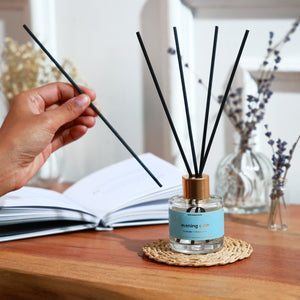




Close the door first. It is half the answer and it costs nothing. A closed bedroom builds concentration; an open one leaks it into the corridor all day.
The three real options: a reed diffuser ₹749–₹849 gives you a fragrant zone with no power, no water and no maintenance; Sukoon ₹1,899 gives real room coverage of 270–320 sq ft but dilutes the oil in water and adds humidity; Safar ₹3,999 throws pure undiluted oil with no water at all, and is named and sold as a car and travel diffuser.
The honest gap: between Safar at personal scale and Vaayu ₹11,999 at 1000 m³ — roughly 2,000–3,000 sq ft — SOSA has no mid-sized waterless bedroom nebuliser. If your requirement is “real room coverage, one bedroom, no water”, this range cannot answer it perfectly and I would rather say so here than after you have paid.
2. Name which mechanism you own. If it is a reed, you own passive capillary diffusion: oil climbs six fibre reeds and evaporates from their surface with no air being moved at all. That produces a rich zone around the bottle and a shallow tail across the room. If it is an ultrasonic machine you own a wet plume that genuinely moves air and covers 270–320 sq ft in the case of Sukoon. If you own neither, the choice below is the whole page.
3. Exhaust the free adjustments before you spend. All six fibre reeds rather than three. The bottle out of a recess and into the air’s path, though never in the direct blast of a running split AC, which strips the top notes within days. The door closed during your occupied hours. A ceiling fan on its lowest speed, which converts a still room into a circulating one. In a great many bedrooms this is the entire fix, and it costs nothing.
4. If you want the room filled rather than the bedside scented, buy transport. Sukoon at ₹1,899 is the sensible first machine for a bedroom: 500ml, 270–320 sq ft, 16–18 hours on low, three 15ml Hotel Collection scents included. The trade you are making is water: the oil is diluted, the output adds humidity, the tank needs filling, and in a hard-water city it can leave a fine white mineral dust.
5. If water is the thing you will not accept, understand exactly what you are buying. Safar ₹3,999 is waterless cold diffusion of pure undiluted oil — the hotel mechanism at personal scale — with a 20ml bottle, 2000 mAh Type-C battery, three speeds, a 1, 2 or 3-hour auto-off timer, up to 10 hours continuous or around 30 hours intermittent per charge, and a 6.9 cm body. It is named and sold as a car and travel diffuser, with bedside and hotel room among the uses SOSA lists for it, and no room-coverage figure has ever been published for it. You should know all of that before ordering rather than discover it afterwards.
Alcohol-free, phthalate-free, paraben-free, IFRA-compliant, 0 ppm formaldehyde. Free shipping above ₹499, and a portion of every order supports girl-child education through Nanhi Kali.
Why one bedroom is the easy problem, and the door is the equipment
People arrive at this question apologetically, as though wanting only one room done were a smaller ambition that deserves a smaller answer. It is the opposite. A hotel corridor and a hotel lobby are hard because they are enormous, ventilated and permanently open; a bedroom is small, enclosed and shut for hours at a time. The reason a lobby needs a commercial machine is not that lobbies smell stronger — it is that a huge, constantly-refreshed volume of air has to be dosed continuously to hold any concentration at all. Your bedroom does not have that problem. It has the opposite one, which is that it will reach a perceptible level rather easily and can just as easily be pushed past pleasant.
The physical quantity that matters is air exchange: how many times an hour the room replaces its air with air from somewhere else. A door left open onto a stairwell, a window on a high floor where wind speed is greater, an extractor running, a corridor with a draught — all of these are transport systems pointing away from you, and they carry fragrance out just as efficiently as a fan carries it around. Closing the door is not a tidy suggestion; it is the single largest intervention available to you and the only one that is free. A great deal of the disappointment I read about is a dosing problem created entirely by an open door.
Which leads to a question nobody asks aloud: am I supposed to be able to smell it all the time? No. A room you can smell continuously, hour after hour, while sitting in it, is a room that has been dosed above what its volume needs. Home fragrance is designed to be noticed on arrival and at transitions — walking in from outside, coming out of the shower, turning in for the night. If you can smell it constantly in your own bedroom, the honest correction is usually fewer reeds or a lower speed setting, not a different scent and certainly not a bigger machine. And if you cannot smell it at all after an hour in the room, that may not be the product either, for reasons the next section deals with.
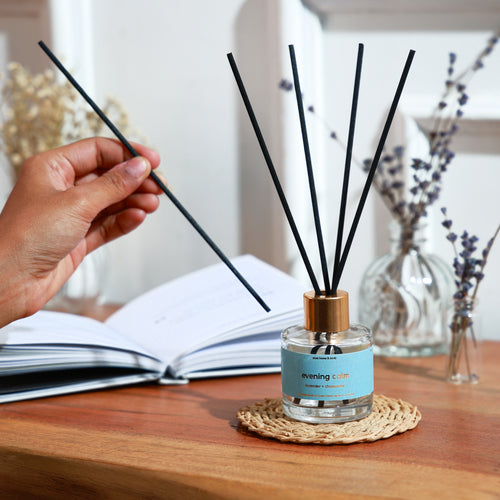
 Mountain Breeze₹849Oil climbs six fibre reeds by capillary action and evaporates from the wetted surface at whatever rate the room’s temperature, humidity and airflow allow. No energy goes in and no air is moved, so concentration is highest at the bottle and falls away with distance. That is a fragrant zone rather than a fragranced room, and it is the design. It is also why the reed wins every row that a machine cannot compete on: it is silent, it needs no power, it has no tank, no filter, no battery, no schedule and nothing to remember, it never creeps into the next room, and it looks like an object on a table rather than an appliance. A 50ml is specified for rooms up to about 150 sq ft, so in an ordinary bedroom it is correctly sized. Reed count is the only output control it has — six for full projection, three for a soft bedside level with roughly double the life.
 Sukoon₹1,899A piezo plate vibrates a mixture of water and fragrance oil into a visible wet mist, and that plume moves air. This is a real step up in reach rather than in strength, and for one bedroom it is very often the right purchase. Sukoon at ₹1,899 holds 500ml, is rated for 270–320 sq ft, runs 16–18 hours on low and arrives with three 15ml Hotel Collection scents. The honest costs: the oil is diluted in water, the output adds humidity to the room, the tank has to be filled, and in a hard-water city it can leave a fine white mineral dust on nearby surfaces. Note also which machine is not the upgrade — Megh at ₹3,499 has a six-litre tank and about a hundred hours of runtime but covers only around 215 sq ft, which is less than the Sukoon. It is a runtime and humidity machine, never a coverage upgrade.
 Hotel Collection₹999Pressurised air shatters undiluted oil into a dry micro-mist that travels with the room’s own airflow. No water, no dilution, no heat, no added humidity, no white dust — and it is the technology luxury hotels actually run, which is why it is the honest answer to every question in this cluster about why a home does not feel like one. At personal scale, Safar ₹3,999 does exactly this: 20ml bottle, 2000 mAh Type-C battery, three speeds, a 1, 2 or 3-hour auto-off, up to 10 hours continuous or about 30 intermittent per charge, 6.9 cm. Two disclosures you are owed. It is named and sold as a car and travel diffuser, though SOSA’s own product page lists bedside and hotel room among its uses, so recommending it here is supported by our own copy. And no room-coverage figure has ever been published for it, so I will not invent one; describe it to yourself as personal and small-space scenting.
The honest three-way, laid out side by side
Every page in this family gives the same three options because there are only three mechanisms, and the choice between them is genuinely a choice rather than a ladder where the expensive one wins. Read the last column carefully: it is the one that decides most purchases and the one that price comparisons leave out. The row for Vaayu is included so that you can rule it out with your own eyes rather than take my word for it.
| Option | Mechanism | What it delivers in a bedroom | Control | The cost you are accepting |
|---|---|---|---|---|
| Reed diffuser ₹749–₹849 | Passive capillary — no air moved | A fragrant zone around the bottle, 50ml specified up to ~150 sq ft | Reed count only. It cannot be switched off | No projection across the room, and zero scheduling |
| Boond ₹899 | Ultrasonic water mist | Up to ~150 sq ft, 300ml, about 6 hours, USB, night light | On or off; stops when the tank empties | Water, dilution, humidity, a short run |
| Sukoon ₹1,899 ★ | Ultrasonic water mist | Real coverage — 270–320 sq ft, 500ml, 16–18 hours on low, three 15ml Hotel Collection scents included | On demand, and you can run it well below its ceiling | Diluted oil, added humidity, refilling, possible white dust in hard water |
| Megh ₹3,499 | Ultrasonic water mist | Only ~215 sq ft — less than Sukoon. Never a coverage upgrade | About 100 hours from a 6L tank | Buy it for runtime and humidity, not for reach |
| Safar ₹3,999 | Waterless cold-air nebulising | Pure undiluted oil, dry mist, personal and small-space scenting. No published room coverage. Named and sold as a car and travel diffuser | 3 speeds and a 1/2/3-hour auto-off; 10h continuous or ~30h intermittent per charge | Recharging, a 20ml bottle, and a device sold for a different primary use |
| Vaayu ₹11,999 | Waterless cold-air nebulising | Up to 1000 m³ — roughly 2,000–3,000 sq ft. Wrong purchase for one bedroom | Bluetooth app, 1h/4h/8h/24h windows, chosen days, key-lock, under 38 dB | Nine-tenths of it wasted unless you want the whole flat done |

Zoning a bedroom properly, before you spend anything
Work through this list in order and stop when the room is right, because a fair share of readers never reach the paid steps. Use all six fibre reeds. More reeds is stronger and shorter rather than simply better, but if you have three in and you are asking why the room feels quiet, that is the first dial to turn. Move the bottle out of a corner — recesses, curtain folds and the backs of shelves are dead air, and a source in dead air produces exactly the complaint that brings people to this page. Put it where air already travels, on a bedside table near the doorway or a metre from where you sit, but never in the direct stream of a running split AC, which will strip the light top materials in days and leave you with the base alone. Close the door for the hours you want the room to smell, rather than running fragrance into an open room all day. Put the ceiling fan on its lowest speed, which turns unreliable convection into dependable circulation and does more for evenness than a second bottle would.
Then check whether the room is even the problem, because you are an unreliable instrument inside your own home. Olfactory receptors adapt to a constant, unchanging stimulus within minutes: the signal still arrives, and the brain stops reporting it because nothing has changed. This is precisely why you smell your own house only after being away from it, and why a hotel is noticeable partly because you arrive un-adapted to it. The test is not to sniff harder. Leave the room for fifteen minutes, do something else, and walk back in. Better still, ask somebody who has just come in from outside. If a guest notices it at the door and you cannot, the diffuser is doing its job for everybody but you, and no purchase will change that.
One more thing worth putting to yourself before spending, because it decides which half of this page applies to you. Do you want the room to smell, or do you want to notice it smelling? Those are different requirements. The first is satisfied by a well-placed reed at the right dose, and a visitor will confirm it. The second — wanting the fragrance to register on you, in your own room, repeatedly — runs directly into adaptation, and the honest answer is that it is best achieved at transitions rather than continuously: a machine on a timer that runs while you are out and greets you at the door, or a room you close and re-enter, rather than a stronger fragrance running permanently at your elbow.
What to buy for one bedroom, in order — and the gap in the range
In the order I would actually spend, cheapest first, with the thing SOSA does not make stated at the bottom rather than buried. I would rather lose a sale to honesty than have somebody open a ₹3,999 box and find the word car on it.
| Buy | What it is | When it is the right answer | Price |
|---|---|---|---|
| 1. Close the door, six reeds in, bottle in moving air, fan on low ★ | The free adjustments, in the order that matters | Always first. It resolves a large share of these questions outright | ₹0 |
| 2. A 50ml reed | Six fibre reeds, refillable glass, specified up to ~150 sq ft, 6–8 weeks, about ₹13–₹15 a day. Evening Calm 8.9 is the softest; Mountain Breeze 9.4 the deepest woody | When you want the room pleasant and contained, with nothing to maintain and nothing that can escape into the corridor | ₹749–₹849 |
| 3. Sukoon | Ultrasonic water mist, 500ml, 270–320 sq ft, 16–18 hours on low, three 15ml Hotel Collection scents included | When you want the room genuinely filled on demand and can accept dilution, added humidity and filling the tank | ₹1,899 |
| 4. Safar | Waterless cold diffusion of undiluted oil. 20ml, 2000 mAh Type-C, 3 speeds, 1/2/3-hour auto-off, up to 10h continuous or ~30h intermittent, 6.9 cm. Named and sold as a car and travel diffuser, with bedside and hotel room among its stated uses | When water is ruled out, and when you want it on only during chosen hours. No room-coverage figure has been published, and it needs recharging | ₹3,999 |
| The honest gap | There is no mid-sized waterless bedroom nebuliser at SOSA. Between Safar at personal scale and Vaayu ₹11,999 at 1000 m³ — roughly 2,000–3,000 sq ft — the range has nothing sized to one room | Said plainly, because “real room coverage, one bedroom, no water” is exactly the request this catalogue cannot fully answer | — |

Versailles
When somebody writes to say they only want one room done, I know the conversation is going to go well, because they have already made the decision that most people get wrong. A home that smells identical everywhere stops smelling of anything within a week. Scent registers at boundaries — a door, a landing, a turn from one room into another — and a flat scented uniformly has removed every boundary it had. Zoning is not the budget option. It is the better outcome.
What I will not do on this page is pretend the range answers every version of the request. If what you want is real coverage across a bedroom with pure undiluted oil and no water at all, we do not make the machine for that. Safar is the right technology at the wrong nameplate — it is sold as a car and travel diffuser and we have never published a room-coverage figure for it — and Vaayu is rated to 1000 m³, which in a bedroom is an expensive way to waste nine-tenths of a machine. That gap is real and it shapes every recommendation in this family.
So my advice is unglamorous. Shut the door, put all six reeds in, move the bottle out of the corner, and give it a day. If a friend walks in and mentions it, you were finished before you started spending. If nobody notices, buy the Sukoon, accept the water, and run it low. Everything we make is composed in Pune, and a part of every order funds a girl’s classroom through Nanhi Kali.
Frequently asked questions
- Hotel fragrance in 100 sq ft — where sizing ends and expectation begins.
- Projection in a 10 × 10 room — yes, and over-dosing is the real risk.
- A 10 × 12 bedroom — the closed-door hours, not the square footage.
- Do I really need a machine at 120 sq ft? — often no, and here is the test.
- Small waterless diffuser versus a reed — undiluted oil and moved air.
- Only while I am in the room — the control question, answered by the timer.
- A hotel suite without fragrancing the house — containment in practice.
- Small room, big projection and reed versus Safar, scored.
- Brand: the SOSA founder story.
SOSA facts verified August 2026: Reed diffusers (passive capillary diffusion) — Morning Freshness ₹749/₹1,249, Evening Calm ₹799/₹1,299, Garden Bloom ₹799/₹1,299, Mountain Breeze ₹849/₹1,349, Fresh Brew ₹849/₹1,349; 50ml suits rooms up to about 150 sq ft and lasts 6–8 weeks, 130ml suits above 150 sq ft and lasts 14–18 weeks; six fibre reeds in a refillable glass bottle, six for full projection and three for a soft bedside level with roughly double the life, flipped every 3–5 days, about ₹13–₹15 a day; heat-stable CCT carrier rather than DPG, alcohol-free, phthalate-free, paraben-free, IFRA-compliant, 0 ppm formaldehyde, tested at 45°C and 85% RH, composed in Pune. Ultrasonic water mist — Boond ₹899 (300ml, up to ~150 sq ft, ~6 hours, USB), Sukoon ₹1,899 (500ml, 270–320 sq ft, 16–18 hours on low, three 15ml Hotel Collection scents included), Megh ₹3,499 (6L tank, ~100 hours, ~215 sq ft — less than Sukoon, and never a coverage upgrade). Waterless cold-air nebulising — Safar ₹3,999 (20ml bottle, 2000 mAh Type-C, 3 speeds, 1/2/3-hour auto-off, up to 10 hours continuous or around 30 hours intermittent per charge, 6.9 cm; named and sold as a car and travel diffuser, with car, handbag, desk, bedside and hotel room among its stated uses; no room-coverage figure has been published) and Vaayu ₹11,999 (up to 1000 m³, roughly 2,000–3,000 sq ft, 400ml tank lasting about 90+ days, Bluetooth app with 1h/4h/8h/24h windows, under 38 dB, 5W, CE/RoHS/SGS). Between Safar and Vaayu there is no mid-sized waterless bedroom nebuliser in the SOSA range, and this guide states that rather than stretching a product to cover it. Hotel Collection oils are water-based and ultrasonic-only: 15ml ₹299 (a refill, never a first purchase), 100ml ₹999, 300ml ₹1,799. Reed oil and Hotel Collection oil are not interchangeable in either direction and there is no hotel-inspired reed diffuser. Free shipping above ₹499. A portion of every order supports girl-child education through Nanhi Kali. SOSA is an independent Indian fragrance house; the Hotel Collection scents are SOSA’s own interpretations inspired by the world’s finest hotels, and SOSA is not affiliated with, endorsed by or a supplier to any hotel brand. Prices subject to change — see the live product pages.