


The placement: keep both machines roughly two metres back from the shared door so neither is feeding the gap.
The dose: never equal. Lead room four to five drops, the quieter room three.
The scent: one across both is easiest. Two only if they share a material.
2. Give one room the lead. Equal doses is the error. Decide which room is the one people gather in — nearly always the living room — run that at four to five drops, and run the adjoining room at three. A home with a quieter and a louder room reads as deliberate; a home at one level everywhere reads as nothing.
3. Understand which way the air is going. Between rooms at different temperatures, an open door exchanges air both ways at once — warm across the top, cool along the floor. An air-conditioned bedroom is exporting its own low-level fragrance and importing the living room's across the top of the door.
4. Use one fragrance, or two that share a material. One scent across both rooms is the easiest thing to live with and the most convincing. If you want two, they need a note in common — The Ritz-Carlton-inspired Quiet Luxury and Westin-inspired White Tea Serenity both run on white tea and cedar, so the threshold between them is a shift rather than a collision.
5. And use the door as a control, not an obstacle. Run each room for thirty to forty minutes with its door shut, then open up. That gives you two properly established rooms which then blend gently, rather than two half-filled rooms sharing their output from the start.
Made in India, composed by an ISIPCA Versailles-trained perfumer — and a portion of every order supports girl-child education through Nanhi Kali.

What an open door actually does
A doorway between two rooms is usually pictured as a hole that fragrance leaks through, slowly, in the direction of whichever room has less. That is not what happens. Where two connected rooms are at different temperatures — and in an Indian home in the evening they nearly always are, because one has an air conditioner and the other does not — the opening carries a steady two-way flow. Warmer, lighter air moves through the upper part of the doorway into the cooler room; cooler, denser air returns along the floor. It is continuous, it is driven by nothing more than temperature difference, and it does not need a fan or a draught to keep going. Two rooms joined by an open door are, in a real sense, one room with a narrow waist in the middle of it.
Once you see the exchange, the practical consequences fall out immediately. The air-conditioned bedroom is exporting fragrance released near floor level and importing the living room's across the top of the door, so a bedroom machine standing low and close to the doorway is largely scenting the living room. Meanwhile the warm living room is losing its upper air into the bedroom, so a living-room machine placed high and near the door is doing the same thing in reverse. Both problems have the same solution, which is distance: put each machine far enough back that its output has joined its own room before it reaches the opening. About two metres is enough in most flats. What you cannot do is stop the exchange — short of shutting the door, which is a legitimate and underused option.
The three rules for a pair of rooms
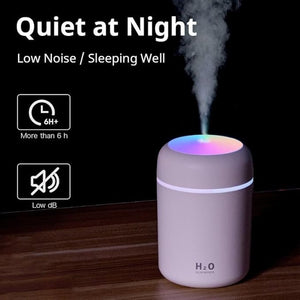
 SOSA Sukoon₹1,899The single most common arrangement I see is two machines placed for convenience, which usually means both of them within a metre of the connecting door, because that is where the sockets and the console tables are. They are then both releasing into the exchange rather than into their rooms. Move each one about two metres back — into the body of its own room, on the far side from the doorway if the layout allows — and each machine gets to establish its room before any of it reaches the opening. This costs nothing and it is the difference between two rooms that each smell of something and two rooms that smell of the same faint compromise. A Sukoon's remote earns its place here, since the correct position is now across the room from the sofa.
Common pairs of rooms
The pairs that actually occur in Indian flats, with what the air between them tends to do in the evening and how to place against it. Temperature difference is the driver, so the air-conditioned room is usually the one setting the direction.
| The pair | What the air does | How to place them | Scent |
|---|---|---|---|
| Living room and master bedroom ★ | Bedroom cooler — it exports low, imports high | Both 2m back; bedroom machine not on the floor | One scent, 4–5 drops living, 3 bedroom |
| Living room and dining, open to each other | One space with a waist, not two rooms | As far apart as the room allows, both a metre up | One scent only — this is one air space |
| Two bedrooms facing across a passage | They blend whenever both doors are open | Each machine on the far wall from its door | One scent, or two sharing a note |
| Bedroom and en-suite bathroom | The extractor pulls from the bedroom continuously | Machine on the far side of the bedroom | Nothing in the bathroom — it is being extracted |
| Living room and kitchen, open plan | Cooking dominates whenever it is running | Machine at the far end of the living side | One scent; run it after cooking, not during |
| Living room and study or nursery | Small room fills fast and over-concentrates | Boond ₹899 in the small room, 2 drops | Same scent, clearly lower |
| Bedroom and balcony | Not a pair — the balcony is outside | Machine well away from the balcony door | Close the door before you run it |
| The arrangement that never works: two machines either side of the same doorway, both close to it, both at five drops, running different fragrances. That is one blended smell at the threshold and two rooms that have lost their own character — and it costs ₹3,798 to achieve. | |||
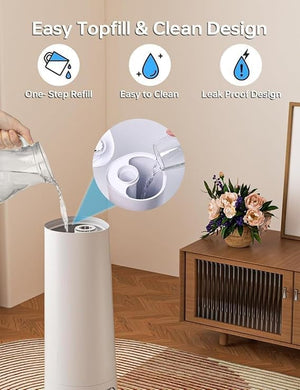
Sukoon · the lead room₹1,899Shop → 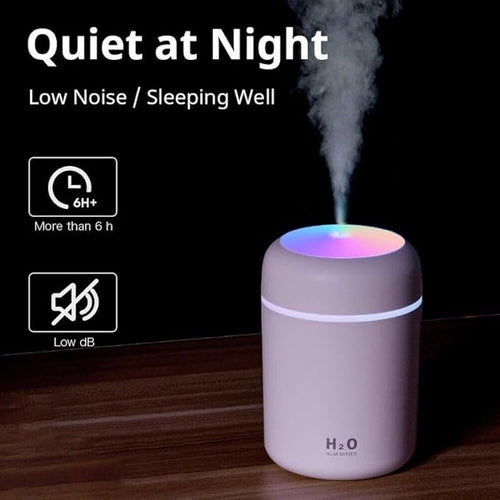 Boond · the quieter room₹899Shop →
 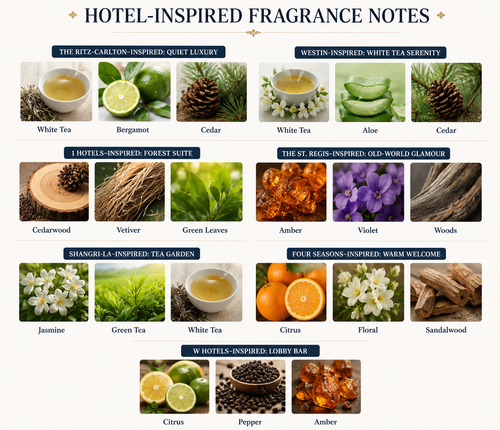 Hotel Collection · one in bothFrom ₹299Shop →
Doses, timing, and using the door itself
Fill each room separately before you connect them. Run both machines for thirty to forty minutes with both doors shut — that is roughly how long a room takes to reach a steady level — and then open up. What you get is two properly established rooms that blend gently at the edges, instead of two half-filled rooms sharing their output from the first minute. This one habit does more for a pair of rooms than any adjustment to the hardware, and on a Sukoon the four-hour timer means you can start both and forget them.
Then set the doses asymmetrically and leave them alone. Four to five drops of Hotel Collection in the lead room, three in the adjoining one. Resist the urge to raise the quieter room when it stops registering — you will have adapted to it within about twenty minutes, and what feels absent to you is usually perfectly present to anybody arriving. If you genuinely cannot detect it after coming in from outside, that is a real signal and worth acting on; anything you notice from the sofa is not. Keep both tanks on the same schedule so the two rooms are never at wildly different ages.
Use the door as an instrument rather than treating it as a leak. Shut it and you have two independent rooms, which is exactly what you want when one person is asleep and another is not. Open it and you have one large space at two strengths, which is what you want when people are over. A pair of machines with a door between them is the most flexible arrangement in home scenting, and most of the flexibility is in the handle. Keep the same fragrance in both tanks unless you have deliberately chosen two that share a note, rinse when you switch, use filtered water in hard-water cities, and never put raw essential or carrier oils into an ultrasonic machine.
What a pair of rooms costs
Two machines, and the arithmetic for each sensible combination. Every Sukoon includes three 15ml fragrances, so a two-Sukoon home arrives with six bottles and no need to add anything.
| Setup | What you get | Covers | Total |
|---|---|---|---|
| Two equal rooms ★ | Two Sukoons ₹1,899 each — 6 × 15ml included | 270–320 sq ft each | ₹3,798 |
| One large, one small | Sukoon ₹1,899 + Boond ₹899 | 270–320 and up to 150 sq ft | ₹2,798 |
| Two small rooms | Two Boonds ₹899 each + one 15ml scent ₹299 | Up to 150 sq ft each | ₹2,097 |
| Two rooms, one bottle | Two Sukoons ₹3,798 + a 300ml ₹1,799 (~₹6/ml) | Both rooms, one scent, months of it | ₹5,597 |
| Running cost | A 100ml refill from ₹999 shared across both machines | Months at 3–5 drops | from ₹999 |
Versailles
The thing nobody tells you about buying a second diffuser is that you have not bought a second room. You have bought a system with three parts — two rooms and the exchange between them — and the third part is the one that decides whether it works. Almost every complaint I get about a two-machine home is really a complaint about the doorway.
What changed how I set these up was realising the door is not a leak but a working exchange, running in both directions, driven by nothing more than the fact that one room has an air conditioner in it. You cannot defeat that with output. You can only give each machine enough distance to establish its own room first, which turns out to be about two metres in a normal flat.
So: both machines well back, one room clearly leading, the same fragrance in both tanks, and each room filled with its door shut for half an hour before you open anything. That is ₹3,798 for two Sukoons with six 15ml bottles in the box, and it will read better than four machines placed carelessly. A portion of every order funds a girl's classroom through Nanhi Kali.
Frequently asked questions
- Where should you place a diffuser in any room? — the single-room rules first.
- How to scent a long corridor or passage — the space between two rooms.
- How many diffusers do you need per room? — when one room needs two.
- Complete guide to diffuser placement and coverage — the whole physics in one place.
- Brand: the SOSA founder story.
SOSA products & prices (verified August 2026): Hotel Collection water-based ultrasonic diffuser fragrance 15ml ₹299 · 100ml ₹999 · 300ml ₹1,799 · Pack of 7 (15ml, all fragrances) ₹1,799; refills 100ml from ₹999. Seven scents: The Ritz-Carlton-inspired (white tea · bergamot · cedar), Westin-inspired (white tea · aloe · cedar), 1 Hotels-inspired (cedarwood · vetiver · green leaves), The St. Regis-inspired (amber · violet · woods), Shangri-La-inspired (jasmine · green tea · white tea), Four Seasons-inspired (citrus · floral · sandalwood), W Hotels-inspired (citrus · pepper · amber). Diffusers: Boond 300ml ₹899 · Sukoon 500ml ₹1,899 · Megh 6L ₹3,499. Water-based, phthalate-free, composed to IFRA standards for home diffusion; 3–6 drops per tank. Made in India, Pune. The Hotel Collection scents are SOSA's own interpretations inspired by the world's finest hotels; all hotel names are trademarks of their respective owners and are used only to describe the scent style — SOSA is an independent Indian fragrance house, not affiliated with or endorsed by any hotel brand. Prices and availability subject to change — see the live product pages.