




Where the cleaning smell actually lives: mop water, the bathroom floor drain, the wet cloth left in a bucket, the kitchen bin liner and the sink trap — not the surfaces themselves.
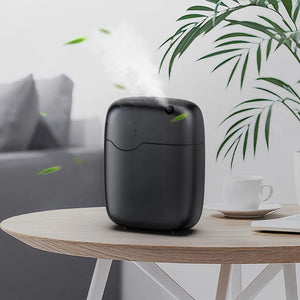
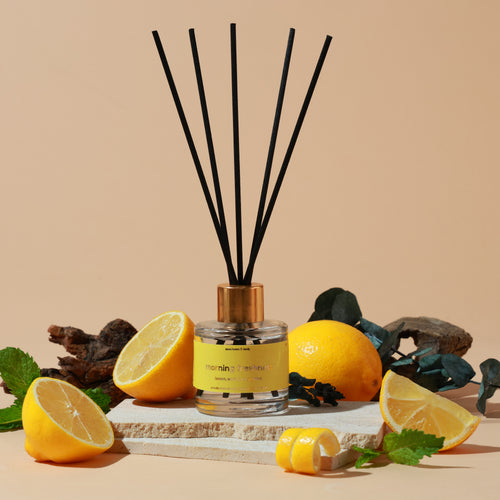
What to add afterwards: something dry and quiet. Morning Freshness from ₹749, a Sukoon at ₹1,899 for one room on a timer, or a Vaayu at ₹11,999 for a whole floor.
What fragrance cannot do: it does not clean air, remove odours or neutralise anything. It adds a smell to whatever is already there. And nobody — us included — can promise that any of this moves a rating.
2. Treat mop water as a source, not a tool. By the third room, a bucket of dirty water is redistributing smell rather than removing it. Change it at least once per turnover, and never leave the wet cloth in the bucket in a closed flat between guests.
3. Deal with the drains. In an Indian flat, an unused bathroom or utility floor drain dries out and lets sewer gas back into the room within days. A mug of water down every trap at the end of the clean is thirty seconds of work and it removes a smell no fragrance will ever cover.
4. Ventilate for twenty to thirty minutes with a cross draught, then close up. Two windows on opposite sides, ceiling fans on, exhaust fans on in kitchen and bathroom. This is the step hosts skip because it happens after the visible work is done and nobody is there to see it.
5. Only now add fragrance, and add it dry rather than sweet. A reed diffuser in the entry, a Sukoon in the living room set to run before arrival, or a Vaayu for a large property. Citrus, white tea, cedar and green notes read as clean. Vanilla, heavy florals and anything foody read as a room that is trying.
6. Understand what you are buying. You are buying the first ninety seconds of a guest's experience, which is real and describable. You are not buying air purification, odour elimination or a better rating — nobody can promise that scenting moves a review score, and we will not pretend otherwise. Composed and handmade in small batches in Pune, and a portion of every order supports girl-child education through Nanhi Kali.
Part one — clean is an absence, and absences are made in a specific order
Ask ten people what a clean room smells like and most will say lemon, or bleach, or "fresh". Ask them to describe the cleanest room they have ever walked into — a good hotel on the first afternoon, a friend's house that always feels effortless — and the description changes. It becomes negative. No damp. No cooking. No previous person. What we recognise as cleanliness is the reliable absence of information, and a strong cleaning smell is a great deal of information. It tells a guest that work happened here recently, which invites them to wonder what the work was for. Three things produce that absence, and all three happen before anything is added.
 Mountain Breeze₹849 · dry woodsCleaning products are designed to evaporate, and given moving air they will. Given a sealed flat they sit in it for hours. The fix is a cross draught: two windows on opposite walls, ceiling fans on, kitchen and bathroom exhausts running, for twenty to thirty minutes with the work finished. This is the step that gets skipped, because it is dead time in a turnover and the housekeeping team has somewhere else to be. If your gap between checkout and check-in is tight, this is the part to protect — it does more than any product on this page. If your property sits empty for days between bookings, ventilate at the start of the turnover as well as the end, because a closed flat develops its own stale note within about three days regardless of how clean you left it.
Part two — what a guest's nose actually does with each smell
This is the table I wish every host had before they bought their first air freshener. It is not about which products are effective at cleaning — they all are. It is about what each residue communicates to somebody who has just walked in with a suitcase and has no other information about how well the place is looked after.
| What the guest smells | Where it usually comes from | What they conclude | The fix | Time it takes |
|---|---|---|---|---|
| Nothing at all ★ | Sources removed, then ventilated properly | Well run. This is the target, and it is free | Nothing — you have arrived | 20–30 min of airing |
| Lemon phenyl or pine disinfectant | Floor cleaner, mopped and sealed in | Institutional — a corridor, a clinic, a station waiting room | Switch to unscented floor cleaner; ventilate | One shopping change |
| Chlorine bleach | Bathroom, sometimes kitchen sink | Something needed disinfecting. Guests wonder what | Rinse and dry surfaces; air the bathroom with the exhaust on | 10 min extra per turnover |
| Damp or musty | Dried-out floor traps, washing machine seal, closed flat, wet mop | Poorly maintained — the worst of the five for a listing | Water every drain, leave the machine door ajar, dry the floors | 2 min, plus ventilation |
| Sweet air freshener over something | Aerosol sprayed just before check-in | Concealment. The mind hunts for what is underneath | Remove the aerosol from the turnover kit entirely | Immediate |
| One quiet, dry fragrance | A reed diffuser or a machine running into a neutral flat | Considered. A property with an opinion rather than a smell | One scent, property-wide, low intensity | From ₹749 |
| The honest caveat: this table describes how smells are commonly interpreted, not how they affect your listing's performance. There is no data connecting any row to ratings, review scores, bookings or nightly rate, and anyone selling you a diffuser on that basis is inventing it. Fragrance also does not purify air, kill anything, or remove an odour — it adds a smell alongside whatever is already present. That is precisely why the removal and ventilation rows come first. | ||||
Morning Freshness · entry & bathfrom ₹749Shop →  Sukoon · one room, timed₹1,899Shop →
 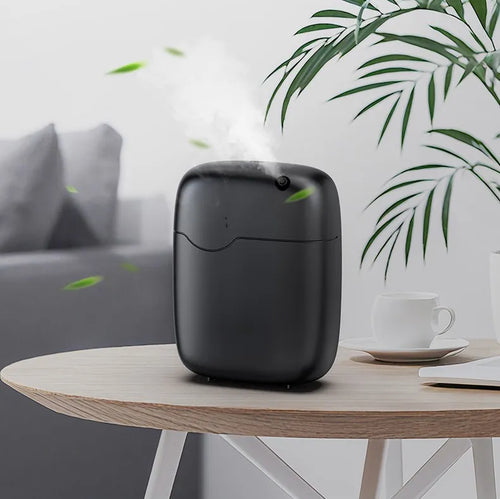 Vaayu · a whole floor₹11,999Shop →
Part three — when fragrance is the wrong answer entirely
There is a category of Airbnb smell problem that no diffuser at any price will solve, and hosts lose real money discovering this the slow way. If the smell has a live source, adding fragrance makes the property smell worse, not better, because the guest now receives two signals instead of one and immediately understands the relationship between them. Cigarette residue in soft furnishings, damp in a wall, a mattress that has absorbed something, a fridge that was left switched off with the door closed, a blocked or dried floor trap, mould behind a bathroom cabinet, or a kitchen where fish was cooked and the extractor was not run — every one of these is a maintenance job. Deep-clean or replace the item. Some of them need a professional and one or two need a plumber. None of them need me.
The second wrong answer is fragrance at the wrong intensity. A property housing strangers has to work for people with asthma, migraine triggers, pregnancy-related sensitivity and simple dislike, and none of them told you before they booked. A scent that is unmistakable from the doorway is a scent a proportion of your guests will find intrusive, and a guest cannot turn off a reed diffuser they did not install or find the plug for a machine hidden behind a console. Err low. Leave a window openable. If you run a machine, run it before arrival rather than through the night, and if you run reeds, use fewer of them than you would at home — four rather than six will still be present in a small room and gives you a longer bottle as a side effect. Keep both away from children and pets, and stand a reed bottle on a tray, because the oil marks wood and stone.
The third wrong answer is spending ₹11,999 on a problem the size of a bathroom. I sell the Vaayu and I would rather say this plainly than have it returned: a waterless cold-air machine covers up to 1000m³, roughly 2,000 to 3,000 sq ft depending on ceiling height, and if your listing is a 1BHK then you are buying ten times the machine your air needs. Under about 800 to 1,000 sq ft of connected volume, the honest answer is one or two reed diffusers, or a Sukoon at ₹1,899 if you want the timing control. The Vaayu earns its price in a villa, a large open-plan floor or a host running several turnovers a week, and nowhere else. Nor, to be complete about it, is a Megh at ₹3,499 a coverage upgrade — it is a 6L runtime and humidity machine that covers about 215 sq ft, less than the Sukoon does.
Part four — the gap between the last wipe and the first guest
Everything above depends on one variable that hosts rarely plan around: how many hours sit between the cleaner locking up and the guest unlocking. That gap decides which of these tools is even available to you. Below is what I would do at each length, using only products we actually sell and prices as they stand in August 2026.
| Gap before check-in | What is realistic | The sequence | What to run | Cost |
|---|---|---|---|---|
| 4+ hours ★ | A genuinely neutral flat, then a settled fragrance | Clean → water drains → air 30 min → close → scent for the last hour | Reeds property-wide, or a timed machine | From ₹749 |
| 2–4 hours | Neutral, plus a light finish in the entry and living room | Clean → air 20–30 min → close → scent | Sukoon on the 2H timer, or reeds already in place | ₹1,899 |
| Under 2 hours | Neutral only. Do not attempt to build a fragrance | Clean → air with fans on → close 15 min before arrival | Reeds left standing all week; nothing new added | From ₹749 |
| Same-day, back to back | Protect ventilation above everything else | Bin out first → air throughout the clean → dry the bathroom | Passive formats only — nobody has time to switch anything on | Free |
| Days empty between bookings | The flat will develop its own stale note — plan for it | Air at the start of the turnover as well as the end | A scheduled machine is worth most here | Vaayu ₹11,999 |
| Remote property, no staff on site | Whatever runs must run without a human | Scheduling is the whole requirement | 1h / 4h / 8h / 24h timers, app control, key-lock | Vaayu ₹11,999 |
Versailles
The first short-let I ever stayed in that got this right was a small flat in Panjim with almost no fragrance in it at all. What it had instead was every window open when I arrived, dry bathroom floors, and one very quiet green note somewhere near the door that I only registered on the way back in from dinner. I have thought about that flat for years, because the host had clearly worked out something most of my customers are still trying to buy their way past.
Fragrance is a finishing material. It behaves like the last coat on a piece of furniture — magnificent over prepared wood, dreadful over dust. Every complaint I get from a host about a diffuser "not working" in a rental turns out, when we go through it, to be a preparation problem: a drain, a mop, a closed flat, an aerosol. The product was being asked to do a job outside its category.
So I would rather you spent nothing with us this month and changed your floor cleaner, and came back in six weeks for one bottle. That is not modesty, it is the only sequence that works. And I want to be clear about the limit of what I am selling even when you do come back: this is about the ninety seconds after a door opens, which is a real and describable thing. It is not about your ratings, your reviews or your bookings. Nobody can promise you those, and I am not going to be the person who tries.
Frequently asked questions
- What should guests smell when they enter an Airbnb? — the hierarchy, from neutral to masked.
- Keeping a listing fresh between check-ins — what an empty, closed flat does to itself in three days.
- The best fragrance before guest arrival — why the answer is a schedule rather than a scent.
- The complete Airbnb arrival scenting guide — this page and the eight around it, in one place.
- Brand: the SOSA founder story.
SOSA Vaayu specifications (verified from the live product page, August 2026): ₹11,999 (the product page displays a rounded ₹12,000). Waterless cold-air nebulisation — pressurised air atomises undiluted fragrance oil into a dry nano-mist; no water, no heat, residue-free. Coverage up to 1000m³, about 2,000–3,000 sq ft. 400ml refillable tank, 90+ days per fill at a mid intensity setting. Bluetooth app plus onboard buttons, 1h / 4h / 8h / 24h timers, adjustable mist intensity, auto-stop and key-lock. Under 38 dB. DC 12V / 1A, 5W. 165 × 80.5 × 215 mm, 0.9 kg, black or white. Freestanding or wall / HVAC mount. CE, RoHS and SGS certified. Ships with four SOSA Hotel Collection fragrances at 100ml each (400ml in total) in one of three combos chosen at checkout. SOSA does not currently sell a separate Vaayu refill oil; the 400ml supplied in the box is the fragrance available at the time of writing, and buyers who need long-term supply should confirm current refill availability with SOSA before purchasing. The cold-air oil supplied with the Vaayu is a different product from the water-based Hotel Collection sold for ultrasonic machines (15ml ₹299 · 100ml ₹999 · 300ml ₹1,799), which must not be used in a Vaayu despite sharing scent names. Other SOSA machines: Boond 300ml ₹899 (~150 sq ft) · Sukoon 500ml ₹1,899 (270–320 sq ft) · Megh 6L ₹3,499 (~215 sq ft — a runtime and humidity machine, not a coverage upgrade) · Aangan ₹25,999 (~8,000–10,000 sq ft) · Meenar ₹38,500 (12,000–18,000 sq ft) · Safar car diffuser ₹3,999. Reed diffusers 50ml ₹749–₹849 (6–8 weeks) · 130ml ₹1,249–₹1,349 (14–18 weeks) · duo sets ₹1,498–₹1,598 · oil-only refills 300ml ₹2,399 / 500ml ₹3,499. Runtime, consumption and coverage figures are manufacturer specifications and vary with intensity setting, run hours, ceiling height, ventilation and season; any per-month or per-day figure in this guide is arithmetic on those specifications, not a measurement. Electricity costs vary by state tariff. No claim is made that scenting affects ratings, reviews, bookings, occupancy, revenue, health, mood or air quality. Free shipping above ₹499. A portion of every order supports girl-child education through Nanhi Kali. Prices subject to change — see the live product pages.