





- The direct answer
- Why an Indian café's own architecture changes the question
- The three decisions this café type has to get right
- Zone by zone, for a premium Indian café
- How restrained the register needs to be
- What to buy, and where to stop
- A note from Sonal
- Questions about scenting a premium Indian café
2. Treat a propped-open door as part of the kitchen's own air, not as a separate entrance zone. Most premium Indian cafés keep a door open for airflow and easy entry rather than closed behind a vestibule; without a real air boundary, whatever is placed at that door is scenting the dining room, not something apart from it.
3. The washroom remains the honest opportunity, exactly as everywhere else in this cluster. It sits away from the kitchen's air by default, and a dry, non-edible register at a modest dose does real work there without touching the aroma the café is actually built on.
4. A genuine vestibule — a second door, a real enclosed lobby — is the one exception worth scenting. Where a premium Indian café has invested in an actual enclosed arrival space rather than a propped-open front, that space can carry a light, dry signature the same way any other café's genuine entrance can.
5. Fresh Brew's coffee-vanilla profile is exactly the wrong direction here, for the same reason a spice note would be. Any gourmand or food-adjacent register sits close enough to what the kitchen already produces that it reads as a second, competing food smell rather than a clean scent decision.
A premium Indian café's fragrance decision comes down to two questions before any product is chosen — is the entrance genuinely separated from the kitchen's air, and is the register dry enough that no one could mistake it for one more thing coming out of that kitchen.
Why an Indian café's own architecture changes the question
A premium Indian café is often built differently from the closed, air-conditioned formats this cluster treats as the default. Doors are frequently propped open for airflow and easy entry, kitchens are often visible or fully open as part of the room's own design, and the resulting air already carries cardamom, cumin, garam masala and brewing chai long before any fragrance decision is even considered. Other café concepts in this cluster start from a closed dining room with a separately controllable entrance; a premium Indian café frequently starts from neither.
That matters because the kitchen's own air here is already doing exactly what a signature scent is meant to do elsewhere — it's assertive, complex, and instantly recognisable as this café's. An owner reaching for a spice, chai or masala-adjacent fragrance to reinforce that identity usually assumes it will read as complementary. In the room it doesn't. It reads as a second, less convincing version of a smell the kitchen is already producing at full strength, in the same way a coffee-scented fragrance reads as artificial next to an actual espresso machine elsewhere in this cluster — only here the temptation to reach for an "on brand" register is stronger, which makes the mistake more common, not less.
The propped-door question deserves its own scrutiny, because it changes the entrance calculation more than in most other café formats. This cluster treats a genuinely separated entrance as a legitimate "sometimes" everywhere else, provided a real boundary exists — a second door, a distinct lobby, a step. A premium Indian café is more likely than most to have a single-room format with a wide, propped-open frontage instead, which means the entrance default resolves to "no" far more often here than in a closed-vestibule café built with a controllable arrival sequence in mind.
The three decisions this café type has to get right
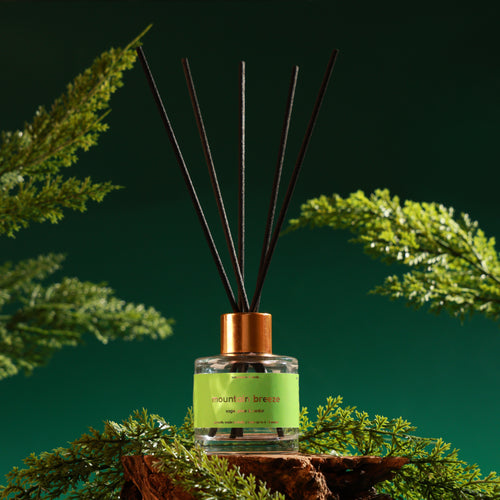
 Mountain Breeze₹849If a customer standing at the till can smell whatever's placed at the door, the door isn't a boundary — it's simply where the dining room's air happens to end for the moment.
Zone by zone, for a premium Indian café
Two extra questions apply here that don't come up in a closed, air-conditioned café format — whether the door is genuinely a boundary, and whether the register itself is food-adjacent.
| Zone | Typical premium Indian café setup | Verdict | What governs it |
| Dining area and open or semi-open kitchen | Where spice, chai and food aromas are produced | Never scented | The kitchen's own air is already assertive and complex; an added fragrance competes with it directly |
| Entrance, if simply a propped-open door | No real boundary between inside and outside air | Not a controllable zone | A propped door is part of the dining room's own air, not a separate volume |
| Entrance, if a genuine enclosed vestibule exists | A real second door, a distinct lobby | Sometimes | The same real-boundary rule as everywhere else in this cluster, rarer to find in this format |
| Washroom | Enclosed, away from the kitchen | Usually, at a dry register | The cluster's usual default allowance, and the safest zone in this format |
| Retail counter selling packaged spice, tea or coffee | Not served food | Usually | No aroma comparison in play once the goods are packaged rather than served |
| A spice, masala or chai-adjacent register is wrong in every zone of a premium Indian café, including the washroom — the whole point of adding fragrance here is a clean, dry signal apart from the kitchen, not an echo of it. | |||
Mountain Breeze · dry pine, sage, cedar₹849Shop →  Sukoon · washroom suite₹1,899Shop →
  Vaayu · a genuine vestibule, zoned₹11,999Shop →
How restrained the register needs to be
Never choose a spice, chai or masala-adjacent register anywhere in a premium Indian café, including the washroom — the entire reason to add fragrance here is a clean signal apart from the kitchen, and a food-adjacent note undoes that from the first day.
Sometimes a genuinely enclosed vestibule, on a larger flagship site with a real second door, can carry a light Mountain Breeze or Morning Freshness signature — provided the boundary is tested from the till, not assumed from the floor plan.
Usually, the correct choice for a washroom under 150 sq ft is a 50ml reed diffuser at six reeds, in a dry pine, sage and cedar or citrus register, dosed low enough that nothing about it reads as food.
What to buy, and where to stop
Matched first to whether the entrance is a real boundary or simply a propped door, and second to the room's actual square footage.
| Route | Premises | Why | What it costs |
| No fragrance at all | Dining area, open or semi-open kitchen, and any propped-open entrance | The kitchen's own aroma is already the room's signature, and a propped door is part of that same air | ₹0 |
| Reed diffuser, Mountain Breeze or Morning Freshness | A washroom under 150 sq ft, most premium Indian cafés | A dry, clearly non-food register at the correct modest scale | ₹749–₹849 |
| Sukoon ultrasonic | A washroom suite, 270–320 sq ft | Steady coverage for a larger non-dining space | ₹1,899 |
| Vaayu, wall or HVAC mounted, zoned | A genuine enclosed vestibule on a larger flagship site | Independent scheduling once a real second door exists | ₹11,999 per unit |
| Any spice, chai or masala-adjacent fragrance | No premium Indian café, in any zone | It competes with the kitchen's own aroma instead of sitting apart from it | Not recommended at any price |
Indian cafés bring me a question I don't get from a closed, air-conditioned coffee shop: an owner wants their café to smell like the food, because the food is genuinely good and they're proud of it — and my honest answer is that the kitchen is already doing that job, at full strength, without any help from a diffuser.
The register mistake I see most often here is a well-meaning attempt at a signature scent built from cardamom, chai or masala notes, usually pitched to me as "on brand." It never reads that way in the room. It reads as a second, less convincing version of a smell the kitchen is already producing, and the two compete instead of reinforcing each other.
Where I do recommend something, it's almost always the washroom, and I keep the register dry and quiet on purpose — pine, sage, citrus, nothing that could be mistaken for one more dish coming out of the kitchen. A genuine vestibule is rarer in this format than in most, and I'd rather tell an owner honestly that their propped-open front door isn't one, than sell a machine into an entrance that doesn't actually exist as its own zone.
Questions about scenting a premium Indian café
- Should a Minimal Japanese-Style Café Use Added Fragrance? — a different design tradition reaching a similarly restrained answer.
- Should a Tea Lounge Have a Signature Scent? — the block's one genuine exception, for contrast.
- Which Areas of a Café Should Be Fragranced — and Which Shouldn't? — the baseline zone rules this page applies to a propped-door format.
- Should a Café Inside a Luxury Hotel Follow the Hotel's Signature Scent? — the next building type, where the governing air system belongs to someone else entirely.
- Brand: the SOSA founder story.
SOSA products & prices (verified September 2026): Reed diffusers 50ml ₹749–₹849 (to 150 sq ft, 6–8 weeks at six reeds) · 130ml ₹1,249–₹1,349 (above 150 sq ft, 14–18 weeks) · reed refill 300ml ₹2,399. Ultrasonic: Boond ₹899 (~150 sq ft) · Sukoon ₹1,899 (270–320 sq ft, ships with three 15ml Hotel Collection fragrances) · Megh ₹3,499 (6L tank, ~100 hrs runtime, ~215 sq ft — a runtime machine, not a coverage upgrade). Waterless cold-air: Safar ₹3,999 (no published coverage figure) · Vaayu ₹11,999 (up to 1000 m³, roughly 2,000–3,000 sq ft; 400ml tank lasting about 90+ days; app and onboard control, 1h/4h/8h/24h run windows, adjustable intensity, key-lock, under 38 dB, freestanding or wall/HVAC mount, 5W, CE/RoHS/SGS) · Aangan ₹25,999 (8,000–10,000 sq ft). Hotel Collection water-based fragrance 15ml ₹299 · 100ml ₹999 · 300ml ₹1,799 is for ultrasonic machines; reed oil and Hotel Collection are not interchangeable. Reed diffusers are alcohol-free, phthalate-free, paraben-free, IFRA-compliant and low VOC, handmade in small batches in Pune. Every purchase funds a girl's education through Nanhi Kali. Prices and availability subject to change — see the live product pages.