



2. Sometimes scent a genuinely separated entrance or vestibule. Only where a real air boundary exists — a second door, a distinct arrival volume, a lobby that isn't simply the front of the dining room. If the entrance is just where the dining room begins, the answer is no.
3. Usually scent washrooms. A washroom has no coffee aroma of its own to protect, and it's the single place in most cafés where a customer's last impression is most easily lost to something unrelated to the product entirely.
4. Usually scent retail or merchandise areas that sell beans, equipment or packaged goods. The test is what's sold there, not where it sits — packaged goods rather than served food, which is exactly why this area behaves like a small shop rather than part of the dining room.
5. The test for every zone is a boundary, not a distance or a label. A door that actually closes, a genuinely separate air volume — an archway, a half-wall or 'the area near the door' is not a boundary, whatever the floor plan calls it.
Vaayu earns its place only in the rooms on the right side of that boundary test — never as a way to reach across it into the dining room.
Why these four zone types split the way they do
The dining room, counter, bar and seating share one property: they carry the live, volatile aroma of coffee actually being made, and the customer is actively evaluating that aroma as part of what they paid for. Any fragrance introduced into that same air becomes a second signal competing for the same attention, at the exact moment attention matters most — while a cup is being made, carried or drunk. This holds regardless of how good the added fragrance is on its own; the mechanism is about two mixtures sharing one air volume, not about whether either one is pleasant.
Washrooms and retail sections share the opposite property: neither has a coffee aroma of its own to protect, because neither is where coffee is made or drunk. A fragrance placed there isn't competing with anything — it's simply the only aroma present, which is precisely the condition under which ambient fragrance does clean, uncomplicated work.
Entrances are the genuinely mixed case, and the one owners get wrong most often. An entrance is defined by air, not by signage — if a second door, a lobby or a distinct arrival volume actually separates it from the dining room, it behaves like a washroom. If it's simply where the dining room's air begins, it behaves like the dining room, whatever the architect called it on the drawing. Interior designers occasionally propose a half-height partition or a change of flooring material to mark an entrance zone — neither of those changes the air, so neither of them changes the verdict.
The three decisions this map actually requires of you
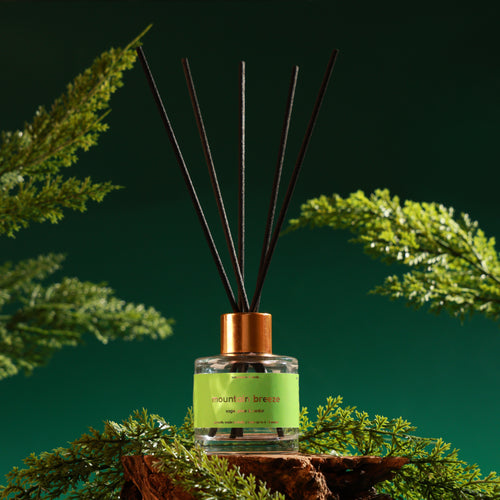
 Mountain Breeze₹849Walk the space and ask, plainly: is there a door here that closes and stays closed between this room and the dining room's air? A door that's usually propped open, an archway, or a half-wall is not a boundary — it's the same air volume with a label on it.
The café zone map, room by room
This is the table this whole cluster is built around — five zone types, and only two of them can hold fragrance well.
| Zone | Fragrance it? | Why | What to use, if anything |
| Dining room, counter, bar, tasting area, seating | Never | Shares live air with the coffee actually being evaluated | ₹0 — nothing, under any circumstances |
| Open or semi-open entrance with no real door | Never | This is simply the front of the dining room by another name | ₹0 — same answer as the dining room |
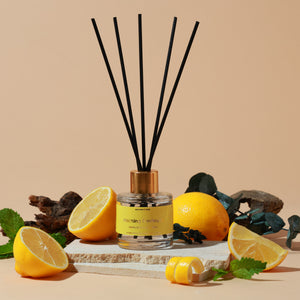
| Genuinely separated entrance or vestibule | Sometimes | A real air boundary — a second door, a distinct arrival volume — keeps it apart | Reed ₹749–₹849 or Sukoon ₹1,899 |
| Washroom | Usually | No coffee aroma present at all, and the last impression a customer leaves on | Reed, Sukoon, or Vaayu for several zones |
| Retail or merchandise section (beans, equipment, packaged goods) | Usually | Sells packaged goods rather than served food, regardless of proximity to the counter | Reed, Sukoon or Vaayu depending on footprint |
| Two of these five zones should never carry fragrance regardless of footprint or budget; the other three depend entirely on whether a real air boundary exists where you're standing. | |||
Mountain Breeze · washroom register₹849Shop →  Sukoon · a separated entrance, self-contained₹1,899Shop →
  Vaayu · washroom, entrance and retail zoned together₹11,999Shop →
The three-zone rule, written out in full
Never place fragrance in the dining room, the counter, the bar, the tasting area or the seating, and never place it anywhere near food preparation or service. This is not a judgement call to revisit case by case — it's the one rule in this whole cluster that has no exceptions, because coffee's aroma is the product and any added scent in that air competes with it directly. It applies equally to a five-seat single-room café and a two-hundred-cover flagship; scale changes the equipment recommendation elsewhere in this guide, never this rule.
Sometimes scent a genuinely separated entrance, vestibule or arrival corridor — but only where a real boundary exists. Test it physically: does a door close and stay closed, is there a distinct air volume, a lobby, a stair. If the entrance is simply the front of the dining room, treat it exactly like the dining room, because that is what it is.
Usually scent washrooms, and retail or merchandise areas that sell beans, equipment or packaged goods rather than served food. These are the genuine commercial opportunity in this vertical — no coffee aroma to compete with, and, for the washroom especially, the room where a café most often loses a customer's impression on the way out. Keep intensity low everywhere fragrance is allowed: if a customer carrying a drink could identify it, it's wrong.
What to buy, by zone
Match the equipment to the zone the table above actually assigns you, not to the zone you'd prefer to have.
| Route | Premises | Why | What it costs |
| Reed diffuser, Mountain Breeze, washroom only | Under 300 sq ft, one washroom | A steady, low-maintenance register with nothing to compete with | ₹749–₹849 |
| Sukoon ultrasonic, separated entrance only | 300–750 sq ft, one genuinely separated zone | Timers hold a consistent level through rush and quiet hours alike | ₹1,899 |
| Vaayu, wall or HVAC-mounted, washroom and entrance | Two qualifying zones in one café | Zoned scheduling runs both independently without either reaching the dining room | ₹11,999 |
| Vaayu, freestanding, retail or merchandise counter | Any café with packaged goods sold apart from service | Independent of the dining room's air and of how the counter is doing | ₹11,999 |
| Aangan, HVAC-integrated, several non-dining zones | Above roughly 3,000 sq ft, a chain or large café with multiple qualifying rooms | Distributes evenly through existing ducting, confined to the zones that pass the test | ₹25,999 |
When I walk a new café for the first time, I ignore the floor plan for the first five minutes and just open doors. Which ones close fully, which ones swing shut on their own, which ones are propped with a chair out of habit — that tells me more about where fragrance can go than any square footage figure the owner hands me.
Owners are usually surprised by how few rooms pass. A café that feels large on the walk-through often turns out to have exactly one qualifying zone — the washroom — because the 'entrance' is just the front third of the dining room and the retail shelf sits behind the same open counter as the espresso machine.
I'd rather tell someone honestly that they have one zone, not four, than sell equipment for three rooms that were never going to hold a level properly. The map only works if it's applied to the café that's actually in front of you, not the one on the drawing. I've turned a four-zone request into a single reed diffuser recommendation more times than I can count, and I'd rather write that in a founder diary than pretend the map produces a bigger order every time.
Questions café owners ask about the zone map
- Why scenting a café is completely different from scenting a hotel or retail store — the comparison this map grows out of.
- Can a café build a signature scent without fragrancing the dining area? — the strategic question this map answers in practice.
- Should the entrance of a premium café have a signature scent? — the entrance zone, worked through in full.
- What should a premium café washroom smell like? — the washroom zone, worked through in full.
- Brand: the SOSA founder story.
SOSA products & prices (verified September 2026): Reed diffusers 50ml ₹749–₹849 (to 150 sq ft, 6–8 weeks at six reeds) · 130ml ₹1,249–₹1,349 (above 150 sq ft, 14–18 weeks) · reed refill 300ml ₹2,399. Ultrasonic: Boond ₹899 (~150 sq ft) · Sukoon ₹1,899 (270–320 sq ft, ships with three 15ml Hotel Collection fragrances) · Megh ₹3,499 (6L tank, ~100 hrs runtime, ~215 sq ft — a runtime machine, not a coverage upgrade). Waterless cold-air: Safar ₹3,999 (no published coverage figure) · Vaayu ₹11,999 (up to 1000 m³, roughly 2,000–3,000 sq ft; 400ml tank lasting about 90+ days; app and onboard control, 1h/4h/8h/24h run windows, adjustable intensity, key-lock, under 38 dB, freestanding or wall/HVAC mount, 5W, CE/RoHS/SGS) · Aangan ₹25,999 (8,000–10,000 sq ft). Hotel Collection water-based fragrance 15ml ₹299 · 100ml ₹999 · 300ml ₹1,799 is for ultrasonic machines; reed oil and Hotel Collection are not interchangeable. Reed diffusers are alcohol-free, phthalate-free, paraben-free, IFRA-compliant and low VOC, handmade in small batches in Pune. Every purchase funds a girl's education through Nanhi Kali. Prices and availability subject to change — see the live product pages.