


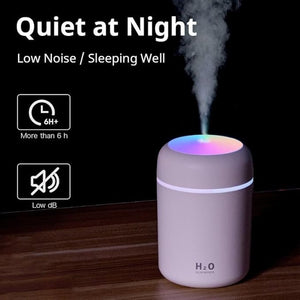
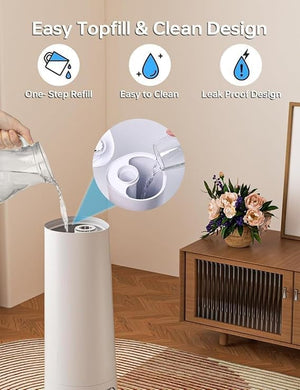
By volume: about thirteen. 1,000 m³ at a 2.7m ceiling is roughly 3,950 sq ft; a Sukoon covers 270–320. Thirteen Sukoons would cost ₹24,687 — so for one open volume the Vaayu is better value.
By what your home can use: one, in a flat of closed rooms — and none at all in a double-height space, where no number of ultrasonics works.
2. About thirteen, if you are converting air. A thousand cubic metres at a 2.7-metre ceiling is roughly 3,950 sq ft of connected floor. Divide by a Sukoon's 270–320 sq ft and you get about thirteen machines, or ₹24,687. On that sum the Vaayu is less than half the price — provided the space is genuinely one open body of air.
3. One, if you are converting what your home can use. This is the number that matters in a flat. A shut bedroom door stops fragrance almost entirely, so a Vaayu standing in the living room reaches the living room. It has replaced one machine. The other rooms are exactly as they were, and each still needs its own ₹1,899 machine.
4. And none, in a double-height room. The one case where the conversion fails in the other direction. In a tall connected space, cool ultrasonic mist rises out of the occupied zone before it has done anything useful, so adding Sukoons does not accumulate into a solution. No number of them equals a Vaayu there.
5. Which means the honest answer is a question. How many separate air spaces does your home have, and how large is the biggest connected one? Six spaces means six Sukoons. One very large connected space means a Vaayu. Most homes are the first, some villas are both, and almost none are only the second.
Made in India, composed by an ISIPCA Versailles-trained perfumer — and a portion of every order supports girl-child education through Nanhi Kali.

Why one question produces three numbers
The reason this sum misbehaves is that the two machines are quoted in incompatible units and the conversion between those units smuggles in an assumption. A Sukoon is rated in square feet: 270–320, which describes a room. A Vaayu is rated in cubic metres: up to 1,000, which describes a body of air. To turn one into the other you must pick a ceiling height, and having picked one you have quietly assumed that all 3,950 sq ft of the result are joined together. That assumption is the entire question. In an office floor or a hotel lobby it is true, and the arithmetic works. In a flat it is false, and every subsequent number is fiction.
It is worth being fair to the Vaayu here, because the volume sum is the one place it wins outright and it wins clearly. If you genuinely have one connected open space of that size — a villa great room with the dining and living zones joined, a farmhouse common area, a double-height hall — then thirteen ultrasonic machines at ₹24,687 is both twice the price and a worse solution, since you would be filling thirteen tanks and still losing the mist upward in a tall room. The Vaayu is not an expensive machine in that context; it is the economical one. What makes it look extravagant in most homes is not its price but the fact that the volume it is quoted for does not exist as a single piece anywhere in the building. The machine is fine. The conversion is what fails — and it fails at the doors.
The three exchange rates
 SOSA Sukoon₹1,899Six Sukoons at ₹1,899 is ₹11,394; a Vaayu is ₹11,999. The gap is ₹605, which is small enough that price stops being the deciding variable and capability takes over. What six machines give you is six independent air spaces, six timers, six choices of fragrance and the ability to run W Hotels-inspired Lobby Bar in the living room while a bedroom has two drops of Westin-inspired White Tea Serenity. What one machine gives you is a single scheduled output over a connected volume. Add that each Sukoon ships with three 15ml bottles, so the six-machine route also delivers eighteen fragrances, and the money comparison tilts further than the headline suggests.
The conversions, side by side
Four sums, four answers, and an honest note on whether each one describes anything real. Read the right-hand column before the numbers — it is the one that decides what you should actually buy.
| Converting by | The sum | Sukoons | Is it useful? |
|---|---|---|---|
| Money | ₹11,999 ÷ ₹1,899 | Six (₹11,394) | Yes — it forces you to name six rooms |
| Rated volume | 1,000 m³ ÷ 2.7m ÷ ~300 sq ft | About thirteen (₹24,687) | Only if the space is genuinely open — then the Vaayu wins |
| Rooms in an ordinary flat ★ | One machine per closed air space | One | Yes — this is the real answer in a 2BHK, 3BHK or 4BHK |
| A double-height room | Volume beats count | No number works | Yes — this is the case that justifies a Vaayu |
| Running cost | Water-based vs neat oil | Not comparable | The Hotel Collection works only in ultrasonics |
| The one rule underneath all four: machines add coverage only across separate air spaces. Within a single space, the things that change the result are placement, dose and airflow — never machine count, and never price. | |||
Sukoon · six for ₹11,394₹1,899Shop → 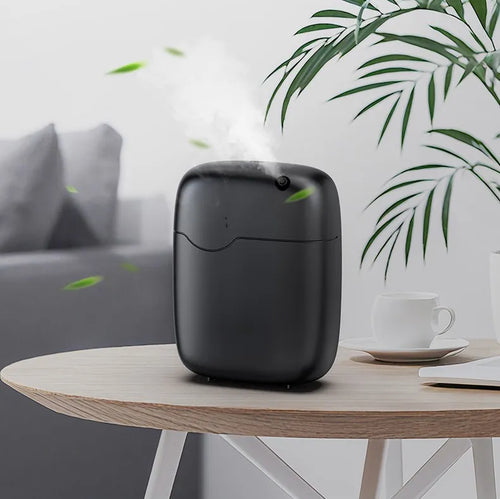 Vaayu · one for ₹11,999₹11,999Shop →
  Hotel Collection · fleets onlyFrom ₹299Shop →
Running a fleet against running one machine
A six-machine fleet is a routine, and the routine is the real cost. Six tanks means six fills and six sets of drops, and if you run them all every evening that is a job. In practice nobody does: households that own several Sukoons settle into running two or three on any given day, using the 2H timers, and topping up the rest at the weekend. Plan for that rather than resenting it. Fill on a fixed day, dose three to four drops each, and keep one 300ml bottle at ₹1,799 as the house supply rather than six 15ml bottles that run out at different times — six machines share a bottle perfectly well because the dose is per tank, not per machine.
One machine is a schedule, and the schedule is the whole interface. With a Vaayu there is nothing to fill and no drops to count; you set an intensity and a programme in the app and then largely leave it. That is genuinely less work, and for a large space that should simply always smell the same it is the better arrangement. The discipline it demands is restraint: set the intensity low, run short bursts rather than continuous output, and start it before the space is used rather than leaving it going all day. A nose stops registering a constant scent within about twenty minutes, so continuous running mostly consumes oil.
A mixed household needs one more decision. Villas and duplexes that end up with a Vaayu in the great room and Sukoons in the bedrooms are running two fragrance ranges, because the Vaayu takes neat oil and the Sukoons take the water-based Hotel Collection. They will not match exactly. Give them a shared character instead — keep the large volume clean and structural, keep the bedrooms quieter, and let a common woody or white-tea material run through both so the transition reads as a change of scale rather than an argument. And never move a bottle from one machine to the other.
The money, laid out
Every step from one machine to thirteen, with the real totals. The two rows to compare are the six-Sukoon row and the Vaayu row — ₹605 apart and buying entirely different capabilities.
| Setup | What you get | Covers | Total |
|---|---|---|---|
| One Sukoon ★ | Sukoon ₹1,899 — 3 × 15ml scents included | One room, 270–320 sq ft | ₹1,899 |
| Three Sukoons | A 2BHK done properly, nine 15ml scents included | Three air spaces | ₹5,697 |
| Six Sukoons | Six machines, eighteen 15ml scents included | Six air spaces | ₹11,394 |
| One Vaayu | Vaayu ₹11,999 — neat oil, app, timer, no Hotel Collection | One connected volume to 1,000 m³ | ₹11,999 |
| Thirteen Sukoons | The volume sum, taken literally | ~3,950 sq ft if it were all connected | ₹24,687 |
Versailles
People send me this question expecting a tidy ratio, and I always want to send back a floor plan instead. The number is not a property of the machines. It is a property of your walls. Six, thirteen and one are all defensible answers to the same sentence, and which one applies to you is settled before either machine is switched on.
I will say the part that is inconvenient for me. For one genuinely large open space, the Vaayu is the cheaper machine and it is not close — thirteen Sukoons would cost twice as much and would still lose the mist upward in a tall room. I would rather state that plainly than pretend a fleet of small machines is always the value answer. It is the value answer in flats, which is where most people live, and that is a different claim.
So the practical instruction is the dull one. Walk the house with every internal door shut, count the separate bodies of air, and note the largest single one. If the count is six and the largest is an ordinary living room, buy Sukoons. If the count is small and the largest is enormous, buy a Vaayu for it and Sukoons for the bedrooms. A portion of every order funds a girl's classroom through Nanhi Kali.
Frequently asked questions
- Is a Vaayu overkill for a home? — misdirection, not excess.
- How to calculate how many diffusers your home needs — counting air spaces properly.
- Sukoon vs Vaayu — rooms against volume, side by side.
- What does it cost to scent your whole home? — the complete budget maths.
- Brand: the SOSA founder story.
SOSA products & prices (verified August 2026): Hotel Collection water-based ultrasonic diffuser fragrance 15ml ₹299 · 100ml ₹999 · 300ml ₹1,799 · Pack of 7 (15ml, all fragrances) ₹1,799; refills 100ml from ₹999. Seven scents: The Ritz-Carlton-inspired (white tea · bergamot · cedar), Westin-inspired (white tea · aloe · cedar), 1 Hotels-inspired (cedarwood · vetiver · green leaves), The St. Regis-inspired (amber · violet · woods), Shangri-La-inspired (jasmine · green tea · white tea), Four Seasons-inspired (citrus · floral · sandalwood), W Hotels-inspired (citrus · pepper · amber). Diffusers: Boond 300ml ₹899 · Sukoon 500ml ₹1,899 · Megh 6L ₹3,499. Water-based, phthalate-free, composed to IFRA standards for home diffusion; 3–6 drops per tank. Made in India, Pune. The Hotel Collection scents are SOSA's own interpretations inspired by the world's finest hotels; all hotel names are trademarks of their respective owners and are used only to describe the scent style — SOSA is an independent Indian fragrance house, not affiliated with or endorsed by any hotel brand. Prices and availability subject to change — see the live product pages.