

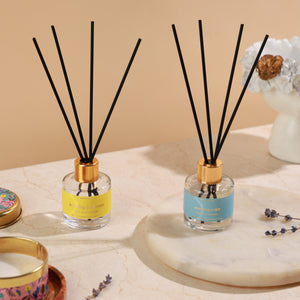

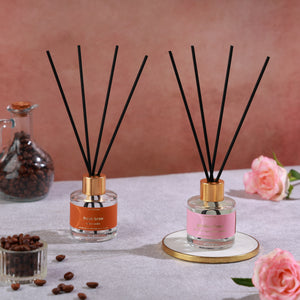

Where they come from: the boxes. Six reeds ship with every bottle, and a house running four reeds per bottle banks two from every purchase.
When to use them: at every refill, and whenever throw drops while liquid remains. Never on a schedule, and never by flipping the old ones instead.
2. You almost certainly already own them. Six reeds come in every box, in both the 50ml and the 130ml. Buy three bottles across a year and eighteen reeds have arrived in your house. If you run the sensible reed counts — six in a living room, four in a bedroom, two or three in a small bathroom — that is twelve in use out of eighteen, so six are banked, which is exactly one full set, with no separate purchase.
3. Use them at every refill. This is the important one. A 300ml refill at ₹2,399 works out at about ₹8.00 a millilitre, so filling a 130ml puts roughly ₹1,040 of fragrance into the glass. Running that through a wick that has already spent sixteen weeks clogging is the single commonest reason people conclude that refills are weaker than new bottles. They are not. The liquid is identical. The wick was old.
4. Use them when throw drops while liquid remains. A room that has gone flat with a third of the bottle still in the glass is a clogged-fibre problem, not a finished bottle. Fit a fresh set, give it forty-eight hours to saturate along its whole length, and judge from the doorway. If the room comes back, you have recovered weeks of use for nothing at all.
5. Do not confuse replacing reeds with adding them. Replacing swaps a clogged wick for a clean one at the same count and costs you nothing in bottle life. Adding reeds turns the volume up and shortens the bottle, because more exposed fibre means more evaporation. Both are useful. They are not the same action, and doing the second when you meant the first is how a 130ml disappears in nine weeks.
Made in India, composed by an ISIPCA Versailles-trained perfumer — and a portion of every order supports girl-child education through Nanhi Kali.
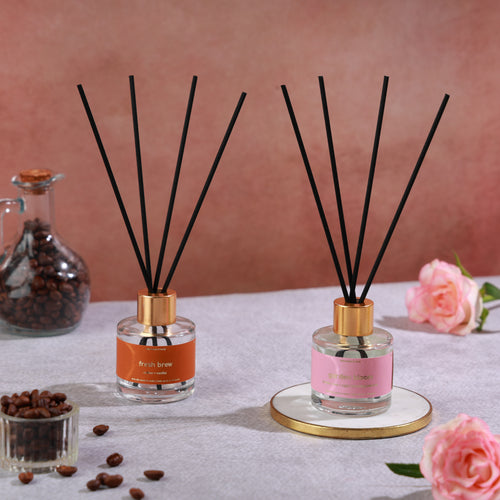
Why reeds are the consumable, and the liquid is not
A reed diffuser is three parts and only one of them wears out. The glass and the collar are effectively permanent — that is why refills exist and why the glass is the thing you stop paying for after the first purchase. The liquid is consumed, obviously, but consumed cleanly: it evaporates and it is gone, and what remains is unchanged in kind. The reeds are the part that degrades while still in place. They do not wear out in the sense of getting thinner; they fill up. Fragrance climbs the porous core by capillary action and evaporates at the exposed tip, but the heaviest, least volatile materials arrive faster than they can leave, so they accumulate inside the fibre and progressively block the path the next drop has to take.
That is why the useful stock to keep in a house is measured in reeds and not in bottles. A blocked wick makes a good bottle behave like a finished one, and every rupee of the liquid underneath it is stranded — with a 300ml refill at about ₹8.00 a millilitre, a 130ml fill is roughly ₹1,040 sitting in the glass waiting for a path to the air. Six clean reeds are worth more to that bottle than another ₹1,249 of fragrance would be. The awkward corollary is that people who refill rather than rebuy will eventually run short, because a refill is liquid only: rebuying a bottle brings six new reeds with it, refilling brings none. That is not an argument against refilling — it is an argument for treating the reeds in every new box as stock rather than as packaging, and putting the spare set in a drawer instead of the bin.
The three moments a reed change earns its keep
 300ml refill₹2,399This is the habit that matters most and the one most often skipped, because the old reeds are standing right there and look serviceable. They are not. A 130ml fill from a 300ml refill is about ₹1,040 of fragrance at ₹8.00 a millilitre, and a wick that has been in service for fourteen to eighteen weeks will deliver a fraction of it. If you take one thing from this page: the moment you pour, you change the reeds.
Reed count by room, and what each one banks
The middle column is the setting; the right-hand column is what the box leaves over. Notice that nothing on this page costs money — the whole table is stock you already own.
| Space | What it needs | How many | Cost |
|---|---|---|---|
| Living room or entrance, up to about 150 sq ft ★ | Six reeds — full strength, and entered by people with a fresh nose. Banks nothing from its own box | 6 in use, 0 spare | ₹0 |
| Main bedroom | Four reeds. Quieter to sleep in and pushes a 130ml past eighteen weeks. Banks two from its own box | 4 in use, 2 spare | ₹0 |
| Small bathroom | Two or three reeds in a small volume. Banks three or four from its own box — the biggest saver in the house | 2–3 in use, 3–4 spare | ₹0 |
| Three-room home, one year in | Eighteen reeds delivered across three bottles, twelve standing in liquid. One full spare set, banked without buying anything | 12 in use, 6 spare | ₹0 |
| A guest room used a few nights a year | Nothing — no bottle and therefore no reeds. Do not hold spares for a bottle that is not running | None | ₹0 |
| A house that refills more often than it rebuys | Refills are liquid only, so reed stock stops replenishing. Keep every new box's spare set and change at each fill rather than each purchase | Hold one set per bottle | ₹0 |
| A note on all of the above: more reeds means a stronger room and a faster bottle — it is a trade, not a free upgrade. Replacing reeds at the same count costs you nothing in bottle life; adding reeds to make a room louder will shorten it noticeably, so decide which of the two you are actually doing before you open the drawer. | |||
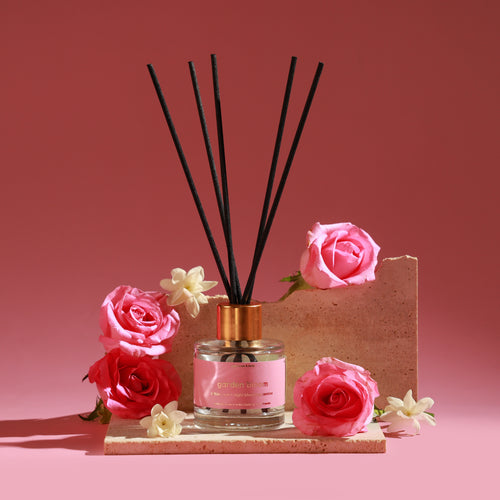 One room · the unitFrom ₹749Shop →
 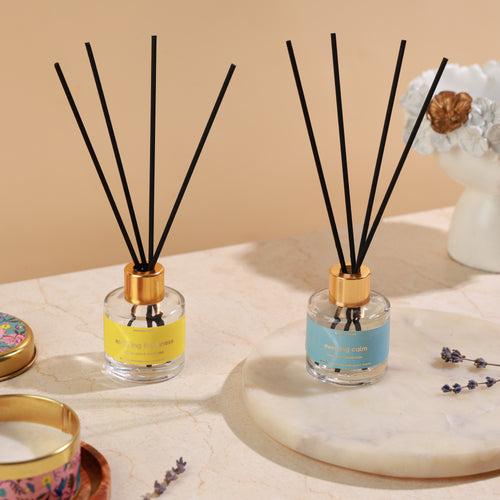 Two rooms · better value₹1,498Shop →
  Large room · a switch₹1,899Shop →
Changing reeds properly, and storing the spares
Store them flat, dry and out of the light, in the box they came in. Fibre reeds are porous by design, which means they will take up whatever is around them — a drawer that smells of camphor or of a spilled bottle will give you reeds that smell of camphor, and a reed that has absorbed something else will hand it back to your living room for a week. Keep them in their sleeve, keep the sleeve away from the bottles themselves, and do not store them standing in a jar "ready to go", because a vertical reed in an open jar collects dust along its whole length.
When you change, change the whole set at once and keep the count the same. Mixing three clogged reeds with three fresh ones gives you a bottle that behaves unpredictably and tells you nothing about whether the change worked. Pull the old ones, stand them on a tissue rather than back in the bottle, wipe the neck of the glass — oil creeps, and a sticky collar will mark whatever the bottle stands on — and put the new set in at the number you were running. Then wait two full days before forming any opinion, because a reed has to saturate along its entire length before it throws properly, and judgements made on day one are the reason people think reed changes do not work.
And keep the counts straight per room. Write the reed count on the base of each bottle with the date the wick went in. A 130ml on four reeds and a 130ml on six are two different products with two different lifespans, and by week eleven nobody remembers which is which. This also stops the commonest accident: reaching for the spare set to make a quiet room louder. If the room is quiet, the answer is almost always a clean set at the same count, then placement, and only then more reeds — because more reeds shortens a 130ml from the eighteen-week end of its range towards the fourteen-week end.
What to buy
Nothing, is the honest answer to the reed half of this question. The table below is for the liquid, which is the part that actually runs out.
| Buy | What it covers | Lasts | Price |
|---|---|---|---|
| One 50ml | A single reed diffuser — a small room on two or three reeds — the bottle that banks the most spare fibre in the house | 6–8 weeks | from ₹749 |
| One 130ml | The value size — a room on four reeds, which banks two spares per purchase and runs past eighteen weeks | 14–18 weeks | from ₹1,249 |
| The duo | Day & Night duo — two rooms at once, arriving with twelve reeds between them | 6–8 weeks each | ₹1,498 |
| Sukoon | 500ml ultrasonic — a room where the honest problem was never the wick or the liquid but the size of the space | Runs when you switch it on | ₹1,899 |
| 300ml refill ★ | The running cost — the liquid, and only the liquid — which is exactly why the spare set matters when you pour it | Roughly 2 × 130ml fills | ₹2,399 |
Versailles
We put six reeds in every box and I am asked fairly often whether that is generous or whether it is a hint that they need replacing. It is the second one. Reeds are the consumable part of a reed diffuser — they clog rather than wear out, and a wick at week sixteen is doing a fraction of the job a clean one does. The six in the box are not spares in the sense of being surplus. They are the next set.
The mistake I would most like to stop is the one that happens on refill day. Somebody buys a 300ml refill, pours about ₹1,040 of fragrance into a 130ml, puts the old reeds back because they are standing right there, and then tells me the refill is weaker than the original bottle. The liquid is the same liquid. It is going up a wick that spent four months filling with the heaviest part of the last one.
So the whole rule is short. One spare set per bottle you are running. Fit them at every refill and whenever a room goes flat with liquid still in the glass. Do not flip the old ones and call it a fix. And if you are refilling more than you are rebuying, keep every set that arrives, because refills come as liquid and nothing else. A portion of every order supports girl-child education through Nanhi Kali.
Frequently asked questions
- When is a bottle genuinely finished? — fresh reeds are the test.
- A second diffuser, or more reeds? — the free fix comes first.
- Do fewer reeds actually save money? — the trade, examined.
- Leaving a bottle empty for a month — the reeds are the casualty.
- Brand: the SOSA founder story.
SOSA products & prices (verified August 2026): Hotel Collection water-based ultrasonic diffuser fragrance 15ml ₹299 · 100ml ₹999 · 300ml ₹1,799 · Pack of 7 (15ml, all fragrances) ₹1,799; refills 100ml from ₹999. Seven scents: The Ritz-Carlton-inspired (white tea · bergamot · cedar), Westin-inspired (white tea · aloe · cedar), 1 Hotels-inspired (cedarwood · vetiver · green leaves), The St. Regis-inspired (amber · violet · woods), Shangri-La-inspired (jasmine · green tea · white tea), Four Seasons-inspired (citrus · floral · sandalwood), W Hotels-inspired (citrus · pepper · amber). Diffusers: Boond 300ml ₹899 · Sukoon 500ml ₹1,899 · Megh 6L ₹3,499. Water-based, phthalate-free, composed to IFRA standards for home diffusion; 3–6 drops per tank. Made in India, Pune. The Hotel Collection scents are SOSA's own interpretations inspired by the world's finest hotels; all hotel names are trademarks of their respective owners and are used only to describe the scent style — SOSA is an independent Indian fragrance house, not affiliated with or endorsed by any hotel brand. Prices and availability subject to change — see the live product pages.