

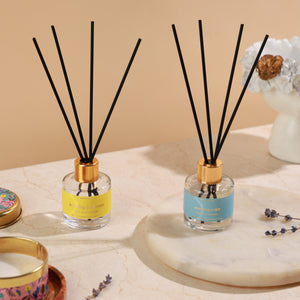

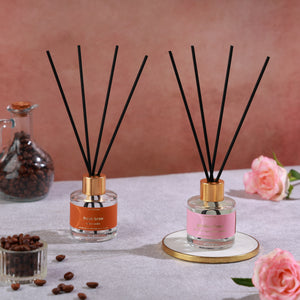

The liquid: oil-based fragrance does not spoil in a month. It ages from the top down, so the character may read slightly heavier. Not a fault.
The reeds: the one thing to replace. Six came in the box, so restarting usually costs ₹0.
2. The reeds are the thing you replace, and they were already going. Reeds clog over months as the heavier, less volatile parts of the blend saturate the fibre. A month in a dry bottle adds stiffness to that but does not reverse it — resting a reed does not clean it. Putting the same reeds back into fresh liquid gives you a bottle that starts life at the throw level of a bottle in its fourteenth week, which is the commonest reason a refill disappoints. Six fibre reeds came in the box. Use them.
3. If there was liquid left, it has not spoiled. Oil-based reed fragrance is stable and a month is not a long time for it. What it does do is age from the top down — the lightest, most volatile materials go first, so a blend that sat with reeds in it for four weeks may read a little heavier and a little less bright than you remember. That is a change of character, not a spoiled product, and it will still work perfectly well.
4. The genuine cost is the opposite mistake. A bottle left running while you are away for a month is the expensive version. A 130ml rated 14–18 weeks loses roughly a quarter of itself in four weeks — about ₹312 of a ₹1,249 bottle, scenting an empty flat. On a 50ml it is worse: four of its six to eight weeks, about ₹428 of a ₹749 bottle. Pull the reeds out before you travel and that stops almost entirely.
5. Light and heat matter far more than the pause does. If you are worried about a bottle sitting unused, worry about where it is sitting. Direct sunlight fades fragrance and heats the oil; a hot windowsill will do more to a bottle in four weeks than four weeks of standing still ever could. Move it to a shaded shelf, keep it off bare polished wood, and the pause becomes a non-event.
Made in India, composed by an ISIPCA Versailles-trained perfumer — and a portion of every order supports girl-child education through Nanhi Kali.

Why the reeds are the only casualty of a pause
Everything a reed diffuser does depends on one mechanism: liquid climbing the porous core of a reed by capillary action, arriving at the exposed length above the collar, and evaporating from there. The glass holds the liquid and the collar sets how many reeds stand in it, and neither of those parts has a working life in any meaningful sense — they will outlast several bottles of fragrance and are the reason refills exist at all. The reeds are different. They are a consumable, and they are consumed the way a filter is: not by wearing out, but by filling up. Over weeks the heavier fragrance molecules arrive at the tip faster than they can evaporate away, so they accumulate inside the fibre and progressively block the path.
That is why a month of standing still changes so little and yet still means new reeds. Time in a dry bottle does not remove what is already in the core; it simply lets the volatile carrier evaporate out of the fibre, leaving the blockage behind and the reed stiffer than it was. A rested reed is a clogged reed that has dried out. Put it back into fresh liquid and it will wick poorly from the first day, which is precisely the situation people describe when they say a refill "did not smell as strong as the original bottle" — the liquid was fine and the wick was fourteen weeks old. Meanwhile the liquid itself is genuinely robust. Oil-based reed fragrance does not turn in four weeks; it loses its lightest notes first and reads a shade heavier, which is a shift in character rather than a defect, and heat and direct sunlight will do more of that in a month than the pause itself.
Three ways a bottle gets paused, and what each one costs
 300ml refill₹2,399The commonest version, and the least eventful. The bottle finished, life happened, and it has been standing on a shelf for four weeks with a set of dark, tired reeds in it. Nothing has gone wrong. Bin the reeds, rinse the glass with a little warm water, let it dry completely — genuinely completely, because water left in the base will sit under an oil-based refill — and fill it when you are ready. A 300ml refill at ₹2,399 does a 130ml roughly twice, at about ₹8.00 a millilitre against ₹9.61 for the liquid inside a new bottle.
What each situation actually needs
Find the bottle you are looking at. Almost every row here costs nothing, which is the honest shape of this question.
| Space | What it needs | How many | Cost |
|---|---|---|---|
| Glass empty, old reeds still in it, standing four weeks ★ | Bin the reeds, rinse with warm water, dry fully. The bottle is fine and so is the collar | Nothing but fresh reeds | ₹0 |
| Bottle with liquid, reeds in, unattended while you were away | You have lost about a quarter of a 130ml or half of a 50ml. What remains is perfectly usable — fit fresh reeds and carry on | Nothing but fresh reeds | ₹0 |
| Bottle deliberately stopped — reeds out, neck covered | Nothing lost at all. This is the correct way to pause and the liquid is waiting for you | Nothing | ₹0 |
| Bottle that spent the month on a sunny windowsill | Light and heat, not the pause, are what aged it. Move it to a shaded shelf before you do anything else | Nothing. Move it | ₹0 |
| An empty bottle in a room nobody has used for a month | Do not refill it there. A month of nobody noticing is information — move the bottle to a room somebody sits in | None | ₹0 |
| Empty bottle you now want running again, no spare reeds left | A 300ml refill fills a 130ml roughly twice, or start again with a new bottle and its six reeds | Refill or replace | ₹2,399 or from ₹1,249 |
| A note on all of the above: none of this changes the coverage figures. A restarted bottle on six fresh reeds holds a closed, still room of up to about 150 sq ft exactly as it did before, and needs the same forty-eight hours for the reeds to saturate before it is worth judging. | |||
One room · the unitFrom ₹749Shop → 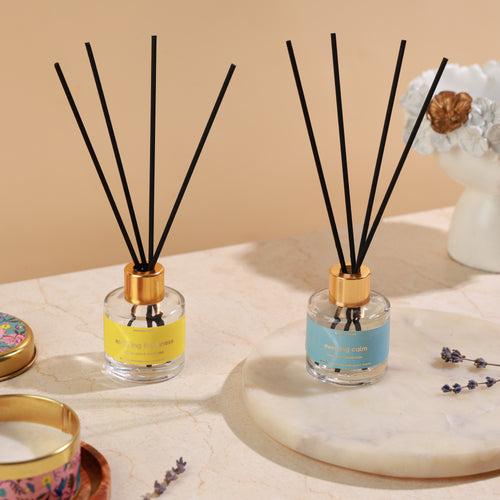 Two rooms · better value₹1,498Shop →
  Large room · a switch₹1,899Shop →
Restarting properly, and how to pause on purpose next time
Restarting: bin the reeds, rinse the glass, dry it completely, then fit a clean set. A little warm water and a swirl is enough for the bottle — you are removing a thin residue, not degreasing an engine. The part people get wrong is drying: an oil-based fragrance and a wet bottle base do not mix, and water trapped underneath will sit there for months, so leave the glass upside down overnight rather than towelling it and hoping. Then put in fresh reeds, the same number you were running before, and give them forty-eight hours to saturate along their whole length before you form any opinion at all.
Pausing on purpose: reeds out, neck covered, out of the sun. Thirty seconds before a trip saves you a quarter of a 130ml. Lift the reeds, wipe the wet length on a tissue, and lay them flat — if the pause is short, a week or two, those same reeds will restart acceptably; if it is a month or more, plan to replace them. Cover the neck of the bottle with its stopper if it has one, or with a scrap of foil and a rubber band if it does not. Then move the bottle away from the window. Heat and light are the only things that genuinely age a paused bottle, and both of them are free to avoid.
And use the pause as information. If a room went a month without fragrance and nobody in the house remarked on it, that is worth more than any coverage figure — it is a fairly direct statement that the room was not earning its bottle. The right response is to move the bottle rather than refill it where it stood. When you do refill, a 300ml refill at ₹2,399 fills a 130ml roughly twice and is also the natural moment to fit fresh reeds, which is the habit that stops the next bottle going quiet early.
What to buy
For most people reading this the answer is nothing, because the spare reeds are already in a drawer. If the bottle is genuinely empty and you want it back, this is the ladder.
| Buy | What it covers | Lasts | Price |
|---|---|---|---|
| One 50ml | A single reed diffuser — a room you know you will pause often — a guest room, or a study you use in bursts | 6–8 weeks | from ₹749 |
| One 130ml | The value size — a room that runs all year, where the longer interval is worth having | 14–18 weeks | from ₹1,249 |
| The duo | Day & Night duo — two rooms restarting together after a long trip away | 6–8 weeks each | ₹1,498 |
| Sukoon | 500ml ultrasonic — a large room where you want a switch you can genuinely turn off while you are away | Runs when you switch it on | ₹1,899 |
| 300ml refill ★ | The running cost — the cheapest way to bring a paused bottle back — about ₹8.00 a millilitre against ₹9.61 | Roughly 2 × 130ml fills | ₹2,399 |
Versailles
People write to me apologetically about this, as though they had neglected something living. They have not. A reed diffuser that has stood empty for a month is a clean piece of glass with a collar on it, and the honest instruction is to rinse it, dry it properly and get on with your life. I would rather say that than invent a reason for you to replace a bottle that is perfectly good.
The reeds are a different matter, and I want to be precise rather than alarming. Reeds do not go off. They clog, slowly, over the working life of the bottle, and a month of standing dry neither speeds that up nor undoes it. The reason to fit a fresh set on restarting is simply that the old ones were already partly blocked when you stopped, and starting a new bottle with a fourteen-week-old wick is how a good refill gets a bad reputation.
If there is one thing to take away, it is the mirror-image mistake. Nobody worries about the month a bottle spent switched off; plenty of people leave one running through a holiday and lose a quarter of it scenting an empty flat. Thirty seconds with a tissue before you lock the door is worth about ₹312 on a 130ml and rather more on a 50ml. A portion of every order supports girl-child education through Nanhi Kali.
Frequently asked questions
- When is a bottle genuinely finished? — fresh reeds are the test.
- How many spare reeds to keep — one set per active bottle.
- A room that is always closed — why a pause may be permanent.
- A room you only use at weekends — two reeds, not two bottles.
- Brand: the SOSA founder story.
SOSA products & prices (verified August 2026): Hotel Collection water-based ultrasonic diffuser fragrance 15ml ₹299 · 100ml ₹999 · 300ml ₹1,799 · Pack of 7 (15ml, all fragrances) ₹1,799; refills 100ml from ₹999. Seven scents: The Ritz-Carlton-inspired (white tea · bergamot · cedar), Westin-inspired (white tea · aloe · cedar), 1 Hotels-inspired (cedarwood · vetiver · green leaves), The St. Regis-inspired (amber · violet · woods), Shangri-La-inspired (jasmine · green tea · white tea), Four Seasons-inspired (citrus · floral · sandalwood), W Hotels-inspired (citrus · pepper · amber). Diffusers: Boond 300ml ₹899 · Sukoon 500ml ₹1,899 · Megh 6L ₹3,499. Water-based, phthalate-free, composed to IFRA standards for home diffusion; 3–6 drops per tank. Made in India, Pune. The Hotel Collection scents are SOSA's own interpretations inspired by the world's finest hotels; all hotel names are trademarks of their respective owners and are used only to describe the scent style — SOSA is an independent Indian fragrance house, not affiliated with or endorsed by any hotel brand. Prices and availability subject to change — see the live product pages.