



Where it goes: living room 130ml on six reeds, 422.5ml. Two bedrooms on four reeds, about 376ml each. Bathroom 50ml, about 325ml — more than a bedroom.
What moves it: six reeds everywhere pushes it to about 1,640ml and a sixth refill. Dropping the room that did not need it brings it to about 1,125ml and four.
2. The arithmetic, so you can redo it for your own home. A 130ml runs 14–18 weeks; take sixteen on six reeds. 52 ÷ 16 = 3.25 cycles a year, and 3.25 × 130ml = 422.5ml. On four reeds it stretches towards eighteen weeks: 52 ÷ 18 = 2.89 cycles, or about 376ml. A 50ml runs 6–8 weeks; at eight that is 6.5 cycles and 325ml — more annual volume than a bedroom gets through, which is the figure that surprises people most. Small bottles are not small consumers. They are the same consumption in inconvenient instalments.
3. Reed count is worth one refill. Put all six reeds in every bottle out of habit and the two bedrooms drop from eighteen weeks to sixteen and the bathroom from eight to seven. The year becomes about 1,640ml — a sixth refill, and ₹2,399. Reed count is the only volume control a reed diffuser has and it moves strength and lifespan together, so this is not a saving you take for free: you are accepting a quieter bedroom in exchange. In a bedroom that is usually the right call anyway.
4. Room count is worth another one. The fourth room on most four-room lists is a second bedroom whose door stands open onto a scented living space, and it is already borrowing. Take it off and the year falls to about 1,125ml — four refills, ₹9,596. That is the single largest lever on this page and it costs you nothing except an honest walk round the flat at nine in the evening, noting which doors are actually shut.
5. And treat five as a ceiling, not a plan. Fifty-two unbroken weeks assumes no travel, no gap between a bottle running dry and the next fill, and no month where you simply forget. Real homes run three to four refills a year rather than five, and that is not a failure — it is what the number looks like when a person rather than a spreadsheet is doing it. Order the first two, see where you are in six months.
Made in India, composed by an ISIPCA Versailles-trained perfumer — and a portion of every order supports girl-child education through Nanhi Kali.
Why a year of home fragrance is measured in millilitres, not bottles
Bottles are a bad unit for an annual figure because they are different sizes and they run for different lengths of time. Millilitres are not. Every room in your home consumes a rate — so many millilitres a week — and a year is simply that rate multiplied out. Work it that way and the surprises appear immediately. A 130ml running sixteen weeks is about 8.1ml a week. A 50ml running eight weeks is about 6.3ml a week, which is only a quarter less despite the bottle being under half the size — because the reed count and the exposed surface, not the volume behind them, set the rate at which fragrance leaves. That is why a small bathroom bottle gets through 325ml over a year while a bedroom on four reeds gets through about 376ml, and why the bathroom feels like it is always empty. It is.
The second reason to count in millilitres is that it makes the levers visible. There are only three things that change an annual figure: how many sources you are running, how many reeds are in each, and how hard the room is on evaporation. The third is worth saying plainly because it is invisible on an invoice. Heat and airflow raise the rate — the same 130ml will comfortably reach eighteen weeks in an air-conditioned bedroom and struggle to hold fourteen on a hot west-facing sill, which across four rooms is the difference between four refills and six. Placement is worth more per year than any discount you will ever be offered. And coverage figures — up to about 150 sq ft on six reeds — assume a closed, still room of standard ceiling height, so a living room with a balcony door open all evening consumes at the top of its range while covering less than the number suggests.
The three decisions behind an annual refill count
 Five refills₹11,995Roughly 1,500ml a year across four rooms. At 300ml a refill that is five, and ₹2,399 × 5 = ₹11,995. The 500ml at ₹3,499 is the better rate — ₹7.00 a millilitre against ₹8.00 — so three of them cover the same 1,500ml for ₹10,497, a difference of ₹1,498. The catch with the larger refill is commitment: 500ml is one fragrance and most of a year of your house, so buy it only after you have run that blend for a full cycle and know it works in your rooms.
Sizing by space — where the 1,500ml actually goes
This is the same four-room home broken into its annual consumption. Two rows are worth nothing at all, and between them they are more than a refill a year.
| Space | What it needs | How many | Cost |
|---|---|---|---|
| Living room, 130ml on six reeds, ~16 weeks ★ | 3.25 cycles a year — the largest single line in the house | 422.5ml | ~₹3,380 of refill |
| Main bedroom, 130ml on four reeds, ~18 weeks | 2.89 cycles a year — fewer reeds, longer bottle, quieter room | About 376ml | ~₹3,008 of refill |
| Second bedroom, 130ml on four reeds, door genuinely closed | Same again — but only if that door is actually shut for hours at a time | About 376ml | ~₹3,008 of refill |
| Bathroom, 50ml on two or three reeds, ~8 weeks | 6.5 cycles a year. The smallest bottle in the house is not the smallest consumer | About 325ml | ~₹2,600 of refill |
| Second bedroom with its door standing open onto the living room | Nothing. It borrows already — and dropping it takes a whole refill off the year | 0ml | ₹0 |
| Kitchen with an extractor, or the corridor between bedrooms | Nothing. One has its air pulled out by design, the other is crossed in four seconds | 0ml | ₹0 |
| A note on all of the above: every figure above assumes continuous running in a closed, still room of standard ceiling height. Heat and airflow raise consumption and reduce coverage at the same time, and real homes have gaps — travel, a fortnight before you get round to refilling, a room you stop bothering with. Treat five refills as the ceiling and three to four as what most households actually order. | |||
 One room · the unitFrom ₹749Shop →
 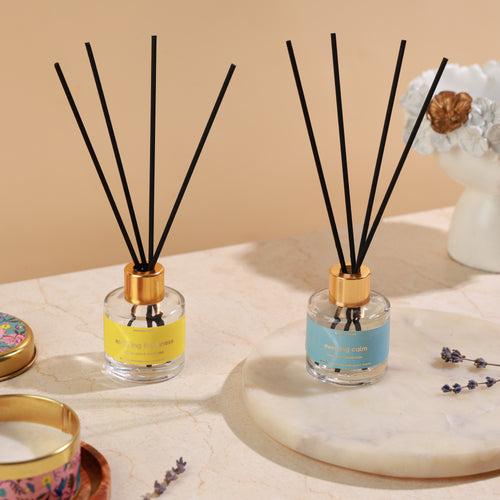 Two rooms · better value₹1,498Shop →
  Large room · a switch₹1,899Shop →
Reeds, staggering, and making each refill go further
Set the reed count per room and leave it alone. Six in the living room, four in the bedrooms, two or three in the bathroom. That single arrangement is the difference between about 1,500ml and about 1,640ml a year — one whole 300ml refill. Change reeds one at a time and give every change forty-eight hours, because fibre has to saturate along its full length before it throws properly and a first-day verdict tells you nothing. Judge from the doorway rather than the sofa: olfactory adaptation is essentially complete within about twenty minutes, which is exactly why households over-buy — they cannot smell what they already own.
Stagger the rooms so the year does not arrive in three lumps. If every bottle is filled on the same day, every bottle empties on the same day, and four rooms go quiet at once while you wait for a delivery. Deliberately let them drift: fill whichever bottle is genuinely dry, use the 40ml left at the bottom of a 300ml on the next one to run low, and within a couple of cycles the house is naturally out of step. That also smooths the spend — four or five refills spread across a year rather than two large orders — and it means there is always at least one room reading properly when someone visits.
Then protect the millilitres you have bought. Keep every bottle out of direct sunlight, off the path of an AC vent or ceiling fan, and away from the line between the front door and the balcony, because all three raise the evaporation rate and shorten every cycle in this article. Fit fresh reeds at each refill — clogged fibre, not empty liquid, is the usual reason a house reads tired in month four, and pouring new oil into old reeds produces a full bottle and a quiet room. Store refills capped, upright and cool. For a house standardising on one blend so a single refill serves every room, Morning Freshness carries from a living room through to a bathroom; Evening Calm is the one to keep for bedrooms if you would rather run two.
What to buy
An annual plan is two purchases repeated. Here is what each option in the range is actually for across a year of four rooms.
| Buy | What it covers | Lasts | Price |
|---|---|---|---|
| One 50ml | A single reed diffuser — the bathroom — and be ready for it to get through about 325ml a year despite the small bottle | 6–8 weeks | from ₹749 |
| One 130ml ★ | The value size — each of the rooms with long hours — 3.25 cycles a year on six reeds, 2.89 on four | 14–18 weeks | from ₹1,249 |
| The duo | Day & Night duo — starting two rooms at once, which gives you two bottles to refill from a single 300ml later | 6–8 weeks each | ₹1,498 |
| Sukoon | 500ml ultrasonic — a room past about 250 sq ft where a passive bottle is being asked to do more than it can | Runs when you switch it on | ₹1,899 |
| 300ml refill | The running cost — the year itself — five of them covers four rooms running continuously, four covers a sensible house | Roughly 2 × 130ml fills | ₹2,399 |
Versailles
I would rather give you the ceiling and let you come in under it than quote you something comfortable. Four rooms running every week of the year is about 1,500 millilitres, which is five 300ml refills and ₹11,995. That is a real amount of money and you should see it before you commit to a four-room home rather than in instalments across twelve months.
The two numbers I actually want you to take away are the levers. Six reeds in every bottle instead of the right count costs you a sixth refill. Scenting a room that did not need it costs you a fifth. Neither of those is a small economy at the margin — each one is ₹2,399, and one of them you get simply by walking round your own flat at nine in the evening and noticing which doors are genuinely shut.
And do not aim for the ceiling. Most households run three or four refills a year, because life has gaps in it, and a fortnight where the bedroom bottle is empty is not a failure of planning. Order two refills, see where you are in six months, and let the rooms drift out of step with each other so the whole house never goes quiet on the same Tuesday. A portion of every order funds a girl's classroom through Nanhi Kali.
Frequently asked questions
- Refills or new bottles across several rooms — ₹8.00 a millilitre against ₹9.61.
- How many rooms one 300ml keeps going — two fills and a remainder.
- The cheapest way to keep four rooms going — three bottles, one scent.
- The complete sizing and quantity guide — every home type, three builds.
- Brand: the SOSA founder story.
SOSA products & prices (verified August 2026): Hotel Collection water-based ultrasonic diffuser fragrance 15ml ₹299 · 100ml ₹999 · 300ml ₹1,799 · Pack of 7 (15ml, all fragrances) ₹1,799; refills 100ml from ₹999. Seven scents: The Ritz-Carlton-inspired (white tea · bergamot · cedar), Westin-inspired (white tea · aloe · cedar), 1 Hotels-inspired (cedarwood · vetiver · green leaves), The St. Regis-inspired (amber · violet · woods), Shangri-La-inspired (jasmine · green tea · white tea), Four Seasons-inspired (citrus · floral · sandalwood), W Hotels-inspired (citrus · pepper · amber). Diffusers: Boond 300ml ₹899 · Sukoon 500ml ₹1,899 · Megh 6L ₹3,499. Water-based, phthalate-free, composed to IFRA standards for home diffusion; 3–6 drops per tank. Made in India, Pune. The Hotel Collection scents are SOSA's own interpretations inspired by the world's finest hotels; all hotel names are trademarks of their respective owners and are used only to describe the scent style — SOSA is an independent Indian fragrance house, not affiliated with or endorsed by any hotel brand. Prices and availability subject to change — see the live product pages.