




Why fibre: natural rattan has open pores that swell and clog in humidity. At 85 per cent monsoon humidity a rattan reed can stop drawing altogether; a synthetic fibre reed keeps a consistent, engineered capillary path.
What that means for the number: because a fibre reed keeps delivering at close to its initial rate for the life of the bottle, six of them do the work that a rattan set needs eight or ten to attempt — and still fades by week three.
The honest gap: we do not sell replacement reeds separately. Refills at ₹2,399 are oil only. Refresh your reeds every few months and keep spares from finished bottles.
2. Do not carry over a count from another brand. If your last diffuser came with ten rattan sticks and told you to use them all, that instruction was compensating for a reed that loses its rate quickly. Six of ours is not a smaller version of ten of theirs.
3. Adjust down for small sealed rooms and sensitive households. Three or four reeds in a bathroom, nursery or box room. Take the spares out and stand them upright in a small glass on the tray — you will want them later.
4. Adjust up for hosting or a large living room, to eight or ten, knowing that a 50ml then runs roughly four to six weeks instead of six to eight. Ten is the top; twelve simply crowds the neck of the bottle.
5. Flip all six weekly, with gloves. Fibre holds the benefit of a flip longer than rattan does, which is why our cadence is weekly where a rattan set often wants more. It is not optional at any count.
6. Refresh the reeds every few months, and always when you refill. Reeds are the consumable; the oil is the stable part. Most people have that the wrong way round. We do not sell reeds as a separate item — an honest gap — so keep the spares from a finished bottle.
Composed and handmade in small batches in Pune, and a portion of every order supports girl-child education through Nanhi Kali.
Part one — why the material changes the number
A reed is not a decoration. It is the delivery system, and the count printed on a box is a maker's estimate of how many of their reeds it takes to move enough oil into a room. Change the reed and you change the estimate. SOSA uses synthetic fibre reeds rather than natural rattan, and that single decision is why our number is six rather than the eight or ten you may be used to. Three properties do the work.
 Garden Bloom₹799 · 8.9/10This is the reason the whole range exists in fibre. Natural rattan is hygroscopic: in high humidity it takes up ambient moisture, the pore walls swell, and the channel that was carrying oil narrows or closes. At 85 per cent humidity — an ordinary August in Mumbai, Kochi or Kolkata — a rattan set can go quiet for weeks while the bottle stays visibly full. That is the classic "it has oil but no fragrance" complaint, and it is a material failure rather than a fragrance one. Fibre does not swell in the same way. We test through 45°C summer heat and 85 per cent monsoon humidity precisely because those are the two conditions that break the imported sets people compare us to, and because a reed count means nothing if the reeds stop drawing halfway through the season.
Part two — fibre against rattan, property by property
The comparison as plainly as I can set it out, with what each property means for the number of reeds you should actually stand in the bottle. This is a comparison of materials rather than of brands, and there are perfectly good rattan diffusers sold in drier climates than ours.
| Property | SOSA fibre reed | Natural rattan | What it means for your count |
|---|---|---|---|
| Capillary structure ★ | Engineered and uniform, reed to reed | Natural, variable along and between sticks | Six that all work beats ten of which four are passengers |
| Behaviour at 85% humidity | Keeps drawing; tested through Indian monsoon conditions | Pores swell and can block, sometimes entirely | Rattan sets often need more sticks to survive a season |
| Behaviour at 45°C | Stable on a heat-stable CCT carrier | Draws faster as oil thins — and empties faster | Do not raise the count in summer; heat has already raised the rate |
| Shape of the curve | Spike, settle, then a flat plateau to the end of the bottle | Bigger opening, then a sloping decline | Six fibre reeds hold; ten rattan sticks start high and fade |
| Response to flipping | Restores close to the designed rate; weekly is enough | Recovers less each time as residue builds | Our cadence is weekly, whatever your last set said |
| Typical supplied count | Six, and the compositions are dosed for six | Often eight to ten, with instructions to use them all | Never carry a count across from one to the other |
| The honest caveat: fibre is not immortal. Reeds are the consumable in this system and the oil is the stable part, which is the opposite of what most people assume. Even a fibre reed accumulates the heavy end of a composition over months, and after a monsoon it will have worked harder than usual. Refresh them every few months and whenever you refill. We do not sell replacement reeds as a separate SKU — that is a real gap in our range, not an oversight I am going to talk around — so the practical answer today is to keep the reeds from a bottle you have finished. | |||

Part three — adjusting from six, the SOSA way
Once you accept six as the origin rather than a starting bid, adjusting is simple and free. Down to four for a room you want gentler; down to three for a nursery, a small sealed bathroom or a household with someone sensitive to fragrance in it. Up to eight for a living room in hosting season, and ten if you want the top of the format for a festive month, accepting roughly four to five weeks from a 50ml instead of six to eight. Take the spare reeds out rather than cutting them, and stand them upright in a small glass on the tray — reed oil marks wood and stone, and those spares are the closest thing to replacement reeds you own. Everything on that list is reversible in ten seconds, which is what makes reed count such a satisfying control compared with buying another bottle.
Two SOSA-specific cautions are worth more than any general advice I could give you. The first: do not put reeds from a previous diffuser into a SOSA bottle. Old reeds carry their previous composition's heavy base for weeks and will muddy whatever you pour over them — and if they are rattan, you have also imported the clogging problem into a bottle designed around a different material. The second: when your oil runs out, the honest upgrade is the oil refill at ₹2,399 for 300ml, which works out around ₹7–8 per millilitre against ₹15–17 for a fresh 50ml — but it is oil only. It does not include reeds, and the commonest way to be disappointed by a refill is to pour good oil through reeds that stopped working two months ago. Remove the reeds, pour to the neck, put fresh or refreshed reeds back, and flip once so both ends are coated.
One last piece of context for the number six, because it explains the whole range. Our compositions are alcohol-free, phthalate-free, paraben-free, low-VOC and IFRA-compliant on a coconut-derived CCT carrier. Phthalate solvents push fragrance off a reed hard, which wins the first week decisively and then degrades in heat until the bottle turns acrid somewhere around week six — a trade I decided not to make when we were designing for Indian summers. The consequence is a smaller opening and a longer, flatter plateau, and six well-behaved fibre reeds is the count that plateau was built around. If you want more than six reeds' worth of room, the levers are all published: add reeds, move the bottle into passing air, or choose a louder composition — Fresh Brew at 9.5 and Mountain Breeze at 9.4. And if the space is past roughly 250–300 sq ft of connected open volume, use two bottles or a Sukoon at ₹1,899, because no count of any reed will cover it.
Part four — the count for each composition
All five reed fragrances with what six fibre reeds does in an ordinary room, and where I would move the count if the room asks for something different. The strength numbers are positions on SOSA's own internal scale measured at six reeds — not an industry standard, not a concentration, and not a quality ranking.
| Composition | At six fibre reeds | Move down to 3–4 when | Move up to 8–10 when | 50ml / 130ml |
|---|---|---|---|---|
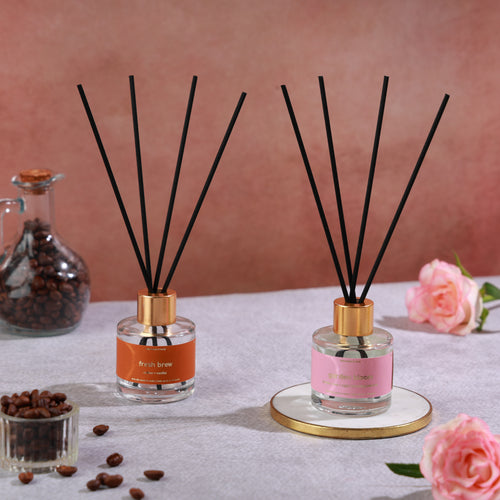
| Fresh Brew · 9.5 ★ | Warm, deep and enveloping — the fullest room in the range | It is going in a small kitchen or a sealed study | Hosting a large closed living room in winter | ₹849 / ₹1,349 |
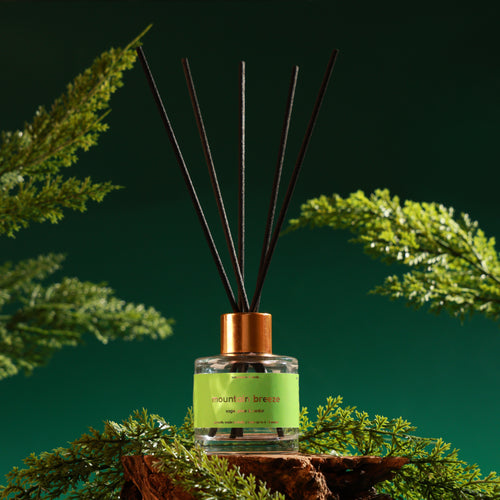
| Mountain Breeze · 9.4 | Dry, resinous and grounding, with no sweetness in it | A small home office where it would distract | A library, yoga room or large bedroom you want to feel still | ₹849 / ₹1,349 |
| Morning Freshness · 9.0 | Cold and clear — reads louder than it measures | A compact bathroom, which is most bathrooms | A kitchen with the extractor running all day | ₹749 / ₹1,249 |
| Garden Bloom · 8.9 | Rounded and furnished — presence without insistence | You want a three-second greeting at the door and no more | A large entrance hall or an open living room | ₹799 / ₹1,299 |
| Evening Calm · 8.9 | The softest we make, built for sleep rather than for show | A nursery, or a shared bedroom where one of you dislikes scent | Rarely — it is not designed to be a loud fragrance | ₹799 / ₹1,299 |
| Not in the range | No oud, no musk-forward composition, no aquatic | — | — | Said plainly |
Versailles
Rattan is the romantic choice. It looks like something that grew, it photographs beautifully, and every reference diffuser I studied in France used it. Then I ran the first samples through a Pune monsoon and watched half of them stop working while the bottles were still two-thirds full. That was the week the range changed material, and the week the count became six.
People sometimes read the switch to fibre as a cost decision. It is the opposite of that: it is the decision that lets me publish a number and stand behind it. If reeds vary, a stated count is a guess and a stated bottle life is a hope. If they do not vary, I can dose a composition to six of them, test it through 45°C and 85 per cent humidity, and tell you what you will actually get in week seven.
What I have not solved is selling you replacements. Reeds are the consumable in this system and we do not yet offer them on their own, which I find genuinely irritating to write on every page. Until we do, keep the spares from a bottle you finish, refresh them every few months, and put fresh ones in when you refill. Everything is composed and handmade in small batches in Pune, and a part of every order funds a girl's classroom through Nanhi Kali.
Frequently asked questions
- How many reeds should you put in a reed diffuser? — six as a dose rather than a default.
- Reed count by room size and counts for a mild room — where to move from six.
- Too few sticks and too many — what going wrong looks like in each direction.
- The complete guide to choosing a reed count, and why can't I smell my reed diffuser?
- Brand: the SOSA founder story.
SOSA reed diffuser range & prices (verified August 2026): alcohol-free, phthalate-free, paraben-free and IFRA-compliant compositions on a heat-stable coconut-derived (CCT) carrier, low-VOC, supplied in a refillable glass bottle with six fibre reeds; 50ml lasts 6–8 weeks and 130ml lasts 14–18 weeks. Morning Freshness (Malabar lemon · peppermint · Nilgiri eucalyptus) 50ml ₹749 · 130ml ₹1,249 · 9.0/10; Garden Bloom (British rose · night-blooming jasmine) 50ml ₹799 · 130ml ₹1,299 · 8.9/10; Evening Calm (Kashmir lavender · chamomile) 50ml ₹799 · 130ml ₹1,299 · 8.9/10; Fresh Brew (Coorg coffee · Kerala vanilla) 50ml ₹849 · 130ml ₹1,349 · 9.5/10; Mountain Breeze (Himalayan pine · sage · Indian cedar) 50ml ₹849 · 130ml ₹1,349 · 9.4/10. Reed diffuser refills are oil only — you reuse your own vessel and reeds: 300ml ₹2,399 (roughly 8–11 months) · 500ml ₹3,499 (roughly 14–18 months), about ₹7–8 per ml against ₹15–17 per ml for a 50ml bottle. Duo sets ₹1,498–₹1,598 for 2 × 50ml and ₹2,498–₹2,598 for 2 × 130ml. Strength figures are positions on SOSA’s own internal strength scale, not an industry standard. Replacement reeds are not sold as a separate SKU; SOSA guidance is to refresh reeds every few months. The reed line is separate from the water-based Hotel Collection for ultrasonic machines (15ml ₹299 · 100ml ₹999 · 300ml ₹1,799) and the two are not interchangeable. Diffusers: Boond 300ml ₹899 · Sukoon 500ml ₹1,899 · Megh 6L ₹3,499 · waterless Vaayu ₹11,999. Composed and handmade in small batches in Pune, India; tested through 45°C summer heat and 85% monsoon humidity. Free shipping above ₹499. A portion of every order supports girl-child education through Nanhi Kali. Prices subject to change — see the live product pages.