

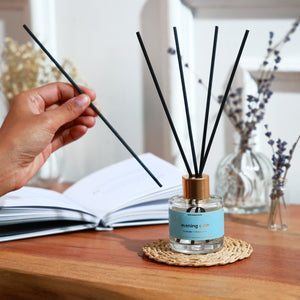



On owning all five SOSA scents: that is a collection, not a scheme. The fifth bottle belongs in a cupboard as a refill option, not on a shelf as a fifth register competing for air with the other four.
The real variety lever: reed count, not fragrance count. One scent at six, three and two reeds already reads as three different experiences in three different rooms.
2. What actually limits the count is the number of boundaries, not the number of rooms. A boundary is any doorway, threshold or open zone where two different fragrances share the same air. A home with n fragrances needs at minimum n−1 boundaries to keep them apart, and in practice needs more, because rooms in a real floor plan connect through a passage that branches to three, four or five doors rather than lining up in a row. Two fragrances usually cost you one or two boundaries — manageable, and each one can be placed on purpose. Four fragrances routinely cost five or six, and every one of those is a place the scheme can start to look accidental rather than composed.
3. Most people who think they want four fragrances actually want three intensities and one fragrance. A single scent run at six reeds in the living zone, three in a bedroom and two in a bathroom already reads as three distinct experiences, because concentration changes how a composition is perceived on its own — no boundary required to produce the variety, because there is nothing for a boundary to divide.
4. Size the count to the home, then cost it: a 1BHK single register runs ₹2,897, a 2BHK on one or two fragrances runs ₹3,696, a 3BHK on a two-fragrance public/private split plus a citrus note in the wet rooms runs ₹4,395, and a 4BHK at its four-fragrance ceiling runs ₹5,244. Every one of those totals matches a bottle-count kit already priced elsewhere in this series — the scent ceiling costs nothing extra to respect, because it is a decision about which bottles you choose, not how many.
5. Four is the ceiling everywhere, even in a home larger than a 4BHK. Past four fragrances, no amount of careful placement keeps a scheme legible — there are simply too many boundaries for any floor plan to hold cleanly.
Composed by an ISIPCA Versailles-trained perfumer, alcohol-free and IFRA-compliant, handmade in small batches in Pune — and every purchase funds a girl's education through Nanhi Kali.
Why boundaries set the ceiling, not rooms
The instinct is to count rooms and assign each one a personality — living room woody, bedroom floral, bathroom citrus, second bedroom something else again — on the theory that a home with more rooms can carry more fragrances. That theory treats fragrance count as a room problem. It is a boundary problem instead. A boundary is any point where the air of one fragrance meets the air of another: an open doorway, a passage the two rooms both vent into, a corridor a guest walks down between them. Rooms do not create boundaries by existing. Adjacent rooms with different fragrances create them, and a real floor plan has far more adjacencies than a straight corridor suggests.
Run the arithmetic properly and the ceiling explains itself. With n different fragrances in a home, you need at least n−1 boundaries just to keep them apart, and that minimum only holds if the home is laid out as a straight line — one fragrance, one doorway, the next fragrance, and so on with no branching. No home is built that way. A typical passage serves three, four or five doors at once, so a fourth fragrance rarely adds one new boundary; it adds one boundary against each fragrance it now sits beside. Two fragrances in a home genuinely does tend to cost one or two boundaries, which is why a Public/Private split is easy to manage. Four fragrances routinely produces five or six, because the fourth bottle is now adjacent to three others, not one. Every one of those five or six boundaries is a place a guest can catch two scents meeting mid-air and register the whole home as slightly muddled, even if each individual bottle, judged on its own, smells excellent.
This is a genuinely different ceiling from the one that caps bottle count, and the two get confused constantly. A home can sit comfortably under its bottle ceiling — six bottles in a 2BHK, say — while blowing straight through its scent ceiling, simply by choosing a different fragrance for every one of those six bottles instead of repeating two or three across them. The bottle ceiling protects against dosage and clutter. The scent ceiling protects against something quieter: a home that has enough fragrance registers to stop having an identity at all.
The three ideas that hold the ceiling up
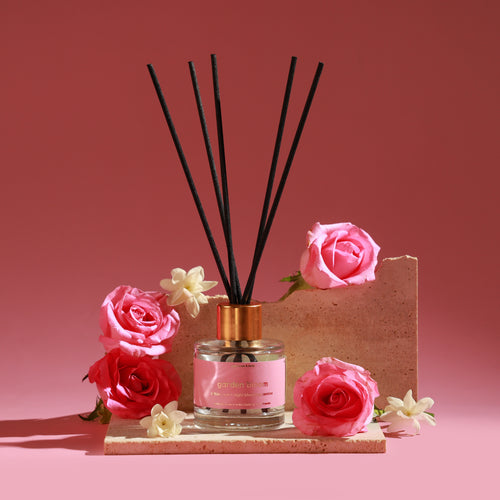
 Garden Bloom 130ml₹1,299A room only needs its own fragrance decision when it shares air with a room carrying a different one. A 3BHK's third bedroom, kept empty most of the year, does not need a fourth fragrance — it needs no bottle at all, or the same one already running next door. Before adding a fragrance, trace the actual air path: does this room's door open onto a passage another fragrance already occupies, or does it sit at the end of a wing that can carry its own note without ever meeting the others? The second case affords a new fragrance almost for free. The first does not.
The scent-count ceiling, size by size
The table below is the working version of the doctrine above, matched to the four home sizes this series covers. "Recommended" is the count that keeps every boundary deliberate; "hard ceiling" is the count past which no amount of careful placement saves the scheme — see the three zoning structures for how each count actually maps to bottles and rooms.
| Home size | Recommended | Hard ceiling | Structure | Total |
|---|---|---|---|---|
| 1BHK | 1 | 1 | Single register, three intensities — six/three/two reeds | ₹2,897 |
| 2BHK, single register | 1 | 2 | Garden Bloom throughout — 130ml living, three 50ml elsewhere | ₹3,696 |
| 2BHK, two fragrances | 2 | 2 | Public zone one scent, the whole private wing a second | ₹3,696 |
| 3BHK ★ | 2–3 | 3 | Public/private split, plus a citrus third in the wet rooms | ₹4,395 |
| 4BHK / large home | up to 4 | 4 | Public + master + one more bedroom register + wet-room citrus | ₹5,244 |
| Any size, all five | — | never | A collection, not a scheme — the fifth stays in the cupboard as a refill | — |
| Note on how to read this table: the "recommended" and "hard ceiling" columns are counts of fragrances, not bottles — a 2BHK's four-bottle standard kit and its single-register four-bottle kit cost the identical ₹3,696, because the totals are set by bottle size and reed count, not by how many different scents fill them. | ||||
Garden Bloom · the constantfrom ₹799Shop → 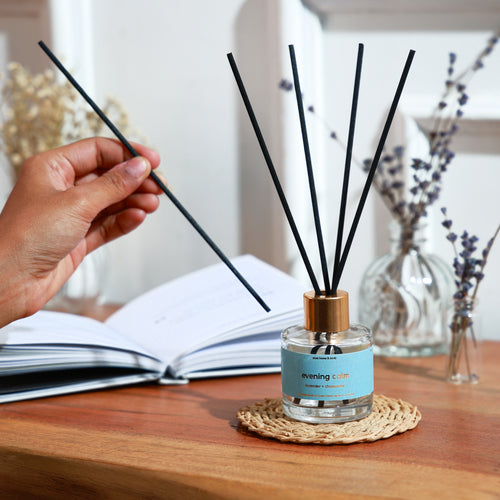 Evening Calm · the private wingfrom ₹799Shop →
  Morning Freshness · the wet roomsfrom ₹749Shop →
Building the three intensities properly
Start with the room that has to work hardest — the living-dining zone or the entrance — on all six reeds, and treat that as the fragrance's loudest register. Take the same fragrance into a bedroom at three reeds and give it three full days before judging it; the room needs to reach a steady state, and a fresh bottle at three reeds on day one reads weaker than it will by day three. Take it into a bathroom at two reeds and expect something closer to a trace than a statement — that is correct, not a failure of the bottle. The three intensities are meant to feel like three different rooms, not three underpowered copies of the living-room version.
When a second fragrance genuinely earns its place — a private wing far enough from the public zone that the two registers never share a doorway, or a wet room where citrus does a job florals and woods cannot — introduce it one bottle at a time and live with it for a week before adding a third. Most over-scented, muddled homes were not built badly in one afternoon; they accumulated a bottle every few months until nobody could remember why the fourth one had been added, or what problem it had solved that a reed count could not.
Flip every reed saturated-end up every three to five days regardless of which register it belongs to — that discipline matters more to how "loud" a fragrance reads than almost any other variable, including the number of fragrances in the home. A well-flipped single register at three intensities will always out-perform a neglected four-fragrance scheme, because neglect reads as inconsistency and inconsistency reads as clutter, exactly the impression a low scent count was meant to avoid.
What each ceiling costs
Every route below matches a bottle-count kit already priced elsewhere in this series — the scent ceiling is a decision about which fragrances go in which bottle, not an extra cost layered on top. All five figures are checked by hand.
| Route | What you get | Fragrance count | Total |
|---|---|---|---|
| 1BHK single register | Garden Bloom 130ml ₹1,299 + 50ml ₹799 + 50ml ₹799 | 1 | ₹2,897 |
| 2BHK, one or two | Garden Bloom throughout, or split with Evening Calm in the private wing | 1–2 | ₹3,696 |
| 3BHK, public/private + citrus ★ | Garden Bloom ₹1,299 + Evening Calm ₹799 ×2 + Morning Freshness ₹749 ×2 | 3 | ₹4,395 |
| 4BHK, the ceiling | Garden Bloom ×2, Evening Calm, Mountain Breeze, Morning Freshness ×2 across six bottles | 4 (maximum) | ₹5,244 |
| Running cost | A 300ml refill ₹2,399, or 500ml ₹3,499 (₹7/ml) | Tops up whichever register you already run | from ₹2,399 |
Versailles
People rarely ask me how many bottles to buy. They ask how many fragrances to buy, which is a more interesting question and one I answer more conservatively than they expect. My honest number, even for the largest home in this series, is four — and I mean that as a ceiling, not a target to reach for.
The reasoning is not aesthetic caution. It is arithmetic. Every fragrance you add after the first has to share a doorway with at least one other, and in a real floor plan it usually shares several. Two fragrances cost you one or two boundaries you can place on purpose. Four cost you five or six, and past four the boundaries outnumber the rooms doing the actual scenting. Nobody composes a home to smell muddled at its own doorways. It happens by accumulation, one well-loved bottle at a time, until the fifth one is the bottle nobody can quite say the purpose of.
I own all five SOSA fragrances myself, and I would not run more than four of them in one home at once. The fifth lives in my cupboard as a refill, waiting for a season or a swap. That is not a compromise. It is the entire point of having a small, well-made range rather than one enormous bottle trying to be everything. Every purchase funds a girl's education through Nanhi Kali — not a percentage, not a quarterly cheque. Every one.
Frequently asked questions
- One signature fragrance in every room — the case for going all the way to a single scent.
- Different fragrances for bathroom and bedroom — the one boundary almost every home should manage.
- One signature fragrance vs different room fragrances — the trade-off argued in full.
- The complete whole-home fragrance wardrobe guide — every structure, costed.
- Brand: the SOSA founder story.
SOSA reed diffusers & prices (verified August 2026): Morning Freshness (Malabar lemon · peppermint · eucalyptus) 50ml ₹749 · 130ml ₹1,249 · Evening Calm (lavender · chamomile) 50ml ₹799 · 130ml ₹1,299 · Garden Bloom (British rose · night-blooming jasmine) 50ml ₹799 · 130ml ₹1,299 · Fresh Brew (Coorg coffee · Kerala vanilla) 50ml ₹849 · 130ml ₹1,349 · Mountain Breeze (Himalayan pine · sage · cedar) 50ml ₹849 · 130ml ₹1,349. Duo sets: Day & Night 2 × 50ml ₹1,498 · 2 × 130ml ₹2,498; Fresh & Grounded 2 × 50ml ₹1,548 · 2 × 130ml ₹2,548; Warmth & Bloom 2 × 50ml ₹1,598 · 2 × 130ml ₹2,598. Refills 300ml ₹2,399 · 500ml ₹3,499. Six fibre reeds included with every bottle; refillable glass. 50ml suits rooms up to 150 sq ft and lasts 6–8 weeks; 130ml suits rooms above 150 sq ft and lasts 14–18 weeks. Fractionated coconut oil (CCT) carrier, alcohol-free, phthalate-free, paraben-free, IFRA-compliant, low VOC; tested through 45°C heat and 85% monsoon humidity. Composed and handmade in small batches in Pune. Ultrasonic machines quoted for comparison: Boond ₹899 · Sukoon ₹1,899 · Megh ₹3,499, which run the separate water-based Hotel Collection fragrances (15ml ₹299 · 100ml ₹999 · 300ml ₹1,799) — the two lines are not interchangeable. Every purchase funds a girl's education through Nanhi Kali. Prices and availability subject to change — see the live product pages.