
 Refill first ₹2,399
  If truly short ₹749
 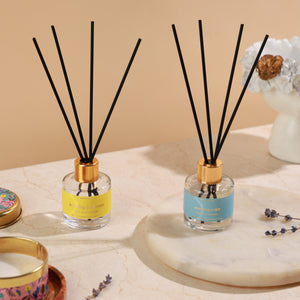 Duo ₹1,498
  Variety, not a 9th ₹1,899
  The standard-kit bottle ₹1,299
The five warning signs: nose-blindness with guests noticing anyway, muddled doorways, a headache in one room (usually the bedroom), a house that smells the same everywhere and has gone boring, and a bottle that empties in three weeks instead of seven.
Before you buy another bottle: try the free fixes first — pull a reed, wait a week, move a bottle. A refill from ₹2,399 is still cheaper and more reversible than a new one.
2. The doorways smell muddled rather than like either scent. Two fragrances meeting mid-air rarely blend into something pleasant; they mostly just cancel and confuse. The fix is not a new fragrance — it is a dropped reed on the stronger side of that doorway, which shifts the boundary without touching the scent itself.
3. You get a headache in one room, and it is almost always the bedroom. Six reeds in a small, sealed room with the door and windows shut is a genuinely high dose in a genuinely small volume of air. Go to three. If the room is smaller than a rug, go to two.
4. The house smells the same in every room, and it has gone from pleasant to boring. This is the opposite failure — over-uniformity — and it is a real one. The fix is not a new fragrance either. It is intensity variation: six reeds in the living room, three in the bedroom, two in the bathroom, so the same signature reads differently as you move through it.
5. A bottle that should run seven weeks is empty in three. That is either a draught — a fan, an AC vent, an open window within a metre — or genuinely too many reeds for the room. Either way, you are paying for fragrance that left the room before you smelled it, not fragrance you used.
None of these five fixes cost a rupee. All five are reversible within a week. That is the whole argument of this page, made by an ISIPCA Versailles-trained perfumer who would rather you fix a doorway than buy a bottle you don't need — and every purchase you do make funds a girl's education through Nanhi Kali.
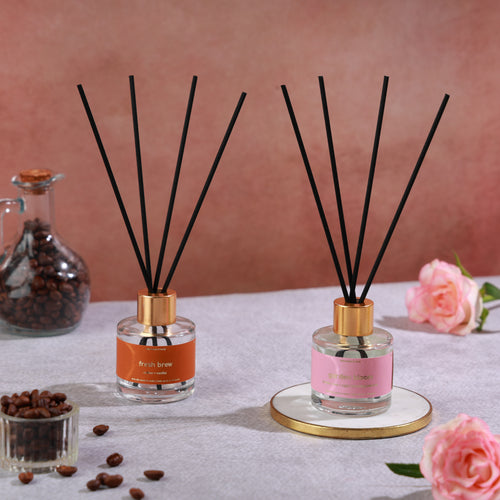
Why doorways set the limit, not bottles
Every other post in this series counts rooms and lands on a bottle figure. This one counts something else: the places where the scented radius of one bottle can plausibly reach the scented radius of another. Call that a boundary. A single bottle in a single closed room has zero boundaries — nothing to collide with. The moment you add a second bottle in an adjoining room with a doorway between them, you have created one. A third bottle, depending on the layout, can create two more boundaries at once if it sits at a junction — a landing, an open-plan kitchen-diner, a passage with three doors off it. Boundaries do not grow at the same rate as bottles. They grow faster, because each new bottle can meet every bottle it is now adjacent to, not just the one before it.
This is why four bottles in a modest 1BHK already produces three or four boundaries, and why eight bottles spread across a large house can produce a dozen. A 1BHK is small enough that most of its doorways lead somewhere central — the living-dining zone — so a fourth bottle there is standing at a genuine crossroads. A 4BHK has more rooms, but it also has more corridors, landings and shared thresholds between them, and each one is a place two fragrances can meet uninvited. Our companion piece on a large home's count works through exactly this arithmetic room by room, and the two ceilings — how many a 4BHK actually needs and how many is too many — turn out to be different questions with the same doorway logic underneath them.
The practical upshot is that "ceiling" is not a synonym for "budget" or "generosity". A household that can comfortably afford twelve bottles for a 4BHK still hits an eight-bottle ceiling, because past eight the extra bottles are not finding new rooms to work in — every remaining room already has one, and the ninth bottle's actual job becomes standing at a doorway, fighting whichever bottle is nearest. Money was never the constraint. Geometry was.
The three ideas that hold the ceiling up
 Garden Bloom 130ml₹1,299A 1BHK's ceiling of four is set by its three or four real thresholds — living-dining, bedroom door, bathroom door, and a closed kitchen if it has one. A 2BHK's ceiling of six follows the same logic across six rooms with six doors between them. A 3BHK's seven and a 4BHK's eight follow the same rule again, just with more rooms and, crucially, more shared corners where three doorways meet rather than two. The number of bottles you can own without a collision is always a few less than the number of rooms you have, because a fully open public zone counts as one bottle even when it serves two or three functions.
The ceiling, size by size
The table below gives three numbers for each home size: the ceiling itself, the point most households actually settle at (which sits comfortably under the ceiling, not at it), and what a bottle past the ceiling actually buys you — which is rarely more fragrance and usually a doorway argument. Totals use SOSA's standard 130ml-for-the-public-zone, 50ml-elsewhere kit, the same one used across this series.
| Home size | Ceiling | Where most households land | What going past the ceiling costs |
|---|---|---|---|
| 1BHK | 4 bottles | 3 bottles is the standard kit — ₹2,847 | A 5th bottle (₹749–₹1,349) has no room left to call its own — it stands at a doorway that already has a bottle either side |
| 2BHK | 6 bottles | 4 bottles is the standard kit — ₹3,696 | A 7th bottle exceeds the ceiling by definition; there is no sixth room left to hold it without a shared threshold |
| 3BHK | 7 bottles | 5 bottles is the standard kit — ₹4,445 | An 8th bottle is past the ceiling for this size; the extra rupees buy a muddled landing, not a scented room |
| 4BHK | 8 bottles | 6 bottles is the standard kit — ₹5,244 | A 9th bottle (often a ₹1,249 130ml, since large homes reach for the bigger size) buys a doorway collision, not new coverage |
| Any size, single-scent "hotel" variant | ceiling unchanged | 3 bottles, one fragrance — ₹2,747–₹3,047 | Same doorway count as the three-scent kit. Going past it means finding a genuine fourth zone, not adding a fourth scent |
| Studio / compact 1BHK | 4 bottles, rarely reached | 2 bottles is usually right — ₹1,498–₹2,098 | There are seldom four real thresholds in a studio, so the ceiling stays theoretical for most of these homes |
| Note: the ceiling assumes one bottle per shut door plus one for the open zone. A home with an extra shut door this table doesn't list — a study, a puja room, a second living space — earns one more bottle for that door, not one fewer for the rest. | |||
Refills · top up what you ownfrom ₹2,399Shop → 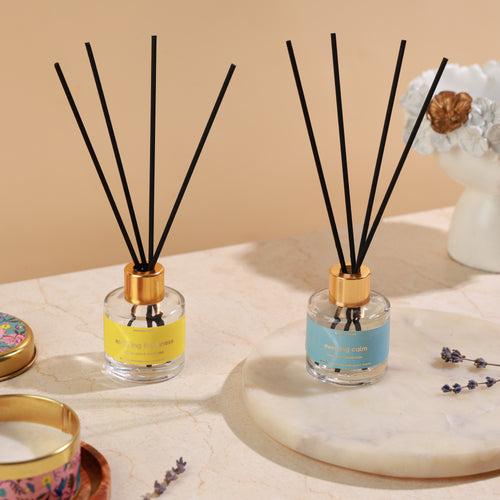 Day & Night duo · two rooms, one purchase₹1,498Shop →
  Sukoon · variety without a new doorway₹1,899Shop →
Running the test properly
Before you conclude a home is over-scented, give it a fair trial: pull one reed from every bottle running at full strength, and do not judge anything for a full week. Reeds that have been saturated for weeks keep releasing at their old rate for several days even after you've reduced the count, so an evening's sniff test tells you almost nothing. Seven days in, walk the flat with fresh attention — ideally after being out of the house for at least an hour, since your nose resets faster away from a smell than in its constant presence. If it still reads as too much at every doorway, pull a second reed. If it now reads as right, you have your answer and you have spent nothing finding it.
The flip side deserves equal honesty, because under-scenting is just as real and gets far less attention in a guide like this one. The tell is simple and unambiguous: walk back into the house after being out for a couple of hours, and if it smells of nothing at all, that is genuinely too few — not too cautious, not tasteful restraint, just too few. A well-dosed home should register faintly the moment you're back through the door, before you've had time to adjust to it again. If that never happens, the fix is not five bottles becoming eight; it is usually one missing bottle, most often the bathroom, or one bottle running on two reeds when it should be running on four.
The two tests use the same instrument — your nose, deliberately reset by leaving and coming back — and they point in opposite directions on purpose. One protects you from spending on a ninth bottle you don't need. The other protects you from under-buying because a guide like this one talked you out of the fourth bottle you genuinely did.
Reeds before bottles, priced out
Every route below costs less than the one after it, and the first three cost nothing at all. The order is deliberate: work down the list until the problem is solved, and stop the moment it is.
| Route | Cost | What it actually fixes | Total |
|---|---|---|---|
| Pull a reed | Free | Nose-blindness stacked on genuine over-dosing — the single most common cause of "too many diffusers" | ₹0 |
| Wait a week | Free | Judging a change same-day, before reeds and your own nose have re-settled | ₹0 |
| Move a bottle, not a fragrance | Free | A muddled doorway — drop a reed on the stronger side rather than swapping the scent | ₹0 |
| Buy the one you're missing ★ | ₹749–₹849 | Genuine under-scenting, confirmed by the two-hour test — almost always the bathroom | from ₹749 |
| Running cost / refill | 300ml ₹2,399, 500ml ₹3,499 | Topping up bottles you already own — always cheaper than a new one, never adds a doorway | from ₹2,399 |
Versailles
Most of what I write in this series is about getting people to buy enough. This page is the exception, and it is my favourite one to write, because it is the one place I get to say plainly: stop. If you have four bottles in a 1BHK, six in a 2BHK, seven in a 3BHK or eight in a 4BHK, you are not under-scented. You are at the edge of the doorway maths, and the next bottle's real job will be arguing with the one next to it.
I trained to notice when a composition is doing too much, not too little — it is the harder skill in perfumery, because doing more always feels like the safer choice. The same is true in a home. A sixth bottle feels generous. A pulled reed feels like giving something up. In practice the reed costs you nothing and the bottle costs you ₹749 to ₹1,349 you can't get back if it turns out you didn't need it. I would always rather you tried the free thing first.
And if, after all five fixes, the house genuinely smells of nothing when you walk back in — that's real too, and it deserves a bottle, not a lecture about restraint. The point was never fewer bottles. It was the right number, and the right number has a ceiling. Every purchase funds a girl's education through Nanhi Kali — not a percentage, not a quarterly cheque. Every one.
Frequently asked questions
- Should every bedroom in a 4BHK have its own reed diffuser? — the ceiling applied to one specific room-by-room question.
- Where to place reed diffusers in a large home — the surfaces, heights and draughts that change everything.
- A signature scent across a large home — one fragrance, varied by intensity, done properly.
- The complete SOSA buying guide for large homes — every route, every price, in one place.
- Brand: the SOSA founder story.
SOSA reed diffusers & prices (verified August 2026): Morning Freshness (Malabar lemon · peppermint · eucalyptus) 50ml ₹749 · 130ml ₹1,249 · Evening Calm (lavender · chamomile) 50ml ₹799 · 130ml ₹1,299 · Garden Bloom (British rose · night-blooming jasmine) 50ml ₹799 · 130ml ₹1,299 · Fresh Brew (Coorg coffee · Kerala vanilla) 50ml ₹849 · 130ml ₹1,349 · Mountain Breeze (Himalayan pine · sage · cedar) 50ml ₹849 · 130ml ₹1,349. Duo sets: Day & Night 2 × 50ml ₹1,498 · 2 × 130ml ₹2,498; Fresh & Grounded 2 × 50ml ₹1,548 · 2 × 130ml ₹2,548; Warmth & Bloom 2 × 50ml ₹1,598 · 2 × 130ml ₹2,598. Refills 300ml ₹2,399 · 500ml ₹3,499. Six fibre reeds included with every bottle; refillable glass. 50ml suits rooms up to 150 sq ft and lasts 6–8 weeks; 130ml suits rooms above 150 sq ft and lasts 14–18 weeks. Fractionated coconut oil (CCT) carrier, alcohol-free, phthalate-free, paraben-free, IFRA-compliant, low VOC; tested through 45°C heat and 85% monsoon humidity. Composed and handmade in small batches in Pune. Ultrasonic machines quoted for comparison: Boond ₹899 · Sukoon ₹1,899 · Megh ₹3,499, which run the separate water-based Hotel Collection fragrances (15ml ₹299 · 100ml ₹999 · 300ml ₹1,799) — the two lines are not interchangeable. Every purchase funds a girl's education through Nanhi Kali. Prices and availability subject to change — see the live product pages.