



Reset second: the smell is now stored in textiles. Wash bedding, curtains, covers and affected clothes; air mattresses, rugs and cushions in October sunlight.
Build third: start deliberately under-dosed. Warm post-monsoon air evaporates a reed faster, so four reeds now does what six did in July.
2. Then reset the textiles, because that is where the smell now lives. Porous materials absorb odour molecules and re-release them slowly for days or weeks, so a flat can be genuinely dry and still smell of the season it just came out of. Wash everything washable: bedding, pillow protectors, curtains, cushion covers, throws, kitchen and bath textiles, and anything that sat in a damp wardrobe. Vacuum upholstery and mattresses with the brush attachment rather than only vacuuming the floor.
3. Use the sunlight, because it is free and it is the best tool available. The weeks after the rains are the single best window of the year for this. Direct sun brings heat and ultraviolet together, and between them they drive absorbed volatiles out of fabric far faster than airing in shade does. Put mattresses, rugs, cushions, pillows and anything that lived in a wardrobe out in it, turning them once. A morning in October sunshine does more for a mattress than any spray on the market.
4. Ventilate hard while the weather is finally on your side. For three months you have been rationing ventilation because opening the windows imported wet air. That constraint is gone. A closed flat exchanges only about 0.2–0.5 of its air an hour against 3–8 cross-ventilated, so ten minutes of two openings on opposite sides, twice a day, will flush the accumulated background of an entire season out of the building.
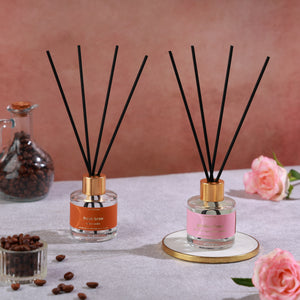
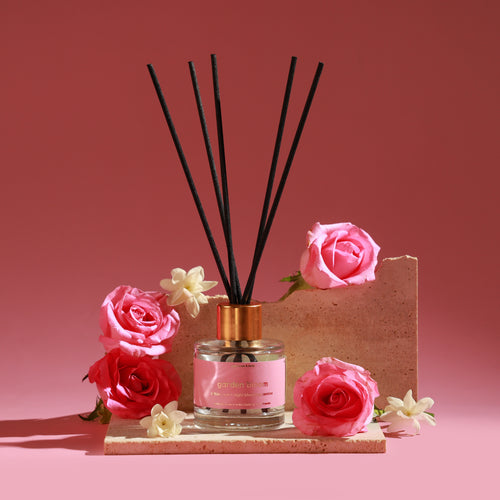
5. Only then build the fragrance, and build it lower than you expect. A reed diffuser is driven by capillary wicking and evaporation, and evaporation rises with temperature and airflow. Warm, dry, well-ventilated post-monsoon air makes the same bottle throw harder and empty faster than it would have in the rains. Start with fewer reeds than you think you need and add one at a time over a week. A reed diffuser from ₹749 for always-on rooms; the Sukoon at ₹1,899 where you want a switch.
Made in India, composed by an ISIPCA Versailles-trained perfumer — and a portion of every order supports girl-child education through Nanhi Kali.
Why the smell outlasts the water by weeks
People expect the smell to disappear on the same day the humidity does, and it does not. Two separate things were happening during the wet weeks. The first was physical: materials absorbed water and released a different set of volatile compounds because they were damp. That part genuinely does stop when the flat dries. The second was biological: mould and bacteria grew on damp substrates, and growth leaves residue — dead cells, metabolic products and staining held in the fibre. That residue does not evaporate when the room dries; it sits in the material and continues to give off odour for weeks. Which is why a flat can be at 55% relative humidity and still smell like September.
This is where sorption matters. Porous materials take odour molecules into the fibre and release them slowly, over days, long after the source is gone — it is the same mechanism that makes cooking smells outlive the cooking. In a flat coming out of monsoon, the reservoir is enormous: bedding, mattresses, curtains, upholstery, rugs, cushion covers, wardrobe contents, towels. Every one of them has been marinating for weeks. You cannot ventilate that out and you certainly cannot perfume it out — it has to be washed or aired and sunned. This is the phase people skip, and skipping it is the single most common reason a diffuser bought in October disappoints in November.
Confirm, reset, build — in that order
 Now is the momentFrom ₹749Three checks, and all three should pass before you go further. The hygrometer in the worst room should settle under 60% across a full week. The places you found growth should still be clean and dry when you torch them at a raking angle. And the honest nose test: leave the flat for thirty minutes, walk back in, and judge your first breath. If there is still an earthy or cellar-like note, the search is unfinished and no amount of washing or scenting will settle it. Go back and look again — behind furniture on external walls, under sinks, ceiling corners, inside cupboards.
Symptom to cause: what is still not right
If something is still off after the flat is dry, it is almost always one of these five. Work down until a row matches, and do not add fragrance until none of the first four do.
| What you notice | Most likely cause | How to confirm it | What actually fixes it |
|---|---|---|---|
| Flat is dry but still smells faintly of the season ★ | Residue held in textiles — sorption, re-releasing slowly over days | Press your nose into curtains, sofa back, mattress and cushions in turn | Wash everything washable; sun mattresses, rugs and cushions; give it a week |
| One cupboard or drawer still smells musty inside | An enclosed volume that never got reset, or a contents problem | Smell the inside after two closed days rather than smelling the room | Empty it, wipe and dry the interior, wash the contents, leave the doors open |
| Smell returns each time the weather turns humid again | The moisture cause was reduced rather than removed | Watch the hygrometer through the next wet spell in the same spot | Go back to the source: drainage, indoor drying, ventilation, a cold surface |
| Earthy or cellar-like note that will not lift | Growth still present somewhere — a health issue, not an odour | Torch external walls behind furniture, ceiling corners, under sinks, cupboard backs | Find and remove it; get a specialist for damp that persists in dry weather. |
| Fragrance smells much stronger than it did in the rains | Warm dry air raising evaporation rate — a reed diffuser is temperature and airflow driven | Count the reeds and note where the bottle is relative to sun and draught | Remove reeds rather than moving the bottle; four instead of six is often right |
| Bottle emptying much faster than the stated weeks | Heat, direct sun or a draught accelerating evaporation | Check whether it sits in afternoon sun, near a window or in a fan path | Move it out of sun and draught, and reduce the reed count |
| If none of these fit: re-run the thirty-minute test once a fortnight through the first month. It is the only honest measurement you have, and it will tell you whether the reset is finished long before your day-to-day nose will. | |||
Reeds · always-on roomsFrom ₹749Shop → 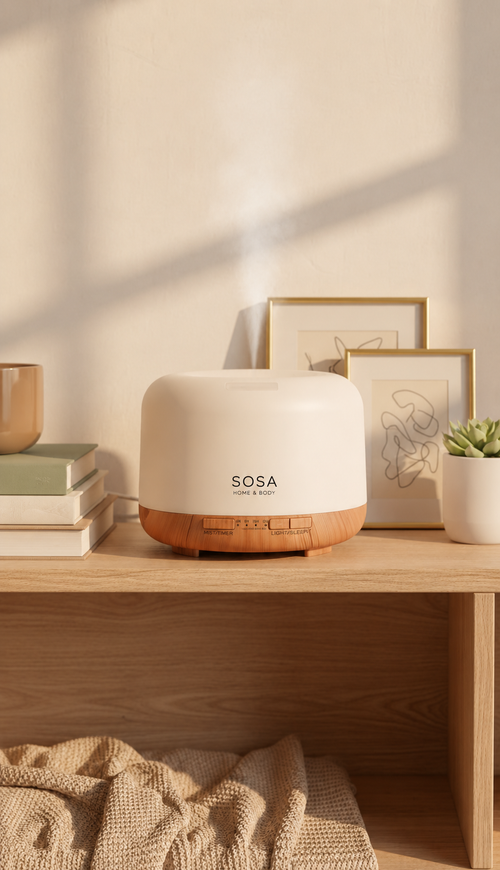 Sukoon · when you want a switch₹1,899Shop →
  Hotel Collection · the scentFrom ₹299Shop →
Room by room, after the rains
Start with the entrance and hall, because it sets the impression of everything behind it. This is the classic reed diffuser position: a room you pass through rather than sit in, where you want a constant, unattended background and there is nothing to switch on. Six reeds at full strength, on a console or shelf away from the door draught — a reed diffuser in a direct draught throws hard and empties fast, which is a waste. A 130ml at ₹1,249 lasts 14–18 weeks here and is better value than replacing a 50ml three times. Something clean and green reads well after a damp season: Morning Freshness or Mountain Breeze rather than anything sweet, because sweetness over the memory of damp is the one combination to avoid.
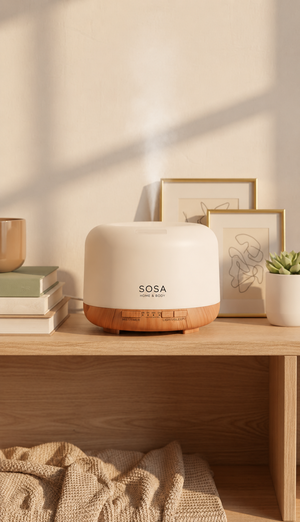
Then the living room, where the decision is reeds or a switch. If the room is up to roughly 150 sq ft and you want it to smell settled all the time, a reed diffuser at six reeds does it with no electricity and no attention. If it is larger, or if you would rather have scent for the hour before people arrive and nothing at 2am, the Sukoon at ₹1,899 covers roughly 270–320 sq ft on 3–6 drops of the water-based Hotel Collection from ₹299 — The Ritz-Carlton-inspired Quiet Luxury or Shangri-La-inspired Tea Garden if you want the quiet, expensive register rather than a domestic one. The two liquids are not interchangeable: oil-based reed fragrance must never go into an ultrasonic machine.
Then the bedrooms and the bathroom, both of which want restraint. A bedroom is a small volume you sleep in for eight hours, so four reeds rather than six and something calm — Evening Calm suits it — placed away from any AC airflow, where the cooler steadier air will also make the bottle last longer. A small bathroom needs only two or three reeds; more is genuinely too much in that volume, and a bathroom smell problem is usually a trap or an extraction problem rather than a fragrance one anyway. Across the flat, a duo at ₹1,498 covers two rooms sensibly, and refills at ₹2,399 for 300ml are the economical way to keep it running once you know which blend belongs where.
What to do, in order
The order is the same as everywhere else in this cluster, but for the first time the fourth step is the point of the exercise rather than a warning.
| Step | What to do | When | Cost |
|---|---|---|---|
| 1. Remove the source | Confirm the fix: hygrometer under 60% for a week, growth sites still clean, and an honest thirty-minute nose test | Before anything else | ₹0 |
| 2. Move the air | Ventilate hard now that the weather allows — ten minutes of two openings on opposite sides, twice a day | Daily, five to ten minutes | ₹0 |
| 3. Deal with what holds it | Reset the textiles: wash bedding, curtains and covers; vacuum upholstery; sun mattresses, rugs and cushions | Weekly to monthly | ₹0 |
| 4. Then the always-on layer ★ | A SOSA reed diffuser — a settled background for the hall, living room and bedrooms — six reeds, six, and four respectively | 50ml 6-8 weeks · 130ml 14-18 | from ₹749 |
| 5. Or the on-demand layer | Sukoon with a Hotel Collection scent — a larger living room or scent on demand before guests; covers roughly 270–320 sq ft | Run it when you want it | ₹1,899 |
Versailles
This is the page in the damp set where I finally get to say yes, and I want to be as useful here as I was blunt on the others. The mistake people make in October is assuming that dry equals neutral. It does not. The water goes and the residue stays in the fabric, so there is a fortnight of washing and airing between the dehumidifier and the diffuser, and that fortnight is what decides whether the fragrance lands.
The second thing is dosage. Almost everyone over-doses after a damp season, because they have spent three months wanting the flat to smell of something. But a reed diffuser is driven by evaporation, and evaporation goes up with temperature and airflow — so the same bottle that was polite in a shut humid flat becomes loud in a warm cross-ventilated one. Start with four reeds where you would have used six, live with it for three days, and add one if you want more. You can always add; you cannot take the scent back out of the room.
And keep the honest test in your routine. Leave for half an hour, come back, judge the first breath. Your nose goes blind to your own home in about twenty minutes, so that first breath is the only real information you get. It will also tell you early if the damp is creeping back next June, which is worth more than any of this. A portion of every order funds a girl's classroom through Nanhi Kali.
Frequently asked questions
- Should I use a reed diffuser for a damp smell? — the page that says not yet.
- Why a coastal flat smells musty every monsoon — the whole-flat humidity case.
- Musty smell but no visible mould — the search method, before you scent anything.
- Keeping a home fresh once the smell is gone — the maintenance routine.
- Brand: the SOSA founder story.
SOSA products & prices (verified August 2026): Hotel Collection water-based ultrasonic diffuser fragrance 15ml ₹299 · 100ml ₹999 · 300ml ₹1,799 · Pack of 7 (15ml, all fragrances) ₹1,799; refills 100ml from ₹999. Seven scents: The Ritz-Carlton-inspired (white tea · bergamot · cedar), Westin-inspired (white tea · aloe · cedar), 1 Hotels-inspired (cedarwood · vetiver · green leaves), The St. Regis-inspired (amber · violet · woods), Shangri-La-inspired (jasmine · green tea · white tea), Four Seasons-inspired (citrus · floral · sandalwood), W Hotels-inspired (citrus · pepper · amber). Diffusers: Boond 300ml ₹899 · Sukoon 500ml ₹1,899 · Megh 6L ₹3,499. Water-based, phthalate-free, composed to IFRA standards for home diffusion; 3–6 drops per tank. Made in India, Pune. The Hotel Collection scents are SOSA's own interpretations inspired by the world's finest hotels; all hotel names are trademarks of their respective owners and are used only to describe the scent style — SOSA is an independent Indian fragrance house, not affiliated with or endorsed by any hotel brand. Prices and availability subject to change — see the live product pages.