




Why it actively backfires: humid air makes all odours read stronger, so a scent laid over damp arrives heavier and mixes rather than covers.
Do this instead: measure the humidity, find what is wet, dry it, and check for growth. Then come back — a dry room holds a fragrance beautifully, and you will notice the difference.
2. No, because fragrance is additive and damp is subtractive work. A damp smell is caused by water in materials and, after a week or two, by microbial growth feeding on that water. Fixing it means taking water out. A diffuser puts something in. These are opposite operations, and doing the additive one does not advance the subtractive one by any amount. You end up with two smells present simultaneously, and because they are unrelated, your nose reports them separately rather than blending them.
3. No, because humidity makes the result worse than you expect. Humid air raises the perceived intensity of odours generally — everything reads heavier and closer in monsoon than it does in December, which is one of the reasons the damp itself is so noticeable. That amplification applies just as much to the fragrance you have just added. A blend that is pleasant at 55% relative humidity can read cloying and heavy at 80%, sitting on top of a musty note that is also reading louder than usual.
4. And emphatically no if the smell might be mould. Mould is a health issue, not an odour to be fragranced. A musty smell is usually microbial growth on a damp substrate, and the reason people live with it for a year is that they got good at covering it. A nice smell in the room removes the daily prompt that would otherwise have made you move the wardrobe and find the wall behind it. Search first — external walls behind furniture, under sinks, ceiling corners, inside cupboards — and treat what you find as a moisture and health matter.
5. Yes, afterwards — and it will be better than it would have been now. Once the room has been dry through a full wet week and smells of nothing much, a reed diffuser from ₹749 is a genuinely good thing to own. A neutral, dry room is a blank canvas: the fragrance arrives clean rather than mixed, it reads lighter, and you get the effect you were hoping for in the first place. Nothing about waiting costs you anything except the wait.
Made in India, composed by an ISIPCA Versailles-trained perfumer — and a portion of every order supports girl-child education through Nanhi Kali.
What a reed diffuser physically does, and what it cannot do
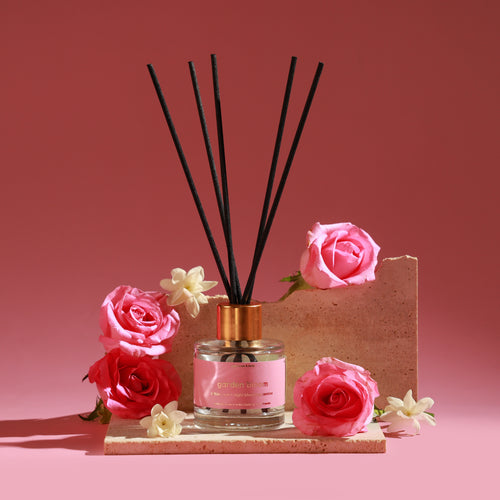
It is worth being specific about the mechanism, because that is what settles the question. A reed diffuser is a bottle of fragrance oil in a carrier, with porous fibre reeds standing in it. Capillary action draws the liquid up through the reed against gravity, and from the exposed upper length it evaporates into the room. That is the whole device — no fan, no filter, no chemistry beyond evaporation. Its rate is governed by temperature, airflow and how much reed surface is exposed, which is why reed count works as a volume dial and why a hot, draughty room empties a bottle faster than a cool still one. Nothing in that description involves the air giving anything back. A diffuser is a source, not a sink.
A damp smell, by contrast, is a moisture problem with a biological consequence. Water vapour has raised the moisture content of the porous materials in the room; sustained dampness has let mould and bacteria grow on the dust, skin cells and fibre finishes already present; and the volatile compounds that growth releases are what you are smelling. To fix it you have to remove water and remove growth. A device whose only action is to add molecules cannot participate in that at all. This is not a limitation of my products specifically — it is true of every reed diffuser, every electric diffuser, every scented candle and every aerosol air freshener on the market, from any brand. Anyone telling you otherwise is selling you something on a false description.
Why scent over damp reads worse than damp alone
 Worth having — laterFrom ₹749People imagine fragrance works like paint over a stain. It does not. Adding a strong pleasant odour to a room that already has a strong unpleasant one does not produce an average; your nose has separate receptors responding to each, and it reports both. What a visitor smells at the door is "damp, and something floral" — which reads as a home that is hiding something, and that is a distinctly worse first impression than plain damp, which at least reads as honest. The stronger the fragrance, the more clearly the combination announces itself.
Symptom to cause: is your room ready for fragrance?
Work down this table. If any row before the last one matches, the answer is still not yet — and the fix column is where your effort should go this week.
| What you notice | Most likely cause | How to confirm it | What actually fixes it |
|---|---|---|---|
| Earthy or cellar-like note anywhere in the room ★ | Microbial growth on a damp material — a health issue, not an odour | Search external walls behind furniture, under sinks, ceiling corners, inside cupboards | Remove growth safely and find the moisture source. No fragrance until it is done. |
| Hygrometer reads above 70% in the room, consistently | Ambient humidity — materials cannot dry and growth is likely | Read it morning and evening for three days in the same spot | Stop indoor drying, ventilate in dry gaps, run an AC or dehumidifier with the door shut |
| Specific soft item smells when you put your nose to it | A single damp reservoir — mattress, sofa cushion, rug, curtain, wardrobe | Smell each candidate at close range; one will be clearly worse than the rest | Fan it dry for a few hours, wash what is washable, remove what is not salvageable |
| Sharp sewer note rather than an earthy one | A dry P-trap or failed seal — this is a drain smell, not damp | Run water down every unused drain and see whether it fades | A plumbing job. Fragrance has no role in it at all. |
| Room smells of nothing much, only slightly closed | Stagnant air rather than moisture — 0.2–0.5 air changes an hour | Cross-ventilate ten minutes and judge your first breath back after thirty | Ventilate twice daily. This room is ready for fragrance once it clears. |
| Room has been dry and neutral through a full wet week | Nothing — the moisture problem is genuinely resolved | Leave for thirty minutes and judge the first breath back in | Now a reed diffuser is worth having, and it will read cleanly |
| If none of these fit: trust the earthy note over the hygrometer. A room can read a reasonable humidity today and still have growth established from three weeks ago, because removing the water does not remove what grew in it. | |||
Reeds · always-on roomsFrom ₹749Shop →  Sukoon · when you want a switch₹1,899Shop →
  Hotel Collection · the scentFrom ₹299Shop →
What to do instead, this week
First, measure and search, because both are free. A hygrometer costs a few hundred rupees and tells you in three days whether you have an ambient humidity problem or a local wet object. Then search with a torch held at a raking angle, in this order: external walls behind wardrobes, sofas and headboards; under the kitchen and bathroom sink; ceiling and wall corners; inside wardrobes; window reveals; under the mattress; behind the fridge. If you find dark speckling, stop treating this as a smell. Remove the growth safely — masked, gloved, wiped wet rather than dry-brushed — discard heavily colonised porous items, and find out why that surface was wet.
Second, take the water out. Stop drying clothes indoors, because a spun load holds litres of water and all of it goes into your air. Run the kitchen extractor while cooking and the bathroom exhaust for fifteen minutes after showers. Ventilate hard in the dry gaps between spells — a cross-ventilated flat manages 3–8 air changes an hour against 0.2–0.5 closed — and run an AC or dehumidifier with the doors shut when it is raining. Then dry the specific things: fan the bare mattress, stand sofa cushions on edge in front of a fan, empty and dry the wardrobe, wash and fully dry the curtains.
Third, wait and retest. Give it a wet week with the fixes in place, then leave the flat for thirty minutes and judge your first breath back in — you cannot smell your own home after about twenty minutes of being in it, so this is the only honest test available. Fourth, when the room reads neutral, buy the diffuser, and you will get far more out of it than you would have now. A reed diffuser from ₹749 for a room that should always smell settled: six reeds for a hall, four for a bedroom, two or three for a small bathroom. Or the Sukoon at ₹1,899 with a Hotel Collection scent from ₹299 if you would rather have a switch than something always on.
What to do, in order
The order below is the whole answer to the question in the title. Steps one to three are the work; step four is the reward, and it is a much better reward once the first three are done.
| Step | What to do | When | Cost |
|---|---|---|---|
| 1. Remove the source | Measure with a hygrometer and search with a torch; remove any growth safely and find why the surface was wet | Before anything else | ₹0 |
| 2. Move the air | Stop indoor drying, extractor and exhaust running, cross-ventilate in dry gaps, AC or dehumidifier with doors shut | Daily, five to ten minutes | ₹0 |
| 3. Deal with what holds it | Dry the specific reservoirs — mattress, sofa cushions, wardrobe interior, curtains, anything on the floor | Weekly to monthly | ₹0 |
| 4. Then the always-on layer ★ | A SOSA reed diffuser — a genuinely good purchase once the room has been neutral through a full wet week, at the reed count the room needs | 50ml 6-8 weeks · 130ml 14-18 | from ₹749 |
| 5. Or the on-demand layer | Sukoon with a Hotel Collection scent — the same job with a switch, for a living room where you want scent only some of the time | Run it when you want it | ₹1,899 |
Versailles
This is the page where the commercially convenient answer and the honest one disagree, so let me be plain. If your room smells damp, do not buy a reed diffuser from me this week. It will not help, you will conclude the product is weak, and you will be right to — because you asked it to do something it has no mechanism for doing.
I trained at ISIPCA in Versailles and I have spent a long time around people who overestimate what fragrance can do. It is an additive layer. It puts pleasant molecules into a room and it takes nothing out — no brand sells anything different, whatever the packaging says. In humid air it also reads heavier than it should, so the season when you most want to reach for something strong is the season when strong behaves worst. And if the damp smell is growth on a wall, covering it is how people end up living with mould for a year. That is a health issue, and I am not willing to be part of delaying it.
Come back when the room is dry. Genuinely dry — through a wet week, with the hygrometer behaving and nothing earthy left when you walk in from outside. Then a reed diffuser is a lovely thing, and it will smell better in that room than it ever would have done in the damp one, because a neutral room lets a fragrance arrive clean instead of mixed. Four reeds in a bedroom, six in a hall. A portion of every order funds a girl's classroom through Nanhi Kali, and that is true whether you buy now or in October.
Frequently asked questions
- Musty smell but no visible mould — the seven places to search, in order.
- Why a coastal flat smells musty every monsoon — the whole-flat humidity case.
- Drying clothes indoors during monsoon — the litres you are adding to your own air.
- After the dampness is fixed — the page where the answer is finally yes.
- Brand: the SOSA founder story.
SOSA products & prices (verified August 2026): Hotel Collection water-based ultrasonic diffuser fragrance 15ml ₹299 · 100ml ₹999 · 300ml ₹1,799 · Pack of 7 (15ml, all fragrances) ₹1,799; refills 100ml from ₹999. Seven scents: The Ritz-Carlton-inspired (white tea · bergamot · cedar), Westin-inspired (white tea · aloe · cedar), 1 Hotels-inspired (cedarwood · vetiver · green leaves), The St. Regis-inspired (amber · violet · woods), Shangri-La-inspired (jasmine · green tea · white tea), Four Seasons-inspired (citrus · floral · sandalwood), W Hotels-inspired (citrus · pepper · amber). Diffusers: Boond 300ml ₹899 · Sukoon 500ml ₹1,899 · Megh 6L ₹3,499. Water-based, phthalate-free, composed to IFRA standards for home diffusion; 3–6 drops per tank. Made in India, Pune. The Hotel Collection scents are SOSA's own interpretations inspired by the world's finest hotels; all hotel names are trademarks of their respective owners and are used only to describe the scent style — SOSA is an independent Indian fragrance house, not affiliated with or endorsed by any hotel brand. Prices and availability subject to change — see the live product pages.