



The thing you cannot know: light. You cannot tell from outside a flat whether it faces a wall, a balcony or the afternoon sun, and light is the one condition a plant will not negotiate on.
How the two fail: a plant dies, visibly, and the household feels responsible. A reed diffuser finishes, on schedule, and nobody feels anything. A glass bottle with six fibre reeds wicking oil into the room — no flame, no socket, no watering.
What to give instead: Mountain Breeze ₹849 for anyone who wanted the green-and-woody feeling, Evening Calm ₹799 for a small flat, the Fresh & Grounded duo ₹1,548 for two rooms.
2. Respect the fact that you cannot see the light. Light is the one condition a plant will not compromise on, and it is precisely the thing a guest cannot assess. A flat facing an internal shaft, a north wall, a covered balcony — all look identical on an invitation. You are being asked to be right about something you have no way of checking.
3. Think about how the gift fails. This is the part that decides it for me. A finished diffuser is an empty bottle and a completed job. A dead plant is a visible, reproachful object on a balcony, and the household reads it as their failure rather than as an ordinary outcome.
4. Consider whether anyone is ever away. A fortnight of work travel, a week at their parents', a wedding out of town — all ordinary, and all fatal to a young plant with nobody assigned to it. A reed diffuser at ₹849 carries on quietly through all of that and is scenting the room when they get back.
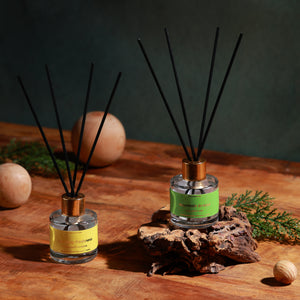
5. If it was the green feeling you wanted, buy the green feeling. Mountain Breeze is Himalayan pine, sage and Indian cedar — dry, resinous and closer to a hillside than to a perfume counter. It is the bottle I send to people who were reaching for a plant for atmospheric rather than horticultural reasons.
6. Assume the plant column is crowded. Plants and crockery are the two categories most likely to arrive in multiples at an Indian housewarming, and a second plant is a second job, not a spare.
7. And give the plant if they are a plant person. Some households genuinely want another one, will know exactly where it goes, and will be pleased for years. That case is argued properly in Part Three, not brushed aside.
Everything is composed and handmade in small batches in Pune, and a portion of every order supports girl-child education through Nanhi Kali.

Part one — the gift that starts a job
Every gift has an ongoing cost to the person receiving it, and most of the time that cost is zero. A book is read or not read. A mug is washed with the other mugs. A plant is one of the very few common gifts whose cost is genuinely recurring, and the size of that cost depends on conditions inside the flat that the giver has never observed. Three separate problems come out of that, and the third one is the reason I stopped giving plants myself. None of them are arguments against plants as objects — they are arguments about who is receiving them, and in which week.
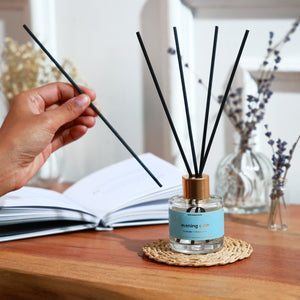
 Evening Calm₹799 · 50mlA plant is the only common housewarming gift with a hard environmental requirement. It needs a specific quantity of light, in a specific part of the day, and it will not negotiate. Meanwhile a great many Indian flats — particularly the affordable ones, particularly in dense cities — face an internal shaft, another tower, a covered balcony or a north wall. From the outside, and from an invitation, none of that is visible. Even the household often does not know yet; they have not lived through a summer in the flat. So the gift arrives carrying a condition that neither party can verify, and the outcome is decided by a coin-toss about window orientation. Compare that with a bottle of fragrance oil, which asks only for a flat surface out of direct sunlight and works identically in a north-facing 1BHK and a top-floor terrace flat.
Part two — what each gift asks in its first month
Not a price comparison — there are no prices here for anything outside the SOSA range, and a plant is not made better or worse by what it cost. The axis that matters is what the household has to do, how often they have to do it, what happens when they inevitably skip it, and whether anyone can see that they skipped it.
| Gift | The first task | How often after that | If they skip it | Who can see the failure |
|---|---|---|---|---|
| Reed diffuser ★ | Stand it on a shelf | Turn six reeds over, weekly | The room is quieter until they do | Nobody — and it is reversible in ten seconds |
| Potted indoor plant | Find the right light, then water | Every few days, forever | It declines, then dies | Everyone, including the person who gave it |
| Large floor plant | Find floor space and the right light | Watering, dusting, rotating, repotting | It leans, drops leaves, then dies slowly | Everyone — it is the largest object in the room |
| Cut flowers | Find a vase they may not own | Water changes for a few days | Nothing — they were always going to end | Nobody, but the gift is gone in a week |
| Herb or kitchen-garden kit | Assembly, soil, a sunny spot | Daily attention while it establishes | It never germinates and quietly disappears | Only the household, which is a mercy |
| Jar candle ₹379 · wax melts ₹474 | Light it — or find a burner for the melts | Every single time, with attention | It simply never gets used | Nobody, but nothing happens either |
| The honest caveat: this table measures effort, and effort is not the only value in a gift. A plant that a household wanted is worth every watering, and the daily involvement that reads as a burden here is exactly what a keen gardener enjoys about it. If you are giving to someone who tends things on purpose, the whole table inverts and the plant is the better gift. | ||||
Mountain Breeze · pine and cedar₹849Shop → 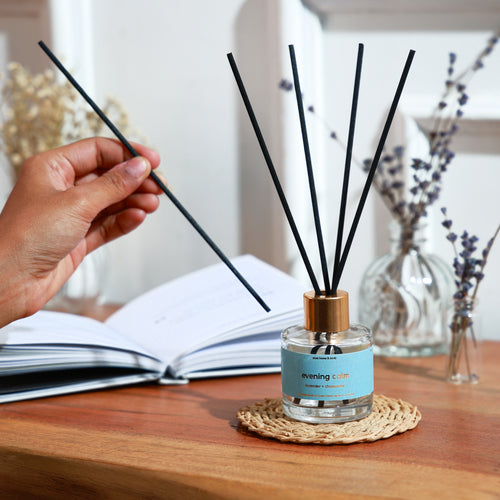 Evening Calm · the quietest₹799Shop →
 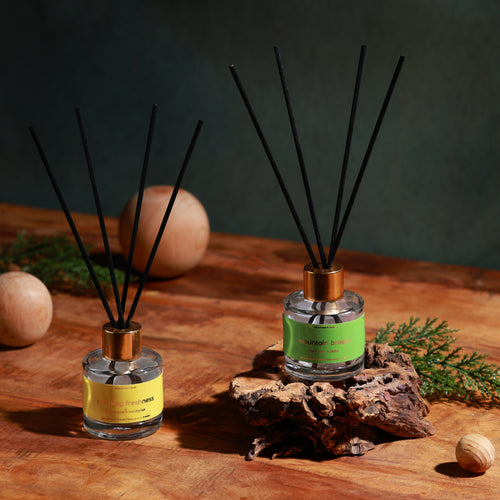 Fresh & Grounded duo · two rooms₹1,548Shop →
Part three — when the plant is genuinely the better gift
Now the other half, and I mean it as seriously as everything above. For a plant person, the plant wins, and it is not close. If the household already keeps things alive on purpose — a balcony with pots on it, a kitchen windowsill in use, someone who talks about repotting or has asked you where you got yours — then everything I have listed as a cost is being read by them as a pleasure. The watering is not a chore, it is a five-minute morning ritual they enjoy. The light problem does not exist, because they know their flat's light better than any guest could and will place the pot correctly within an hour. And the failure mode largely disappears, because experienced growers lose plants without moral distress; they simply try something else. Give that household a plant. It will outlive any bottle I could sell them and they will remember where it came from for years, which is more than I can honestly promise for fragrance.
There is a second, narrower case: a household that has explicitly asked for green things, or one moving into a place with a real balcony they are visibly excited about. A move into a flat with outdoor space is often the first time in years that someone can keep plants at all, and arriving with one is joining in with something they are already planning. The signal to look for is intent, not aesthetics — plenty of people like the look of plants in photographs and have never watered anything. Someone who has actually said "I finally have a balcony" is telling you what to bring. And if you are unsure which sort of person you are dealing with, that uncertainty is itself the answer: the safe gift is the one that does not depend on a habit you are guessing at.
One more honest note, because it belongs on every page in this cluster. A new flat smells of paint, of polish, of new wood and sometimes of damp, and a reed diffuser does not remove any of that — nothing standing on a shelf does. The remedy for a paint smell is ventilation and time: windows open, fans on, a few weeks. A diffuser sits alongside it until it fades and is then the only thing left in the room. Say that when you hand it over. It is more useful than any claim I could make, and it means the gift gets judged in the week it was built for rather than the week it arrived.
Part four — what to send, by how the household actually lives
Sorted by the one thing that decides it: whether anybody in that home tends things on purpose, and how much they are away. Budget follows from the relationship, not the other way round.
| How they live | Plant or not? | What I would send | Price |
|---|---|---|---|
| You wanted to give something green and alive-feeling ★ | No — buy the feeling, not the duty | Mountain Breeze 50ml | ₹849 |
| They already keep plants and enjoy it | Yes — genuinely the better gift | Buy the plant; bring wax melts ₹474 only if you want a second small thing | ₹474 |
| One person, travels for work, away often | No — nothing that needs a carer | Evening Calm 50ml | ₹799 |
| A flat with no balcony and doubtful light | No — the condition you cannot verify | Morning Freshness 50ml | ₹749 |
| A couple, two rooms, both working long hours | No — two plants is two jobs | Fresh & Grounded duo, 2 × 50ml | ₹1,548 |
| You want the gift to still be running at the new year | No — buy duration instead | Garden Bloom 130ml | ₹1,299 |
Versailles
I gave plants for years, and I was proud of it. It felt like the thoughtful choice — alive, growing, nothing wasteful about it. Then a friend I had given one to told me, laughing, that she had replaced it twice so that I would not notice when I visited. I had given her a small ongoing performance to keep up.
What stayed with me was not the dead plants. It was the discovery that a gift can quietly transfer work, and that the transfer is invisible to the giver. You hand over something lovely; they receive something lovely plus a standing appointment. If they happen to enjoy that appointment, you have given a wonderful gift. If they do not, you have given them a slow, visible way to feel bad, and they will never tell you.
So my rule now is to find out whether the household tends things on purpose, and to give accordingly. Plant people get plants — I mean that, and I would rather lose the sale than sell a bottle into a home that wanted a fiddle-leaf fig. Everyone else gets something that works without being remembered. A glass bottle and six reeds cannot die. It runs for six to eight weeks and then it is finished, which is a much simpler thing to receive. Everything is made in Pune in small batches, and a part of every order funds a girl's classroom through Nanhi Kali.
Frequently asked questions
- Gifts other than crockery — sets that must match, and cupboards that are already full.
- Gifts other than candles — the activation step, and where gifts quietly die.
- Why a reed diffuser is a different sort of gift — the mechanism, explained for someone who has never owned one.
- The complete unique-gift guide — the whole "don't bring what everyone brings" argument in one place.
- Brand: the SOSA founder story.
SOSA range & prices used in this guide (verified from the live store, August 2026): Reed diffusers — alcohol-free, phthalate-free, paraben-free, IFRA-compliant compositions on a heat-stable coconut-derived (CCT) carrier, supplied in a refillable glass bottle with six fibre reeds; 50ml lasts 6–8 weeks, 130ml lasts 14–18 weeks. Morning Freshness 50ml ₹749 · 130ml ₹1,249; Garden Bloom 50ml ₹799 · 130ml ₹1,299; Evening Calm 50ml ₹799 · 130ml ₹1,299; Fresh Brew 50ml ₹849 · 130ml ₹1,349; Mountain Breeze 50ml ₹849 · 130ml ₹1,349. Duo sets: Day & Night ₹1,498, Fresh & Grounded ₹1,548, Warmth & Bloom ₹1,598 (2 × 50ml); ₹2,498–₹2,598 (2 × 130ml). Oil-only refills 300ml ₹2,399 · 500ml ₹3,499 (the glass vessel and reeds are not included). The least expensive SOSA reed diffuser is ₹749, so no reed diffuser exists below that price in any format. Below it SOSA sells scented candles from ₹379 (roughly 15–18 hours), a Sandalwood jar candle ₹449, wax melts ₹474, ceramic mugs ₹474, ribbed and face mugs ₹569, bubble and taper candles ₹474–₹569, a ceramic trinket dish ₹664 and candle duos ₹664 (roughly 30–36 hours). The store runs an automatic discount, so several prices display with a .05 tail (₹379.05, ₹474.05); whole rupees are quoted here. Machines: Boond 300ml ₹899 · Sukoon 500ml ₹1,899 · Megh 6L ₹3,499 · waterless Vaayu ₹11,999. The water-based Hotel Collection (15ml ₹299 · 100ml ₹999 · 300ml ₹1,799) is a fragrance for an ultrasonic machine and is not a standalone gift. SOSA does not sell a gift card, a gift hamper, a gift box or a curated reed gift set, and gift wrapping, gift notes, direct-to-recipient shipping and any bulk or corporate terms are unconfirmed — check at checkout or with SOSA rather than assuming them. Composed and handmade in small batches in Pune, India; tested through 45°C summer heat and 85% monsoon humidity. Free shipping above ₹499. A portion of every order supports girl-child education through Nanhi Kali. Prices subject to change — see the live product pages.