
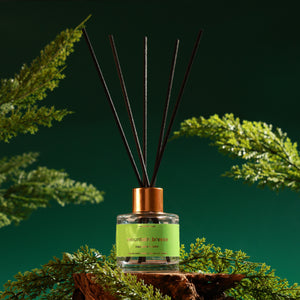
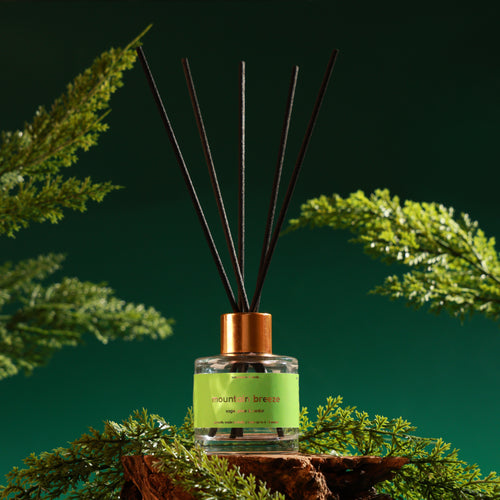
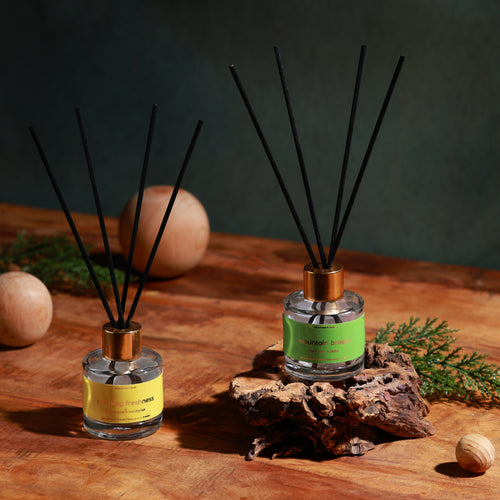
 Mountain Breeze ₹849
 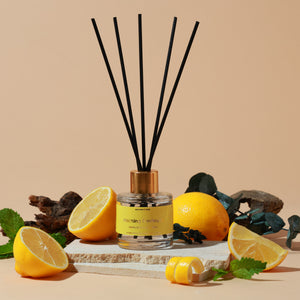 Morning Freshness ₹749
 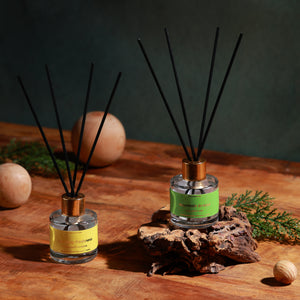 Fresh & Grounded duo ₹1,548
 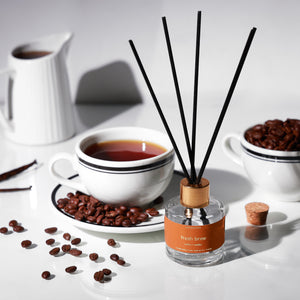 Fresh Brew ₹849
  Sukoon ₹1,899
The one exception where two genuinely work: the eyewear store is a separate premises — its own entrance from the street or the mall concourse, its own air-conditioning, a full-height wall and either no connecting door or one that is kept shut. Two shops sharing a brand can hold two scents. Two halves of one shop cannot.
Judge it by the walk, not by the drawing. If a person can get from the frames to the waiting seats in under ten seconds without opening anything, you have one air path and one scent.
What this page will not claim: no fragrance here affects how anyone feels, how long they wait or what they buy, and nothing here is medical or safety advice. Some people are sensitive to airborne fragrance, which is why the clinical pathway stays fragrance-free and a fragrance-free seat should always exist.
2. Make the step by lowering reception as well as raising retail. Four reeds at reception and six in the optical area is a larger, clearer step than six and eight — and it puts less fragrance into the building overall, which is the right direction in a clinic.
3. Two scents work in exactly one situation: the eyewear store is a separate premises with its own entrance, its own air-conditioning and either no connecting door or one that is genuinely kept shut. A person who arrives from the street never experiences a transition, so there is no seam to defend.
4. If you do run two, choose a pair that shares a note. Mountain Breeze and Morning Freshness meet on green eucalyptus; Fresh Brew and Garden Bloom meet on warmth. Unrelated pairs are how you get a third smell.
5. Neither answer changes the clinical rooms. Diagnostics, examination, consultation and procedure areas stay fragrance-free in both versions, and no source is ever mounted into shared ducting in a clinical building.
6. Whatever you run, run it low. A clinic's correct intensity is lower than a salon's or a showroom's, and the person to calibrate against is the receptionist who sits in it for eight hours, not the visitor who is in it for eight minutes.
7. Nothing here is clinical advice. Ventilation, cleaning protocol, infection control and patient suitability rest with you and your clinicians. Everything SOSA makes is composed and made in small batches in Pune, and a portion of every order supports girl-child education through Nanhi Kali.
Part one — why one composition wins in almost every building
The case for two scents is intuitive: a shop and a waiting room are different rooms doing different jobs, so give them different air. The case against is that in a clinic they are usually not two rooms in the only sense that matters — they are one volume with two functions, and one volume takes one scent.
 Sukoon 500ml₹1,899 · retail side onlyAn optometrist walks from the dispensing table to the consultation corridor twenty times a day. A receptionist crosses to the frame wall to help someone. Textile holds fragrance and releases it slowly, so in a building running two compositions the staff themselves become a third source moving between the zones. This is not a health point and I am not making one; it is a consistency point, and it is the reason two-scent schemes feel muddled even in buildings where the air path looks defensible on paper. It is also the argument for the level being set by the people who work in it: they are exposed for eight or nine hours, patients for forty minutes, and staff are the ones who will tell you honestly whether the retail side is a half-step or a full one.
Part two — what running two scents actually costs you
Set aside how the two smell for a moment. This is the week-to-week job you are signing up for, in the column on the right.
| The recurring job | One composition, two densities | Two different compositions | Where the two-scent version breaks first |
|---|---|---|---|
| Reordering ★ | One product, one refill size, one line on the order | Two products on two different run-out dates | One runs out; the store runs half a scheme for three weeks |
| Setting the level | A reed count anyone can verify from the doorway | Two levels that must be judged against each other, not absolutely | Nobody can say whether the seam moved or a level drifted |
| Staff handover | One instruction: this bottle, this many reeds, here | Two instructions, and which belongs where | The wrong bottle is topped up in the wrong zone |
| A complaint about strength | Lower one number and the whole building follows | You must first work out which of the two is being noticed | Both get lowered, and the scheme quietly becomes nothing |
| A change of season or occupancy | One adjustment, everywhere | Two adjustments, and the balance between them changes too | The seam lands somewhere new and nobody notices for a month |
| Opening a second location | Copy one line of a standard | Copy a relationship between two products and a floor plan | The second building has different walls, so the scheme does not port |
| The honest caveat: this table describes operational workload and how air is likely to behave between connected spaces, not how anybody experiences a fragrance. No claim is made about comfort, mood, waiting, browsing, purchases, footfall or revenue, and no product is described as safe or unsuitable for any patient group. Whether fragrance belongs anywhere in your building is a judgement for you and your clinicians, and SOSA does not advise into it. | |||
Mountain Breeze · one scent, two densities₹849Shop →  Sukoon · retail side, one setting₹1,899Shop →
  Fresh & Grounded · two premises only₹1,548Shop →
Part three — the one exception, and the ways it fails
There is a single arrangement in which two compositions are genuinely right, and it is worth stating precisely because so many buildings almost meet it. The eyewear store is a separate premises: it has its own entrance from the street or the mall concourse, its own air-conditioning unit or loop, a full-height wall between it and the clinic, and either no connecting door or a door that is genuinely kept shut through the trading day. In that building a customer arrives from outside, spends their visit in one air, and leaves. Nobody experiences a transition, so there is no seam to defend and no gradient to explain. Two shops that happen to share a brand can hold two identities. Two halves of one shop cannot.
The exception fails in four predictable ways, and all four are worth checking before you buy a second bottle. First, the connecting door gets propped open in the second week, usually because the store feels cut off from the front desk — a door is a boundary when it is shut and a doorway when it is not. Second, the two units turn out to share one air-conditioning loop or a common ceiling void, in which case the partition is decorative as far as air is concerned and the two scents meet above your head. Third, staff move between the two all day, carrying one scent into the other on clothing. Fourth, the store's own back door opens onto the clinic corridor, which is the commonest fit-out compromise I see and the one that quietly cancels the whole arrangement. If any of those four is true, run one composition at two densities and put the money towards holding it properly.
Two more things before you decide. If you do run two, choose a pair that shares a note — Mountain Breeze and Morning Freshness meet on green eucalyptus, and Fresh Brew and Garden Bloom meet on warmth — so that any small leak reads as a relative rather than a stranger. And whichever scheme you run, the supply question decides how long it survives. Reed compositions have published oil-only refills at 300ml ₹2,399 and 500ml ₹3,499. SOSA does not currently sell a separate cold-air refill oil for the Vaayu; the 400ml in the box lasts roughly ninety days or more at a mid setting and is the whole supply at the time of writing, so confirm availability through the contact page before a scheme depends on it. The water-based Hotel Collection is for ultrasonic machines only and must never go into a Vaayu; those scents are inspired by the atmosphere of well-known hotels, and SOSA is an independent Indian brand unaffiliated with any hotel group.
Part four — the density ladder, zone by zone
This is the whole scheme on one composition. The last column is the one that keeps a building honest — it is what must never differ between zones.
| Zone | Level to run | How to make that level | What must not differ from the rest |
|---|---|---|---|
| Optical display and frame walls ★ | The highest level in the building — and still low | Six reeds, or a Sukoon ₹1,899 on its lowest setting | The composition. Never a second scent here |
| Waiting seats | One step down from the display | Four reeds in a 130ml ₹1,349, or nothing but the tail of the retail source | Set for the fortieth minute, not the first |
| Reception desk | Lower again — nothing sited within reach of the desk | No source on the counter; borrow from the waiting bottle | Staff exposure decides this number, not visitors |
| Dispensing table and fitting mirror | No source at all, though it sits inside the scented zone | Keep bottles two metres clear of where frames are handled | Nothing should seem to come off an object in someone's hand |
| Corridor mouth to consultation | Zero — this is where the scented zone ends | No source within three metres; source at the far end of retail | The boundary. It is drawn at the consultation door |
| Diagnostics, examination, cabins, procedure, post-op | Fragrance-free, always | Nothing. No reed, no machine, no HVAC mounting | This does not change for any scheme, one scent or two |
Versailles
A clinic manager rang me because her building had begun to smell of something she could not name. They had run a woody composition in reception for a year and were happy with it; three months earlier they had added a warmer one in the optical bay because the bay was being refurbished as a proper retail space. Nobody objected to either scent. What they objected to was the four metres between them, where the two arrived together in a proportion that changed every time the front door opened.
We took the warm bottle out on a Tuesday and put the reception composition in the bay at six reeds while dropping reception to four. The building had a shop end and a waiting end again, and neither of them had a smell that needed explaining.
I think the mistake is a reasonable one. Two functions really do want two weights, and it is not obvious until you have lived with it that weight and identity are separable. They are, and the separable version is cheaper, reversible and easier to hold for years. Everything we make is composed and handmade in small batches in Pune, and a part of every order funds a girl's classroom through Nanhi Kali.
Frequently asked questions
- Scenting optical differently from the medical side — what counts as a real boundary.
- Making a register shift legible and what the eyewear section should smell like.
- A signature fragrance for an optical brand — and what is not available.
- Reeds or a machine for a large optical store and standardising across a chain.
- Brand: the SOSA founder story.
SOSA range, specifications and prices used in this guide (verified August 2026): Vaayu ₹11,999 — waterless cold-air nebulisation of undiluted fragrance oil; no water, no heat, no added humidity, no white mineral dust. Coverage up to 1000 m³, about 2,000–3,000 sq ft. 400ml refillable tank lasting roughly 90+ days at a mid setting. Bluetooth app plus onboard controls, 1h / 4h / 8h / 24h run windows, day selection, adjustable intensity, auto-stop and key-lock. Under 38 dB. DC 12V / 1A, 5W. Freestanding or wall / HVAC mount. CE, RoHS and SGS certified. SOSA does not currently sell a separate Vaayu cold-air refill oil; the 400ml supplied in the box is the fragrance available at the time of writing, so a practice planning continuous or multi-site use should confirm current refill availability with SOSA before committing. The water-based Hotel Collection is made for ultrasonic machines and must not be used in a Vaayu. Other machines: Boond 300ml ₹899 (~150 sq ft, ultrasonic) · Sukoon 500ml ₹1,899 (270–320 sq ft, 16–18 hours on low, remote and steady/2H/4H timers, three 15ml fragrances included, ultrasonic) · Megh 6L ₹3,499 (~215 sq ft — a runtime and humidity machine that covers less than a Sukoon, never a coverage upgrade) · Safar ₹3,999 (waterless cold diffusion, cordless, 20ml, about 6.9cm, three speeds, 1/2/3-hour auto-off — sold as a car and travel diffuser, personal-scale only; SOSA publishes no coverage figure for it) · Aangan ₹25,999 (HVAC nebulising, ~8,000–10,000 sq ft) · Meenar ₹38,500 (commercial HVAC, 12,000–18,000 sq ft). Water-based Hotel Collection for ultrasonic machines: 15ml ₹299 · 100ml ₹999 · 300ml ₹1,799 · pack of seven ₹1,799; scents are inspired by the atmosphere of well-known hotels — SOSA is an independent Indian brand and is not affiliated with, endorsed by or supplying any hotel group. Reed diffusers ₹749–₹1,349 (50ml 6–8 weeks, 130ml 14–18 weeks, six fibre reeds, no 100ml size; replacement reeds are not sold separately). Reed oil cannot be used in an ultrasonic machine and Hotel Collection oil cannot be used in reeds. SOSA sells no room spray or home spray — every SOSA spray is a car perfume. Nothing in this guide is medical, clinical or safety advice. A fragrance diffuser adds a scent to the air. It does not clean, purify, filter, sanitise or disinfect air, does not remove or neutralise disinfectant, damp or occupancy smells, and has no effect on comfort, anxiety, waiting time, recovery or any clinical outcome. Some people are sensitive to airborne fragrance, which is why this guide recommends that examination rooms, diagnostic areas, consultation cabins, procedure suites and post-operative areas remain fragrance-free, that a fragrance-free seating option always exist, and that a diffuser is never mounted into shared HVAC in a clinical building. Decisions about clinical policy, ventilation standards, infection control and patient suitability rest entirely with the practice and its clinicians. A persistent stale, damp or disinfectant smell is a ventilation, moisture or cleaning problem — SOSA sells no dehumidifier and no air purifier, and fragrance should never be used to cover one. Coverage, runtime and longevity figures are manufacturer specifications and typical ranges, not guarantees, and vary with room volume, ceiling height, air exchange, occupancy and season. SOSA publishes no commercial or bulk pricing, no corporate account, no annual maintenance contract, no installation service, no stated warranty term and no multi-location programme; warranty length, spare parts, servicing and app platform availability are unconfirmed, and larger or multi-site enquiries should go through the contact page before any commitment. Composed and made in small batches in Pune, India. Free shipping above ₹499. A portion of every order supports girl-child education through Nanhi Kali. Prices subject to change — see the live product pages.