
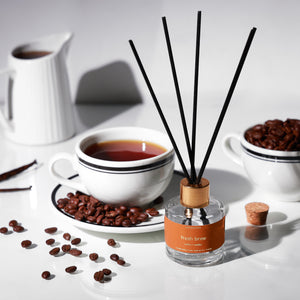



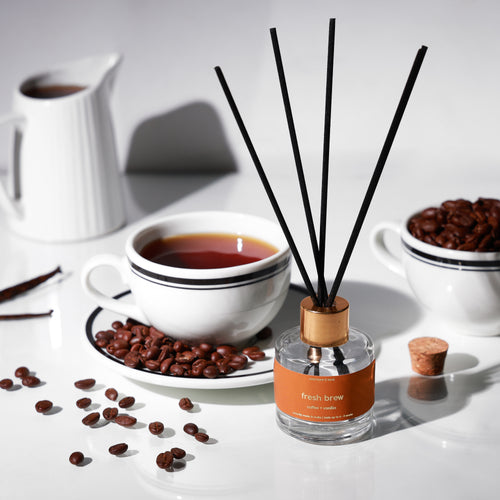
If the optical section is genuinely separate — its own room, a door that is normally closed — a warmer register is defensible. In the SOSA reed range that means Fresh Brew at ₹849 / ₹1,349 and nothing else: there is no oud, no musk and no amber reed in the range.
If it shares air with reception, run the same scent one half-step up. One extra reed in the optical bottle, or the same machine setting sited on the retail side. A half-step of the same composition is the version of "warmer" that survives an open floor plan.
What this page will not claim: no fragrance here affects how long anyone browses, what they buy or how anyone feels, and nothing here is medical or safety advice. Some people are sensitive to airborne fragrance, which is why the clinical pathway stays fragrance-free.
2. If it does have its own air, a half-step warmer is defensible — and only a half-step. The optical section is retail: people stand, handle frames, look in mirrors and leave. That justifies a register with a little more body. It does not justify a showroom level, and it never justifies anything that could travel.
3. In the SOSA reed range, "warmer" means Fresh Brew and nothing else. Coorg coffee over Kerala vanilla, at 9.5 on our own internal strength scale at six reeds — a position on SOSA's scale, not an industry standard and not a concentration. There is no oud, no musk-forward composition and no amber in the reed line.
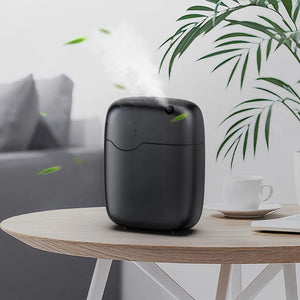
4. Size to the optical zone, not to the clinic. Most optical bays measure 120–320 sq ft. Under about 150 that is a reed bottle; from roughly 150 to 320 a Sukoon at ₹1,899; a Vaayu at ₹11,999 only past 320 sq ft of connected volume.
5. Put the source at the far end of the retail run from the corridor. Not on the dispensing table, not near the fitting mirror, not on the counter where an optometrist works all day. If the optical section has a street entrance, the source belongs between the frames and that entrance.
6. Nothing here is clinical advice. Ventilation, cleaning protocol, infection control and patient suitability rest with you and your clinicians. A practice that reads this page and decides its optical section gets nothing has read it correctly.
Everything SOSA makes is composed and made in small batches in Pune, and a portion of every order supports girl-child education through Nanhi Kali.
Part one — why optical is different, and what that buys you
Every other zone in this cluster is judged by how little it announces itself. The eyewear section is the exception, and the reason also sets the limit. Optical is retail, and retail is allowed a register that a waiting room is not — but the permission is issued by the floor plan, not by the category.
 Sukoon 500ml₹1,899 · optical zoneStand in the middle of your frame display and walk the shortest route to the first consultation cabin. Count the things that would stop air: a door that is normally closed, a lobby with two doors, a change of level, a full-height partition with the AC supply on one side and the return on the other. An archway is not a boundary. A half-height display run is not a boundary. A change of flooring is not a boundary — it is a change of flooring, and air walks over it without noticing. If you counted zero, your optical section and your clinical corridor are one air path, and the warmer-register conversation is closed for your building. If you counted one real boundary, you have a retail room and the rest of this page is written for you.
Part two — six optical layouts, and what each permits
Here are the six arrangements I see most often in Indian eye clinics. Find yours in the first column; the last column is the only recommendation you need from this table.
| How your optical section sits | Air path to the clinical corridor | Warmer register? | What I would actually run |
|---|---|---|---|
| Separate optical room, door normally closed, own entrance ★ | Broken — a door is a boundary when it is shut | Yes, a half-step | Fresh Brew, or a Sukoon on low inside that room |
| Optical room off reception, door usually propped open | Open in practice, whatever the drawing says | Only if the door is genuinely kept shut | Decide the door first. Until then, the reception scent |
| Optical alcove off waiting, corridor on the far side | Continuous — optical air crosses waiting to reach the corridor | No | One composition, one reed more in the alcove bottle |
| Frame display along one wall of the waiting room | The same air as the seating; there is no second zone | No — nothing to make warmer | Nothing additional. One source for the whole arrival zone |
| Optical at the front, clinic behind, one long lobby between | Long and indirect, but continuous unless a door exists | Half-step, if the source sits at the street end | Source between the frames and the street door, never mid-lobby |
| Optical shares a ceiling void and one AC loop with the cabins | Shared mechanically, whatever the walls do | No, and no HVAC mounting either | Freestanding and low on the retail side — or nothing |
| The honest caveat: this table describes how air is likely to move between rooms, not how anybody experiences a fragrance. No claim is made about comfort, anxiety, browsing, purchases, footfall or revenue, and no product is described as safe or unsuitable for any patient group. Whether fragrance belongs anywhere in your building is a judgement for you and your clinicians, and SOSA does not advise into it. | |||
Fresh Brew · behind a door only₹849Shop → 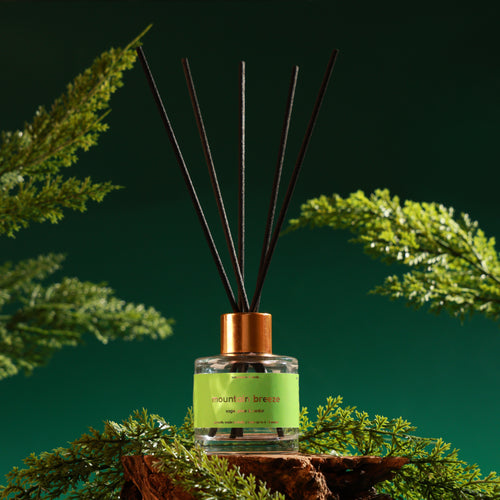 Mountain Breeze · the open-plan answer₹849Shop →
  Sukoon · 150–320 sq ft optical zones₹1,899Shop →
Part three — when the eyewear section should get nothing extra
There are several optical sections I would leave exactly as they are, and the first is the commonest arrangement in the country. If the frames are a wall of the waiting room, you do not have an optical zone — you have a piece of furniture in an arrival zone. Adding a second source there is not zoning; it is doubling the dose in a room already carrying one, and the extra material will find the corridor before it finds the display.
The second is an optical room that shares a ceiling void or an air-conditioning loop with the consultation cabins, which is commoner than the drawings suggest. Walls that stop at a false ceiling stop nothing that matters here. If the supply and return for your optical room and your cabins sit on the same loop, the two rooms are one air path regardless of the partition between them, and the only safe specification is a low freestanding source on the retail side or nothing at all. In a clinical building I would not mount a diffuser into shared ducting under any circumstances — it delivers fragrance to every room the system serves, including the ones that must stay clear.
The third case is supply. SOSA does not currently sell a separate cold-air refill oil for the Vaayu. The 400ml supplied in the box lasts roughly ninety days or more at a mid setting and is the whole supply available at the time of writing. For a home that is an inconvenience; for an optical business that has decided its display area smells a particular way, it is a business problem, and worse across several branches. The water-based Hotel Collection is made for ultrasonic machines and must never be used in a Vaayu; those scents are inspired by the atmosphere of well-known hotels, and SOSA is an independent Indian brand unaffiliated with any hotel group. Confirm refill availability through the contact page before committing an optical section to a Vaayu.
Part four — what to specify for the optical zone
Measure the optical section alone — not the clinic, and not reception plus optical unless they genuinely share one open volume. The last column is the one that keeps you honest.
| Your optical zone | Specify | Start at | The condition attached |
|---|---|---|---|
| Separate optical room, 120–150 sq ft, door kept shut ★ | Fresh Brew 130ml ₹1,349 on a tray, far end from the clinic wall | Four reeds, not six, for the first fortnight | The door. If it starts being propped open, the bottle changes |
| Separate optical room, 150–320 sq ft | Sukoon ₹1,899 with a 15ml Hotel Collection scent | Lowest intensity, 4H timer set to trading hours | Ultrasonic, so it adds humidity — keep it off frame stock and paper |
| Optical alcove sharing air with waiting, under 150 sq ft | The reception composition, a second small bottle in the alcove | One reed more than the reception bottle — the whole half-step | No second fragrance. Two scents in one air path make one muddled scent |
| Frames along a wall of the waiting room | Nothing extra. The arrival-zone source already does this room | ₹0 today | Adding here doses the corridor, not the display |
| Optical floor plus its own reception, 320–800 sq ft connected | Vaayu ₹11,999, freestanding, key-lock on, run window at trading hours | Lowest intensity. Under 38 dB, so nobody hears it | Never HVAC-mounted in a clinic — and confirm refill supply first |
| Optical sharing an AC loop or ceiling void with the cabins | Nothing, or one low freestanding source on the retail side | ₹0 until the air path is understood | A partition that stops at the false ceiling is not a boundary |
Versailles
An optometrist sent me photographs of a new optical fit-out — walnut cabinetry, warm lighting, brass trim — and asked which of our compositions would suit it. I asked for the floor plan instead, and the answer was in it: the display ran along the wall opposite the consultation corridor, with nothing between them but four metres of open floor. The room he had built was retail. The air it sat in was not.
We did not put Fresh Brew in that clinic. We put the dry cedar composition his reception was already running, one reed higher at the display end, and left it. He was not thrilled — he had spent real money on a room that looked like a shop and I was telling him it could not smell like one.
Six months later he opened a second location where optical sits behind its own door with its own entrance from the street. That room runs Fresh Brew and it is right there. The composition never changed; the architecture did. That is why I ask for a drawing before answering a question about a scent. Made in Pune in small batches, and a part of every order funds a girl's classroom through Nanhi Kali.
Frequently asked questions
- Scenting optical differently from the medical side — what counts as a real boundary.
- The note direction for a spectacle display and making the register shift legible.
- Clinic and store — one scent or two.
- Standardising one scent across an optical chain — and what stands in the way.
- Brand: the SOSA founder story.
SOSA range, specifications and prices used in this guide (verified August 2026): Vaayu ₹11,999 — waterless cold-air nebulisation of undiluted fragrance oil; no water, no heat, no added humidity, no white mineral dust. Coverage up to 1000 m³, about 2,000–3,000 sq ft. 400ml refillable tank lasting roughly 90+ days at a mid setting. Bluetooth app plus onboard controls, 1h / 4h / 8h / 24h run windows, day selection, adjustable intensity, auto-stop and key-lock. Under 38 dB. DC 12V / 1A, 5W. Freestanding or wall / HVAC mount. CE, RoHS and SGS certified. SOSA does not currently sell a separate Vaayu cold-air refill oil; the 400ml supplied in the box is the fragrance available at the time of writing, so a practice planning continuous or multi-site use should confirm current refill availability with SOSA before committing. The water-based Hotel Collection is made for ultrasonic machines and must not be used in a Vaayu. Other machines: Boond 300ml ₹899 (~150 sq ft, ultrasonic) · Sukoon 500ml ₹1,899 (270–320 sq ft, 16–18 hours on low, remote and steady/2H/4H timers, three 15ml fragrances included, ultrasonic) · Megh 6L ₹3,499 (~215 sq ft — a runtime and humidity machine that covers less than a Sukoon, never a coverage upgrade) · Safar ₹3,999 (waterless cold diffusion, cordless, 20ml, about 6.9cm, three speeds, 1/2/3-hour auto-off — sold as a car and travel diffuser, personal-scale only; SOSA publishes no coverage figure for it) · Aangan ₹25,999 (HVAC nebulising, ~8,000–10,000 sq ft) · Meenar ₹38,500 (commercial HVAC, 12,000–18,000 sq ft). Water-based Hotel Collection for ultrasonic machines: 15ml ₹299 · 100ml ₹999 · 300ml ₹1,799 · pack of seven ₹1,799; scents are inspired by the atmosphere of well-known hotels — SOSA is an independent Indian brand and is not affiliated with, endorsed by or supplying any hotel group. Reed diffusers ₹749–₹1,349 (50ml 6–8 weeks, 130ml 14–18 weeks, six fibre reeds, no 100ml size; replacement reeds are not sold separately). Reed oil cannot be used in an ultrasonic machine and Hotel Collection oil cannot be used in reeds. SOSA sells no room spray or home spray — every SOSA spray is a car perfume. Nothing in this guide is medical, clinical or safety advice. A fragrance diffuser adds a scent to the air. It does not clean, purify, filter, sanitise or disinfect air, does not remove or neutralise disinfectant, damp or occupancy smells, and has no effect on comfort, anxiety, waiting time, recovery or any clinical outcome. Some people are sensitive to airborne fragrance, which is why this guide recommends that examination rooms, diagnostic areas, consultation cabins, procedure suites and post-operative areas remain fragrance-free, that a fragrance-free seating option always exist, and that a diffuser is never mounted into shared HVAC in a clinical building. Decisions about clinical policy, ventilation standards, infection control and patient suitability rest entirely with the practice and its clinicians. A persistent stale, damp or disinfectant smell is a ventilation, moisture or cleaning problem — SOSA sells no dehumidifier and no air purifier, and fragrance should never be used to cover one. Coverage, runtime and longevity figures are manufacturer specifications and typical ranges, not guarantees, and vary with room volume, ceiling height, air exchange, occupancy and season. SOSA publishes no commercial or bulk pricing, no corporate account, no annual maintenance contract, no installation service, no stated warranty term and no multi-location programme; warranty length, spare parts, servicing and app platform availability are unconfirmed, and larger or multi-site enquiries should go through the contact page before any commitment. Composed and made in small batches in Pune, India. Free shipping above ₹499. A portion of every order supports girl-child education through Nanhi Kali. Prices subject to change — see the live product pages.