

2. Cleaning removes what's settled. Exhaust removes what's still airborne. These are not two versions of the same fix — a surface can be spotless while the air above it is still carrying odour compounds that haven't been pulled out of the room at all.
3. Undersized or poorly positioned extraction is the usual mechanism. A hood or fan that isn't capturing from where odour is actually produced, or isn't moving enough air for the space, lets odour recirculate no matter how often the surfaces underneath it are wiped down.
4. Soft furnishings are usually where this shows up first. Fabric, curtains and upholstery absorb airborne odour continuously; if they smell despite a proper cleaning routine, air is depositing more into them than cleaning is removing.
5. No fragrance, in any zone, fixes an exhaust problem. Adding scent over air that isn't being properly replaced doesn't clear the original odour — it produces a combined smell that's harder to place and, usually, worse than either on its own.
A clean café that still smells isn't a contradiction — it's a sign the air side of the problem has never actually been checked, and no amount of extra cleaning will check it for you.
Why clean and odour-free aren't the same thing
It's easy to assume that a smell in a well-run café must mean something wasn't cleaned properly, because cleaning is the most visible and most controllable part of running a room. But odour doesn't only sit on surfaces waiting to be wiped away — a good part of it stays suspended in the air itself, drifting from where it's produced to wherever the air in the room happens to carry it. Cleaning has no effect on that portion at all. It can only remove what's already settled, which means a café can run an exemplary cleaning routine and still have a persistent smell, because the routine was never addressing the part of the problem that was actually causing it.
Extraction is what handles the airborne portion, and it does that by physically removing air from the room before it has time to settle odour into fabric, upholstery or anywhere else porous. When extraction is undersized for the space, positioned away from where odour is actually produced, or fighting against a make-up air imbalance that pulls unfiltered air back in through a door or gap, the odour it's meant to remove simply keeps circulating instead. None of that shows up as dirt. It shows up as a smell in a room that, by every visible measure, looks properly kept.
This is precisely why a café owner can end up cleaning harder and harder in response to a complaint that cleaning was never going to solve. The visible half of the problem — surfaces, floors, bins — gets more attention each time, while the invisible half — whether air is actually being pulled out of the room fast enough — never gets checked at all. Confirming which half is actually at fault is a five-minute mechanical check, not a deeper clean, and it's the step this page exists to point toward.
Three signs the exhaust is the cause
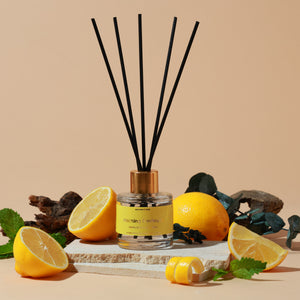
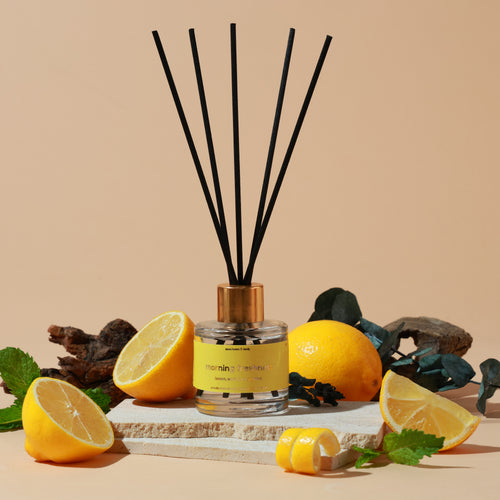
 Morning Freshness₹749A smell reappearing quickly after closing-level cleaning almost always means air is redepositing odour faster than the room is being cleared of it, not that the clean itself was inadequate.
What you're seeing, matched to the likely cause
None of the rows below are a cleaning verdict — each one points toward an air-side check instead, confirmed by a kitchen or ventilation professional, not a fragrance purchase.
| What you're seeing | What it usually isn't | What it usually is | Who confirms it |
| Smell returns within a few hours of a full clean | Not a gap in the cleaning routine that just happened | Air recirculating odour faster than it's being replaced | A ventilation or kitchen engineer, not a fragrance supplier |
| Smell sits near one fixed point close to cooking or the pass | Not necessarily a dirtier spot than the rest of the room | Extraction not capturing specifically from that point | Same |
| Sofas, curtains or banquette fabric carry a smell that surfaces don't | Not a laundering-frequency problem on its own | Fabric absorbing airborne odour faster than the room's air is being cleared | Same, alongside the café's own upholstery-cleaning routine |
| Smell is noticeably worse on the busiest service of the week | Not a sign the cleaning rota needs to run more often | Extraction sized for an average service rather than a peak one | Same |
| Any of the above, however rigorously the space is cleaned | Cleaning has already done its job by this point | The air side of the problem hasn't been looked at yet at all | A dedicated exhaust assessment, not a deeper clean |
| A café that keeps cleaning harder without ever having its exhaust actually assessed is solving a problem that was never a cleaning problem to begin with — and no fragrance route belongs in this table until that assessment has happened. | |||
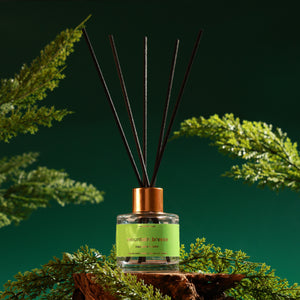
Morning Freshness · washroom, once resolved₹749Shop → 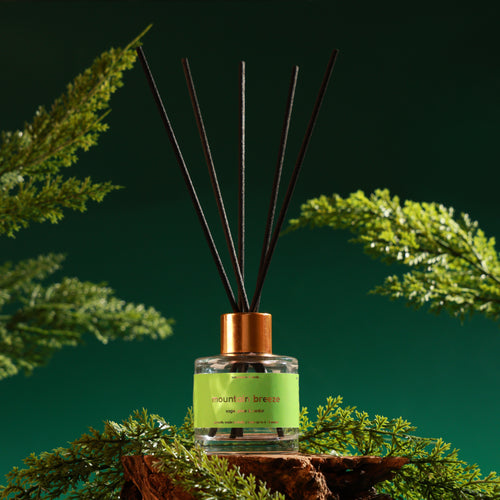 Mountain Breeze · entrance, once resolved₹849Shop →
  Vaayu · zoned, larger café, resolved₹11,999Shop →
Where fragrance fits, if anywhere
Never use fragrance to answer a complaint that a clean café still smells — no scent, in any zone, corrects an air-movement problem, and layering one over an unresolved exhaust issue produces a combined smell that reads as worse and harder to place than the original.
Sometimes, once extraction has actually been checked and confirmed to be moving enough air from the right points, a washroom or a genuinely separated entrance is a reasonable next step — a reed diffuser at ₹749–₹849, or Vaayu where the café is large enough and the zones are separated enough to justify it.
Usually, the honest answer to "the café is clean but still smells" costs nothing in fragrance at all — it's a mechanical service check on the exhaust, carried out by a kitchen or ventilation professional, and it's worth doing before any scenting decision is made anywhere in the building.
What to actually check first
In the order that actually resolves a clean-but-smelly café — mechanical first, fragrance only once the air side is settled, and only in the zones this cluster allows.
| Route | Premises | Why | What it costs |
| Confirm exhaust fans and hoods run at rated airflow | Any café where cleaning hasn't resolved a persistent smell | The single most common actual cause of this exact complaint | No purchase — a mechanical service check |
| Check make-up air isn't fighting the extraction | Cafés where the smell is worse with doors or windows shut | Extraction can't remove air it's simultaneously being fed back through a gap elsewhere | No purchase — a ventilation assessment |
| Confirm hood or capture position matches the current kitchen layout | Any kitchen altered, re-equipped or re-laid-out since the original install | A hood that isn't over the source can't capture from it, whatever its rated capacity | No purchase — a kitchen engineer's assessment |
| Reed diffuser, Morning Freshness or Mountain Breeze | A washroom or entrance, once the checks above are complete | The correct next step, but only after the air side is confirmed sound | ₹749–₹849 |
| Vaayu, wall or HVAC mounted, zoned | Entrance and retail zones of a larger café, exhaust already resolved | Independent scheduling once the structural question is genuinely settled | ₹11,999 per unit |
I get this question in almost exactly the same words every time: "we clean properly, so why does it still smell?" And almost every time, the answer has nothing to do with how the café is cleaned — it's that nobody has checked whether the extraction is actually pulling enough air out of the room, from the right points, at the rate the space needs.
It's an easy thing to overlook because it isn't visible in the way a dirty surface is. You can see a table that needs wiping. You can't see air failing to move the way it should, so the instinct is to keep addressing the thing you can see, even when it was never the actual cause.
I won't sell fragrance into a café asking this question until the exhaust has been looked at — not because the fragrance wouldn't smell nice on its own, but because it would sit on top of an unresolved problem and very likely make the combined smell worse, not better. Fix the air first. The washroom and entrance question can wait a week.
Questions about exhaust and café odour
- How Do I Remove Fried-Food Smell From a Café Without Covering It With Perfume? — the source-side companion to this page's exhaust question.
- Why Does Kitchen Smell Travel Into My Café Seating Area? — what happens when the same air-movement gap reaches the dining room.
- Why Does My Air-Conditioned Café Develop a Closed-Room Smell? — a related air-movement problem in a café that never opens its doors.
- Exhaust, Grease, Drains, Upholstery, HVAC, Humidity or Fragrance: What Should I Fix First if My Café Smells Bad? — the full ordered triage this page's exhaust step sits inside.
- Brand: the SOSA founder story.
SOSA products & prices (verified September 2026): Reed diffusers 50ml ₹749–₹849 (to 150 sq ft, 6–8 weeks at six reeds) · 130ml ₹1,249–₹1,349 (above 150 sq ft, 14–18 weeks) · reed refill 300ml ₹2,399. Ultrasonic: Boond ₹899 (~150 sq ft) · Sukoon ₹1,899 (270–320 sq ft, ships with three 15ml Hotel Collection fragrances) · Megh ₹3,499 (6L tank, ~100 hrs runtime, ~215 sq ft — a runtime machine, not a coverage upgrade). Waterless cold-air: Safar ₹3,999 (no published coverage figure) · Vaayu ₹11,999 (up to 1000 m³, roughly 2,000–3,000 sq ft; 400ml tank lasting about 90+ days; app and onboard control, 1h/4h/8h/24h run windows, adjustable intensity, key-lock, under 38 dB, freestanding or wall/HVAC mount, 5W, CE/RoHS/SGS) · Aangan ₹25,999 (8,000–10,000 sq ft). Hotel Collection water-based fragrance 15ml ₹299 · 100ml ₹999 · 300ml ₹1,799 is for ultrasonic machines; reed oil and Hotel Collection are not interchangeable. Reed diffusers are alcohol-free, phthalate-free, paraben-free, IFRA-compliant and low VOC, handmade in small batches in Pune. Every purchase funds a girl's education through Nanhi Kali. Prices and availability subject to change — see the live product pages.