
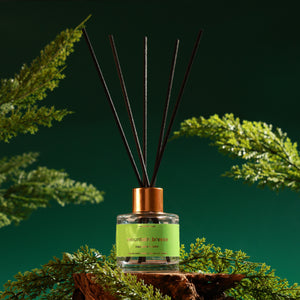

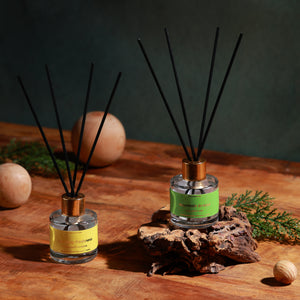
Why it cannot match the hotel: a reed is passive capillary diffusion — no power, no fan, no atomiser. A hotel uses waterless cold-air nebulising at building scale, releasing undiluted oil as a dry mist into moving air on a fixed schedule. Those are different machines doing different physics, not the same idea at two price points.
The good news: your bedroom has one enormous advantage the lobby will never have. It is small and it has a door. A closed 120 sq ft room reaches a perceptible concentration far faster than any lobby, which is why the cheapest tool in this subject is free.
The honest gap: between Safar at ₹3,999, named and sold as a car and travel diffuser with no published room-coverage figure, and Vaayu at ₹11,999 and 2,000–3,000 sq ft, SOSA has no mid-sized waterless bedroom nebuliser.
2. The hotel’s oil is never diluted and never evaporated. Pressurised air shatters pure oil into a dry mist that stays suspended rather than settling. Your reeds release molecules gently from a fibre surface at whatever rate the room’s temperature and humidity allow. Same category of liquid, entirely different payload arriving in the air.
3. The hotel never varies its intensity and you cannot help varying yours. A machine holds a set output through a scheduled window. A reed is generous on a hot afternoon and quiet in a cold air-conditioned room, and there is no dial. What you remember as “powerful” is frequently just unwavering.
4. The space was designed around the effect. Hard surfaces, high volume, controlled temperature, a doorway everybody funnels through, and a scent held constant for years so that returning guests recognise it. You are comparing a room in a flat with a system that has a budget line and a maintenance schedule.
5. And you arrived at the hotel un-adapted, which is worth more than any of the above. Olfactory receptors stop reporting a constant smell within minutes, so you cannot smell your own home and could smell that lobby the instant you walked in with a suitcase. Part of what you are trying to buy back is the freshness of your own nose, and nothing on any shelf sells that.
Alcohol-free, phthalate-free, IFRA-compliant, 0 ppm formaldehyde. Free shipping above ₹499, and a portion of every order supports girl-child education through Nanhi Kali.
The three advantages the building has, none of which is the fragrance
It helps to be specific about what you are up against, because “hotels just do it better” is both true and useless. Three things account for nearly the whole gap, and not one of them can be bought in a bottle. Reading them in order tends to make the whole subject less annoying, because it becomes clear that you were never in the running and were never supposed to be.
 Vaayu₹11,999Here is a small observation that explains a great deal: you can never find the diffuser in a hotel. You look for it — on the console, behind the reception desk, under the stairs — and it is not there. That is because the scent is usually introduced into the building’s moving air rather than released from an object standing in a room, often at the air-handling unit itself. There is no gradient to walk up and no source to locate, and that absence of a findable source is much of why the smell reads as designed rather than added. Your reed is the opposite in every respect: an object, on a table, with a very findable gradient around it. Neither approach is wrong. They are answers to different questions.
 Safar₹3,999A hotel sets an output level and a run window and leaves them alone, so the corridor at nine in the morning matches the corridor at midnight and the lobby this month matches the lobby last year. Your reed cannot do this and it is not a defect: evaporation follows temperature, humidity and airflow, all three of which change through the day, and a reed has no switch. Control is a real feature rather than a luxury one. Safar offers the small version — three speeds and a one, two or three-hour auto-off, up to ten hours continuous or around thirty intermittent per charge. Vaayu offers the large one — 1, 4, 8 or 24-hour windows, a choice of days, adjustable intensity, under 38 dB. Both are buying you steadiness rather than volume.
 Garden Bloom₹799A lobby has height, hard surfaces that hold nothing back, controlled temperature and humidity, and a single entrance that every guest passes through at the same walking pace. The fragrance is chosen to work in that volume and then kept for years, because consistency, not novelty, is what turns a smell into a signature. A hotel that changed its scent quarterly would have no signature at all. Your flat has soft furnishings, cooking, an open window in the mornings, several doors and a person who quite reasonably wants something different by the third bottle. Nothing about that is a failure. It is a home rather than a lobby, and homes are supposed to smell of more than one thing.
Why the honest comparison should feel like relief
People brace for this page to end with “so buy the expensive machine”, and for most readers it does not. The useful consequence of knowing you are competing with a building is that you can stop trying to win. Every rupee spent on a stronger bottle, a deeper composition or a fourth scent was spent on the one variable that was never producing the effect you were chasing, and knowing that ends a fairly expensive loop. It also removes the suspicion that you chose badly. You did not. There is no reed in existence, at ₹749 or at ₹3,000, that produces lobby presence, and a more expensive reed would have felt exactly the same.
The second piece of relief is that your room has an advantage no lobby will ever have. It is small, and it has a door. A hotel spends a great deal of money forcing a perceptible concentration into an enormous, constantly ventilated volume with people walking in and out of it. A 120 sq ft bedroom with the door closed reaches that concentration almost trivially by comparison, which is why closing the door is the cheapest and most effective tool in this entire subject and why it gets skipped so often. A running split air conditioner helps too, and in a way people find counter-intuitive: it recirculates air inside a closed room, and recirculating air is precisely the distribution a passive diffuser cannot generate for itself. The trade-off is that the drier air also speeds evaporation, so the bottle empties sooner — better distribution and a shorter life, in the same season.
And the third: you were probably remembering more than the fragrance. You arrived un-adapted, from outside, at the start of a holiday, into a room somebody else had cleaned, with nothing to do that evening. Fragrance carries memory with extraordinary efficiency and takes credit for a great deal of context it did not create. The reproducible parts are real and worth having; the part that was “being on holiday” is not for sale. Saying that plainly is not a way of lowering your expectations. It is a way of aiming them at the components that will actually respond.
| Variable | The hotel | Your bedroom with a reed | Can you close the gap? |
|---|---|---|---|
| Mechanism | Waterless cold-air nebulising — pressurised air, undiluted oil, dry mist | Passive capillary — evaporation from six fibre reeds, no air moved | Yes, by buying the mechanism: Sukoon ₹1,899 or Safar ₹3,999 |
| Distribution | The building’s ventilation carries it everywhere at once | Whatever draught happens to exist that afternoon | Partly — a fan, a running AC, or a machine that moves its own air |
| Schedule and intensity | Fixed output, fixed hours, unchanged for years | Rises and falls with heat and humidity; cannot be switched off | Yes — Safar’s 3 speeds and 1/2/3-hour timer, Vaayu’s 1/4/8/24-hour windows |
| Volume of space | Thousands of square feet, high ceilings, constant air exchange | About 120 sq ft with a door you can shut | You already win this one. Small and closed is far easier to scent than large and open |
| Your own nose | You arrive un-adapted, from outside, with a suitcase | You adapt within minutes and stop registering it | No — but a visitor will tell you the truth for free, and you get it on the way in from outside |
| Cost, silence and upkeep | A plant room, a power draw, a maintenance contract | About ₹13–₹15 a day, silent, no power, nothing to fill or charge | You win this one too, and it is not a small row |
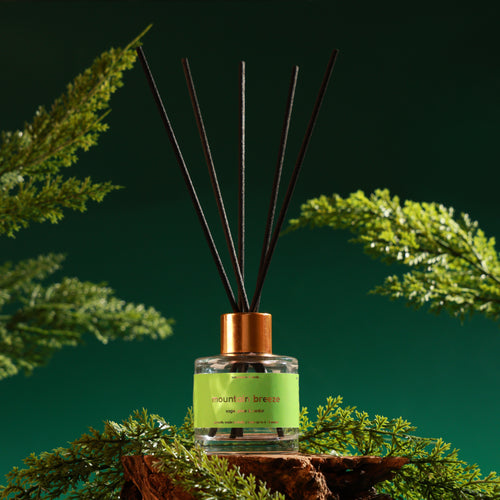
Passive · Mountain Breeze₹849Shop → 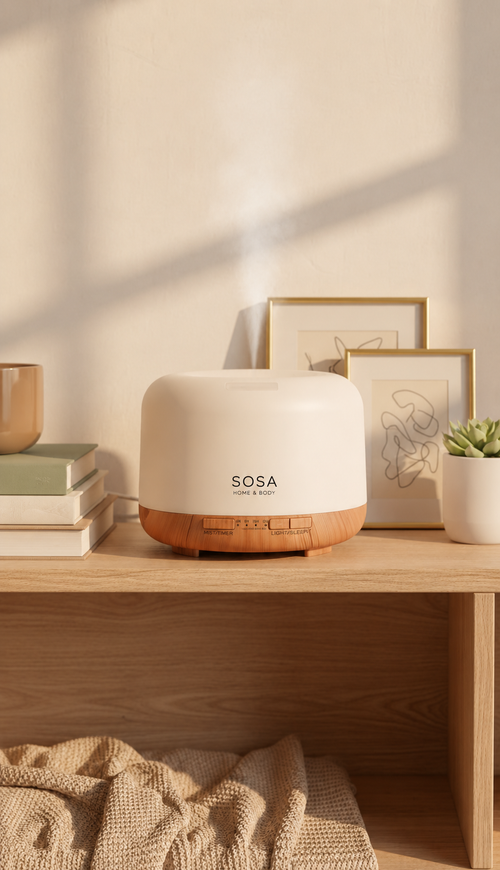 Ultrasonic · Sukoon₹1,899Shop →
 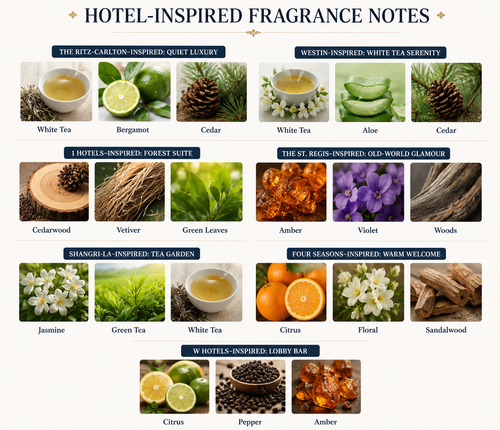 The oils · Hotel Collection₹999Shop →
The part of the hotel effect that is genuinely available to you
Three of the hotel’s four decisions transfer to a flat, and one of them is free. Consistency transfers completely. Choose one scent and keep it for a year instead of rotating through five, and use it in one or two places rather than everywhere; a home that smells identical in every room stops registering as a smell within a week, and a home that changes scent monthly never acquires a signature at all. This costs nothing and is the most under-used advice in home fragrance. Containment transfers completely too. Close the door of the room you care about and you have created the small, controlled volume that the hotel spends money simulating at scale.
Undiluted oil and a schedule transfer at a price. The cheapest genuine room coverage in the range is Sukoon at ₹1,899 — 500ml, 270 to 320 sq ft, 16 to 18 hours on low, three 15ml Hotel Collection scents in the box. It moves air, which is the missing variable, and the honest costs are that the oil leaves diluted in water, the room gains humidity, the tank needs filling and hard water can leave a white mineral film. The hotel mechanism itself, at personal scale, is Safar at ₹3,999: pressurised air, undiluted oil, dry mist, 20ml bottle, 2000 mAh Type-C battery, three speeds, a one, two or three-hour auto-off, 6.9 cm. It is named and sold as a car perfume diffuser — its own product page lists car, handbag, desk, bedside and hotel room as intended places, so a bedside is supported rather than improvised, but you should know the name before you buy rather than after. SOSA publishes no room-coverage figure for it and I will not supply one.
What does not transfer at any sensible price is the building. Vaayu at ₹11,999 is rated to 1000 m³ — roughly 2,000 to 3,000 sq ft — and in a 120 sq ft bedroom it is nine-tenths wasted. It is a serious machine for a whole floor, an open-plan living-dining, a large home, a villa, a clinic, a salon, a showroom or a reception, and it is the right buy when you genuinely want one machine scenting the entire flat on a schedule. Buying it to solve one bedroom is buying a building’s answer to a room’s question. And this is where the gap in the range has to be said out loud: between Safar and Vaayu there is no mid-sized waterless bedroom nebuliser at SOSA. Nothing here is a Vaayu for one room, which is exactly why the honest recommendation on this page is sometimes a machine and quite often the bottle you already own, moved three feet.
What to buy, in order — and the rung that does not exist
In the order I would spend it, starting with the things that cost nothing at all. The last row is the honest gap in the range.
| Step | What it is | When it is the right answer | Price |
|---|---|---|---|
| 1. Close the door, use six reeds, keep one scent for a year ★ | Containment, full volume and consistency — the three hotel disciplines that are free | Always first. Consistency is the strongest luxury signal available and it costs nothing | ₹0 |
| 2. The reed, placed properly | Out of a dead corner, into the path air already takes, never in the direct AC blast. 50ml up to ~150 sq ft, 130ml above | When you want a beautiful silent zone and no appliance in the room. About ₹13–₹15 a day | ₹749–₹1,349 |
| 3. Sukoon with the Hotel Collection | Ultrasonic water mist, 500ml, 270–320 sq ft, 16–18 hours on low, three 15ml scents included | The first honest step towards a covered room, if water, humidity and refilling are acceptable | ₹1,899 |
| 4. Safar | The hotel mechanism at personal scale — undiluted oil, 20ml, 2000 mAh, 3 speeds, 1/2/3-hour auto-off. Named and sold as a car and travel diffuser, with bedside and hotel room among its stated uses | When no water is the requirement and you want control over the hours. No published room-coverage figure | ₹3,999 |
| Not for a bedroom: Vaayu | 1000 m³ or roughly 2,000–3,000 sq ft, 400ml tank lasting about 90+ days, app scheduling, under 38 dB | A whole floor, an open-plan living-dining, a villa, a clinic, a showroom — or one machine for a whole flat. In 120 sq ft it is nine-tenths wasted | ₹11,999 |
| The honest gap | No mid-sized waterless bedroom nebuliser exists at SOSA, and Megh ₹3,499 does not fill it — it covers about 215 sq ft, less than the ₹1,899 Sukoon | Said plainly, because it is why the answer is sometimes Safar, sometimes Sukoon and sometimes the reed you own | — |
Versailles
The most useful hour I ever spent on this subject was in a hotel corridor, looking at the ceiling instead of the flowers. I had gone in expecting to find a beautiful diffuser somewhere and to feel professionally competitive about the composition. There was nothing to find. The scent was in the air itself, at the same level it had been an hour earlier, with no object anywhere producing it.
That is when the comparison stopped being about perfumery for me. A hotel is a machine, a ventilation system, a schedule and a decade of not changing its mind. No amount of skill on my part makes six fibre reeds behave like that, and I would rather tell you so than sell you a fifth bottle in the hope that the fifth one is different.
What I would not do is treat the reed as the losing side of that comparison. It is silent, it needs nothing, it cannot break down, it does not hum at three in the morning, and it looks like something you chose rather than something you installed. Those are real virtues that no machine in my own range can offer, and the honest recommendation for a great many rooms is still the bottle you already own — with all six reeds in it, a door closed, and one scent kept long enough to become yours. Everything is composed in Pune, and part of every order funds a girl’s classroom through Nanhi Kali.
Frequently asked questions
- I bought a hotel-inspired reed diffuser and my room is not a hotel — the premise, corrected.
- Right up close, wrong across the room — the most diagnostic sentence in this family.
- The right fragrance, no experience — composition quality against delivered concentration.
- Weak oil or weak projection? — a three-point test you can run tonight.
- Lovely in the bottle, absent across the room — headspace against room concentration.
- Hotel-inspired scent vs hotel-style scenting and why the same notes do not give the same room.
- Oil or diffusion technology? — which decides presence and which decides preference.
- Before blaming the oil — the family pillar.
- Brand: the SOSA founder story.
Facts verified August 2026: Three diffusion mechanisms are described — passive capillary (reed diffusers), ultrasonic water mist (Boond ₹899, 300ml, up to ~150 sq ft, ~6 hours; Sukoon ₹1,899, 500ml, 270–320 sq ft, 16–18 hours on low, three 15ml Hotel Collection scents included; Megh ₹3,499, 6L tank, ~100 hours runtime, ~215 sq ft, which is less coverage than Sukoon) and waterless cold-air nebulising (Safar ₹3,999, 20ml bottle, 2000 mAh Type-C battery, up to 10 hours continuous or around 30 hours intermittent, 3 speeds, 1/2/3-hour auto-off timer, 6.9 cm, named and sold as a car and travel diffuser with car, handbag, desk, bedside and hotel room among its stated uses, no published room-coverage figure; Vaayu ₹11,999, coverage up to 1000 m³ or roughly 2,000–3,000 sq ft, 400ml refillable tank lasting up to about 90+ days, Bluetooth app and onboard buttons, 1h/4h/8h/24h run windows, adjustable intensity, key-lock, under 38 dB, freestanding or wall/HVAC mount, 5W, CE, RoHS, SGS). SOSA reed diffusers: five scents, 50ml ₹749–₹849 lasting 6–8 weeks and suiting rooms up to ~150 sq ft, 130ml ₹1,249–₹1,349 lasting 14–18 weeks and suiting above 150 sq ft, six fibre reeds included and flipped every 3–5 days, about ₹13–₹15 a day, heat-stable CCT carrier rather than DPG, alcohol-free, phthalate-free, paraben-free, IFRA-compliant, 0 ppm formaldehyde, refillable glass bottle, climate-tested at 45°C and 85% RH, composed in Pune. SOSA strength scale: Evening Calm 8.9, Garden Bloom 8.9, Morning Freshness 9.0, Mountain Breeze 9.4, Fresh Brew 9.5. Hotel Collection fragrance oils are water-based and ultrasonic-only at 15ml ₹299 (a refill), 100ml ₹999 and 300ml ₹1,799; they cannot be used in reed diffusers and reed oil cannot be used in ultrasonic machines, so no hotel-inspired reed diffuser exists. No health, air-quality, allergy or antimicrobial claims are made, and fragrance does not remove a smell — source, then ventilation, then fragrance. Free shipping above ₹499. A portion of every order supports girl-child education through Nanhi Kali. SOSA is an independent Indian fragrance house; the Hotel Collection scents referenced here are SOSA’s own interpretations inspired by the world’s finest hotels, and SOSA is not affiliated with, endorsed by or a supplier to any hotel brand. Prices subject to change — see the live product pages.