
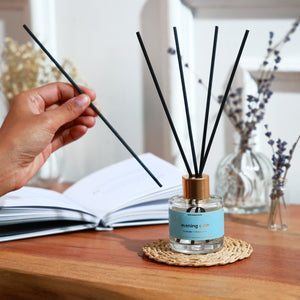


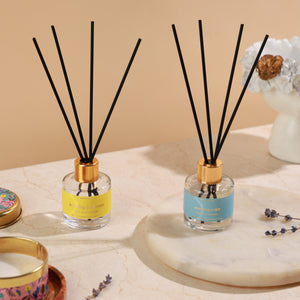

The third mechanism, which is real and physical: the bed is normally the furthest point from the bottle and you are lying down, which puts your face below the height at which the vapour is densest. That part is not perception — it is geometry, and it is fixable for nothing.
Free fixes, in order: move the bottle to the bedside, at or slightly below the height of your head on the pillow; three reeds rather than six at that distance; ceiling fan on low, which supplies the transport a reed lacks; door closed; out of the AC blast and off the windowsill.
The honest gap: none of this makes a bedroom even. A reed is a point source with no transport and will always have a gradient. If evenness is the requirement, that is an active diffuser question, and the honest first answer is Sukoon at ₹1,899, not something dearer.
2. Lying still is a constant stimulus, and constant stimuli are what adaptation removes. Within minutes of settling, the receptors have adjusted and the brain stops forwarding the signal. The concentration around your pillow has not dropped. Your reporting of it has. This is why you can be lying in a properly fragranced room and honestly say you smell nothing — and be right about your experience and wrong about the room.
3. Underneath both of those, the bed really is the worst seat in the house. A reed diffuser is a point source with no transport: the peak is at the reeds and it falls away with distance. The bed is usually the furthest surface from the dresser, and lying down drops your face below the level the vapour occupies most densely. So there is a genuine physical shortfall as well as a perceptual one, and it is the half you can fix for free.
4. So move the bottle to the bedside, and drop to three reeds. At half a metre from your head, six reeds is often too much and three is the right setting — it is a soft bedside level and it roughly doubles how long the bottle lasts. Put it at or just below the height of your head on the pillow, on the table rather than the floor.
5. Then the fan and the door, which are free and which do the most. A ceiling fan on low, in a closed room, with the bottle out of the direct downdraught, supplies the transport a reed structurally lacks — the best free change available. It will shorten the bottle’s life, and you should know that before you switch it on. Closing the door contains what you have, and containment is half the equation.
Alcohol-free, phthalate-free, IFRA-compliant, made in Pune. A portion of every order supports girl-child education through Nanhi Kali.
Three mechanisms, stacked — and only one of them is about the product
It is worth taking these apart, because the fix for each is different and two of the three are not faults at all. People usually arrive at this question assuming one explanation must be the right one. In fact all three are running at once in an ordinary Indian bedroom, and once you can name them you can decide which ones you actually mind.
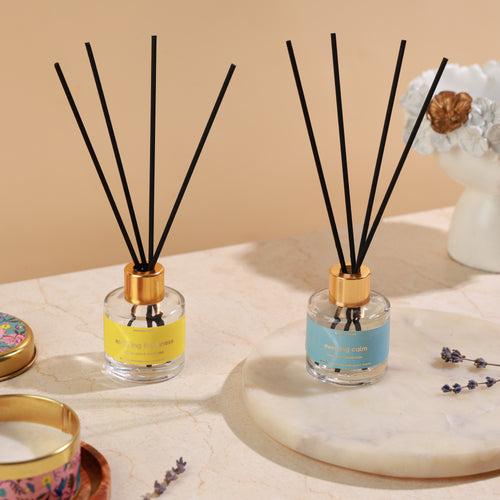
 Morning Freshness₹749A closed bedroom with a diffuser in it and a corridor without one are two different atmospheres separated by a doorway. Everywhere else in the house, concentration changes gradually as you move; at that threshold it changes almost instantly, because the closed door has been holding the two volumes apart all evening. You walk through and the reading goes from nearly zero to the room’s full level in the time it takes to take two steps. The olfactory system responds to rate of change with far more enthusiasm than it responds to level, which is why that moment is the strongest fragrance experience of your day — and why it is not a fair measurement of what the room is doing.
 Mountain Breeze₹849Once you are horizontal and still, nothing about the input is changing, and receptors adapt to an unchanging stimulus within minutes. This is ordinary and universal and has nothing to do with the quality of what is in the bottle. It is also the reason two people in the same bed can disagree entirely: the one who has just come upstairs will smell it and the one who has been reading for half an hour will not. Neither is imagining anything. Sensitivity varies between people, and you are always the most adapted person to your own home. If a guest remarks on the fragrance and you cannot detect it, it is working for everyone but you.
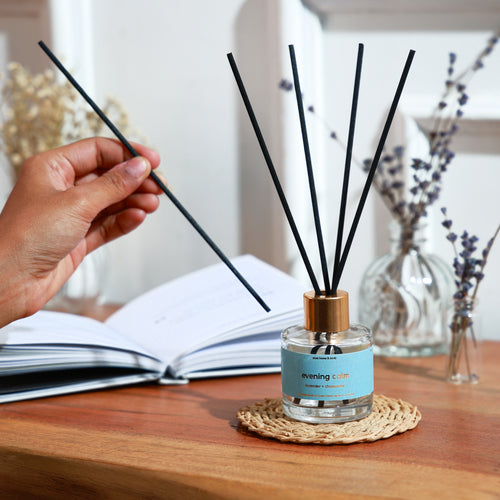
 Evening Calm₹799This one is not perception, and it is the reason I do not want the whole answer to be “you have adapted”. A reed diffuser has no fan and no pump: oil climbs six fibre reeds by capillary action, evaporates, and then goes wherever the room’s own air takes it. Concentration is highest at the bottle and lower everywhere else. Now look at where things are. The diffuser is on a dresser or a shelf, because that is where there is room for it; the bed is on the other side, because that is how bedrooms are laid out; and when you lie down your face drops nearly a metre. You have arranged, without meaning to, for your head to spend eight hours at the furthest and lowest point from the source.
Emission, transport, and why buying a louder bottle does not fix a quiet bed
There are two quantities in this problem and it is worth keeping them apart, because almost every unsatisfying purchase in home fragrance comes from mixing them up. Emission is how much fragrance leaves the bottle: reed count, bottle size, temperature and the oil itself. Transport is how far it gets, and it is decided almost entirely by moving air, which a reed diffuser does not supply. Your doorway experience is proof that emission is fine — you cannot walk into a wall of lavender if the bottle is not emitting properly. The bed is a transport question. Adding reeds, or buying a larger bottle, or choosing a scent higher on our strength scale, all raise emission and leave transport exactly where it was, which is why each of those changes tends to disappoint in the same way.
The bottle-size point deserves saying plainly because it is the most common mistake I see: volume is a duration specification, not a coverage specification. A 130ml SOSA reed runs 14–18 weeks against 6–8 for a 50ml. It lasts longer. It reaches precisely as far. The clearest demonstration is on our own shelf rather than a competitor’s — the Megh ultrasonic at ₹3,499 carries six litres and about a hundred hours of runtime and covers around 215 sq ft, which is less than the ₹1,899 Sukoon’s 270–320. Six litres buys runtime and humidity, not room.
The other thing not to buy in this situation is a stronger-smelling oil. Strength on our scale is perceived intensity in the room, not quality and not reach: Evening Calm sits at 8.9 and Fresh Brew at 9.5, and the difference between them is character and dose, not distance. Moving from a softer scent to a deeper one raises the peak at the reeds — where you were already happy — and does not change the concentration a metre and a half above your pillow in any way you will notice. If anything it makes the doorway moment louder, which is the part you did not need help with.
What each mechanism costs to fix
The three mechanisms, what each one is really doing, whether it is a fault, and what it costs to change. The last row is the one that no free fix touches, and it is the only honest reason to consider spending.
| What is happening | Is it a fault? | What actually changes it | Cost |
|---|---|---|---|
| The doorway is a three-second gradient crossing | No — it is your nose working correctly | Nothing, and you would not want to lose it | — |
| Receptors adapt to a steady stimulus within minutes | No, and it happens at any concentration | Leave for fifteen minutes and return; ask a visitor | Free |
| The bed is the furthest point from the bottle | No, but it is a real shortfall you can remove | Move the bottle to the bedside; halve the distance | Free |
| Lying down puts your face lower than the vapour | No — geometry | Bottle at or just below head-on-pillow height, on a table | Free |
| Six reeds at half a metre is too much | No — the reeds are a volume dial | Drop to three; it also roughly doubles the bottle’s life | Free, and it saves money |
| The room barely moves its own air | No, but it is the ceiling on everything | Ceiling fan on low, door closed, bottle out of the downdraught | Free; shortens the bottle’s life |
| What none of it fixes: an even room | Not a fault — a design limit | A point source always has a gradient. Evenness needs moved air, which means an active diffuser | From ₹1,899 |

The fifteen-minute test, and what to do with the answer
Before you change anything, run the only diagnostic that separates the perceptual half of this from the physical half. Get into bed as usual, notice what you can detect, then get up, leave the bedroom for a quarter of an hour with the door closed behind you, and walk back in and lie straight down. If the fragrance is obvious for the first minute or two after you return and then fades again, you have proved that adaptation is doing most of the work and your room is fine. If it is faint even on that first breath from a lying position, the shortfall is geometric, and moving the bottle to the bedside will make a visible difference within a day.
The second half of the test costs nothing and is more reliable than the first: ask somebody else. A partner coming to bed later, a guest, a family member who has been out. They have not adapted to your house and they will give you an honest reading. I have lost count of the letters that end with a sentence like my mother asked where the spa smell was coming from, and I could not smell a thing. That is not a failure of the product or of your nose. It is what a constant stimulus does to any nose, including mine, in my own flat.
What to change, and what to buy only if you must
In order, and with the free things first because most of this problem is free to solve. The last row names the limit that no arrangement of reeds removes, and the gap in our own range, because a page that only lists what we sell is an advertisement rather than an answer.
| Step | What it is | When it is the right answer | Price |
|---|---|---|---|
| 1. Bottle to the bedside, three reeds ★ | Halves or better the bottle-to-pillow distance, at head height, on the table | First, always. It fixes the physical half of the problem outright | Free |
| 2. Ceiling fan on low, door closed | The only free change that adds transport rather than emission | Always worth trying; it shortens the bottle’s life, which is the trade | Free |
| 3. A softer scent for the bedside | Evening Calm at 8.9 is the gentlest we compose; three reeds at half a metre | If the doorway moment is lovely but the bedside feels like a lot | ₹799 |
| 4. Two bottles for two zones | Day & Night duo, 50ml × 2 — one at the bedside and one elsewhere | Only for a long or L-shaped room used at both ends. It gives two peaks, not one even room | ₹1,498 |
| 5. Sukoon ultrasonic | 500ml, 270–320 sq ft, 16–18h on low. Moves air. Water-diluted, adds humidity, needs filling | Only if the requirement turns out to be evenness rather than a good bedside | ₹1,899 |
| What no reed does: flatten the gradient | A point source has a peak by definition. And between Safar ₹3,999 — named and sold as a car and travel diffuser, with no published room coverage — and Vaayu ₹11,999, which is built for 2,000–3,000 sq ft, SOSA has no mid-sized bedroom nebuliser | Said plainly. For one bedroom, Sukoon is the sensible stop | ₹1,899 |
Versailles
I like this question because the person asking it has already given me the most useful piece of evidence without realising. If it is strong when you walk in, the bottle is working. Oil is climbing the reeds, evaporating properly, and filling the room to a level you can detect from the threshold. Nobody with a faulty diffuser writes that sentence. So whatever we are solving, it is not a quality problem, and it is certainly not a reason to go looking for a stronger fragrance.
What we are solving is partly your nervous system and partly your furniture. The nervous system half I would leave alone — adaptation is not a defect and a room you can smell continuously, at full intensity, hour after hour, is usually a room that has been over-dosed. The furniture half is worth ten minutes of your evening. Put the bottle where your head goes, at the height your head is, and take three reeds out. That is not a downgrade; a point source used at close range with a low dose is the way this object was meant to be used.
And then, if the fan is there, use it. A reed diffuser gives you six or eight weeks of silence, no socket, nothing to fill, nothing to charge, nothing to remember, and it carries on through a power cut for about thirteen or fifteen rupees a day. The one thing it does not have is a fan of its own. Yours is on the ceiling and it is free. Everything is composed in Pune, and a part of every order funds a girl’s classroom through Nanhi Kali.
Frequently asked questions
- My diffuser is across the bedroom and I can’t smell it from my bed — the four changes, in order.
- How to make the fragrance reach the bed — why distance is the dominant lever.
- Should it go on the bedside table? — yes, and it is not a compromise.
- Only 100 sq ft and still nothing from the bed — small does not mean even.
- A 10 × 12 bedroom with the diffuser near the door — the worst spot in the room.
- Move it closer, or buy better projection? — move it, and why free comes first.
- Fragrance wherever I am — are reeds enough? — for evenness, honestly no.
- Two diffusers on opposite sides? — two hills, not a plateau.
- Reaching the bed without the bottle beside it — where active diffusion legitimately begins.
- Brand: the SOSA founder story.
SOSA facts verified August 2026: Reed diffusers in 50ml and 130ml only — Morning Freshness ₹749 / ₹1,249, Evening Calm ₹799 / ₹1,299, Garden Bloom ₹799 / ₹1,299, Mountain Breeze ₹849 / ₹1,349, Fresh Brew ₹849 / ₹1,349. 50ml suits rooms up to about 150 sq ft and runs 6–8 weeks; 130ml suits above 150 sq ft and runs 14–18 weeks; roughly ₹13–₹15 a day. Six fibre reeds, not rattan, in a refillable glass bottle, on a heat-stable CCT carrier rather than DPG, alcohol-free, phthalate-free, paraben-free, IFRA-compliant, 0 ppm formaldehyde, tested at 45°C and 85% RH, composed in Pune. SOSA strength scale, which measures perceived intensity rather than quality or reach: Evening Calm 8.9, Garden Bloom 8.9, Morning Freshness 9.0, Mountain Breeze 9.4, Fresh Brew 9.5. Duos: Day & Night ₹1,498, Fresh & Grounded ₹1,548, Warmth & Bloom ₹1,598. Machines: Boond ₹899, Sukoon ₹1,899 (500ml, 270–320 sq ft, 16–18h on low), Megh ₹3,499 (6 litres, about 100 hours runtime, only about 215 sq ft), Safar ₹3,999 (waterless cold diffusion of undiluted oil, 20ml, three speeds, 1/2/3-hour timer — named and sold as a car and travel diffuser, with no published room coverage figure), Vaayu ₹11,999 (up to 1000 m³, roughly 2,000–3,000 sq ft). Between Safar and Vaayu SOSA has no mid-sized waterless bedroom machine. Reed oil and the water-based Hotel Collection are separate products and are not interchangeable in either direction; there is no hotel-inspired reed diffuser. Fragrance does not remove an unwanted smell — deal with the source, then ventilate, then fragrance. Free shipping above ₹499. A portion of every order supports girl-child education through Nanhi Kali. SOSA is an independent Indian fragrance house; the Hotel Collection is SOSA’s own interpretation inspired by the world’s finest hotels, and SOSA is not affiliated with or endorsed by any hotel brand. Prices subject to change — see the live product pages.