



The trap: you seal the room because the AC is on, so its air-change rate sits at the bottom of the 0.2–0.5 an hour range for eight straight hours.
The one-minute test: if the smell arrives within a minute of switching the unit on, the unit is the source — filter, coil or drain. If it builds slowly over the night, the sealed room is.
2. Because running it is why the room is sealed. Nobody runs an air conditioner with the window open. The door is shut too, so the cooled air does not escape into the hall. That is a deliberate, sensible decision for comfort and electricity, and it also takes the room to the bottom end of the 0.2–0.5 air changes an hour range and holds it there for the entire night, with one or two people breathing into it.
3. Because the indoor unit can itself be a source. The coil is cold and therefore wet with condensate. The filter in front of it collects dust, fibre and skin cells. A damp, dusty surface with a fan blowing across it is a place where biofilm develops, and then every cubic metre of air in the room is passed across it, several times an hour, all night. If the smell has a specific damp or sour character rather than a general closed one, this is where to look first.
4. Because eight hours of occupancy has nowhere to go. Moisture and skin-surface compounds from sleeping bodies go into the bedding and the room air continuously. In a ventilated room some of that leaves. In a sealed cooled room it circulates, condenses partially on the coil, and the rest is still there in the morning. The bedding holds the balance and releases it back through the day.
5. And fragrance is not a substitute for an opening. Adding scent to recirculating air gives you scented recirculating air. Wash the filter, air the room morning and evening, get the bedding onto a weekly cycle, then add a reed diffuser or a Sukoon as the finishing layer.
Made in India, composed by an ISIPCA Versailles-trained perfumer — and a portion of every order supports girl-child education through Nanhi Kali.

What an air conditioner actually does with the air in your room
The word conditioning has done a lot of damage here. A domestic split air conditioner is a closed loop with four parts: a grille that draws room air in, a coil cold enough to take heat and moisture out of it, a blower that pushes it back into the room, and a drain that carries away the water that condensed on the coil. There is no fifth part that brings in outside air, because bringing in outside air would mean cooling hot air from scratch every minute, which is exactly what the design avoids. The machine is efficient precisely because it re-uses the air it has already cooled. That is good engineering and it is also why your bedroom at 6am contains the same air it contained at 10pm, minus some moisture, plus everything eight hours of occupancy added to it.
The second effect is behavioural and it matters more than most people expect. Running an AC changes how a room is used: the window goes shut, the door goes shut, the curtains often stay drawn, and none of that gets undone until morning. A bedroom is already the lowest-ventilation room in a flat — smallest volume, longest occupancy — and adding air conditioning pushes it to the bottom of the range and keeps it there. The machine does not just fail to ventilate; it removes the reason you would have opened anything. Then there is the unit itself. Its coil is deliberately kept below the dew point, so it is wet whenever it runs. Its filter sits in front of that coil catching dust, textile fibre and skin cells. A wet, dusty surface with air driven across it is a hospitable place, and if the smell in your room has a sour or musty edge rather than a general closed quality, the machine has stopped being neutral and become the source.
Three things happening in a cooled, sealed room
 Step fourFrom ₹749Every cubic metre of air in the room passes through the indoor unit repeatedly over the course of a night. That circulation is why the room cools evenly and it is also why any odour present is distributed perfectly rather than staying where it started. What it never does is dilute. The fix is not to stop using the AC; it is to add a genuine air change at each end of the night. Ten minutes of two openings before you switch the unit on, and ten minutes on waking before you leave the room, takes the bedroom from roughly 0.2–0.5 air changes an hour to 3–8 twice a day — which is the entire difference.
Symptom to cause: the room or the machine
The most useful distinction here is timing relative to the AC switch. Work through these rows with that in mind, because the two families of cause have completely different fixes.
| What you notice | Most likely cause | How to confirm it | What actually fixes it |
|---|---|---|---|
| Fine at bedtime, closed and heavy by morning ★ | Recirculation plus a sealed room — eight hours of occupancy at zero exchange | Sleep one night with the AC off and the window open, and compare the morning | Air the room for ten minutes before switching on and again on waking |
| A distinct smell in the first minute after switching the AC on | The indoor unit — clogged filter, damp coil or the condensate path | Smell at the return grille with the unit off, then switch it on and smell again | Wash filters monthly, run fan-only at the end of the night, check the drain line |
| Musty smell strongest directly under the indoor unit | Standing water in the drip tray or a blocked condensate drain | Look at where the drain pipe discharges and whether it drips while running | Have the drain line cleared and the tray cleaned; this is a service job |
| Cold but heavy — comfortable temperature, unpleasant air | The AC removing heat and moisture while removing no odour at all | Open the window for ten minutes with the AC off and see how quickly it lifts | A ventilation habit at both ends of the night; the AC is not part of this fix |
| Much worse in the monsoon than in peak summer | The coil staying wet longer and humidity raising perceived intensity | Compare the same room in May against a wet week in July | Longer fan-only run at the end; more frequent filter washes in wet months |
| Persistent musty smell with staining on the wall or ceiling near the unit | Damp or mould around the unit or its drain — a health issue, not an odour | Inspect the wall behind and below the indoor unit and the sleeve through the wall in daylight | Get the leak or drain fixed and the growth removed. Do not fragrance this. |
| If none of these fit: try one night on fan-only with the window open. If the morning reading is completely different, your problem is exchange rather than the machine, and the fix is a habit rather than a service call. | |||
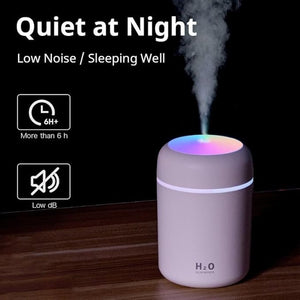
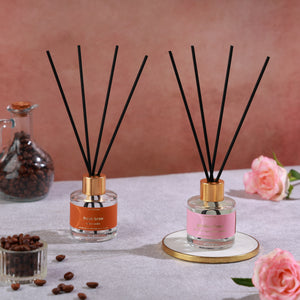
Reeds · always-on roomsFrom ₹749Shop →  Sukoon · when you want a switch₹1,899Shop →
  Hotel Collection · the scentFrom ₹299Shop →
The AC bedroom routine, in order
First, deal with the machine, because it may be the actual source. Take the front panel off and wash the mesh filters in warm water — monthly through the season, more often if anyone in the house has allergies or the flat is on a dusty road. Dry them completely before refitting; a damp filter is worse than a dirty one. Check where the condensate drain discharges and that it actually drips while the unit runs. And switch to fan-only mode for the last ten or fifteen minutes before you turn the AC off, so the coil dries out rather than sitting wet all day. If the smell survives all of that, book a proper coil clean; that is a service job, not a household one.
Second, put a real air change at each end of the night. Before you switch the unit on, open two openings on different sides of the flat with the bedroom door open, and give it ten minutes — you are starting the night with replaced air rather than the day's accumulation. On waking, throw the bed covers right back, open the window and the bedroom door, and give it another ten before you make the bed. That takes the room from roughly 0.2–0.5 air changes an hour to 3–8 twice a day, which is the only thing in this article that genuinely removes anything.
Third, reduce what the sealed room contains, then add the layer. Bedding weekly, pillow protectors weekly, mattress vacuumed and sunned when the weather allows, worn clothes out of the bedroom, wardrobe doors opened during the morning airing, attached bathroom door kept closed at night and its drain given a mug of water weekly. Only then does fragrance make sense — and in an air-conditioned room it behaves differently, which is worth knowing before you buy. Reed diffusers work by capillary wicking, and evaporation rises with heat and airflow; a cooled room slows it, so the same reed diffuser from ₹749 throws more softly and lasts longer here than it would in a hot living room. Use four reeds for a quiet background and add reeds rather than a second bottle if you want more. If you would rather have scent only in the hour before bed, the Sukoon at ₹1,899 with a Hotel Collection scent from ₹299 switches off completely. Neither removes an odour.
What to do, in order
In an AC bedroom the first step is unusual: the appliance itself is a candidate source, so it gets checked before the room does. After that the order is the same as everywhere else.
| Step | What to do | When | Cost |
|---|---|---|---|
| 1. Remove the source | Wash the AC filters monthly, dry them fully, run fan-only before switching off, check the condensate drain | Before anything else | ₹0 |
| 2. Move the air | Ten minutes of cross-ventilation before you switch the AC on and ten more on waking, bedroom door open | Daily, five to ten minutes | ₹0 |
| 3. Deal with what holds it | Bedding weekly, mattress vacuumed and sunned, worn clothes out of the room, wardrobe aired during the purge | Weekly to monthly | ₹0 |
| 4. Then the always-on layer ★ | A SOSA reed diffuser — a soft background that lasts longer in cooled air — use four reeds rather than six | 50ml 6-8 weeks · 130ml 14-18 | from ₹749 |
| 5. Or the on-demand layer | Sukoon with a Hotel Collection scent — an hour of scent before bed and nothing overnight; covers roughly 270–320 sq ft | Run it when you want it | ₹1,899 |
Versailles
The sentence I repeat most often in this cluster is that an air conditioner cools, it does not ventilate. It sounds obvious written down and it is genuinely not obvious in use, because the room feels transformed the moment you switch it on. Cool air reads as fresh air to the body. It is the same air, and after eight hours it is very much the same air.
The filter is the other thing I would put money on. I have lost count of the number of people who described a musty AC bedroom, took the panel off for the first time in two years, and did not need to read the rest of my reply. Wash them monthly in season, dry them properly, and give the coil ten minutes of fan-only before you switch off at night. That last habit is free and almost nobody does it.
If you do buy fragrance for an air-conditioned bedroom, buy knowing it will behave differently. Reeds evaporate more slowly in cooled air, so the throw is softer and the bottle lasts longer — that is usually a good trade in a bedroom, where I think restraint is nearly always right. Four reeds, placed across the room rather than by your head. And if there is staining on the wall near the unit, stop and get that looked at instead; fragrance has no business anywhere near a damp problem. A portion of every order funds a girl's classroom through Nanhi Kali.
Frequently asked questions
- Why does my bedroom smell stale every morning? — eight hours of occupancy.
- Windows open and it still smells closed — why one opening is not ventilation.
- Can a dirty AC filter make a clean bedroom smell bad? — the machine as the source.
- How do I find the source of a stale smell? — the room-by-room method.
- Brand: the SOSA founder story.
SOSA products & prices (verified August 2026): Hotel Collection water-based ultrasonic diffuser fragrance 15ml ₹299 · 100ml ₹999 · 300ml ₹1,799 · Pack of 7 (15ml, all fragrances) ₹1,799; refills 100ml from ₹999. Seven scents: The Ritz-Carlton-inspired (white tea · bergamot · cedar), Westin-inspired (white tea · aloe · cedar), 1 Hotels-inspired (cedarwood · vetiver · green leaves), The St. Regis-inspired (amber · violet · woods), Shangri-La-inspired (jasmine · green tea · white tea), Four Seasons-inspired (citrus · floral · sandalwood), W Hotels-inspired (citrus · pepper · amber). Diffusers: Boond 300ml ₹899 · Sukoon 500ml ₹1,899 · Megh 6L ₹3,499. Water-based, phthalate-free, composed to IFRA standards for home diffusion; 3–6 drops per tank. Made in India, Pune. The Hotel Collection scents are SOSA's own interpretations inspired by the world's finest hotels; all hotel names are trademarks of their respective owners and are used only to describe the scent style — SOSA is an independent Indian fragrance house, not affiliated with or endorsed by any hotel brand. Prices and availability subject to change — see the live product pages.