

2. Several reed sets in one large zone make several small pockets, not one field. Each set does its own local job well; none of them reaches far enough to meet its neighbour, so the space between two reed vessels in a large room stays functionally unscented no matter how many sets are added.
3. Adding more reeds usually just adds more pockets, not more coverage. A large café owner who notices a gap and responds by placing a fourth or fifth reed set is solving the wrong problem — the gap is what passive, local diffusion always produces at that scale, and another local source doesn't change that.
4. The running cost also stops making sense well before the coverage problem is fixed. Five or six reed sets at ₹749–₹1,349 each, replaced every 6–18 weeks, adds up to an ongoing cost that can approach a single Vaayu's price while still leaving an uneven result.
5. One correctly sized active source solves the actual mechanism. A machine that moves air produces one coordinated field across the zone's real volume, which is the coverage a large space was always going to need — reeds were never going to get there by being multiplied.
Reed diffusers are the right tool for a small, bounded room. Multiplying them across a large zone doesn't scale that tool up — it just repeats its limits several times over.
Why several reeds don't add up to one field
It helps to be precise about what a reed diffuser actually does, mechanically, because the instinct to add more of them comes from picturing it as something it isn't. A reed diffuser has no fan, no moving air and no distribution mechanism of its own. Fragrance oil wicks up the reeds and evaporates from their exposed surface at a slow, steady rate, and that evaporated fragrance then has to travel through the room on whatever air movement already exists — usually very little, since most cafés don't run enough ambient airflow to carry a scent far from its source.
That's precisely why reeds work well within their intended range and stop working past it. Within a metre or two, and within a room under roughly 150 sq ft, the fragrance released is enough relative to the air volume to be noticeable throughout. Once the zone is larger, or is really a long entrance corridor or a wide retail floor, the same amount of fragrance is diluted across far more air, and the effect collapses to a small radius around the vessel itself — which is exactly the pocket a large café owner notices and tries to patch with another reed set.
Adding a second, third or fourth set doesn't change the physics of any one of them. Each new set builds its own separate pocket, at its own separate location, still with no mechanism connecting it to the others. Walk the length of a large entrance with five reed sets placed along it and what's actually there is five short bursts of fragrance and four longer stretches of nothing — a pattern a visitor reads as inconsistent and patchy, not as one considered scent decision, however many reeds were bought to produce it.
The three things that go wrong with multiple reeds
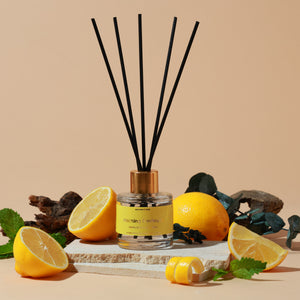
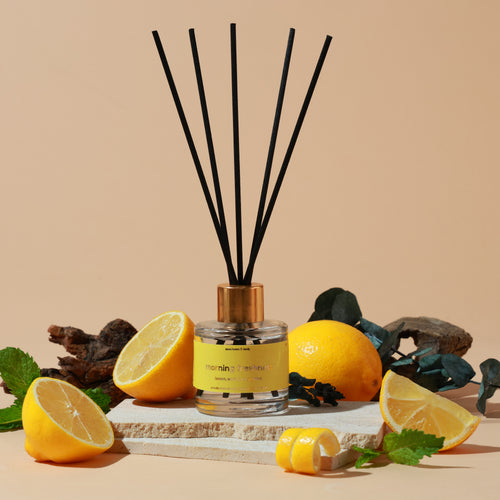
 Morning Freshness₹749A visitor moving through the zone passes in and out of fragrance rather than experiencing one continuous impression, which reads as inconsistent rather than considered.
Reed count vs zone size, honestly
This table isn't about whether reeds work — they do, within their range. It's about what happens once a zone outgrows that range and more reeds are added instead of a different tool.
| Zone size | Reed sets typically used | What actually happens | Better route |
| Under 150 sq ft, one bounded room | One reed set | Even coverage across the whole room — this is the reed's intended range | Correct as is |
| 150–300 sq ft, still one bounded room | One 130ml reed set | Still workable, provided the room is genuinely one enclosed space | Correct as is |
| 800–1,500 sq ft entrance or retail floor | Three to four reed sets scattered around the room | Several small pockets near each vessel, flat unscented air between them | One correctly sized Vaayu |
| 2,000–3,000 sq ft entrance and retail combined | Five to six reed sets, often replaced on staggered schedules | A patchy, inconsistent impression that reads as under-maintained even when it isn't | One Vaayu, wall or HVAC mounted |
| Any zone where a visitor can identify exactly where each reed vessel sits by the fragrance nearby | As many as have been added so far | The room is being scented in spots, not as a whole — more reeds confirm the pattern rather than fix it | Replace the reed sets with one sized active source |
| The dining floor, coffee counter or any tasting area, regardless of size, never carries reed diffusers or any other fragrance — that boundary doesn't move as the café gets larger. | |||
Morning Freshness · one small room₹749Shop →  Sukoon · a washroom suite₹1,899Shop →
  Vaayu · a large entrance or retail floor₹11,999Shop →
What actually solves it
Never treat a faint or patchy corner in a large zone as a sign that another reed set is needed there — it's usually a sign the zone has already outgrown what reeds, in any number, can do.
Sometimes a genuinely large zone can be sensibly split into two smaller sub-zones, each served by its own correctly sized source, rather than treated as one enormous space needing a single oversized machine.
Usually, one Vaayu, sized to the zone's real square footage and mounted where its output can actually move through the room, replaces what several scattered reed sets were being asked to do, at a lower combined running cost over time.
The costed comparison
What multiplying reeds actually costs, set against the single active source that solves the same zone properly.
| Route | Premises | Why | What it costs |
| One reed set | A single bounded room under 150 sq ft | Exactly the range reed diffusion is built for | ₹749–₹849 |
| Three to four reed sets scattered across a large zone | 800–1,500 sq ft entrance or retail floor | The common but mistaken response to a large zone — several pockets, not one field | ₹2,247–₹5,396, replaced every 6–18 weeks |
| Five to six reed sets scattered across a large zone | 2,000–3,000 sq ft entrance and retail combined | A running cost that competes with a single Vaayu while still leaving the room patchy | ₹3,745–₹8,094, replaced every 6–18 weeks |
| One Vaayu, sized to the zone | The same 2,000–3,000 sq ft entrance or retail floor | One coordinated field across the zone's actual volume, with a 400ml tank lasting about 90+ days | ₹11,999 |
| Two Vaayu units | A large entrance and a separate retail section, each zoned independently | The complete non-dining hardware plan for most large cafés at this size | ₹23,998 |
I've walked into more than a few large cafés where someone has clearly tried hard with reed diffusers — six or seven vessels placed thoughtfully along an entrance, refilled on schedule, in a considered fragrance — and the entrance still smells uneven, because the number of reeds was never the variable that mattered. The mechanism was always going to produce that result at that scale, however carefully it was executed.
What I say to an owner in that position isn't that the reeds were a bad idea — they weren't, for the room they'd have been right for. It's that a large open zone needs a fundamentally different kind of source, one that moves air rather than waiting for it to move on its own, and that no amount of careful reed placement substitutes for that difference.
The owners who make this switch usually tell me the same thing afterwards: the zone doesn't smell stronger, it smells more even. That's the actual change one correctly sized machine makes over several scattered reed sets — not more fragrance, just one field instead of several disconnected pockets.
Questions about reeds at large-café scale
- Should a Large Café Scent Its Entrance, Retail Section and Washrooms but Leave Dining Neutral? — the complete plan this page's mechanism is protecting.
- How Do Central AC and Kitchen Exhaust Affect Fragrance Distribution in a Café? — the other mechanical picture that decides whether a zone stays even.
- When Does a Café Actually Need Commercial Waterless Scenting? — the threshold this page's zones are already past.
- When Does SOSA Vaayu Make Sense for a Café — and When Is It the Wrong Product? — the honest both-sides case for the machine named here.
- Brand: the SOSA founder story.
SOSA products & prices (verified September 2026): Reed diffusers 50ml ₹749–₹849 (to 150 sq ft, 6–8 weeks at six reeds) · 130ml ₹1,249–₹1,349 (above 150 sq ft, 14–18 weeks) · reed refill 300ml ₹2,399. Ultrasonic: Boond ₹899 (~150 sq ft) · Sukoon ₹1,899 (270–320 sq ft, ships with three 15ml Hotel Collection fragrances) · Megh ₹3,499 (6L tank, ~100 hrs runtime, ~215 sq ft — a runtime machine, not a coverage upgrade). Waterless cold-air: Safar ₹3,999 (no published coverage figure) · Vaayu ₹11,999 (up to 1000 m³, roughly 2,000–3,000 sq ft; 400ml tank lasting about 90+ days; app and onboard control, 1h/4h/8h/24h run windows, adjustable intensity, key-lock, under 38 dB, freestanding or wall/HVAC mount, 5W, CE/RoHS/SGS) · Aangan ₹25,999 (8,000–10,000 sq ft). Hotel Collection water-based fragrance 15ml ₹299 · 100ml ₹999 · 300ml ₹1,799 is for ultrasonic machines; reed oil and Hotel Collection are not interchangeable. Reed diffusers are alcohol-free, phthalate-free, paraben-free, IFRA-compliant and low VOC, handmade in small batches in Pune. Every purchase funds a girl's education through Nanhi Kali. Prices and availability subject to change — see the live product pages.