
2. The bergamot and cardamom opening is only the first part of the case. It's genuinely bright and cool, but it's the least interesting evidence for airiness — plenty of fragrances open bright and still turn heavy later.
3. The real evidence is the jasmine sambac heart. It's a lighter, greener jasmine than the heavy white florals — tuberose, jasmine grandiflorum — that can make a fragrance feel dense and opaque. Jasmine sambac keeps the middle of Adaa as transparent as the opening.
4. The white musk finish is what keeps it airy at the end, too. Where a heavier attar settles into sandalwood or oudh — both rich, warm, present notes — Adaa settles into a quiet musk that sits close to skin rather than filling a room.
5. Crisp and airy is a whole-composition trait here, not just an opening. Try it at 3 ml (₹379) and pay particular attention to how it feels three hours in, not just in the first ten minutes.
Airiness that only lasts through the top note isn't really airiness — Adaa is built to hold that quality all the way to the drydown.
What makes a fragrance actually read as airy
Airiness is usually described as a top-note property — a bright citrus, a sparkling green accord, something that lifts on first contact. That's part of it, but it's not the whole story, and it's not even the hardest part to get right. Plenty of fragrances open crisp and then settle into something dense and full an hour later, at which point the earlier lightness reads more like a trick than a genuine character. A fragrance that's actually airy has to stay that way through its heart and its base, not just its first ten minutes — and that's a much harder thing for a composition to sustain than a bright opening on its own.
This is where most heavy florals struggle, and it's exactly what jasmine sambac avoids in Adaa. Full white florals — tuberose, jasmine grandiflorum, the kind that dominate a room — are rich and indolic, and they tend to turn a composition opaque the moment they arrive, however bright the opening was. Jasmine sambac is a different variety entirely: lighter, greener, closer to a citrus-adjacent floral than a heavy one. It lets Adaa move from its bergamot opening into a floral heart without the composition thickening at that transition, which is usually where airiness is lost — a lot of otherwise promising fresh fragrances make exactly this mistake by reaching for a heavier jasmine once the citrus has faded.
The last stretch is the base, and it's the stretch people account for least when judging "airy." Sandalwood and oudh are both rich, present notes — beautiful in their own right, but neither is transparent, and both fill the space around a wearer rather than staying close to it. Adaa finishes on a clean white musk instead, which keeps the composition light and close to skin at exactly the stage where most fragrances, attar or otherwise, finally settle into something dense. Transparency held for three stages, not one, is the actual definition of airy this comparison is arguing for, and it's the standard almost nobody applies when they first form an opinion of a fragrance from its opening alone.
Three things that decide how airy a scent stays
 Adaa₹379If it's the opening, almost any bright citrus will satisfy you. If it's the hours-later feeling, the heart and base matter more than the top note — and that's where Adaa's case is actually strongest.
Adaa's transparency, stage by stage
Tracking airiness through the whole arc of the composition, not just the opening, is the honest way to judge the claim — a fragrance can pass the first test and still fail the later ones.
| Stage | Note | Character | Does it stay airy? |
| Top | Bergamot, green cardamom | Bright, cool, citrus-led | Yes — the easiest stage for any fresh fragrance to get right |
| Early heart | Jasmine sambac beginning to show | Light, greener floral, not heavy or indolic | Yes — this is the stage where many other florals would turn dense |
| Full heart | Jasmine sambac at its clearest | Transparent floral warmth, not a heavy white floral | Yes — this is the strongest evidence in the whole composition |
| Early base | White musk beginning to take over | Clean, quiet, close to skin | Yes — no sandalwood or oudh richness arriving to thicken it |
| Full drydown | White musk alone | Soft, close, low presence | Yes — the composition ends as transparently as it began |
| For comparison: Ameeri's arc | Rose, sandalwood, saffron, soft oudh | Warm, rounded, building in richness | No — and it was never composed to |
Adaa · 3 ml — test the whole arc, not just the top₹379Shop → Adaa · 6 ml — once the drydown has confirmed it stays airy₹669Shop → Adaa · 12 ml — for daily wear, confirmed₹1,149Shop →
Wearing Adaa so the airiness actually reads
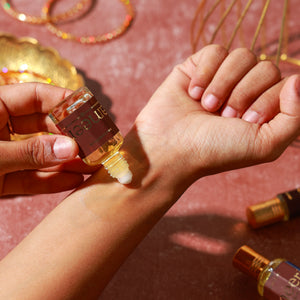
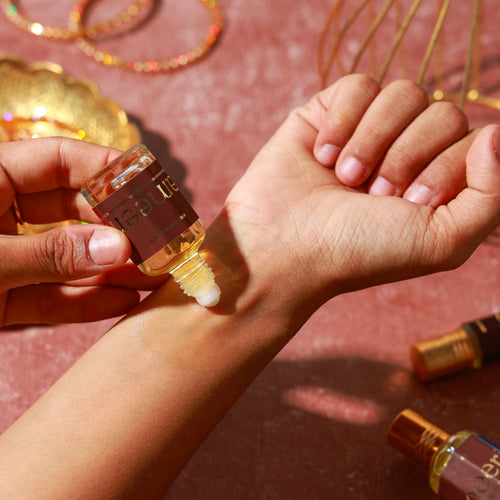
Apply sparingly. Airiness is partly a question of density on skin, and a heavier hand with any oil-based fragrance, however light its notes, will read as more present than intended. A small amount at the wrist or the neck lets Adaa's transparency come through the way it's meant to, rather than being crowded out by too much oil sitting on the same small area of skin.
Pay deliberate attention to the drydown, not just the opening. Because oil unfolds more slowly than a spray, the jasmine sambac heart and the white musk base take longer to arrive than they would in an alcohol-based perfume — the real test of "airy" here happens an hour or more in, not in the first five minutes. Checking in at that later point is the single most useful habit for judging this particular claim fairly.
Wear it on a day with nothing else competing for attention, at least the first time. A clean, crisp, airy fragrance is easiest to judge fairly against the standard of your own skin, without another product, fabric fragrance or environment muddying the impression. A freshly laundered shirt or a strongly scented moisturiser worn the same day can make it harder to tell what's actually coming from the attar itself.
What to buy for a clean, crisp taste
Matched to whether you're testing the whole arc or specifically the drydown you're most curious about, since that's usually the stage a clean, crisp taste cares about most and notices least in a first impression.
| Route | Best for | Why | What it costs |
| Adaa, 3 ml | Testing whether the whole composition, not just the opening, stays airy | Enough to wear it long enough to reach and judge the full drydown | ₹379 |
| Adaa, 6 ml | Confirmed the drydown stays as transparent as the top | Same formula, sized for regular wear once the whole arc has convinced you | ₹669 |
| Adaa, 12 ml | A confirmed daily clean, crisp attar | The honest size once it's not a test anymore | ₹1,149 |
| Ameeri, 3 ml (for contrast) | Curious how a rounder, warmer register compares | Useful mainly as the opposite reference point to Adaa's transparency | ₹385 |
| Do nothing yet | Still associating "airy" purely with a citrus top note | Worth reading the stage-by-stage comparison above first — the drydown is where this claim is actually tested | No purchase |
When people describe a fragrance as clean, crisp and airy, they're almost always describing an opening — and almost never noticing that the quality they're actually praising has to survive the heart and the base to mean anything. I built Adaa against that fuller standard, not just the easier one, because a fragrance that only holds up for its first ten minutes isn't one I'd want to put my name on.
The hardest decision in the whole composition was the floral stage. I could have skipped a floral heart entirely and kept Adaa airy by default — cutting straight from citrus to musk — but that would have left the fragrance feeling thin rather than genuinely transparent. Jasmine sambac was the note that let me add real warmth in the middle without giving up the lightness I'd built at the top; it's a variety chosen specifically for how little it weighs the composition down, and I tested it against several heavier white florals before settling on it for exactly that reason.
The base was, in some ways, the easier decision, but it mattered just as much. Sandalwood and oudh are gorgeous notes, and I use both elsewhere in the range deliberately — but neither is transparent, and putting either under Adaa's opening would have undone everything the citrus and the jasmine sambac had done. A clean white musk was the only base that kept the promise the rest of the composition made, and it's the note I'd ask a sceptical reader to wear all the way to, rather than stopping their judgement at the opening.
Questions about clean, crisp and airy attar
- I Love Fresh Perfumes — Which Attar Should I Try First? — the full entry-level case for Adaa, from every angle.
- I Like Fresh Perfumes but Don't Want My Attar to Smell Like Aftershave — What Should I Choose? — why the same jasmine sambac heart also avoids a sharper, soapier register.
- I Usually Wear Fresh Citrus Perfumes — Which Perfume Oil Would Suit Me? — how the opening this post treats briefly actually behaves in oil.
- I Love Bergamot in Perfume — Which Type of Attar Should I Explore? — a closer look at the single note that opens this composition.
- Brand: the SOSA founder story.
SOSA attars & prices (verified September 2026): All four are alcohol-free roll-on attars in 3 ml, 6 ml and 12 ml. Adaa (bergamot, green cardamom, jasmine sambac, white musk) ₹379 · ₹669 · ₹1,149. Ameeri (Taif rose, Indian sandalwood, Persian saffron, soft oudh) ₹385 · ₹679 · ₹1,165. Mastani (night-blooming jasmine, Damask rose, oudh) ₹389 · ₹685 · ₹1,179. Nawaab (white royal oud, Mysore sandalwood, Kashmir saffron) ₹399 · ₹699 · ₹1,199. The Ameeri + Nawaab + Mastani trio is ₹1,055 · ₹1,859 · ₹3,189. Prices are the live store prices at the time of writing.