
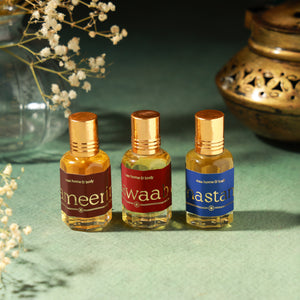
- The direct answer
- Why oil and alcohol carry bergamot differently
- Three things a citrus wearer should decide before buying
- What actually changes, stage by stage
- How to wear Adaa so the citrus reads at its best
- What to buy, and what not to expect
- A note from Sonal
- Questions citrus-perfume wearers ask about attar
2. But the opening will not be the same. A spray gives citrus in a fast, fizzy burst because alcohol evaporates quickly, throwing the lightest, most volatile molecules into the air first. Oil doesn't evaporate the same way — the bergamot in Adaa is present but never explosive.
3. What you get instead is citrus that reads softer but stays present longer. Where a spray's citrus note can fade within the first twenty minutes as the alcohol carrying it evaporates, an oil-suspended bergamot releases slowly across the whole wear, so the citrus impression lingers rather than flashing and vanishing.
4. The cardamom is doing more work here than it would in a spray cologne. Because there's no sharp alcohol lift, green cardamom sits right alongside the bergamot from the first minute, giving the opening a cool, herbal edge instead of the more aldehydic freshness a spray citrus often leans on.
5. Try it at 3 ml before deciding the difference bothers you. Some citrus wearers find the softer, longer read is actually closer to what they wanted all along; others miss the burst specifically. ₹379 is a cheap way to find out which you are.
The note is honestly the same. The way it's delivered is not — and that difference, not the ingredient list, is what actually decides whether Adaa suits a citrus wearer.
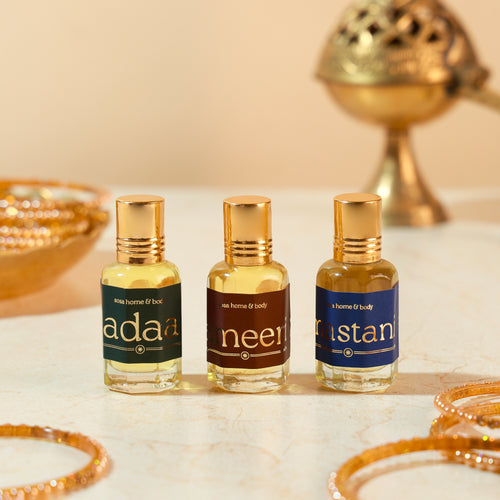
Why oil and alcohol carry bergamot differently
Bergamot is one of the most volatile materials in perfumery — it evaporates fast, which is exactly why it works so well as a spray's opening note. Alcohol itself evaporates quickly too, and the two effects stack: the moment a citrus cologne leaves the bottle, the alcohol flashes off and throws the bergamot into the air with it, giving that immediate, fizzy lift a citrus wearer recognises instantly. It's a genuine, well-engineered effect, and it's specific to the alcohol format — remove the alcohol and the effect doesn't simply weaken, it stops happening at all, because there's no fast-evaporating carrier left to throw the bergamot upward.
Oil doesn't evaporate that way. Suspended in a carrier oil rather than alcohol, bergamot in Adaa has nothing to flash off with — there's no fast-evaporating solvent dragging it into the air on contact. Instead it releases gradually as the oil itself warms against skin, which means the citrus reads present but restrained on application, never explosive, and keeps releasing over hours rather than concentrating its whole impression into the first few minutes. The molecule is identical; only the mechanism carrying it to your nose has changed, and that mechanism is the entire difference between a spray and an attar.
This is precisely the trade worth stating honestly, rather than glossing over: the citrus in Adaa is real, not a substitute or a watered-down version, but it behaves on a different timeline. A citrus wearer judging Adaa by its first ten seconds against a spray's first ten seconds will reasonably conclude the attar is weaker. Judged across a full day of wear, the comparison usually reverses — the oil's bergamot is often still perceptible when a spray's has long since faded, simply because it was never released all at once in the first place.
Three things a citrus wearer should decide before buying
 Adaa₹379If what you love is specifically that first fizzy lift on application, no attar will replicate it — that effect belongs to alcohol. If what you love is the bergamot itself, the cool, slightly bitter citrus character, Adaa carries that faithfully, just on a slower release.
What actually changes, stage by stage
The honest comparison isn't spray versus attar in general — it's what happens to the same bergamot note at each stage of wear.
| Stage | Spray citrus cologne | Adaa (oil-based) | What changes |
| First application | Fast, fizzy lift — the alcohol evaporates instantly and carries the bergamot with it | Present but restrained; the oil hasn't begun to warm against skin yet | No burst — this is the biggest single difference |
| First 20 minutes | Citrus often at its peak, then already starting to fade | Bergamot and green cardamom settling in together, still building rather than fading | Adaa is quieter here but not weaker over the full arc |
| 1–2 hours | Citrus largely gone, base notes taking over | Bergamot still perceptible, easing toward the jasmine sambac heart | The oil's citrus has more staying power at this stage |
| Several hours | Citrus note typically no longer detectable up close | A softer bergamot echo can still be present alongside the white musk | This is where Adaa's slower release tends to outlast the spray's |
| Overall impression | Sharp, bright, then gone | Softer throughout, present longer, closer to the skin | Neither is "better" — they're built for different expectations |
Adaa · 3 ml — try the softer citrus first₹379Shop → Adaa · 6 ml — once you've confirmed you don't miss the burst₹669Shop → Adaa · 12 ml — for daily wear once it's a known quantity₹1,149Shop →
How to wear Adaa so the citrus reads at its best
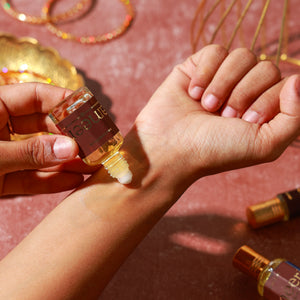
Apply to warm skin — the inner wrist, the side of the neck — rather than clothing. Oil releases its lightest notes, bergamot included, as it warms against body heat, so the citrus reads more clearly from skin than it would from fabric, which stays cooler and holds the oil's heavier notes back instead. A wrist you can bring close to your nose without thinking about it is usually the easiest spot to actually notice the citrus doing its work.
Don't judge the citrus in the first minute. Give it ten to fifteen minutes before deciding what you're smelling, because the bergamot is still settling in alongside the cardamom during that window — checking immediately after application is the single most common reason a citrus wearer concludes an attar has "no citrus" when it simply hasn't opened yet. That early window is the one stage where a spray still has the clear advantage, and it's worth expecting that honestly rather than being caught off guard by it.
Reapply through the day rather than expecting one application to carry it the way a heavier spray might. A small roll-on at 3 ml or 6 ml is priced and sized for exactly this habit — a touch-up at lunch reads closer to how most citrus wearers already treat a spray bottle kept at a desk, and it keeps the bergamot from ever fully fading into the background across a long day.
What to buy, and what not to expect
Sized to how confident you already are that a slower, softer citrus will actually suit the way you wear fragrance.
| Route | Best for | Why | What it costs |
| Adaa, 3 ml | Testing whether the softer, slower citrus works for you | Low commitment, enough for two to three weeks of real wear | ₹379 |
| Adaa, 6 ml | Confirmed the trade suits you; want it to last longer | Same formula, sized for regular reapplication over months | ₹669 |
| Adaa, 12 ml | A citrus attar as a genuine daily habit | The honest size once it's not a test anymore | ₹1,149 |
| Ameeri, 3 ml | Your citrus cologne sits on a warm, ambery base rather than a clean one | Rose, sandalwood, saffron and soft oudh — closer to that specific drydown | ₹385 |
| Do nothing yet | The burst itself is the whole reason you wear citrus | No format built on oil will replicate a fast alcohol evaporation — that's worth knowing before you spend anything | No purchase |
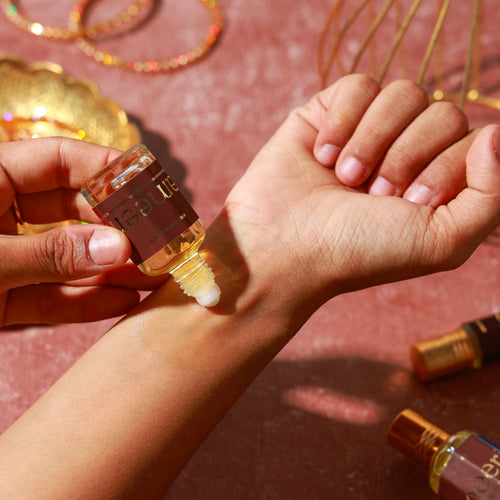
Citrus wearers ask me some version of the same question more than anyone else: "will it still smell like citrus?" I understand why — bergamot is one of the most recognisable notes in perfumery, and people who wear it every day know exactly what they expect from it. My honest answer is always the same: yes, it's real bergamot, and no, it will not hit you the way a spray does in the first ten seconds. I'd rather say that upfront than have someone discover it for themselves and feel misled.
I composed Adaa knowing that trade was coming. That's part of why I paired the bergamot with green cardamom rather than leaning on citrus alone — cardamom gives the opening a cool, herbal presence that doesn't depend on fast evaporation to register, so the first impression still reads fresh even without the fizz a spray gives. It was a deliberate compensation for the format, not an accident, and it took several rounds of testing on actual skin, not just paper strips, before the balance between the two notes felt right.
What actually surprises citrus wearers who try Adaa, more often than the softer opening, is how long the bergamot stays perceptible. A spray's citrus is usually the first thing to disappear; an oil's citrus is often one of the last things you can still catch, hours in, close to the skin. I'd rather say that plainly than let someone expect a burst that was never going to arrive. Once a citrus wearer stops measuring Adaa against the first ten seconds of a spray, the comparison tends to become a lot more generous.
Questions citrus-perfume wearers ask about attar
- I Love Fresh Perfumes — Which Attar Should I Try First? — the full entry-level case for Adaa, beyond just the citrus question.
- I Love Bergamot in Perfume — Which Type of Attar Should I Explore? — a closer look at bergamot itself, and its place in Adaa's structure.
- Which Attar Should I Try If I Like Clean, Crisp and Airy Perfumes? — the same attar, reached through its drydown instead of its citrus.
- I Like Fresh Perfumes but Don't Want My Attar to Smell Like Aftershave — What Should I Choose? — why Adaa's cardamom and jasmine sambac avoid a sharper, soapier register.
- Brand: the SOSA founder story.
SOSA attars & prices (verified September 2026): All four are alcohol-free roll-on attars in 3 ml, 6 ml and 12 ml. Adaa (bergamot, green cardamom, jasmine sambac, white musk) ₹379 · ₹669 · ₹1,149. Ameeri (Taif rose, Indian sandalwood, Persian saffron, soft oudh) ₹385 · ₹679 · ₹1,165. Mastani (night-blooming jasmine, Damask rose, oudh) ₹389 · ₹685 · ₹1,179. Nawaab (white royal oud, Mysore sandalwood, Kashmir saffron) ₹399 · ₹699 · ₹1,199. The Ameeri + Nawaab + Mastani trio is ₹1,055 · ₹1,859 · ₹3,189. Prices are the live store prices at the time of writing.