



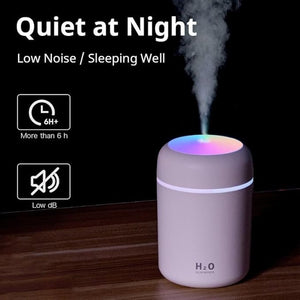
For an 8 PM dinner: on at 6:30, off by itself at 8:30 — which is around when food lands.
Why not twenty minutes: the Sukoon does reach a steady level in about twenty minutes from cold. The other seventy are for the room to settle and, more honestly, so that you are not fiddling with a machine at five to eight.
The setting that saves money: low gives 16–18 hours per fill at 30–50 ml/h against 9–12 on high. Low is not merely gentler, it is cheaper per evening — and it is also the better result.
2. Then the machine on at 6:30 to 6:45 — ninety minutes before arrival. Low setting, four drops of Hotel Collection, 2H timer. Fill the tank with plain water to the line, add the drops to the water, close it, press the timer twice.
3. It reaches a steady level by about seven and holds it. The Sukoon takes roughly twenty minutes from cold to put a proper level into a normal room. The remaining hour is the room settling and you being free, which are both real and neither of which is about the machine.
4. At 8:15 it stops on its own. Two hours from 6:15 to 8:15, or 6:45 to 8:45 if your guests are the sort who arrive at half past. Either way the mist ends around the time the food does, which is the point of choosing 2H over 4H or steady.
5. At about 9:30, change the bottle if you want a second act. Rinse the tank, three drops of something heavier, 2H timer again. Optional, and very good.
6. Use the low setting throughout. 16–18 hours per fill at 30–50 ml/h against 9–12 hours on high, so low is not only the better result in a room with food in it, it costs you meaningfully less fragrance and water per evening.
A portion of every order supports girl-child education through Nanhi Kali.

Why ninety minutes and not twenty
The specification says twenty minutes and the specification is accurate. A Sukoon started cold in a normal Indian sitting room will have put a legible, steady level of fragrance into the air in about twenty minutes, and it will not get meaningfully stronger after that unless you add drops or turn it up. So the obvious question is why I am telling you to switch it on ninety minutes before people arrive rather than at half past seven, and the answer has two halves. One of them is about the room and is slightly technical. The other is about you and is the more important of the two, which is not the sort of thing a product page will usually tell you.
The full clock for an eight o'clock dinner
This is the timetable I would actually run, minute by minute, in a normal Indian flat with a kitchen that opens onto or beside the living room. Adjust the whole thing by however much your guests habitually deviate from the time you gave them. The only two rows that are genuinely fixed relative to each other are the ventilation and the machine: air first, always, and never the other way round.
| Time | What you do | Why then |
|---|---|---|
| 6:30–6:45 PM ★ | Sukoon on. Low setting, four drops, 2H timer | Ninety minutes before arrival. Twenty of those minutes get it to a steady level; the rest let the room even out and leave you free at eight |
| Until about 6:20 PM | Finish the cooking with the extractor running, and leave it running ten minutes after the hob goes off | Extraction removes the smell at source. Ten minutes after is not optional — the fat aerosols are still airborne |
| 6:20–6:40 PM | Windows open on two opposite walls, internal doors open, fan on. Twenty minutes of genuine cross-ventilation | This does more for how the flat smells than any product in the range. Fragrance layers onto clean air or it does not work |
| 6:40 PM | Close the windows, shut the kitchen door, wipe the hob and the counter, take the bin out | The kitchen door is the single highest-value thing in this list if you have one. A closed kitchen stops re-supplying the flat |
| 8:00–8:15 PM | Guests arrive. Do nothing to the machine | The room is at its level and has been for an hour. Nothing is climbing, nothing is hissing, nothing announces itself |
| 8:15–8:30 PM | The Sukoon stops on its own. Food comes out | The 2H timer doing the part you would otherwise forget. From here the room holds a trace and the food has the air to itself |
| About 9:30 PM | Optional: rinse the tank, three drops of something heavier, 2H timer again | Eating has finished. A warmer room from here is what makes people stay sitting rather than start looking for their phones |
Low, four drops, and what a fill actually costs
Take the low setting seriously, because it is not the timid option and the specification proves it. The Sukoon runs 16–18 hours per fill on low at an output of 30–50 ml/h, against 9–12 hours on high. That is close to double the running time from the same 500ml of water and the same drops of fragrance. So low is cheaper per evening in the most literal sense, and it is also the better result: a lower output over a longer period produces a more even room than a high output over a short one, for the same reason a slow oven produces a more even roast. On a dinner night you are only using two of those hours, which means a single 500ml fill covers something like eight dinner parties on low against four or five on high. Put next to the ₹299 you spent on the bottle, that is a per-evening fragrance cost most people would struggle to calculate without a decimal point. The drops do not scale with the machine and this is worth repeating because it saves people money. Three to six drops per tank, and per tank means per tank: a 300ml Boond at ₹899 takes the same four drops as the 500ml Sukoon. You are scenting the mist, not the water. Buying a bigger machine buys you hours and floor area, never a stronger smell, and if you want a stronger smell the lever is drops and the answer on a dinner night is usually that you do not want one.
Then the adjustments, because your flat is not the flat I described. If your guests reliably arrive forty minutes after the time you gave them, move everything forty minutes later rather than letting the machine run out before anybody sees the room. If the sitting room is small — under about 150 square feet — drop to three drops and consider starting at seven instead, since a small volume reaches its level faster and holds it more stubbornly. If the space is genuinely large or open-plan, do not raise the dose; raise the machine's tank instead, which is what the Megh at ₹3,499 with its six litres is for, and keep the four drops. If the air conditioning will be on, start earlier rather than dosing higher, because an AC unit recirculating air will flatten a fragrance faster than an open window will remove it. And if you are cooking something genuinely heavy — a biryani, a fish fry, anything deep-fried — push the whole timetable back and give the ventilation thirty minutes rather than twenty. Fragrance over frying is a worse smell than frying, and no timing fixes that. Placement stays constant across all of these: waist height or above, at the edge of the room rather than in a doorway, out of the path of a fan or an AC vent, and away from soft furnishings you cannot wash. Cool mist falls rather than rises, so a machine on the floor is scenting a rug and nothing above knee height.
Then habituation and the constraints. By the second or third dinner you host with the same bottle, you will not be able to smell your own sitting room, and your instinct will be to add drops. Do not. A nose reports change and discards constants, which is why you cannot smell your own home and every visitor can. Your guests are receiving the level you originally set, not the level you can currently detect, and the only reliable instrument is one honest friend asked to be truthful rather than polite before anybody else arrives. Owning two 15ml bottles at ₹598 and alternating them is a better defence against this than any amount of adjusting, because the switch resets your own perception. On the constraints, briefly: the Hotel Collection is water-based and runs in the Sukoon, the Boond and the Megh only, never in a reed diffuser, which is a separate alcohol-free line with its own scents, and never in the waterless Vaayu at ₹11,999. Never put raw essential or carrier oils into an ultrasonic — they clog the 2.4MHz plate and that damage is not reversible. Rinse the tank when you change scent, which matters on a dinner night because you may be running two bottles in one evening. And the principle: the best hosting decisions are the ones you make at half past six, when you still have a clear head, and then never have to think about again.
The SOSA edit
In buying order for somebody whose actual question is about timing rather than scent. The first row is the machine, because everything on this page depends on a timer existing. The last row is the honest note about what you cannot buy your way out of, which is the twenty minutes of open windows.
| Buy | What it is | When it earns its place | Price |
|---|---|---|---|
| 1. Sukoon ★ | 500ml, 270–320 sq ft, steady/2H/4H timers, auto shut-off, 16–18h per fill on low at 30–50 ml/h, three 15ml scents included | First. On at 6:30 for an 8 PM dinner, low, four drops, 2H — and then forgotten about | ₹1,899 |
| 2. Hotel Collection 15ml | Water-based fragrance for ultrasonic machines, three to six drops per tank, none of the seven sweet | Four drops for a normal sitting room, three for a small flat. The Sukoon includes three of these, so most people buy their fourth here | ₹299 |
| 3. 300ml refill | About ₹6 per millilitre against roughly ₹20 at 15ml | Once you know which bottle you actually run. Second purchase, never first — a 15ml lasts weeks at four drops a night | ₹1,799 |
| 4. Boond | A 300ml ultrasonic for a hall, an entrance or a second room, same drops as the Sukoon | When one room is not the whole answer. Cheaper than a second Sukoon and takes the same fragrance | ₹899 |
| 5. Megh | Six litres for a genuinely open-plan or double-height space | Only if the flat has no walls. The honest fix for a large volume is more tank, not more drops | ₹3,499 |
| Free, and it beats all of the above: twenty minutes of cross-ventilation at 6:20 | Two openings on opposite walls, internal doors open, extraction on through the cooking and ten minutes after | Every time. Nothing on this list works properly on air that has not been changed first, and no timing setting substitutes for it | — |

Versailles
The question I get asked most often about hosting is not which scent. It is when. And almost everybody guesses too late, because they are thinking about the machine rather than about themselves. They read that a diffuser works in twenty minutes, they do the arithmetic, and they plan to switch it on at twenty to eight. Then twenty to eight arrives and they are looking for a serving spoon, and the machine goes on at five past eight with the doorbell already going, and the first thing their guests meet is a room in the middle of becoming something.
So I moved my own answer to ninety minutes years ago and I have never moved it back. Half of the reason is that the room settles and the composition rebalances; the other half is that half past six is an hour when I can count four drops without resenting it. And the 2H timer takes care of the end, which is the half nobody plans, because a host at ten past eight is not going to walk across a room and switch off a diffuser. Set at six thirty, it stops at eight thirty, and the food gets the air to itself. That is a good evening arranged with one button, ninety minutes early, by somebody who was not yet under any pressure.
Everything is made and supported from Pune, and a part of every order funds girl-child education through Nanhi Kali. You get a home that smells like somewhere you chose; a girl gets a classroom. That equation has always felt right to me.
Frequently asked questions
- Should my dining room smell fragranced while guests are eating? — why the machine has to stop, argued properly.
- I'm hosting dinner at home — how do I stop the house smelling like cooking when guests arrive? — the ventilation half of this timetable.
- We fry food before guests arrive — how long should we ventilate before using home fragrance? — when twenty minutes is not enough.
- I'm hosting 12 people in a small 2BHK — how do I use home fragrance without making the room feel stuffy? — when the answer is to switch it off entirely.
- Brand: the SOSA founder story.
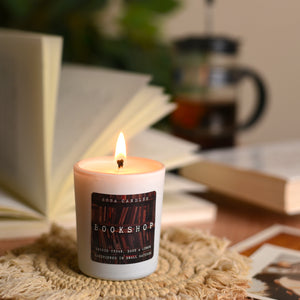
Facts verified August 2026: Timings in this guide: a scented candle puts noticeable fragrance into a normal room in roughly 15–20 minutes; a Sukoon ultrasonic diffuser reaches a steady level in about 20 minutes from cold; a reed diffuser needs roughly 24–72 hours for the oil to travel the reeds and the room to settle, so it is not a same-day solution. SOSA products and prices: Sukoon 500ml ultrasonic diffuser ₹1,899 (270–320 sq ft, 16–18h on low, 9–12h high, 30–50 ml/h, 2.4MHz cool mist, 7-colour LED, remote, steady/2H/4H timers, BPA-free, auto shut-off, includes three 15ml Hotel Collection scents of your choice); Boond 300ml ₹899; Megh 6-litre ₹3,499; waterless Vaayu ₹11,999 (up to 1000m³); Aangan ₹25,999; Meenar ₹38,500. Hotel Collection water-based fragrance 15ml ₹299, 100ml ₹999, 300ml ₹1,799, Pack of 7 at 15ml ₹1,799 / 100ml ₹5,999 / 300ml ₹10,799; dose 3–6 drops per tank. Reed diffusers (separate alcohol-free line): Morning Freshness from ₹749, Garden Bloom and Evening Calm from ₹799, Fresh Brew and Mountain Breeze from ₹849; 130ml from ₹1,249; duos from ₹1,498; 300ml refills ₹2,399. Scented candles: Bookshop 80g ₹379 (~15–18 hours), Bookshop + Cozy Corner ₹664 (~30–36 hours), Amber Rose 130g ₹599 (~25–30 hours) and 220g ₹799 (~40–50 hours), ceramic jar candles ₹949, Pure Calm wax melt set ₹854. Free shipping above ₹499. SOSA does not make a room or linen spray for the home — the sprays in the range are car perfumes. The Hotel Collection scents are SOSA's own interpretations; SOSA is not affiliated with or endorsed by any hotel brand. Prices subject to change — see the live product pages.