



Seconds 2–4: the sightline. A face behind the desk, or a wall of backs in a queue.
Seconds 3–5: the noise floor, and whether someone acknowledges you before you speak.
Seconds 5–8: visible cleanliness — floor edges, seat fabric, the toy box, the glass.
Seconds 8–10: air. Temperature first, movement second, odour third — and odour should be unremarkable rather than fragrant.
2. A sightline that ends in a person, not a queue. In the next two seconds the parent scans for where to go. The best outcome is an unobstructed line from the door to a desk with a face behind it. The worst is a line that ends in the backs of five people, a stack of files or a closed shutter. This is a furniture problem more often than an architecture problem: a desk turned fifteen degrees, a standee moved, a chair row pulled back a foot, and the sightline is repaired without a contractor.
3. A low noise floor and a quick acknowledgement. A paediatric waiting room is never silent and should not be. But there is a large difference between a murmur with one child talking and a hard-surfaced room in which two crying children are amplified off tile and glass. A shrieking waiting room reads as chaos no matter how good the interior is. Alongside it, the desk should acknowledge an arrival within a few seconds even if it cannot serve them — eye contact and a raised finger is enough, and it removes the anxiety of not knowing whether you have been seen.
4. Surfaces that survive a close look. Between roughly five and eight seconds the eye starts checking specifics, and it goes to the same places every time: the edges of the floor where the mop does not reach, the seat fabric at the front edge of the chairs, the toy box, the glass on the door and the counter. Parents in a children’s clinic are unusually attentive to this because their child will be touching all of it. Visible cleanliness is second only to the wait in what signals a well-run clinic.
5. Air that is comfortable, and odour that is unremarkable. Only at the end of the sequence does air register, and it registers as three things in order: temperature, movement, odour. Overcooled and completely still is the commonest failure, because AC cools without ventilating. The target for odour is neutrality — no disinfectant, no bin, no closed-building smell. If you add a fragrance, it should be quiet enough that it never becomes a step in this sequence at all.
Made in India, composed by an ISIPCA Versailles-trained perfumer — and a portion of every order supports girl-child education through Nanhi Kali.
Why the sequence is fixed, and why smell comes last in it
Vision and hearing are fast and directional. A parent walking through a door has a picture of the room and a reading of its noise level before they have taken a full breath. Olfaction is slower, needs a few breath cycles to build a stable impression, and carries almost no directional information — you cannot tell where a smell in a room is coming from without walking around. That is the whole reason the sequence runs the way it does. By the time a parent could describe what the reception smells like, they have already decided whether the place looks and sounds competently run. This is not an argument that smell does not matter; it is an argument about where it sits in the queue, and it sits at the back.
The asymmetry is that smell is weak at building a good impression and disproportionately strong at wrecking one. A pleasant fragrance at the door adds a small increment that most parents will never mention. A smell of phenyl, a nappy bin, drain gas or last week’s closed air is noticed instantly and remembered, and it overrides everything the eye just approved of. That gives a clear instruction for spend: put money and attention into removing bad smells and almost none into adding good ones. A clinic that is odour-neutral at the door has captured nearly the whole available benefit. Going further — into a noticeable signature — buys very little and risks a great deal, because a children’s waiting area is occupied for thirty to sixty minutes by people who cannot leave.
The three things worth getting right in that window
 Entrance onlyFrom ₹749Stand outside your own clinic and walk in carrying something in both hands. Note whether the door needs a shoulder, whether the closer slams it behind you, whether the mat moves, whether there is a lip to trip on with a pram, and where your eye lands when you straighten up. The single highest-yield repair in most paediatric receptions is the door closer and the position of the desk, in that order. Then clear the sightline: standees, cartons, a water dispenser and a stack of chairs are what usually stand between the door and the face behind the counter.
Zone by zone, along the route a parent actually walks
This table follows the parent from the pavement inwards. Note that the scentable part of the journey ends before the first clinical door, and that most of the floor plan is deliberately left alone.
| Area of the clinic | Scented? | Why | What we would use |
|---|---|---|---|
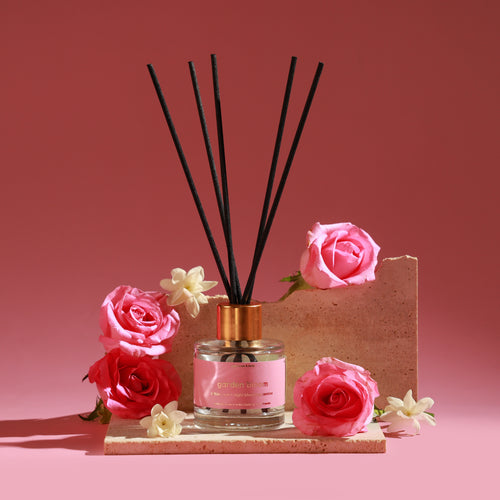
| Doorway and entrance mat ★ | Yes, very low | Fresh noses arriving from outside — the only point in the visit where a signature registers at all | Reed from ₹749, three reeds not six |
| Reception desk and queue | Yes, low | Two to three minutes of standing time; the same source as the doorway, no second unit | Sukoon ₹1,899 in intermittent mode |
| Parent and child waiting seating | Minimum only | Thirty to sixty minutes of exposure for a child who cannot leave — the longest dwell in the building | Nothing separate; whatever reaches it from reception |
| Consultation and examination rooms | No | The parent’s ten seconds are over; this room is a workplace where clinicians use their own senses | Nothing |
| Vaccination, injection and procedure rooms | No | A distinctive scent repeatedly paired with an unpleasant procedure becomes associated with it | Nothing |
| Nebulisation, asthma and neonatal follow-up | Never | Respiratory patients and newborns; no added airborne load, at any intensity, for any reason | Nothing |
| Before any of this: walk the sequence yourself with a fresh nose at nine in the morning and again at five in the evening. If either walk turns up disinfectant, a bin, drain gas or closed air, that is the work — not the table above. | |||
Small reception · no power neededFrom ₹749Shop →  Mid reception · has an off switch₹1,899Shop →
 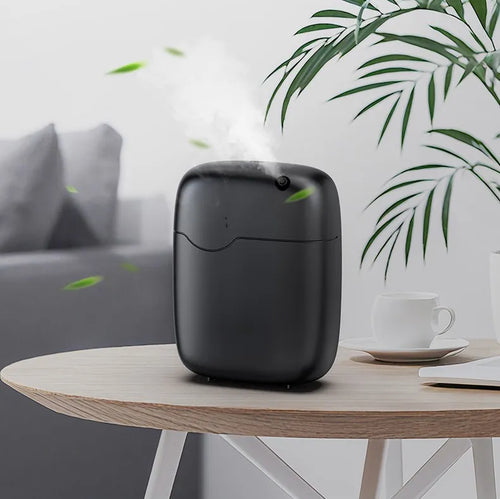 Large lobby · timed, dialable₹11,999Shop →
If you do scent the entrance, what the level should be
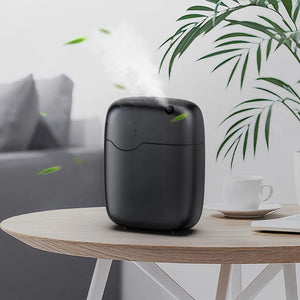
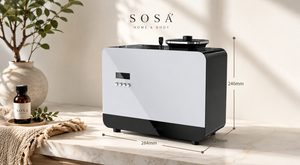
Set it so it never becomes a step in the sequence. The test is whether a parent walking in from the street notices the fragrance as a separate event. If they do, it is too strong — you have inserted a sixth item into a five-item sequence and given them something to evaluate. On a Vaayu, that means the shortest on-time and longest off-time the machine offers, scheduled to clinic hours only. On a Sukoon, three drops rather than six and intermittent rather than continuous. On reeds, three reeds in the bottle and the rest left in the box.
Calibrate from outside, because the sequence is written for someone arriving from outside. Olfactory adaptation is essentially complete in about twenty minutes, so by mid-morning nobody in the building can judge the level — and because they cannot smell it, staff reliably ask for more. That single mechanism is behind most over-scented clinic receptions. Give the calibration to whoever has just walked in from the road, or step out for half an hour and judge your own first breath on return. Repeat it a fortnight later, which is when the level usually creeps.
Keep it out of the child’s breathing zone and keep an off switch within reach of the desk. A child’s breathing zone sits roughly 0.8–1.2 m from the floor against an adult’s 1.5–1.7 m, so a unit standing on a counter doses the child more than the parent beside them. Mount high and aim away from seating. Then be able to switch the thing off in seconds for a family who asks, and say so in a plain line at the desk. Take the whole decision through your own clinical governance, infection-control and housekeeping leads rather than through a fragrance supplier.
What we would actually install
Sized to the entrance and reception, not to the clinic’s ambitions. The last row is on the table because for a clinic that has fixed its door, its sightline, its acoustics and its cleaning, it is frequently the right answer.
| Option | Suits | Control you get | Price |
|---|---|---|---|
| Reed diffuser ★ | A small reception desk — a single-door entrance and a compact desk; nothing to power, nothing for a toddler to reach | Reed count only — no switch, no timer | from ₹749 |
| Sukoon 500ml | A reception up to ~320 sq ft — an entrance plus a reception up to about 320 sq ft; the cheapest option with a genuine off switch | On/off, intermittent mode, you control the drops | ₹1,899 |
| Vaayu | A large lobby or a zoned duct — an entrance hall large enough that a passive diffuser never reaches the door line | Duty cycle in seconds, timer, app scheduling | ₹11,999 |
| Aangan | Whole-facility HVAC — a multi-floor centre with genuinely zoned ducting that can exclude every clinical room | Zone-level control, but only if the ducting is zoned | ₹25,999 |
| Nothing at all | A clinic whose door, sightline, noise floor and cleaning are already right — at that point the first ten seconds are working and fragrance adds very little | Complete — and the correct answer more often than the trade admits | ₹0 |
Versailles
The first time I timed this properly was in a clinic in Pune whose owner had asked me for a signature scent. I stood outside for half an hour and then walked in as a parent would. The door needed a shoulder, the sightline from the door ended in a water dispenser and a stack of chairs, and two children were crying into a tiled ceiling. I never got as far as the smell, and neither did anyone else walking through that door.
We fixed the closer, turned the desk, moved the dispenser and put a soft panel behind the seating. The owner called three weeks later to say parents had started commenting on how much calmer it felt. Nothing had been scented. I have thought about that call a great deal, because it is the clearest illustration I have of where in the sequence our product actually sits.
We did eventually put a reed at that entrance, on three reeds, and it was a good detail — quiet, dry, gone before the waiting area. That is the honest scale of the contribution: a good detail at the end of a sequence, not the sequence. Keep every clinical room out of it, keep an off switch at the desk, and let your infection-control and clinical governance leads make the final call. A portion of every order funds a girl’s classroom through Nanhi Kali.
Frequently asked questions
- What makes parents perceive a clinic as premium? — the ranked list, argued.
- Which sensory details actually matter? — sound, touch, temperature, then smell.
- Improving the first impression without renovating — the cheap, high-yield list.
- Should it smell obviously fragrant on entry? — no — obvious is the failure mode.
- Brand: the SOSA founder story.
SOSA products & prices (verified August 2026): Hotel Collection water-based ultrasonic diffuser fragrance 15ml ₹299 · 100ml ₹999 · 300ml ₹1,799 · Pack of 7 (15ml, all fragrances) ₹1,799; refills 100ml from ₹999. Seven scents: The Ritz-Carlton-inspired (white tea · bergamot · cedar), Westin-inspired (white tea · aloe · cedar), 1 Hotels-inspired (cedarwood · vetiver · green leaves), The St. Regis-inspired (amber · violet · woods), Shangri-La-inspired (jasmine · green tea · white tea), Four Seasons-inspired (citrus · floral · sandalwood), W Hotels-inspired (citrus · pepper · amber). Diffusers: Boond 300ml ₹899 · Sukoon 500ml ₹1,899 · Megh 6L ₹3,499. Water-based, phthalate-free, composed to IFRA standards for home diffusion; 3–6 drops per tank. Made in India, Pune. The Hotel Collection scents are SOSA's own interpretations inspired by the world's finest hotels; all hotel names are trademarks of their respective owners and are used only to describe the scent style — SOSA is an independent Indian fragrance house, not affiliated with or endorsed by any hotel brand. Prices and availability subject to change — see the live product pages.