



2. Sound. The noise floor, the reverberation time, and the television nobody has turned down.
3. Touch. Every surface a hand meets: door handle, counter edge, chair arm, seat fabric, toy, pen, card machine.
4. Temperature. Where the vent points, whether a child under a blanket and a parent in outdoor clothes can both be comfortable.
5. Smell. Fifth, and the only one where the right answer is often nothing.
2. Sound — the floor level, the tail, and the television. A reception finished in tile, glass and laminate holds sound, so one distressed child fills it and two sound like an emergency. Add absorption where it is permitted — a ceiling tile over the seating zone, a panel behind it, heavier curtains at a window — and address the volume competition, which almost always starts with a television turned up to be heard over the room and then heard over by the room. A reception is allowed to have life in it; what it cannot have is a long reverberation tail, because that is what turns life into chaos.
3. Touch — the channel nobody briefs and everybody experiences. Make a list of every surface a parent or child physically contacts in one visit. In most clinics it runs to a dozen: the door handle, the counter edge, a pen, the card machine, the chair arm, the seat fabric, a magazine, a toy, the toilet door and lock, the tap. Now check each one for the faults that register instantly and are never mentioned out loud — a tacky counter surface, a torn vinyl seat repaired with tape, a chair arm that is cold bare metal, a toy with a rough moulding seam, a pen that does not write. Touch is the fastest of the five channels to communicate neglect and the cheapest to put right.
4. Temperature, draught and humidity — one thermostat, two very different occupants. A feverish toddler wrapped in a blanket and a parent who has just walked in from thirty-four degrees want opposite things from the same room, and the parent is holding the child. Aim for the middle and remove the specific faults: an air-conditioning vent blowing directly onto a waiting seat, which is the most common thermal complaint in Indian clinics and costs a deflector to fix; a cold draught at ankle height where children play on the floor; and a room so heavily air-conditioned that it is comfortable for staff in the afternoon and unpleasant for a family in the morning. Remember also that air conditioning cools and recirculates but does not ventilate, so thermal comfort and fresh air are two separate jobs.
5. Smell — fifth, and different in kind from the other four. The first four channels are properties of the room that can be adjusted up or down. Smell is the only one that is additive: you can remove odour through housekeeping and ventilation, but any fragrance you add puts molecules in and takes none out. It is also the only channel a seated child cannot avert — you can look away, you can move seats, you can put a hand on a different surface, and you cannot stop breathing. That asymmetry is the reason it goes last, goes low, and in a great many clinics correctly goes to zero.
Made in India, composed by an ISIPCA Versailles-trained perfumer — and a portion of every order supports girl-child education through Nanhi Kali.

Why touch and temperature are the channels that get skipped
Both of them are invisible to a camera, and the entire design conversation around clinics is conducted through images. A mood board can show a timber counter, a colour, a light fitting and a mural; it cannot show that the counter edge is tacky by four in the afternoon, that the chair arm is cold to the touch in a heavily air-conditioned room, or that the vent above seat three blows straight down someone’s neck. So those things are never specified, never checked at handover and never on anybody’s list afterwards. Parents, meanwhile, experience a reception with their bodies rather than with a camera, and they do it for thirty to sixty minutes while holding a child who is unwell and probably wriggling. The channels that do not photograph are precisely the channels that accumulate over a long wait.
Smell sits last for three reasons that are worth separating, because they are often run together. First, it is additive: the other four channels are adjustments to what the room already is, whereas fragrance introduces something new into the air, and in a room containing children with asthma, allergic rhinitis and post-viral cough that is a reason for conservatism on its own. Second, it cannot be averted — a parent who dislikes the artwork can look elsewhere and a parent who dislikes the chair can stand up, but nobody can opt out of the air. Third, it is the channel where staff judgement is least reliable, because olfactory adaptation is essentially complete within about twenty minutes, so the people who set the level are the people least able to perceive it. No such problem exists with a draught or a torn seat: those you can see, feel and fix.
Auditing the three channels nobody has audited
 Channel fiveFrom ₹749Walk your own reception and physically touch everything a visitor touches: door handle, counter edge and top, pen, card machine, chair arms, seat fabric front edge, table, toys, toilet door, lock and tap. Score each one for cleanliness, temperature, texture and integrity. The common failures are a counter that is sticky rather than dirty, seat fabric worn through at the front edge, tape over a split in vinyl, bare metal arms in a cold room, and toys with rough seams or missing parts. Fix the integrity faults, put the high-contact surfaces on a twice-daily wipe rather than a daily one, and agree the products and frequencies with your housekeeping and infection-control leads.
Zone by zone, across the five channels
Four of the five channels apply everywhere in the building. The fifth applies to the first two rows only, which is why the right-hand column empties out so quickly.
| Area of the clinic | Scented? | Why | What we would use |
|---|---|---|---|
| Entrance and reception counter ★ | Yes, low | Sightline to a face, a counter edge that is pleasant to touch, no draught at the desk | Reed from ₹749, or Sukoon ₹1,899 |
| Waiting seating and play corner | Minimum only | Where touch, sound and temperature are experienced for the full dwell — check every seat individually | Nothing separate from reception |
| Patient toilet and nappy-change | No | A high-contact room judged by touch above all — dry floor, working tap, lock that closes, lidded bin | Extract and an hourly check |
| Consultation and examination rooms | No | Touch and temperature matter here too — a warmed couch cover and a chair for the parent, nothing added | Nothing |
| Vaccination, injection and procedure rooms | No | Every sensory channel except smell should be softened; a distinctive scent becomes attached to the memory | Nothing |
| Nebulisation, asthma and neonatal follow-up | Never | Respiratory patients and newborns — thermal comfort and quiet yes, added airborne load no | Nothing |
| Before any of this: audit the first four channels before touching the fifth. A room with a sticky counter, a draught over seat three and a television at full volume is not short of a fragrance. | |||
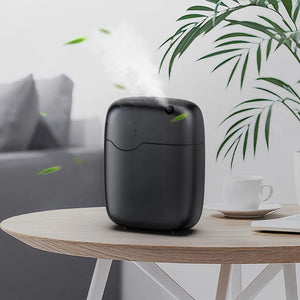
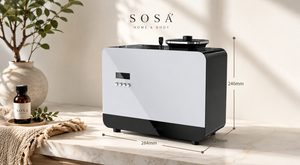
Small reception · no power neededFrom ₹749Shop →  Mid reception · has an off switch₹1,899Shop →
 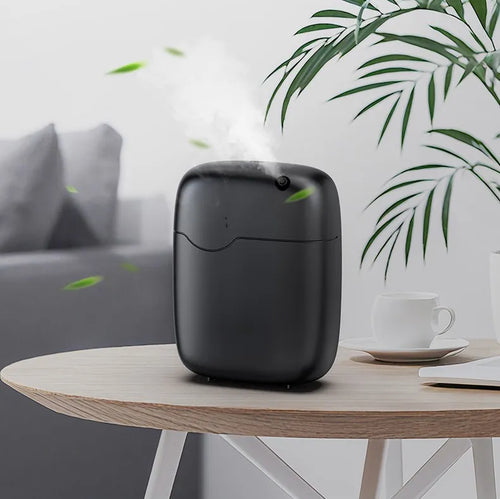 Large lobby · timed, dialable₹11,999Shop →
If the fifth channel is used at all
Add it only to a room whose first four channels are already right. Fragrance is not a substitute for any of the other four and it does not repair them — a scented room with a draught is a room with a draught. Assuming the audit is done and the reception is odour-neutral, start at the equipment minimum and schedule it to clinic hours only. A Sukoon at ₹1,899 on three drops in intermittent mode suits a reception up to about 320 sq ft; note that it is water-based, so it adds a little humidity — welcome in a heavily air-conditioned room, less so in a coastal monsoon. A Vaayu at ₹11,999 is waterless and adds none, and its duty cycle is what lets it run low enough for a clinic; it is the right answer only where the reception is genuinely too large for passive diffusion.
Set the level with a nose that has been outside for thirty minutes, and set it from a seat. Not from the doorway, where the arriving nose is freshest and the exposure shortest, but from the furthest waiting seat, after ten minutes, at the busiest hour. Staff cannot do this — adaptation is essentially complete within twenty minutes, which is why the request from inside a clinic is always for more, and why nearly every over-scented reception got that way honestly. Write the setting on a card beside the unit and name one person allowed to change it.
And keep the fifth channel switchable in a way the other four are not. You cannot turn off the acoustics for one family, but you can turn off the fragrance in seconds, and you should be willing to for a parent whose child is scent-sensitive or asthmatic. Mount any unit high and aim it away from the seating so that it is not delivering into the 0.8–1.2 m band where a child breathes rather than the 1.5–1.7 m band where an adult does, and keep it well clear of the play corner. Consultation, examination, vaccination and injection rooms, nebulisation and asthma areas, neonatal follow-up, procedure and sample-collection rooms and any isolation area stay fragrance-free, and the whole decision belongs with your own clinical governance, infection-control and housekeeping leads.
What we would actually install
Sized for the fifth of five channels. The last row is on this table because a reception that has sorted its sightlines, sound, surfaces and air very often needs nothing at all in the fifth.
| Option | Suits | Control you get | Price |
|---|---|---|---|
| Reed diffuser ★ | A small reception desk — a counter where the fifth channel should be the smallest object in the room; three reeds, no lead | Reed count only — no switch, no timer | from ₹749 |
| Sukoon 500ml | A reception up to ~320 sq ft — a reception up to about 320 sq ft — water-based, so it adds a little humidity as well as fragrance | On/off, intermittent mode, you control the drops | ₹1,899 |
| Vaayu | A large lobby or a zoned duct — a large reception needing an active source; waterless, adds no humidity, and dials down by duty cycle | Duty cycle in seconds, timer, app scheduling | ₹11,999 |
| Aangan | Whole-facility HVAC — a large centre with zoned ducting that genuinely excludes every clinical room | Zone-level control, but only if the ducting is zoned | ₹25,999 |
| Nothing at all | A reception whose sightlines, acoustics, surfaces and airflow have all been audited — four channels done properly is the premium reception, with or without the fifth | Complete — and the correct answer more often than the trade admits | ₹0 |
Versailles
The most useful hour I ever spent in a client’s clinic involved no fragrance at all. I sat in every chair in their waiting room and touched everything a parent would touch. Three of the seven chairs had tape over a split in the vinyl, and the counter was sticky at the height a child rests their chin. They had just spent a substantial sum on the ceiling.
The other thing I found that day was a vent pointing straight at the second seat from the door. The receptionist knew about it and had stopped noticing; parents did not know about it and moved seats within a couple of minutes without ever saying why. A deflector fixed it for almost nothing, and it improved that room more than anything I could have sold them.
So my answer to this question is not the answer a fragrance company is meant to give. Do the sightlines, the sound, the touch audit and the air, and then decide whether you want anything in the fifth channel at all. If you do, keep it small, keep it out of every clinical room, keep an off switch at the desk, and put the decision through your own clinical governance and infection-control leads. A portion of every order funds a girl’s classroom through Nanhi Kali.
Frequently asked questions
- What makes a clinic read as premium — six signals, ranked honestly.
- Improving the first impression with no building work — six jobs, no contractor.
- Light, colour, furniture and fragrance — four dials, one impression.
- Should it smell obviously fragrant? — no — obvious is the failure mode.
- Brand: the SOSA founder story.
SOSA products & prices (verified August 2026): Hotel Collection water-based ultrasonic diffuser fragrance 15ml ₹299 · 100ml ₹999 · 300ml ₹1,799 · Pack of 7 (15ml, all fragrances) ₹1,799; refills 100ml from ₹999. Seven scents: The Ritz-Carlton-inspired (white tea · bergamot · cedar), Westin-inspired (white tea · aloe · cedar), 1 Hotels-inspired (cedarwood · vetiver · green leaves), The St. Regis-inspired (amber · violet · woods), Shangri-La-inspired (jasmine · green tea · white tea), Four Seasons-inspired (citrus · floral · sandalwood), W Hotels-inspired (citrus · pepper · amber). Diffusers: Boond 300ml ₹899 · Sukoon 500ml ₹1,899 · Megh 6L ₹3,499. Water-based, phthalate-free, composed to IFRA standards for home diffusion; 3–6 drops per tank. Made in India, Pune. The Hotel Collection scents are SOSA's own interpretations inspired by the world's finest hotels; all hotel names are trademarks of their respective owners and are used only to describe the scent style — SOSA is an independent Indian fragrance house, not affiliated with or endorsed by any hotel brand. Prices and availability subject to change — see the live product pages.