


What Should I Consider Before Scenting a Clinic Where Babies and Young Children Visit?

What Should I Consider Before Scenting a Clinic Where Babies and Young Children Visit?

★ ★ The pre-purchase checklist · four stages · three answers that end the conversationReeds from ₹749 · Sukoon ₹1,899 · Vaayu ₹11,999 · Aangan ₹25,999A portion funds girl-child education
★ Before you buy · the questions that come before the catalogue
Twelve questions, and three of them settle it without a fragrance ever being chosen
There is a running order to this: patient mix, then the air-space map, then the housekeeping baseline, then governance. Fragrance choice is the last thing on the list, not the first.
The running order
Four stages, in sequence
Three answers end the purchase outright — a list built around newborn or respiratory care, a reception that shares return air with clinical rooms, and a live odour that has not been traced.
The three stoppers
Any one of them is decisive
Work out the longest continuous exposure any patient has in your building before you look at any equipment. That number sets the intensity, and it is usually far longer than owners assume.
The number that matters
Longest dwell, not average
Measure the mounting height available before choosing a format. If nothing can go above about 1.8 m and out of reach, the shortlist is already empty.
The physical audit
Height and reach first
Name the person who owns the setting and the date it gets reviewed. A clinic without those two has a habit, not a policy, and habits drift upward.
The governance question
One owner, one review date
Every item on this checklist can be answered in an afternoon, at no cost, and several clinics finish the afternoon having decided to install nothing.
What it costs to do properly
An afternoon, and ₹0
There is a running order to this: patient mix, then the air-space map, then the housekeeping baseline, then governance. Fragrance choice is the last thing on the list, not the first.
The running order
Four stages, in sequence
Three answers end the purchase outright — a list built around newborn or respiratory care, a reception that shares return air with clinical rooms, and a live odour that has not been traced.
The three stoppers
Any one of them is decisive
Work out the longest continuous exposure any patient has in your building before you look at any equipment. That number sets the intensity, and it is usually far longer than owners assume.
The number that matters
Longest dwell, not average
Measure the mounting height available before choosing a format. If nothing can go above about 1.8 m and out of reach, the shortlist is already empty.
The physical audit
Height and reach first
Name the person who owns the setting and the date it gets reviewed. A clinic without those two has a habit, not a policy, and habits drift upward.
The governance question
One owner, one review date
Every item on this checklist can be answered in an afternoon, at no cost, and several clinics finish the afternoon having decided to install nothing.
What it costs to do properly
An afternoon, and ₹0
✓ Clinical areas stay fragrance-free — reception is the only zone we would scent ✓ Intensity is set by duty cycle, so it can be dialled to almost nothing ✓ If housekeeping or ventilation is the problem, fragrance is not the fix


Founder Diaries · Scenting a children’s clinic
By Sonal Sahani · ISIPCA Versailles 11 min read Updated September 2026
Almost every clinic that asks us about scenting starts at the wrong end of the problem — with a fragrance direction, a machine and a budget. None of those is the first question, and in a clinic where babies and young children visit, three of the earlier questions can end the purchase outright. What follows is the list we would work through with a clinic before quoting for anything, arranged in the order the answers actually matter. It takes an afternoon and costs nothing.
Quick answers — read this first
Stage one — who is in the room: the age profile, and whether your list includes newborn, respiratory or immunosuppressed children.

Stage two — the air-space map: which rooms share return air, not which rooms share a wall.

Stage three — the baseline: what the clinic smells of right now, and why.

Stage four — governance: who owns the setting, who can switch it off, and when it gets reviewed. Fragrance choice comes after all four.
The short answer
Short answer: Work through four stages in order — patient mix, air-space map, housekeeping baseline, then governance — before you look at a single product. The fragrance direction is the last decision, not the first, and for a great many paediatric clinics the checklist finishes before it gets there.
The three answers that end the purchase: A patient list built around newborn, respiratory or immunosuppressed children. A reception that shares a return-air path with consultation or examination rooms. And a live, untraced odour anywhere in the building — because fragrance is additive and would simply arrive alongside it.
If you clear all twelve: Then the answer is a light, dry, low-sweetness note at the entrance and reception only — a reed diffuser on three reeds for a small desk, or a unit mounted above reach at its lowest setting — with every clinical area left alone and the decision signed off by your own clinical governance and infection-control leads.
Straight answer
What should I work through before scenting a clinic that babies and young children visit?
1. Who is actually on the list, and how young. Not the clinic’s name — the appointment book. Count what proportion of a normal week is newborn and under-one, what proportion is respiratory (asthma review, nebulisation, post-viral cough, allergic rhinitis), and whether you see any immunosuppressed or oncology follow-up children at all. If newborn or respiratory care is the centre of your list rather than the edge of it, the checklist stops here and the recommendation is to install nothing. That is not a soft warning; it is the single most common outcome of doing this properly.

2. What the longest continuous exposure in your building is. Take the longest a patient realistically stays in one room, not the average across the day. A parent at the desk is twenty seconds. A child in a paediatric waiting area is thirty to sixty minutes. A baby waiting for a second weight after a feed can be two hours. The intensity that suits the twenty seconds is oppressive at the forty minutes, and every equipment default you will be shown is written for the twenty. Design to the longest number in your building, and the answer comes out lower than any catalogue setting.

3. Which rooms share air — not which rooms share a wall. Stand in reception, then walk to each clinical room and look up. If reception and the consulting rooms feed the same return grille or sit on the same AC loop, they are one air space and a partition changes nothing. A great many clinics discover at this step that the zoning plan they were about to buy cannot physically exist in their building. It is a five-minute check with a torch and it saves the entire budget.

4. What the clinic smells of at seven in the morning, and at six in the evening. Two readings, taken by someone who has been outside for thirty minutes. The morning reading tells you about overnight air change — a closed building sits at roughly 0.2 to 0.5 air changes an hour. The evening reading tells you about accumulation and about what your soft furnishings are holding. If either reading produces a describable smell — phenolic, damp, bin, drain, closed — you have a housekeeping, ventilation or drainage job and not a fragrance job, and doing the fragrance job first gives parents both.

5. Where a unit could physically go, and who can reach it. Before choosing a format, find the mounting positions: a wall above roughly 1.8 m, behind or above the counter, with the outlet aimed away from seating and play space and no lead crossing a floor children walk on. Rule out every low table, console, window sill and skirting socket, because those are within reach of the people your clinic exists for. If that leaves you with no position at all, you have your answer, and it costs nothing.

Made in India, composed by an ISIPCA Versailles-trained perfumer — and a portion of every order supports girl-child education through Nanhi Kali.

TL;DR: work through four stages in order before choosing anything — the age and respiratory profile of your list, the air-space map, the current odour baseline morning and evening, and who owns and reviews the decision. Three answers end the purchase on their own: a newborn or respiratory list, a reception sharing return air with clinical rooms, and any live untraced odour. Clear all twelve and the recommendation is a light dry note at reception only, signed off by your own governance leads.
SOSA reed diffusers
If the checklist clears, this is usually the answer
SOSA reed diffusers From ₹749
For most paediatric receptions that pass every stage of this list, a SOSA reed diffuser from ₹749 is the whole purchase: no power, no lead, no timer to creep upward, no reservoir, and an intensity ceiling low enough that it cannot dominate a room children sit in for forty minutes. Use three reeds rather than six, and keep the bottle behind the counter rather than on a low table. Composed and made in India, in Pune, and phthalate-free.

Why the order of these questions decides the answer

Clinics that scent badly almost never do so because they chose a poor fragrance. They do it because they answered the questions in the wrong order — equipment first, then placement, then, months later and usually after a complaint, patient mix. Running the list forwards instead is what makes it useful, because the early questions are the ones with veto power. Patient mix can end the purchase; fragrance direction never can. A clinic whose list is half asthma reviews does not have a fragrance problem to solve with a better note, and no amount of duty-cycle control turns a shared return-air path into two zones. Working forwards also means the expensive decisions are taken last, when the cheap information is already in — which is the ordinary discipline of any specification, and it is oddly absent from how scenting is usually sold.

The second reason is that most of this list is free and reversible, and the last item on it is neither. Counting your under-one appointments costs nothing. Looking up at a return grille costs nothing. Standing in your own reception with a nose that has been outside for half an hour costs nothing, and it is the single most informative thing anyone in this trade can tell you to do. By contrast, a machine bought for a room it does not suit is an awkward object that tends to stay switched on because it was expensive, and a fragrance absorbed into a waiting room’s cushions and curtains cannot be switched off at all. Sorption is why the fragrance decision is less reversible than it looks — the air clears in minutes, the soft furnishings hold on for weeks. Front-load the cheap questions and you keep every option open.

The four stages, and what a fail looks like

1
STAGE ONE · THE PATIENT LIST
Count the appointment book, not the signage
SOSA reed diffusersIf it clearsFrom ₹749Four counts, from a normal week: newborn and under-one visits; respiratory attendances including asthma review, nebulisation and post-viral cough; any immunosuppressed or oncology follow-up; and the longest single dwell anyone has in the building. A list where newborn or respiratory care is central rather than incidental is a stop, not a caution. A general list with a scattering of both is a clinic that can consider a light reception note provided every clinical area stays alone. The count takes twenty minutes and it is the only stage nobody can do for you.
Stage one has veto power over everything below it. If it fails, no equipment, placement or setting rescues the decision.
2
STAGE TWO · THE AIR-SPACE MAP
Walls are not boundaries; grilles are
Draw your floor plan and mark, in a different colour, every supply diffuser and every return grille. Rooms that feed a common return are one air space regardless of doors and partitions. Then check the obvious leaks: the gap under a consulting-room door, a transfer grille cut into a partition for cooling, a false ceiling that is continuous above the walls, and whether the play corner is simply part of reception with furniture around it. Zoning scent only works if the ducting is zoned, and in most small clinics it is not. If reception and consultation share a return, the honest reading is that you have one room, and the fragrance-free rule for clinical areas therefore covers the whole of it.
This is a five-minute check with a torch. It regularly ends a purchase that a supplier had already quoted for.
3
STAGE THREE AND FOUR · BASELINE, THEN GOVERNANCE
What it smells of now, and who owns what happens next
Take the two baseline readings — first thing in the morning before anyone opens up, and last thing in the evening after a full clinic day — using someone who has been outside for thirty minutes, in every room, at standing height and again at about a metre. Write down what you can describe. Anything describable is a source to trace: disinfectant choice and dilution, bin type and emptying frequency, basin and sluice traps, the AC filter and drain pan, damp, and soft furnishings holding old events. Only when both readings come back as nothing do you move to stage four: who owns the setting, who is allowed to change it, who can switch it off within seconds for a family that asks, what the review date is, and which of your governance, infection-control and housekeeping leads has signed the policy.

Zone by zone, once the checklist has been cleared

This table only applies to a clinic that has passed all four stages. Printed here so that an owner working through the list can see what a pass actually buys them — which is less than most expect, and deliberately so.

The post-checklist table
What clearing the list does and does not permit
Area of the clinic Scented? Why What we would use
Entrance and reception desk ★ Yes, low Short dwell, arriving noses, and the only zone where a signature genuinely registers Reed on three reeds from ₹749, or Sukoon ₹1,899
Administrative, billing and back office Yes Staff-facing, no patient seated for any length of time, no clinical function Whatever reception uses, same source
Waiting seating and play corner Only at minimum, if at all The longest dwell in the building, at child breathing height, among sorptive surfaces No separate unit — and nothing if it shares air with the play corner
Consultation and examination rooms No Clinicians use their own sense of smell, and a seated child cannot move away from the room Nothing
Vaccination, injection and procedure rooms Never A distinctive scent repeatedly paired with an injection becomes a cue a child carries forward Nothing
Nebulisation, asthma and neonatal follow-up Never Respiratory and newborn patients — the two groups with the least tolerance for added airborne load Nothing
Before any of this: none of the rows above are live until stages one to four are complete. A clinic that has not counted its respiratory list, mapped its return air and taken both baseline readings is not choosing between these rows yet; it is choosing between guessing and finding out.
Shop this guide
What we would install for a clinic that clears the list
The SOSA principle
Three answers on this checklist end the purchase — and none of them is about fragrance.
Patient mix, shared return air, and a live untraced odour. Any one of them settles the question before a scent has been chosen or a machine quoted.

What a pass looks like in practice

A pass buys you reception, at the bottom of the range, on a schedule. It does not buy you a scented building. Start at the equipment minimum — three reeds rather than six on a passive diffuser, or on a Vaayu the shortest on-time against the longest off-time the unit offers, scheduled to clinic hours so nothing runs into an empty building overnight. Duty cycle is the reason a waterless machine is usable in a clinic at all: it can sit far below the floor of any passive diffuser. Direction stays dry and low in sweetness — white tea, green tea and cedar, such as Ritz-Carlton-inspired Quiet Luxury or Westin-inspired White Tea Serenity — rather than florals, vanilla or anything gourmand.

Then re-run stage three a fortnight later, and again a quarter after that. The baseline is not a one-off measurement. Olfactory adaptation is essentially complete within about twenty minutes, so nobody who works in the building can judge the level after the first coffee, and the predictable consequence is that staff ask for more. The second week is when most clinics creep upward. Give the reading to someone arriving from outside, take it at about a metre as well as at standing height, and treat a parent commenting on the fragrance as an instruction to reduce rather than as a compliment.

And keep every stage on paper, with names against it. The output of this checklist should be a single page: which areas may carry fragrance, which never may, which product and at what setting, who is permitted to change it, who can switch it off within seconds on request, and the date it is reviewed. That page belongs to the facility’s clinical governance, infection-control and housekeeping leads, not to a fragrance supplier — our part is to supply what they decide, including nothing. A clinic that cannot name the owner of the setting does not have a policy; it has a habit, and habits in this trade drift in one direction only.

The purchase decision is made before the catalogue opens — and most of it is made by your patient list.
— Sonal Sahani, SOSA

What we would install, if the list clears

The ladder in the order we would consider it for a clinic that has passed all four stages. The last row is where a meaningful proportion of clinics that run this checklist honestly end up.

The pre-purchase edit
Matched to reception size — after the checklist, not before it
Option Suits Control you get Price
Reed diffuser ★ A small reception desk — a small reception desk that cleared every stage, three reeds not six, bottle behind the counter Reed count only — no switch, no timer from ₹749
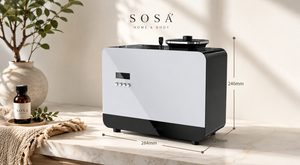
Sukoon 500ml A reception up to ~320 sq ft — a separate front-of-house up to about 320 sq ft, intermittent mode, three drops, unit above reach On/off, intermittent mode, you control the drops ₹1,899
Vaayu A large lobby or a zoned duct — a large lobby or a reception genuinely on its own duct zone — the duty cycle is why it can run low enough Duty cycle in seconds, timer, app scheduling ₹11,999
Aangan Whole-facility HVAC — a facility of 8,000–10,000 sq ft where the ducting is zoned and every clinical zone is excluded at the duct Zone-level control, but only if the ducting is zoned ₹25,999
Nothing at all Any clinic failing stage one, two or three — a newborn or respiratory list, shared return air, or an untraced odour still in the building Complete — and the correct answer more often than the trade admits ₹0
Honest notes before you buy: three things need saying plainly, because this is a healthcare setting and children are involved. First, fragrance is additive, not subtractive. It adds pleasant molecules; it removes nothing. A clinic that smells of disinfectant, damp or a full bin has a housekeeping, ventilation or drainage problem, and scenting over it gives parents both smells at once. Fix the cause first — the order is source, then air, then surfaces, then, if you still want it, fragrance. Second, clinical areas should stay fragrance-free. Consultation, examination, vaccination and injection rooms, nebulisation and asthma areas, neonatal and newborn follow-up, procedure and sample-collection rooms: none of these should carry added scent, for reasons this cluster sets out in detail. Paediatric patients include children with asthma, allergic rhinitis, post-viral cough and chemical sensitivity, and fragrance is a recognised trigger for some of them. Third, this is guidance on ambience, not clinical advice. SOSA is a fragrance house, not a healthcare consultancy. Any decision about scenting a clinical environment should go through the facility’s own clinical governance, infection-control and housekeeping leads, and should follow whatever policy the establishment operates under. We make no health, clinical or wellness claim for any SOSA product; these are ambient fragrances for occupied indoor space, not clinical equipment and not aromatherapy. All SOSA fragrances are phthalate-free and composed to IFRA standards for ambient diffusion. A portion of every order supports girl-child education through Nanhi Kali.
SOSA Vaayu waterless cold-air scent machine
Only where the space justifies it
SOSA Vaayu ₹11,999
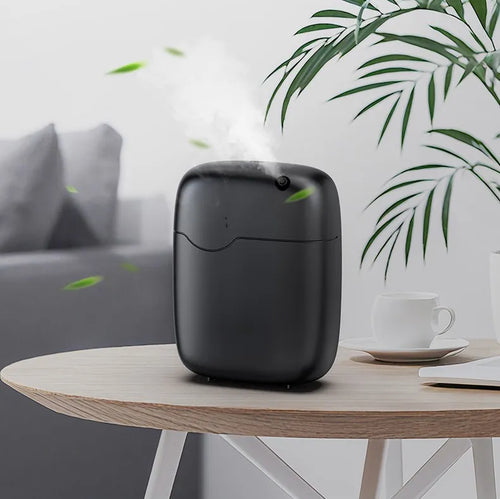
The Vaayu is a waterless cold-air machine: it atomises neat fragrance oil into dry micron droplets, adds no humidity, and sets intensity by duty cycle — seconds on against seconds off — with a timer and app scheduling. That dialability is the reason it suits a clinic at all, because it can run far lower than a passive diffuser ever goes. It is rated for large areas, so in a 300 sq ft clinic it is the wrong machine, not the premium one.
SS
ISIPCA
Versailles
A note from Sonal

When a paediatric clinic calls us about scenting, the first thing I ask for is not the floor area. It is the appointment book and a description of what the reception smells like at seven in the morning. Those two answers decide most of these enquiries before anyone has opened a catalogue, and a fair number of them decide it in the direction of buying nothing. I would rather find that out in the first conversation than after a machine has been installed and a parent has complained.

The stage owners are most tempted to skip is the air-space map, because it feels like an engineering question rather than a fragrance one. It is the one I would skip last. Almost every disappointed scenting installation I have seen in healthcare failed there: someone drew a boundary on a floor plan, the building moved air straight across it, and a consulting room that was promised as fragrance-free was not. A torch and five minutes settles it, and the answer is not negotiable afterwards.

If a clinic works through all four stages and comes out the other side wanting a light dry note at the desk, that is a reasonable, defensible detail and I am glad to supply it. Keep it out of every clinical room, keep it below the level anyone remarks on, be able to switch it off in seconds for a family that asks, and put the finished page in front of your own infection-control and clinical governance leads rather than in front of me. A portion of every order funds a girl’s classroom through Nanhi Kali.

Frequently asked questions

What should I consider before scenting a clinic where babies and young children visit?
Four stages, in order. First the patient list — how much newborn, respiratory and immunosuppressed care you do, and the longest continuous dwell in your building. Second the air-space map: which rooms share return air rather than which share a wall. Third the odour baseline, taken morning and evening by a nose that has been outside for thirty minutes. Fourth governance: who owns the setting, who can switch it off, and when it is reviewed. Fragrance choice comes after all four.
Which answers mean we should not scent at all?
Three of them. A patient list built around newborn, respiratory or immunosuppressed children. A reception that shares a return-air path with consultation or examination rooms, because that makes them one air space whatever the partitions say. And any live odour that has not been traced to a source, since fragrance is additive and would arrive alongside it rather than resolve it.
How do I check whether reception and the consulting rooms share air?
Walk the plan with a torch and mark every supply diffuser and every return grille. Rooms feeding a common return are one air space. Then look for the leaks: the gap under a consulting-room door, transfer grilles cut into partitions, a false ceiling that runs continuously above the walls, and a play corner that is really part of reception. If they share, the fragrance-free rule for clinical areas covers the whole space.
How long should the whole checklist take?
An afternoon, and it costs nothing. The appointment-book count is about twenty minutes, the air-space map is five with a torch, and the two baseline readings need one early morning and one evening. Only the last stage — writing the policy page and getting it signed — needs anyone else’s diary, and that is the stage that makes the decision stick.
If we pass everything, what do we actually buy?
Less than most owners expect: a light, dry, low-sweetness note at the entrance and reception only, at the bottom of the equipment range and scheduled to clinic hours. A reed diffuser on three reeds from ₹749 covers a small desk; a Sukoon at ₹1,899 suits a separate reception up to about 320 sq ft. Every clinical area stays fragrance-free, and the decision belongs with your own clinical governance and infection-control leads.
Before you buy anything
Run the checklist first — it is free, and it often ends the purchase
SOSA commercial scenting for healthcare receptions: reed diffusers from ₹749 for a small desk, the Sukoon at ₹1,899 for a reception up to about 320 sq ft, the Vaayu at ₹11,999 where a large lobby or a genuinely zoned duct justifies it, and the Aangan at ₹25,999 for whole-facility HVAC. Phthalate-free, IFRA-standard ambient fragrances for occupied indoor space. Clinical areas stay fragrance-free, and if the checklist says install nothing, we will say so.
See SOSA commercial scenting → Reed diffusers from ₹749
Continue the read
More on deciding whether to scent at all
Editorial standards & sources
About this guide: Written by Sonal Sahani, ISIPCA Versailles-trained founder and perfumer at SOSA Home & Body, on ambient scenting in paediatric environments. This is guidance on ambience and odour management, not clinical, regulatory or infection-control advice, and it is no substitute for a facility’s own clinical governance. SOSA products are ambient fragrances, not clinical equipment, and no health, curative or wellness benefit is claimed for them. Coverage figures are SOSA’s own for the stated products.

SOSA products & prices (verified August 2026): Hotel Collection water-based ultrasonic diffuser fragrance 15ml ₹299 · 100ml ₹999 · 300ml ₹1,799 · Pack of 7 (15ml, all fragrances) ₹1,799; refills 100ml from ₹999. Seven scents: The Ritz-Carlton-inspired (white tea · bergamot · cedar), Westin-inspired (white tea · aloe · cedar), 1 Hotels-inspired (cedarwood · vetiver · green leaves), The St. Regis-inspired (amber · violet · woods), Shangri-La-inspired (jasmine · green tea · white tea), Four Seasons-inspired (citrus · floral · sandalwood), W Hotels-inspired (citrus · pepper · amber). Diffusers: Boond 300ml ₹899 · Sukoon 500ml ₹1,899 · Megh 6L ₹3,499. Water-based, phthalate-free, composed to IFRA standards for home diffusion; 3–6 drops per tank. Made in India, Pune. The Hotel Collection scents are SOSA's own interpretations inspired by the world's finest hotels; all hotel names are trademarks of their respective owners and are used only to describe the scent style — SOSA is an independent Indian fragrance house, not affiliated with or endorsed by any hotel brand. Prices and availability subject to change — see the live product pages.
Back to blog