

What to avoid: gourmand accords, heavy florals, anything sweet or vanillic. They read as somebody’s living room rather than as a designed environment, and in a showroom they compete with the product instead of framing it.
The volume problem: this is the one space where a 1000 m³ machine is genuinely working near its rating, and a double-height ceiling consumes coverage that a square-foot figure completely hides. Reason in cubic metres and place the unit in the airflow path rather than against it.
The honest gap: if the space is genuinely larger than one unit can serve as a single volume, the answer is Aangan ₹25,999 or a second zone, not a higher setting on the machine you already have. Turning the intensity up does not extend coverage; it only over-doses the near half of the room.
2. Keep it the same accord as the rest of the circuit. This zone is the anchor because it is the biggest, so whatever you choose here is effectively the building’s signature. Everything else on the circuit should be the same composition at a different intensity, because a visitor accumulates whatever they walk through and two compositions meeting in a doorway read as a mixture.
3. Dose for the crossing, not for the sitting. The nose reports change far better than it reports steady state, so the moment that does the work is the second or two when somebody steps out of the corridor and into this volume. Once they sit down for a scene demonstration, adaptation takes over within minutes and the fragrance quietly disappears from their awareness — and that is the design working, not failing.
4. Reason in cubic metres, because this room is where the ceiling gets you. One Vaayu covers up to 1000 m³ of connected volume. A double-height living demonstration open to a hall and a dining vignette can consume that faster than the floor plan suggests, and the honest response to a volume that is genuinely too large is a second zone or a larger machine, never a higher setting.
5. Place it with the air, and mount it properly. Into the airflow path, at height, away from a return that will pull the mist straight out of the room — unless you are deliberately mounting into the HVAC return, which is the most even distribution available and the reason to involve services coordination early. That is a mechanical integration and a real one; it is not a digital one.
Vaayu is ₹11,999, covers up to 1000 m³, runs under 38 dB, draws 5W at DC 12V / 1A, holds a 400ml sealed residue-free tank lasting up to about 90+ days, and is CE, RoHS and SGS certified. Free shipping above ₹499, and a portion of every order supports girl-child education through Nanhi Kali.

The register: why dry beats warm in a room that is selling capability
There is a reflex in showroom design that says a living room should feel warm and inviting, and in an actual home I would agree with it. A demonstration living room is not an actual home, and the difference is what it is for. This room exists to show a client what a well-engineered building feels like — the scene that settles the lighting in one press, the shades that arrive together, the audio that appears from nowhere. Warmth in the fragrance pulls against all of that. Vanilla, caramel, heavy amber and rich floral accords carry strong domestic associations, and a domestic association in this particular room quietly reframes the technology as an add-on to somebody’s sitting room rather than as the reason the room works.
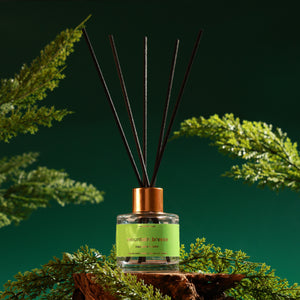
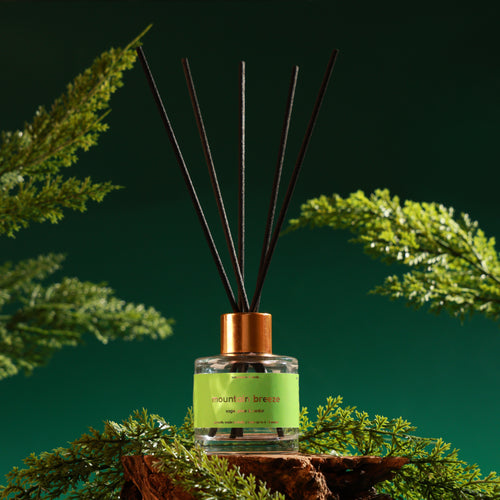
 Mountain Breeze₹849Woody materials give a fragrance a spine without giving it sweetness, which is exactly the trade a large public-facing room wants. Cedar in particular reads as dry, composed and faintly architectural; it does not invite anyone to comment on it. Above that, a tea-like transparency keeps the whole thing from settling into timber, and a light citrus at the top supplies the small lift that a visitor perceives on the way in. What you must not do is let the base get rich. Depth is the enemy in a room this size, because a deep accord in a large volume needs a great deal of material to feel coherent, and by the time it feels coherent to the person who set it, it is far too much for the person walking in. Our reed line is a useful reference for the register even though it is a different mechanism entirely: Mountain Breeze at ₹849 is the dry green-woody direction, and Fresh Brew at ₹849 — a coffee and vanilla gourmand — is the direction to stay away from here.
 Vaayu₹11,999People often ask why a very good hotel lobby smells wonderful and yet there is never a diffuser anywhere to be seen. The answer is that there usually is not one in the room to find. The scent has been introduced into the building’s moving air rather than released from an object on a console, so there is no gradient to walk up and no source to locate. That distinction is the whole reason a demonstration living room should use a nebuliser rather than passive sources. A reed diffuser scents the air near itself; put two at either end of a large room and you get two concentration peaks with a valley in the middle, because the midpoint is the farthest point from both and neither of them moves any air. A cold-air machine puts a dry mist into air that is already circulating, so the room reads as evenly conditioned rather than as decorated with a fragrance.
Ask before specifyingContactNobody should be smelling this room continuously. A space you can smell all the time is set too strong for its volume, and in home fragrance the level is meant to be noticed on arrival and at transitions rather than held constantly at the front of somebody’s attention. In a showroom that principle is even more useful, because your visitor is only ever arriving. Set the machine at the lowest level that survives a walk in from the corridor, and treat every judgement made from inside the room as unreliable — including your own, ten minutes after you started adjusting it. Then key-lock the setting. Your team will be certain the machine has stopped working by mid-morning; they are simply adapted, and the ratchet that follows from believing otherwise is how a well-specified showroom ends up over-scented by the third month.
Vaayu₹11,999People often ask why a very good hotel lobby smells wonderful and yet there is never a diffuser anywhere to be seen. The answer is that there usually is not one in the room to find. The scent has been introduced into the building’s moving air rather than released from an object on a console, so there is no gradient to walk up and no source to locate. That distinction is the whole reason a demonstration living room should use a nebuliser rather than passive sources. A reed diffuser scents the air near itself; put two at either end of a large room and you get two concentration peaks with a valley in the middle, because the midpoint is the farthest point from both and neither of them moves any air. A cold-air machine puts a dry mist into air that is already circulating, so the room reads as evenly conditioned rather than as decorated with a fragrance.
Ask before specifyingContactNobody should be smelling this room continuously. A space you can smell all the time is set too strong for its volume, and in home fragrance the level is meant to be noticed on arrival and at transitions rather than held constantly at the front of somebody’s attention. In a showroom that principle is even more useful, because your visitor is only ever arriving. Set the machine at the lowest level that survives a walk in from the corridor, and treat every judgement made from inside the room as unreliable — including your own, ten minutes after you started adjusting it. Then key-lock the setting. Your team will be certain the machine has stopped working by mid-morning; they are simply adapted, and the ratchet that follows from believing otherwise is how a well-specified showroom ends up over-scented by the third month.
The largest volume on the circuit, and what that does to the specification
Almost every other room in a demonstration suite is small enough that the machine is comfortably inside its rating. This one frequently is not, and it is the reason I keep insisting that coverage is a volume figure rather than an area figure. Up to 1000 m³ is roughly 2,000 to 3,000 sq ft at an ordinary ceiling height, and the phrase doing the work is ordinary ceiling height. A living demonstration with a void above it, an exposed services soffit at four metres, or a mezzanine gallery looking down into it is consuming volume that never appears anywhere on the floor plan. The same is true of the connections: if this space runs into the dining vignette and the entrance hall without a door anywhere in between, all of it is one body of air and all of it counts.
When the connected volume is genuinely beyond what one unit can serve, there are two honest answers and one dishonest one. The dishonest one is turning the intensity up, which does not extend coverage — it simply over-doses the half of the room near the machine while the far end stays thin, and it burns oil doing it. The honest answers are a second zone with its own machine, positioned so the two overlap rather than compete, or a larger machine: Aangan at ₹25,999 covers approximately 8,000 to 10,000 sq ft and Meenar at ₹38,500 covers 12,000 to 18,000, both designed to work through an air-handling system. Which of those is right depends on connected volume, ceiling height, doors, HVAC layout and occupied hours, and I would rather you sent a plan through the contact page than took a number from a web page.
Air conditioning is the other variable and it works in your favour more often than not. Recirculation inside a closed volume distributes fragrance evenly, which is why a sealed, conditioned demonstration room is an easier space to scent well than a naturally ventilated one; air that leaves the building takes the fragrance with it, so a showroom that props its doors open during trading hours is not a fragrance environment for those hours. What central air does badly is when the machine is placed to fight it — sitting directly beneath a supply grille that blasts the mist to the floor, or beside a return that removes it from the room before it has travelled. Placement solves that. Intensity does not.
Four registers, judged for a living-room demonstration zone
The comparison as I would present it to a showroom owner, including the two registers I would talk you out of. The reed scents named here are references for the direction rather than products for this machine — reed oil and cold-air oil are different physical systems and are not interchangeable in either direction.
| Register | What it reads as | Behaviour in a large volume | Verdict for this zone | Reference direction |
|---|---|---|---|---|
| Dry woody-fresh ★ | Engineered, composed, well-kept | Holds structure at a low level; does not need volume to feel coherent | The answer — cedar and white tea with a clean citrus lift | Mountain Breeze direction, ₹849 |
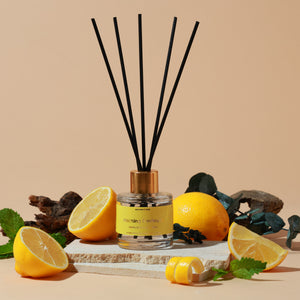
| Bright citrus-mint | Awake, clean, slightly cool | Lifts well but the lightest materials leave first, so it thins across a big room | Good as a lift inside the woody accord; thin on its own here | Morning Freshness direction, ₹749 |
| Soft herbal | Quiet, restful, low-key | Very easy to under-perceive in a large connected volume | Better in the bedroom zone than here | Evening Calm direction, ₹799 |
| Floral | Domestic, decorative, occasion-led | Reads as an event rather than an environment; noticed and commented on | Fights the product — I would not specify it | Garden Bloom direction, ₹799 |
| Warm gourmand | Cosy, edible, domestic | Heavy materials linger on upholstery and build through the day | The clearest wrong answer for a technology showroom | Fresh Brew direction, ₹849 |
Vaayu · up to 1000 m³₹11,999See specification → One accord, whole circuit₹1,799Shop →  Aangan · beyond one unit₹25,999See it →
Setting the level for a room people are only ever entering
A home living room is occupied for hours, so the design target there is a level that registers on arrival and disappears in occupancy. A demonstration living room is occupied for four minutes at a time by somebody who has never been in it before, which means the arrival is essentially the whole experience and you are dosing for it exclusively. That is an unusually favourable position to be in, and it means the setting can be genuinely low. An un-adapted nose crossing a threshold is an extremely sensitive instrument; it does not need a strongly fragranced room to notice a change, it needs a clean one with a slight, consistent character in the air.
The other half of the setting is the schedule, and the run windows are the tool. A 1h / 4h / 8h / 24h window with a day selection lets you cover trading hours and then stop, which does two useful things: it keeps a 400ml tank running up to about 90+ days depending on intensity and hours, and it prevents the building saturating overnight with nobody in it. If the showroom is closed on a particular day, deselect it rather than running the machine into an empty room. And if the space is used for evening events on some days and not others, do not chase that with the schedule — set the machine for the ordinary week and let somebody switch the window manually before an event, which is a perfectly honest way to use the app and takes about ten seconds standing next to the unit.
One last operational point that belongs on this page because this is the room where clients sit down. Soft furnishings absorb fragrance and release it slowly for hours afterwards, so a large upholstered demonstration living room carries a little of yesterday into today. That is usually a good thing at a low setting — it makes the room read as consistent rather than freshly sprayed — but it becomes a problem the moment the level creeps up, because the accumulation is invisible to everybody who works there. It is one more reason the key-lock matters, and one more reason the correct verification is a walk in from the street rather than an opinion formed on the sofa.
What I would specify for this zone — and the honest gap
The living-room demonstration zone written as a specification, in the order the decisions are actually made. The last row is the limitation I would rather you knew at drawing stage than discovered during a client walkthrough.
| Decision | What to specify | Why | Reference |
|---|---|---|---|
| 1. Register | Dry woody-fresh — cedar and white tea with a clean citrus lift, no sweetness in the base | Reads as engineered rather than domestic, and frames the product instead of competing with it | Cold-air oils, 300ml ₹1,799 |
| 2. Connected volume | Cubic metres with doors in their trading position, ceiling height annotated where the space is double-height | The only figure that says whether one unit is enough, and the one a square-foot number hides | Up to 1000 m³ per unit |
| 3. Position and mounting | In the airflow path at height, or into the HVAC return; low-voltage supply at that exact point | Placement fixes evenness; intensity never does | DC 12V / 1A, 5W |
| 4. Intensity | The lowest setting that survives a walk in from the corridor, then key-locked | Staff adapt within minutes and drive the level upward over a fortnight | Adjustable intensity, key-lock |
| 5. Window and days | 1h / 4h / 8h / 24h across trading hours, closed days deselected | Keeps a 400ml fill running up to about 90+ days and stops the room saturating overnight | Auto-stop, 400ml sealed tank |
| 6. Acoustic and finish | Under 38 dB, black or white, sealed residue-free tank | An audible or leaking machine in a room being demonstrated is a defect, not a detail | Under 38 dB, CE / RoHS / SGS |
| Not a bus device: the honest gap | The machine cannot be brought into a lighting or audio scene. It holds its own schedule over Bluetooth and runs alongside the automation rather than inside it — the same lived outcome for a client, but not something an integrator can trigger from a keypad | Disclose it in the specification rather than at commissioning; this audience respects being told | Ask us first |
Versailles
The brief I am usually handed for a demonstration living room asks for something memorable, and I nearly always argue the word down. Memorable is what you want a visitor to say about the building, not about the smell of it. The fragrances that achieve that are almost boring on paper: dry, clean, structured, low. They do their work in the two seconds when somebody comes through the opening from the corridor, and then they get out of the way while the shades come down and the client watches the room change.
The reason I am so firm about avoiding sweetness here is not taste, it is dose. Any composition pushed too high flattens into a single sweet or sharp impression — which is exactly what people mean when they say something smells like an air freshener — and warm accords reach that point far sooner in a large room than dry ones do. Restraint is the whole luxury signal in this category, and it is free. A dry accord at a modest level in a well-made room is one of the cheapest strong impressions available to a showroom, and one of the hardest to get wrong once it is locked.
The mistake I would most like to prevent is the one where the level goes up because the room felt quiet on a Tuesday afternoon. Your own nose has already adapted; the client’s has not, and it never will, because they only ever arrive. Set it from the doorway, lock it, and trust the physics rather than the last opinion in the room. Everything is composed in Pune, and a portion of every order funds a girl’s classroom through Nanhi Kali.
Frequently asked questions
- Scenting a multi-room demonstration suite — closed doors make separate zones.
- The bedroom experience zone — small, sealed, softer register, lower dose.
- Should the home theatre be scented? — the sharpest room on the circuit.
- The smart-kitchen display — why a gourmand accord fails there.
- A different fragrance in every room? — usually not, and here is why.
- One signature scent or multiple zones — the decision page.
- The arrival fragrance — the un-adapted nose at the front door.
- Fragrance inside a demonstration — what can honestly be shown.
- Light, sound, climate and fragrance together — run as a timetable.
- Brand: the SOSA founder story.
SOSA Vaayu — facts verified August 2026: ₹11,999. Waterless cold-air nebulising diffuser; pressurised air shatters undiluted oil into a dry nano-mist, with no water, no dilution, no added humidity and no residue. Coverage up to 1000 m³, approximately 2,000–3,000 sq ft at standard ceiling height, read as connected volume rather than floor area. Control: Bluetooth app plus onboard buttons, run windows of 1h / 4h / 8h / 24h, day selection, adjustable mist intensity, auto-stop and key-lock; each unit holds one schedule and one intensity, stored in that unit. SOSA publishes no Wi-Fi, Alexa, Google Assistant, Matter, Zigbee, Z-Wave, KNX, Crestron, Control4, RS-232, dry-contact or API integration of any kind; Vaayu units cannot be grouped, zoned, addressed, triggered or monitored by any home-automation control system, voice assistant, hub or sensor, and there is no central app across units. Mounting: freestanding, wall-mounted or into an HVAC return — a mechanical integration, not a digital one. Power DC 12V / 1A, 5W at the mounting position. Under 38 dB. 400ml sealed, residue-free, refillable tank lasting up to about 90+ days depending on intensity and scheduled hours; SOSA publishes no millilitres-per-hour consumption rate and none is estimated here. CE, RoHS and SGS certified. Black and white finishes. Oils must be alcohol-free, water-free fragrance oils formulated for cold-air diffusion, such as the SOSA Hotel Collection (100ml ₹999 · 300ml ₹1,799 · pack of seven ₹1,799); thick undiluted essential oils are not recommended as they clog the fine nozzle. Other SOSA machines: Sukoon ₹1,899 ultrasonic (500ml, 270–320 sq ft, 16–18h on low, three 15ml scents included), Boond ₹899 (up to about 150 sq ft), Megh ₹3,499 (six-litre tank, about 100 hours runtime, only about 215 sq ft — a runtime and humidity machine, never a coverage upgrade over Sukoon), Aangan ₹25,999 (~8,000–10,000 sq ft), Meenar ₹38,500 (12,000–18,000 sq ft). Ultrasonic machines dilute oil in water, add humidity and can leave a fine white mineral deposit. SOSA reed diffusers named here as register references are alcohol-free, phthalate-free, paraben-free, IFRA-compliant and 0 ppm formaldehyde, with six fibre reeds in a refillable glass bottle, composed in Pune; reed oil and cold-air oil are separate systems and are not interchangeable. A scent machine adds fragrance; it does not clean, purify or deodorise air, and SOSA makes no health or air-quality claim. SOSA publishes no dealer programme, reseller margin, trade price, territory, minimum order, lead time, installation charge or maintenance contract; commercial enquiries are welcome at https://sosahomeandbody.com/pages/contact. Free shipping above ₹499. A portion of every order supports girl-child education through Nanhi Kali. SOSA is an independent Indian fragrance house; the Hotel Collection scents are SOSA’s own interpretations inspired by the world’s finest hotels, and SOSA is not affiliated with or endorsed by any hotel brand or any home-automation manufacturer. Prices subject to change — see the live product pages.